by Editor | Nov 17, 2019 | News
Data cooperatives with fiduciary obligations to members provide a promising direction for the empowerment of individuals through their own personal data. A data cooperative can manage, curate and protect access to the personal data of citizen members. Furthermore, the data cooperative can run internal analytics in order to obtain insights regarding the well-being of its members. Armed with these insights, the data cooperative would be in a good position to negotiate better services and discounts for its members. Credit Unions and similar institutions can provide a suitable realization of data cooperatives.
Several states have now asked credit unions to look into the idea of data cooperatives, but the model has yet to gain a foothold. “Credit unions are conservative,” Professor Pentland said. But assuming the idea gains traction, the infrastructure won’t be difficult to build. Technology exists to automatically record and organize all the data that we give to companies; and credit unions, which have 100 million members nationwide, possess charters readymade to take on data management.
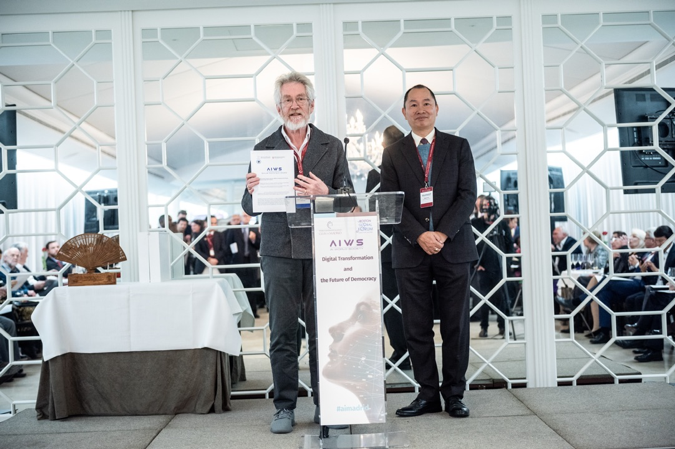
Professor Pentland contributed his idea to the AI World Social Contract 2020, which will be discussed at Global Cybersecurity Day Symposium on December 12, 2019, at Loeb House, Harvard University: Every citizen is entitled to basic rights and dignity that are enlarged by AI and in the Internet Age and entail greater responsibility:
Data Rights and Responsibilities for Citizen: each citizen will be entitled to access to a smart phone or similar device and will control their own data (Data Home), including a right to privacy.
Individuals would pool their personal data in a single institution — just as they pool money in banks — and that institution would both protect the data and put it to use. Credit unions as one type of organization that could fill this role. And while companies would need to request permission to use consumer data, consumers themselves could request analytic insights from the cooperative.
Professor Alex Pentland, MIT, is one of top 7 most powerful data scientists. He is a co-founder of the AIWS Innovation Network and the AIWS Social Contract 2020.

by Editor | Nov 17, 2019 | News
The challenge is to infuse human values into Industry 4.0. Trust, fairness and empathy should be preserved in this cyber age.
The fourth Industrial Revolution has swept the world, leaving its indelible impact on the shop floor, in stores, offices, boardrooms and beyond. The fusion of technologies that characterizes this revolution has triggered a wave of transformative change, impacting society in ways we could not have imagined earlier and at a pace that we have not seen before.
The benefits of digital technologies are many. They have the power to revolutionize society as, for the first time, the disadvantaged have access to information, services, skilling opportunities and markets that can enable them to improve their lives. However, as in the case of the earlier Industrial Revolutions, this one too, brings formidable challenges for society. The frenetic speed of digital adoption and the entry of machines is making the skills of millions of people irrelevant almost overnight. It also raises the need to determine what a machine should do and which tasks should remain under a human’s purview.
In addition, the Michael Dukakis Institute for Leadership and Innovation (MDI) also established the Artificial Intelligence World Society (AIWS) for the purpose of promoting ethical norms and practices in the development and use of AI to serve and strengthen democracy, human rights, and the rule of law.
The original article can be found here.
by Editor | Nov 17, 2019 | News
Google researchers have revealed they are taught an artificial intelligence (AI) machine how to smell, bring the cyber-sense up to the standards of sight and hearing. Google’s Brain Team described how they used machine-learning to train a robot to accurately categories different smells by assessing their molecular structure. The robot was instructed via a database containing 5,000 molecules analyzed and identified by perfume makers with descriptions such as “earthy” and “pungent”.
Researchers inputted two-thirds of the database into the machine’s neural network. Then the AI bot passed after analyzing the remaining scents. Researchers have long attempted to program a sense of smell using artificial intelligence, but significant issues have proved problematic. Difficulties included the subjectivity involved in describing smells.
Based on analogous advances in deep learning for sight and sound, it should be possible to directly predict the end sensory result of an input molecule, even without knowing the intricate details of all the systems involved. Solving the odor prediction problem would aid in discovering new synthetic odorants, thereby reducing the ecological impact of harvesting natural products.
According to Michael Dukakis Institute for Leadership and Innovation (MDI), AI technology and application can be a force for helping people achieve well-being and happiness and relieving them of resource constraints and arbitrary/inflexible rules and processes.
The original article can be found here.
by Editor | Nov 10, 2019 | News
With the philosophy of AI Humanism, Boston Global Forum establishes AI World Society Innovation Network (AIWS Innovation Network) to:
1. Create an environment to develop applications of AI for governments, companies:
AIWS Innovation Network will connect and receive demands from governments, connect with resources from top universities, and connect companies to provide services for governments and companies.
2. Build a better world with norms of AIWS Social Contract 2020
Connect and encourage leaders to monitor governments and businesses that violate standards and norms and compromise with dictatorships or totalitarian governments.
AIWS Young Leaders calls and supports concepts, standards, and norms of the AIWS Social Contract 2020.
Public Policy Group: contribute to develop AIWS Social Contract 2020 and policies, initiatives for AI
Activists Group: organize campaigns both offline and online to support for the AIWS Social Contract 2020.
Monitor Group: report on governments and corporations that violate AIWS Social Contract 2020 norms, standards, and concepts (we call for the isolation of those governments and corporations).
3. Creative and Innovative works, especially art and culture in AI
Philosophy: AI Humanism
Develop recommendations for the use of AI for public good.
This would complement the current AIWS/BGF work that is developing ethics and cybersecurity, which call to action to counteract the negative, manipulative, surveillance, micro-targeting use of AI.
It could focus on ways to reach, connect, and co-create with people and groups to enhance positive wellbeing and interactions and peaceful and enduring solutions.
4. Mentorship: Former presidents, former prime ministers, current leaders, thoughtleaders to inspire and encourage AIWS Young Leaders and support their activities.
BGF will officially launched AIWS Innovation Network at Global Cybersecurity Day Symposium December 12, 2019 at Loeb House, Harvard University.
by Editor | Nov 11, 2019 | News
Standards and Norms of the Social Contract 2020 are very good ideas, but how does one enforce them? Great powers such as USA, China, and Russia do not cooperate or trust each other. In addition, big companies and corporations try to become dictators in AI and big data.
How does one solve this dangerous issue? The Boston Global Forum calls for an alliance between OECD, G7 governments, leaders of civil society, and former leaders to solve this dangerous issue.
AI World Society Young Leaders will contribute to monitor violations of norms, standards, and the Social Contract 2020 and report to the Alliance.
Based on data from monitoring, AIWS Young Leaders build the Ethics Index about governments, companies.
AI World Society Young Leaders are present in many countries as US, Canada, Europe, Australia, New Zealand, Japan, India, Vietnam, and Latin America.