
by Editor | Nov 24, 2019 | News
Artificial intelligence is redefining the very meaning of being an enterprise. The rapidly advancing artificial intelligence (AI) capability is on its way to revolutionizing every aspect of an enterprise. The ability to access data has leveled the playing field and brought every enterprise a unique possibility of progress. What needs to be seen is in this level playing field, which enterprises will be able to compete and lay a new foundation for fundamental transformation and which ones will decline.
Enterprises across industries are undergoing a profound and lasting shift in the relative balance of AI adoption. AI application will offer each enterprise as many opportunities as it does challenges. While access to technology, data, and information is common to all enterprises, what is not common is how each enterprise uses that information—and for what reason. While AI has given enterprises across industries and nations the same starting point in access to AI technology, it is crucial to understand the parameters that will define their individual and collective success.
The potential of Enterprise AI can transform the enterprise ecosystem in many ways. From decision making to supply chain intelligence and tracking capabilities to the automation of business processes, AI can change the entire enterprise ecosystem across CAGS. The time is now to understand its risks and rewards. According to AI impact to society, the Michael Dukakis Institute for Leadership and Innovation (MDI) also established the Artificial Intelligence World Society (AIWS) to share its commitment to the constructive and development of AI for mitigating risks and enhancing transparency as well as ethical values.
The original article can be found here.

by Editor | Nov 24, 2019 | News
Intel Corp. is turning its attention to the convergence of high-performance computing and artificial intelligence (AI) with the launch late today of a new general-purpose graphics processing unit that’s optimized for both types of workloads.
In addition, Intel announced its oneAPI initiative, which aims to provide a simpler programming model for developing HPC and AI applications that can run on any kind of architecture, including GPUs, central processing units, field-programmable gate arrays and neural network processors.
Announced at the Supercomputing 2019 event in Colorado today, the new Ponte Vecchio discrete GPUs are built on Intel’s Xe architecture using its most advanced seven-nanometer process and have been designed especially for HPC and AI training workloads.
“Several years ago, Intel saw the need to develop one graphics architecture to scale up from traditional GPU workloads to the new HPC/exascale/AI and deep learning training,” Ari Rauch, vice president and general manager of Intel’s Visual Technologies Team and Graphics Business, said in a press briefing.
According to Michael Dukakis Institute for Leadership and Innovation (MDI), AI technology and application can be a force for relieving us of resource constraints, arbitrary/inflexible rules and processes to solve important issues, such as SDGs.
The original article can be found here.
by Editor | Nov 17, 2019 | News
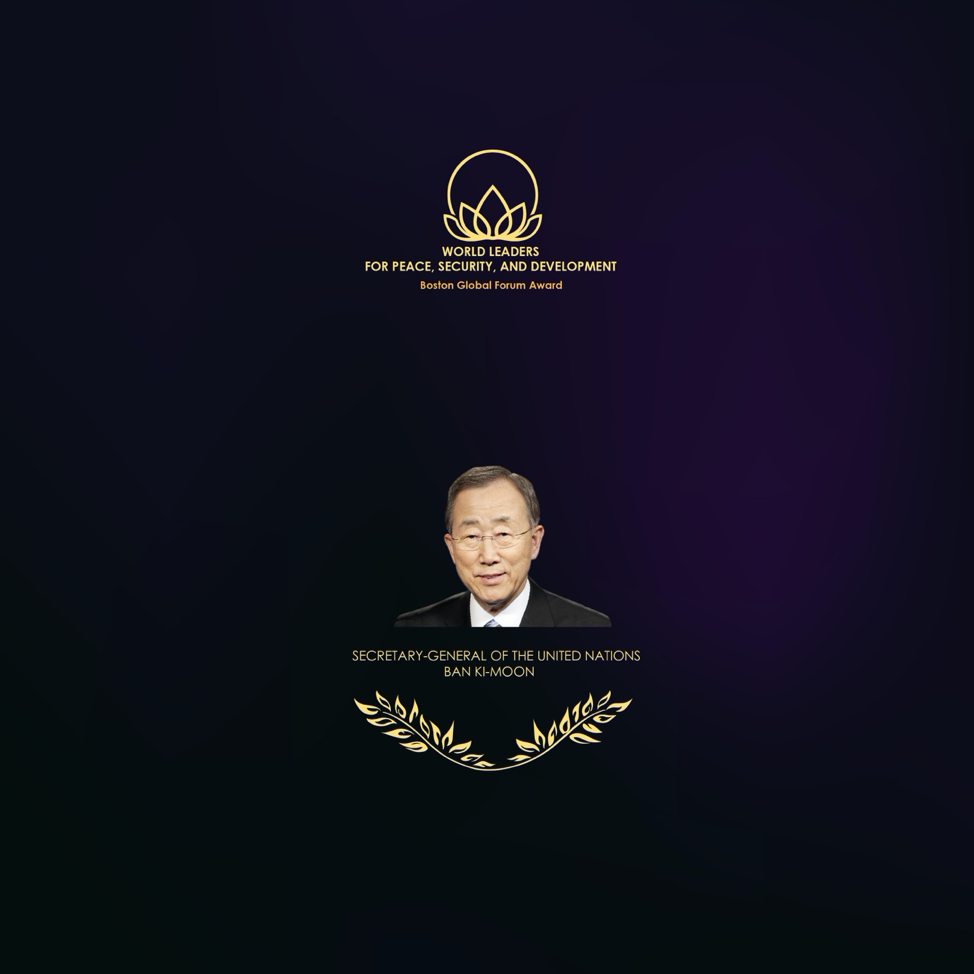
On the first Global Cybersecurity Day on December 12, 2015, the United Nations Secretary-General Ban Ki-moon sent the statement of congratulations. Here is his letter.
Ban Ki-moon was honored with the World Leaders for Peace and Security Award 2016.
—
Message to the Boston Global Forum
Boston, 12 December 2015
It is a pleasure to greet the Boston Global Forum. Thank you, Governor Dukakis, for convening this gathering and for guiding its initiatives.
I welcome your focus on cybersecurity.
Advances in technology and science have opened up wonderful new opportunities, but they have also exposed us to new risks. As our lives have moved increasingly online, so, too, must our values and principles.
Cybersecurity has become a major global challenge, with wide-ranging implications for peace, security, trade and sustainable development. The United Nations has recognized the need to confront the threats that arise from the use of ICTs and the Internet for purposes that are inconsistent with the objectives of the UN Charter and the Universal Declaration of Human Rights.
Member States have been working to develop a global culture of cybersecurity that can fight cybercrime and cyber-attacks while protecting freedoms and sharing the benefits of ICTs and the Internet.
Cybersecurity will also be crucial as we implement the recently adopted 2030 Agenda for Sustainable Development, which will require us to tap into the potential of the data revolution and close today’s still-large digital divides.
On 15-16 December, the United Nations General Assembly will convene a High-level Meeting to review progress in the implementation of the outcomes of the World Summit on the Information Society. Your discussion at this year’s Boston Global Forum can provide a timely contribution as we strive together to meet these challenges.
Thank you for your support, and please accept my best wishes for a productive Forum.
by Editor | Nov 17, 2019 | News
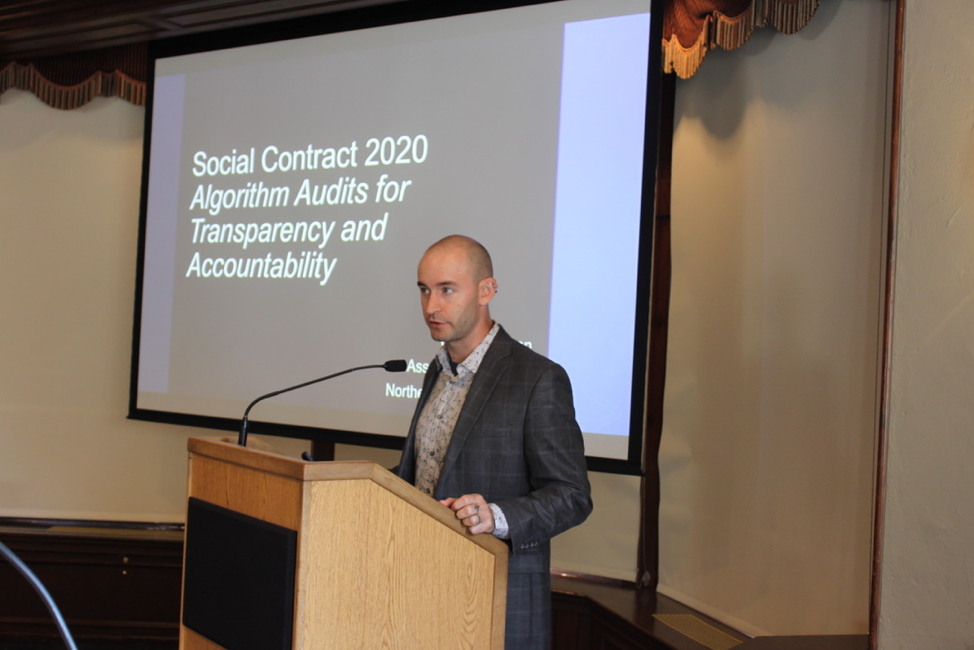
The AIWS Innovation Network will be officially launched on Global Cybersecurity Day Symposium December 12, 2019 at Loeb House, Harvard University. Professor Wilson, a Michael Dukakis Leadership Fellow, a founding member of the Cybersecurity and Privacy Institute at Northeastern, Berkman Klein Fellow of Harvard Law School, will lead the section to monitor and audit governments and companies in ethics, norms, and standards of AI, and the AIWS Social Contract 2020. He presented the ideas for this in AIWS Conference September 23, 2019 at Harvard University Faculty Club. With purpose to alarm governments and companies that violate norms, standards, and the AIWS Social Contract 2020, this section will contribute reports and call for actions to maintain norms of the AIWS Social Contract 2020 as framework for peace, and security in Digital Age.
Governor Michael Dukakis, Mr. Nguyen Anh Tuan, and Professors Alex Pentland (MIT), Nazli Choucri (MIT), David Silbersweig (Harvard), Thomas Patterson (Harvard) are co-founders of the AIWS Innovation Network. The Network is sponsored by MIT Connection Science and the Massachusetts Government.

by Editor | Nov 17, 2019 | Event Updates
Minister Taro Kono will speak “On a Vison for Ensuring Trusted Data for use by the Japanese Government” at Global Cybersecurity Day Symposium, 8:30 am – 12:00 pm, December 12, 2019 at Loeb House, Harvard University.
Boston Global Forum created the Annual Global Cybersecurity Day in 2015. Every year, on December 12, Boston Global Forum will organize a Global Cybersecurity Day Symposium with topics about cybersecurity and data safety.
This year, the topic is Enhancing Cybersecurity in AI World Society.
Global Cybersecurity Day is meant to inspire the shared responsibility of the world’s citizens to protect the Internet’s safety and transparency. As a part of this initiative, Boston Global Forum (BGF) also calls upon citizens of goodwill everywhere — from ordinary people to leaders — to follow BGF’s Ethics Code of Conduct for Cyber Peace and Security (ECCC).
BGF includes, among others, scholars, business leaders and journalists, and is chaired by former Massachusetts Gov. Michael Dukakis, a national and international civic leader and BGF’s co-founder.
At the Annual Global Cybersecurity Day Symposium, BGF also celebrates and presents the World Leader for Peace and Security Award. This year, President of Latvia and the World Leadership Alliance-Club de Madrid, Vaira Vike-Freiberga, is honored as a World Leader for Peace and Security.