
by Editor | Nov 10, 2019 | News
Artificial Intelligence (AI) is everywhere. If you shop online or occasionally speak to a voice assistant in the morning, you are already embracing the changes this technology has created. Many people are familiar with the advances of autonomous vehicles or facial recognition technology, and some may be curious, or even anxious, about how they will affect safety or privacy.
Make no mistake, AI is a transformative technology that is influencing our daily lives and will touch every sector of the global economy. Whether society and government enable or inhibit the AI race, and the extent to which they do so, will be a critical question of the next decade. Regardless of the answer, the technology will forge ahead. To sit out this race, add hurdles or not take it seriously, would not be a wise decision.
Indeed, the only way to enable AI that benefits all of society in ways that are ethical, responsible and economically advantageous is for the federal government to lead with purpose, smart policy and appropriate levels of investment.
The importance of AI Ethics has also been initiated by Artificial Intelligence World Society (AIWS) for the purpose of promoting ethical norms and practices in the development and use of AI. AI can be an important tool to serve and strengthen democracy, human rights, and the rule of law.
The original article can be found here.

by Editor | Nov 10, 2019 | News
The Cortex blockchain network claims to be able to do “everything that Bitcoin and Ethereum can do,” with AI and machine learning to boot.
With a growing presence in consumer products and services, artificial intelligence and blockchain have become synonyms for innovation. But the two words are rarely used together in the same sentence.
Cortex blockchain, which was launched in June this year, aims to change that discourse. The platform calls itself the first blockchain to integrate decentralized applications that use artificial intelligence.
“We can do everything that Bitcoin and Ethereum can do and, on top of that, we can also do machine learning,” Gary Lai, global operations manager at Cortex, told Decrypt.
“AI on blockchain is no longer an abstract concept,” he said. Last week, Cortex released its first decentralized app (dapp), Digital Clash, which incorporates AI in the form of a training model for game scenarios.
According to Michael Dukakis Institute for Leadership and Innovation (MDI), AI technology together with cutting edge technology such as blockchain can be a force for relieving them of resource constraints and arbitrary/inflexible rules and processes, and is potentially to solve important issues, such as SDGs.
The original article can be found here.
by Editor | Nov 3, 2019 | News
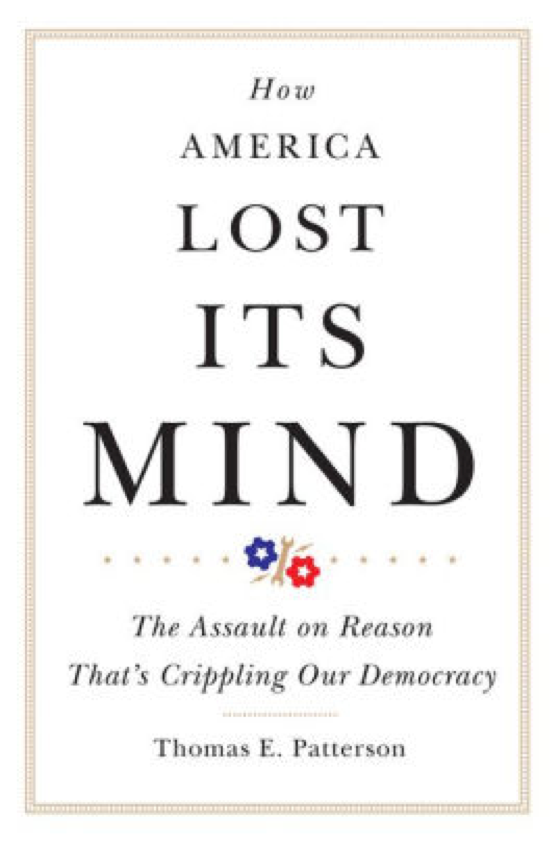
Thomas Patterson, a co-founder of the Boston Global Forum, has a new book, How America Lost Its Mind: The Assault on Reason That’s Crippling Our Democracy.
Misinformation is at its highest level in the history of polling. On everything from climate change and immigration to vaccines and social security, tens of millions of Americans have views of reality that are wildly at odds with the facts, rendering them unable to think sensibly about public issues and making them susceptible to leaders who exploit their vulnerability.
In How America Lost Its Mind, Patterson explores the forces that are misleading us and tearing us apart: politicians for whom division is a strategy; talk show hosts who have made an industry of outrage; news outlets that act as megaphones for unproven claims, and partisan outlets and foreign agents who spout disinformation to advance a cause, make a buck, or simply amuse themselves.
As Patterson shows, the problem was in place long before Donald Trump became president. Trump has aggravated the problem, but he is more the symptom than the cause of it. America’s misinformation disorder has roots in changes in politics and the media that began in the 1960s. The problem worsened as cable and the internet gave rise to media outlets that had little fidelity to traditional standards and as the divide between the Republican and Democratic parties grew ever wider. Americans now had access to sources that told them what they wanted to believe and had more reason to believe what their side of the partisan divide was claiming.
The corruption of information is eroding governing institutions and traditions that took more than two centuries and ten generations of Americans to build. And
he consequences are severe. How America Lost Its Mind maps a political landscape convulsed with distrust, gridlock, brinksmanship, petty feuding, and deceptive messaging. It’s also a landscape that fosters abuse of power. As the philosopher Hannah Arendt wrote decades ago, demagogues thrive when “people for whom the distinction between fact and fiction, true and false, no longer exists.”
Age-old incentives – the lure of power, celebrity, and money – underlie America’s misinformation problem, and they guarantee that the problem will not soon disappear.
by Editor | Nov 3, 2019 | Event Updates
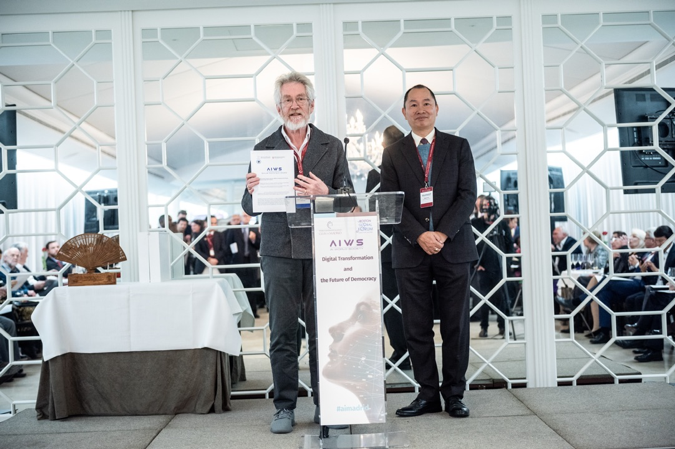
The World Leadership Alliance – Club de Madrid (WLA-CdM), a global assembly of over 110 democratic former Heads of State and Government from over 60 countries, convened its Annual Policy Dialogue in Madrid on 21-22 October 2019. Hosted in partnership with the IE School of Global and Public Affairs and under the patronage of Ms Mariya Gabriel, Member of the European Commission, this 2019 edition focused on Digital Transformation and the Future of Democracy.
At the event, AI World Society Social Contract 2020 was introduced at the ceremony honoring President Vaira Vike-Freiberga as World Leader For Peace and Security Award, co-organized by the Boston Global Forum and World Leadership Alliance-Club de Madrid on October 21, 2019.
Digital transformation, particularly the use of artificial intelligence, is posing new risks for democracy around the world. Fundamental rights related to privacy and security, freedom and non-discrimination are challenged by the large-scale collection and use of personal data for advertising, communication and automated decision-making purposes. Rising inequalities and the changing panorama of employment in the data economy are demanding a redefinition of the social contract, while technological giants are gaining leverage as curators of public spaces without democratic accountability. For most citizens, it is also becoming harder to know and trust democratic institutions, as information manipulation, bots and algorithmic filters are increasingly distorting the picture of society that reaches them through digital media.
Yet, digital transformation also provides powerful tools to build better democracy. Guided by adequate values, and goals, new technologies can enable the provision of improved public services, including health care and education, that respond to fundamental rights and increase quality of life. The data economy is facilitating the customization of employment, empowering diversity and enabling mobility. Access to information through digital technologies can also empower citizens and strengthen democratic accountability. But harnessing the potential of digital transformation as a force for the global democratic good requires strategic policy action. It befalls public powers to put in place regulatory frameworks and policy measures that will ensure transparency in the use of digital technologies and accountability for the decisions guided by artificial intelligence systems.

by Editor | Nov 3, 2019 | News
Thien Tram, a sacred culture of Nha Trang – Khanh Hoa, will start organizing the New Year Thien Tram ceremony to celebrate and promote peaceful, innovative, tolerant, and honest values of humanity. Thien Tram is legend culture of Nha Trang – Khanh Hoa that Governor Michael Dukakis visited April 2013.
New Year Thien Tram ceremony will take place at 12:00 am on New Year’s Day.
Nha Trang is one of the most beautiful bays and beach in the world. The people of Nha Trang is highly educated and very charming and elegant.
Nha Trang benefits greatly from its topography: sea, islands, mountains and deltas make it an attractive region. An endless mountain range is located west of Nha Trang. It houses a wide variety of birds and animals. Nha Trang is sheltered from the wind and never receives typhoons.
It is a city that is known for Tram Huong (Agar Wood), which represents health, luck, honest and wisdom for each individual, family, and the city as the whole. Deeply associated with the history and culture, Agar Wood is widely depicted in literature.
Despite a severe lack of information, materials and facilities, in late 1995 in Nha Trang, Nguyen Anh Tuan successfully established VietNet network, which brought Internet services to the country, 2 years before the Vietnam government officially sanctioned Internet services.
Thien Tram culture is representative of knowledge, wisdom, humanity, honesty, loyalty, diligence, compassion, friendliness, and innovation.
AI World Society recognizes New Year Thien Tram Ceremony as an event of AI World Society, and will send a preeminent thoughtleaders to come to Nha Trang and present a speech at the ceremony.