
by Editor | Nov 3, 2019 | News
On October 21, a special dinner organized by the Boston Global Forum (BGF) and its AI World Society program, served as the occasion to bestow on former President of Latvia (1999-2007) and current President of World Leadership Alliance-Club de Madrid (WLA-CdM), Vaira Vike-Freiberga, the World Leader for Peace and Security award for her solutions and initiatives for the Baltic region, Europe, and the world.
Through videoconference, Michael Dukakis, former Governor of Massachusetts (1975-1979; 1983-1991) and Chairman of the BGF, underlined Vike-Freiberga’s merits for recivieng this prize: “You have had a rich career, serving for two terms as President of Latvia at the time it joined the European Union (…) You have been a leading voice in strengthening the Baltic region, most continuously but not solely through the Riga Conference, which you founded in 2006, and meets annually to discuss foreign policy issues”.
As master of ceremonies, Laura Chinchilla, former President of Costa Rica (2010-2014) and current Vice President of WLA-CdM, accompanied Dukakis’s remarks by stating that “we, as members of World Leadership Alliance-Club de Madrid, feel very proud of this well-deserved distinction” to Vike-Freiberga’s life and work.
Upon accepting the award, President Vike-Freiberga thanked the BGF for honoring her as World Leader for Peace and Security for a second consecutive year, while calling for “more fundamental research on the impact of Artificial Intelligence in society and democracy”, for us to be prepared for the implications of the digital transformation.

by Editor | Nov 3, 2019 | News
Mozilla has announced a partnership with Element AI in a bid to advocate for the use of ethical artificial intelligence (AI).
On Monday, the tech giant said the strategic partnership between Mozilla and Element AI is focused on addressing “how new AI technologies and tools present challenges and opportunities for today’s digital frontiers.”
In particular, the ethical case for AI and its applications is of concern. AI, despite its infancy, has already proven itself in use cases that benefit humanity such as its use in neuroscience to assist paralyzed patients to communicate, the diagnosis of medical conditions and for tracking in academic research projects.
However, for every worthwhile, ethical purpose, AI can also be used for applications that some may deem unethical, including the development of unmanned weapons and military vehicles, as well as for mass surveillance.
The importance of ethical AI technology in the society is also initiated and mentioned in AI Ethics Report from AI World Society (AIWS) to promote ethical standards and frameworks for constructive use of AI in the society with the collaborations of different organizations and entities.
The original article can be found here.

by Editor | Nov 3, 2019 | News
Google’s recent claim that it has achieved quantum computing supremacy – apart from being contested by rival tech giants such as IBM – is still quite a ways off in terms of real-world applications.
The healthcare industry, for example, will still need to build a new set of applications to take advantage of quantum, and it still won’t account for the cost of the hardware and the operating costs to cool the systems and keep them operational.
If healthcare costs were not already high enough, these capabilities don’t help in keeping cost burdens low, and because quantum introduces all kinds of potential security risks, data privacy for healthcare patients could be compromised even further.
However, possible applications for artificial intelligence and machine learning to help with data analysis could prove critical further down the road.
Quantum computing could provide unprecedented power and speed of processing as well as novel and fundamentally different algorithmic search and data homogenization strategies.
According to Michael Dukakis Institute for Leadership and Innovation (MDI), AI technology together with advanced quantum computing can be a force for relieving them of resource constraints and arbitrary/inflexible rules and processes, and is potentially to solve important issues, such as SDGs.
The original article can be found here.
by Editor | Oct 27, 2019 | News
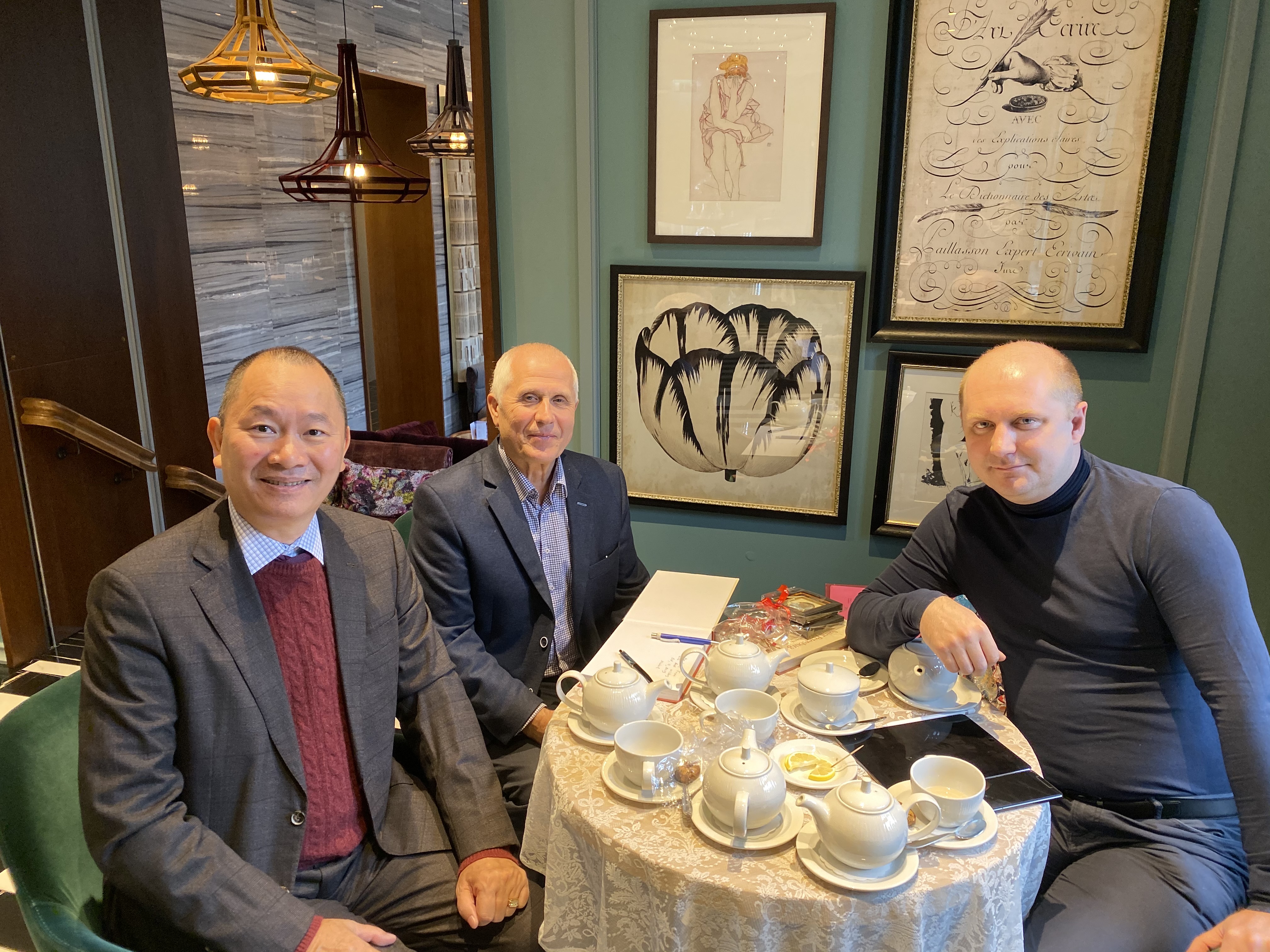
Michael Dukakis Institute for Leadership and Innovation will collaborate with LETI to deploy the first leadership program in AI in the world at Saint Petersburg Electrotechnical University (LETI): AI World Society Leadership Program. This is a one year master program.
https://etu.ru/en/university/news/strengthening-the-leading-position-in-the-artificial-intelligence-market
Nguyen Anh Tuan formulated the concept of a future master’s program: “Students will be invited to join the AIWS Young Leaders community and will have an opportunity to develop leadership skills in solving practical problems. They will be set an ambitious task to create a strategic concept in the field of artificial intelligence. Students transform into innovators, incredibly charismatic, able to attract and inspire. The Michael Dukakis Institute will support them throughout their careers.”
ETU “LETI” and the Michael Dukakis Institute for Leadership and Innovation are planning to award double diplomas, the prestige of which will be ensured by a high level of educational programs. Students will receive a diploma only if they successfully master the curriculum and pass all the tests by solving all the tasks set by professors.
Another important step in the development of relations between partners will be the establishment of a Center of Smart Data at St. Petersburg Electrotechnical University LETI, a key node in the development of artificial intelligence in Russia. ETU “LETI” will provide the necessary infrastructure, including a site for the Center and a hardware and software system.
The Center’s strategy will be aimed at advancing Russian science in artificial intelligence, setting and solving problems, creating global advanced ideas and concepts, and inviting leading teachers from Harvard University, the Massachusetts Institute of Technology and Northeastern University to advise the center on ways to solve these global problems. ETU “LETI” will attract the foremost authorities from St. Petersburg and all Russia to work at the Center.
“The main goal of cooperation between ETU “LETI” and the Michael Dukakis Institute for Leadership and Innovation is to prepare future world leaders who will lead the international community to a better, more prosperous and peaceful future using artificial intelligence technologies. Graduates of the program will become strong leaders capable of developing initiatives in the field of artificial intelligence to solve problems in the high-tech era. They will shape public opinion, reform the business world and politics, and improve our culture and society for the better.” Viktor Sheludko, Rector of ETU “LETI”
The Center’s strategy will be aimed at advancing Russian science in artificial intelligence, setting and solving problems, creating global advanced ideas and concepts, and inviting leading teachers from Harvard University, the Massachusetts Institute of Technology and Northeastern University to advise the center on ways to solve these global problems. ETU “LETI” will attract the foremost authorities from St. Petersburg and all Russia to work at the Center.
by Editor | Oct 27, 2019 | News
A new social contract is needed to blunt such developments and encourage beneficial ones. To achieve this goal, the Boston Global Forum, working with MIT Connection Science (connection.mit.edu) is developing a set of principles and guidelines that could inform the creation of a social contract for the Digital Age. We are calling it the AI World Society Social Contract 2020
We see five centers of power and responsibility that need to be taken into account in the social contract: government, citizens, firms, civil society organization, and AI assistants. In the US, where the Government has branches, the Executive, Legislative and Judicial, we foresee the emergence of seven centers of power.
And we see a need for a social contract that places a priority on transparency, privacy, and the empowerment of citizens as opposed to government.
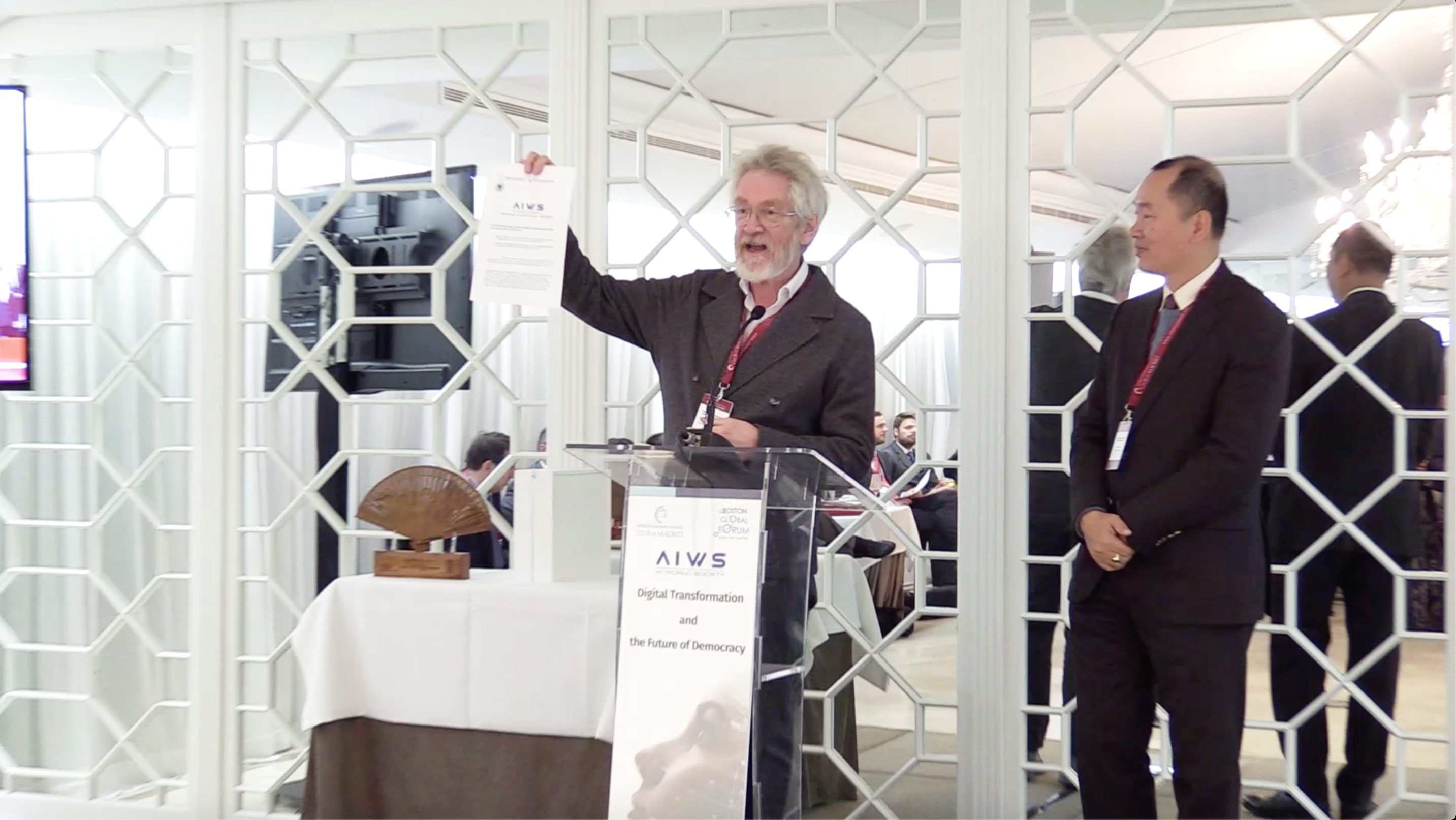
This message was delivered by Mr. Nguyen Anh Tuan and Professor Alex Pentland at the 2019 Policy Dialogue ‘Digital Transformation and the Future of Democracy: How can Artificial Intelligence Drive Democratic Governance?’ of World Leadership Alliance-Club de Madrid on October 21, 2019.
The file can be found here.