Throughout 2020, a wave of AI hardware startups will launch their companies and products. Cerebras started this wave with its wafer-scale engine last September. This week, Intel announced its AI chips from Nervana, Groq (founded by the inventors of Google TPU) announced its quadrillion ops per second TSP, and Graphcore announced that its chip is available on Microsoft Azure and Dell servers. Last week, a startup named “Blaize,” previously named “Thinci,” emerged from stealth, having already reached key milestones in four areas: innovative hardware, a comprehensive software stack, a staff of over 325 employees, and most importantly, 15 pilot projects underway in the USA, Europe and Asia.
Architectural innovation forms the core of every AI HW startup. Simply adding more multiply/accumulate registers or on-die memory will be inadequate for most high-performance applications. Blaize’s team built a general-purpose graph processor which can natively process graph-based applications, including, but not limited to the Deep Neural Networks which lie at the heart of most modern AI work. While the company claims this architecture can deliver massive gains in efficiency, we will need to await production-ready silicon next year to evaluate how well it performs against other engines that are coming to market.
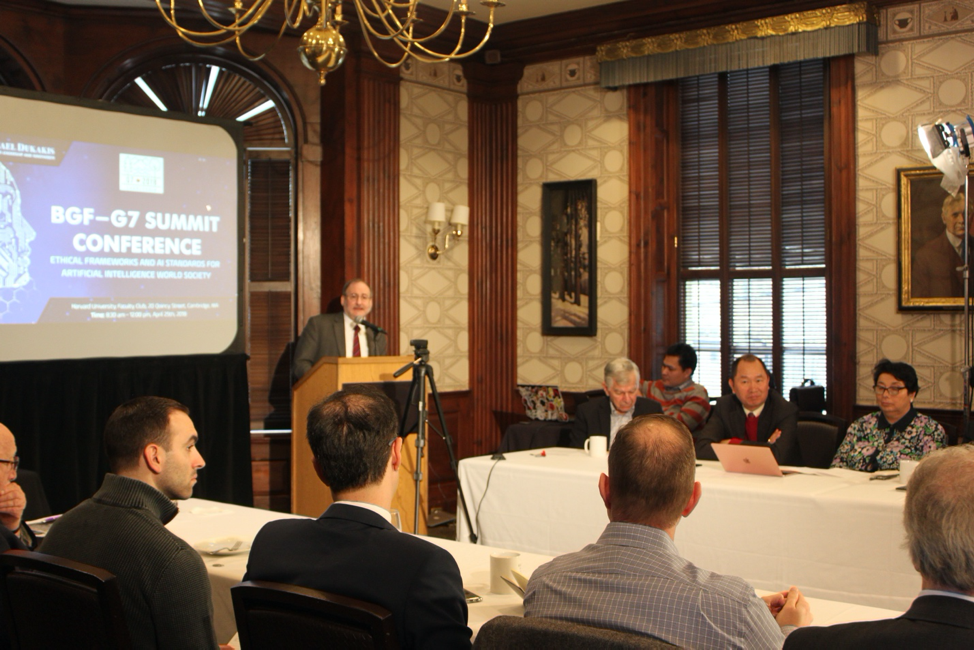
To support for AI technology and development, Michael Dukakis Institute for Leadership and Innovation (MDI) has established AI World Society (AIWS) to invite participation and collaboration with think tanks, universities, non-profits, firms, as well as start-up companies that share its commitment to the constructive and development of AI.
The World Political Leaders (WPL), the worldwide network of female politicians, honored Former Prime Minister of Peru, Representative of the Boston Global Forum in Peru, with the WPL Trailblazer 2019 Award in recognition for her achievements as Peru´s Prime Minister and carrying out the role of Ombudsman as well.
Established in 2013, the WPL gives the Trailblazer Award to outstanding women political leaders who have made strides toward a society where balance between women and men in politics is the reality. The Boston Global Forum is proud of Prime Minister Beatriz, Representative of the Boston Global Forum in Peru and warmly congratulations her to be worthy of this prestigious recognition.
The BGF also sincerely thank Women Political Leaders organization for this honor and for the incredible contributions made to female participation in politics at global level. This recognition commits her to continue working to ensure the voices of women are heard in politics.
The Women Political Leaders Trailblazer Award 2019 recognizes the achievements of three women Presidents and Prime Ministers. The awards are delivered on the occasion of the Reykjavík Global Forum – Women Leaders which took place on November 18th-20th in Reykjavík, Iceland:
Ameenah Gurib-Fakim, President of Mauritius (2015-2018)
Julia Gillard, President of Australia (2010-2013)
Martha Beatriz Merino Lucero, President of Peru (2003)
At Boston Global Forum’s Global Cybersecurity Day Symposium at Harvard University on December 12, 2019, AIWS Innovation Network will be officially launched.
The Network will have 3 core components: 1. AI Innovation, 2. Monitors and Judges, 3. AI for Humanity.
AI Innovation: This component as an Uber model of AI services. The Network will help governments, companies, organizations can find out resource to solve, do their demands in apply AI, develop AI strategies, policies, and AI experts, scholars from universities, companies, organizations to find out each other their AIWS Innovation Network’s app. This App includes:
Demanders: demands from governments, companies, organizations.
Providers: resources from top universities: Harvard, MIT, Tufts, Northeastern, Boston College, Stanford, Berkeley, UCLA, Carnegie Mellon, Dartmouth, Brown, Princeton, Yale, University of Pennsylvania, University of Chicago, Oxford, Cambridge etc. Resources from companies.
Judge: Using AI to umpire, judge conflicts between governments, companies, organizations in benefit, interest, information, data.
This component will be operated by AIWS Young Leaders. AIWS Young Leaders call and support for concepts, standards, norms of the AIWS Social Contract 2020.
Outstanding AIWS Young Leaders will be invited to Harvard to talk at AIWS Summit Conference late April every year.
AIWS Young Leaders will be get rewards for their contribution: give them points Social Value Reward, using measurement of Professor Alex Pentland, and AIWS Innovation Network will make deals exchange points with companies, service providers, schools.
AI for Humanity: Creative, Innovative works in applying AI for humanity. Develop recommendations for the use of AI for public good.
This would complement the current AIWS/BGF work that is developing ethics and cybersecurity calls to action to counteract the negative, manipulative, surveillance, micro-targeting use of AI.
It could focus on ways to reach, connect and co-create with people and groups to enhance positive wellbeing and interactions, and peaceful and enduring solutions.
This component is a place to introduce products, apps using AI for a better society.
Any AI experts, innovators have products meet AIWS Innovation Network requirements can introduce and list on this Component.
Government of Massachusetts and MIT Connection Science are sponsors of The AIWS Innovation Network.
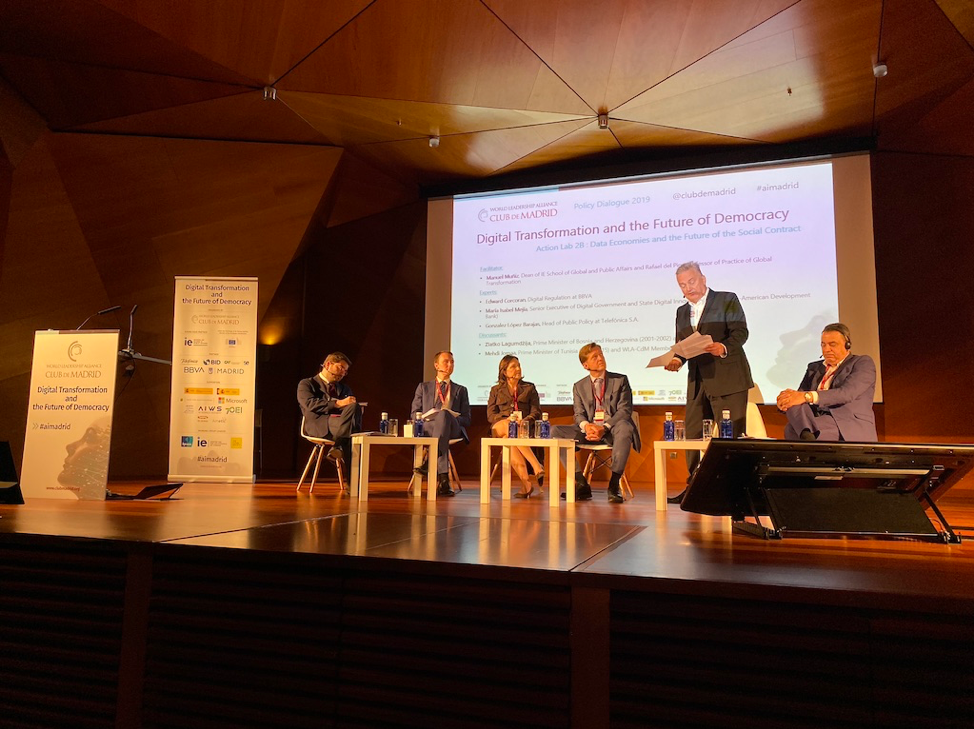
The World Leadership Alliance – Club de Madrid (WLA-CdM), a global assembly of over 110 democratic former Heads of State and Government from over 60 countries, convened its Annual Policy Dialogue in Madrid on 21-22 October 2019.
Digital transformation, particularly the use of artificial intelligence, is posing new risks for democracy around the world. Fundamental rights related to privacy and security, freedom and non-discrimination are challenged by the large-scale collection and use of personal data for advertising, communication and automated decision-making purposes. Rising inequalities and the changing panorama of employment in the data economy are demanding a redefinition of the social contract, while technological giants are gaining leverage as curators of public spaces without democratic accountability. For most citizens, it is also becoming harder to know and trust democratic institutions, as information manipulation, bots and algorithmic filters are increasingly distorting the picture of society that reaches them through digital media.
Yet, digital transformation also provides powerful tools to build better democracy. Guided by adequate values, and goals, new technologies can enable the provision of improved public services, including health care and education, that respond to fundamental rights and increase quality of life. The data economy is facilitating the customization of employment, empowering diversity and enabling mobility. Access to information through digital technologies can also empower citizens and strengthen democratic accountability. But harnessing the potential of digital transformation as a force for the global democratic good requires strategic policy action. It befalls public powers to put in place regulatory frameworks and policy measures that will ensure transparency in the use of digital technologies and accountability for the decisions guided by artificial intelligence systems.
The Annual Policy Dialogue afforded us an opportunity to gather the thoughts of over 100 renowned experts, policy makers and industry leaders. They distilled the implications of digital transformation and artificial intelligence for fundamental rights, the future of the social contract in the data economy, and trust and public debate in the face of disinformation.
Boston Global Forum is pioneering with the AIWS Social Contract 2020 to solve the issue of “the future of the social contract.” Professor Alex Sandy Pentland introduced and President of Bosnia Herzegovina Zlatko Lagumdžija discussed the AIWS Social Contract 2020 at this event.
The United Nations will mark its hundredth year in 2045. This series will address issues that will help define the world as it will exist at the UN’s centennial. How will AI (Artificial Intelligence) shape the world and how can the UN direct the development of AI to promote a safer and more prosperous world? What are the challenges of the AI Age to peace, security, human values, and international norms? How can the UN play an enlarged role in forging a better world? Are there ways that citizens can contribute through the UN? Such questions and others will be examined in the United Nations Centennial Series, which will feature articles by distinguished thinkers and leaders.
Governor Michael Dukakis, President Vaira Vike-Freiberga, father of the Internet Vint Cerf, Professor Alex Sandy Pentland, Professor Nazli Choucri, and other great figures are confirmed to contribute to this series. Mr. Nguyen Anh Tuan, co-founder and CEO of the Boston Global Forum, is named as the curator of United Nations Centennial Series.