
by Editor | Dec 2, 2019 | News
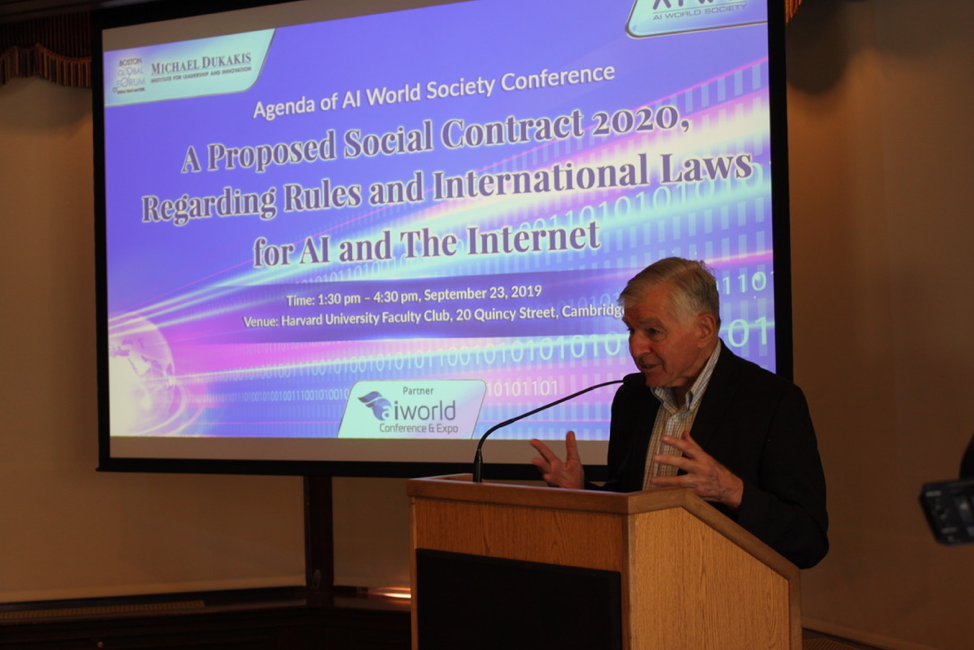
On September 23, 2019, at AIWS Conference at Harvard University Faculty Club, Former President of Ecuador Jamil Mahuah discussed the AIWS Social Contract 2020.
President Jamil Mahuah is a candidate for the Nobel Peace Prize, and now is a visiting professor at Harvard University. He is very interested in the AIWS Social Contract 2020. He enthusiastically contributed ideas from the point of view of governments.
Some important questions need to solve for the AIWS Social Contract 2020 are:
- How can the Citizens, Civic Society, and AI Assistant enforce laws and aid in governmental decision-making.
- Civic Societies: how can civic society, citizens, and AI Assistant impact and effect decisions by governments and business to enforce common values and standards?
Discussion to build the AIWS Social Contract 2020 is continued by group contributors such as world leaders, distinguished thinkers, AIWS Young Leaders. The official version of the AIWS Social Contract 2020 will be launched on April 28, 2020 at Harvard University with participation of world leaders, distinguished thinkers, and AIWS Young Leaders.
by Editor | Dec 2, 2019 | News
As a great governor for three terms of Massachusetts, and wonderful success in public transportation, Governor Michael Dukakis, Co-founder and Chair of the Boston Global Forum, recently talked on Boston.com: “Let’s just get the damn public transportation system working well” and “The answer is clear in my judgment: Don’t spend any more money on highways.”
Governor Dukakis has been fighting highway development since the 1960s. He said “This city would have been paved over if we let these guys do what they wanted to do. And by the time I left office, we had the best public transportation system in the country.”
Governor Dukakis touted improvements to the MBTA during his time in office, including new cars and the Red Line extension to Alewife. But he said the transit system was neglected by subsequent administrations, amid projects like the Big Dig. Now, amid the region’s congestion crisis, Dukakis says a simple, renewed focus on the MBTA could good a long way toward increasing ridership and freeing up the roads.
The original article can be found here.
by Editor | Dec 2, 2019 | News
On December 12, 2019, AIWS Innovation Network will official launch at the BGF Global Cybersecurity Day Symposium at Loeb House, Harvard University.
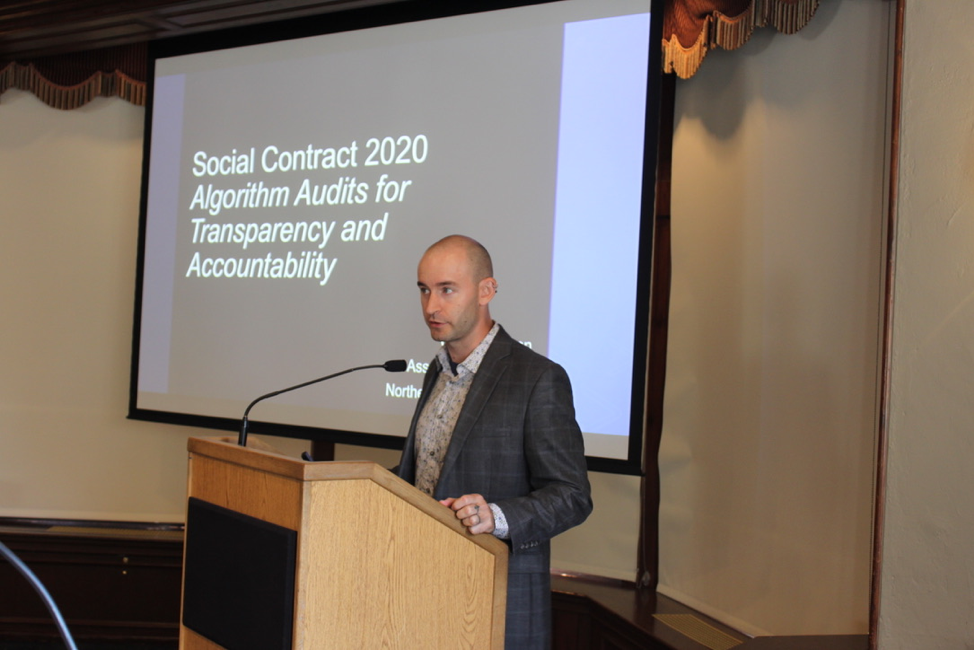
One of components of AIWS Innovation Network is to monitor and judge governments and companies in respect to AIWS Social Contract 2020 norms. AIWS Young Leaders in many countries will volunteer in this important mission. The core team to monitor and judge is based in Boston, USA.
They are professors, thoughtleaders, activists, students such as Professor Christo Wilson, Activist Rebecca Leeper, etc. Governor Michael Dukakis, Co-founder and Chairman of the Boston Global Forum and world leaders, distinguished thinkers are mentors. After Japanese Minister of Defense Taro Kono give keynote speech, Mr. Yasuhide Nakayama, Former Foreign Affair Vice Minister will speak on “How AIWS Young Leaders convince governments, corporation respect AIWS Social Contract Norms” at this event.
by Editor | Dec 2, 2019 | Event Updates
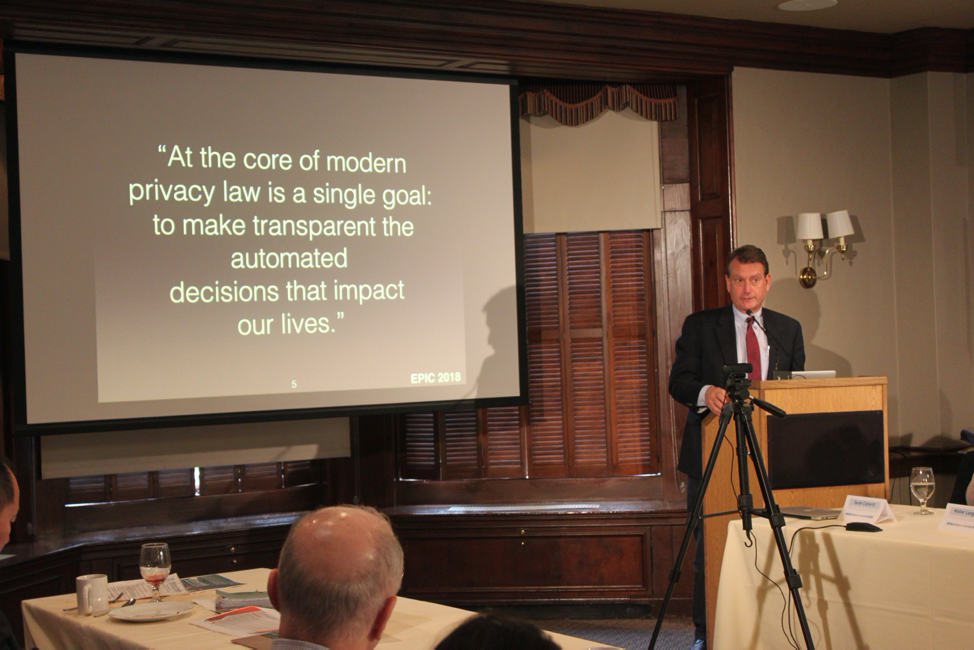
Marc Rotenberg, President and Executive Director of the Electronic Privacy Information Center (EPIC) in Washington, D.C, will join the BGF Global Cybersecurity Day Symposium December 12, 2019 at Loeb House, Harvard University.
Marc is a member of the Michael Dukakis Institute’s AIWS Standards and Practice Committee. He also spoke at AIWS Conference on AI-Government and Treaty on AI Ethics and Practices in September 2018 at Harvard University Faculty Club.
He teaches at Georgetown Law and frequently testifies before Congress on emerging privacy and civil liberties issues. He has served on several national and international advisory panels. He has authored many amicus briefs for federal and state courts. He is a founding board member and former Chair of the Public Interest Registry, which manages the .ORG domain. He is editor of “The AI Policy Sourcebook” (EPIC 2019), “EPIC v. DOJ: The Mueller Report” (EPIC 2019), “The Privacy Law Sourcebook” (EPIC 2018), “Privacy in the Modern Age: The Search for Solutions” (The New Press 2015), and author (with Anita Allen) of “Privacy Law and Society” (West 2016). He currently serves on expert panels for the Aspen Institute, the National Academies of Science, and the OECD. He is on the editorial boards of the European Data Protection Law Review, the Journal of National Security Law and Policy, and Law 360 Cybersecurity and Privacy. He is a graduate of Harvard College and Stanford Law School and received an LLM in International and Comparative Law from Georgetown Law. He served as Counsel to Senator Patrick J. Leahy on the Senate Judiciary Committee after graduation from law school.

by Editor | Dec 2, 2019 | News
After speaking at an MIT conference on emerging AI technology earlier this year, I entered a lobby full of industry vendors and noticed an open doorway leading to tall grass and shrubbery recreating a slice of the African plains. I had stumbled onto TrailGuard AI, Intel’s flagship AI for Good project, which the chip company describes as an artificial intelligence solution to the crime of wildlife poaching. Walking through the faux flora and sounds of the savannah, I emerged in front of a digital screen displaying a choppy video of my trek. The AI system had detected my movements and captured digital photos of my face, framed by a rectangle with the label “poacher” highlighted in red.
I was handed a printout with my blurry image next to a picture of an elephant, along with text explaining that the TrailGuard AI camera alerts rangers to capture poachers before one of the 35,000 elephants each year are killed. Despite these good intentions, I couldn’t help but wonder: What if this happened to me in the wild? Would local authorities come to arrest me now that I had been labeled a criminal? How would I prove my innocence against the AI? Was the false positive a result of a tool like facial recognition, notoriously bad with darker skin tones, or was it something else about me? Is everyone a poacher in the eyes of Intel’s computer vision?
This is not to say tech companies should not work to serve the common good. With AI poised to impact much of our lives, they have more of a responsibility to do so. To start, companies and their partners need to move from good intentions to accountable actions that mitigate risk. They should be transparent about both benefits and harms these AI tools may have in the long run. According to this, Artificial Intelligence World Society (AIWS) has developed AIWS Ethics and Practice Index to measure the ethical values and improve transparency of AI applications in our human daily life.
The original article can be found here.