
by Editor | Dec 16, 2019 | Event Updates
On December 12, at Loeb House, Harvard University, with attending of distinguished thinkers of Harvard, MIT, Naval War College, and leaders of Massachusetts, business leaders, under moderation by Governor Michael Dukakis, Chair of the Boston Global Forum (BGF), Japanese Minister of Defense Taro Kono presented AIWS Distinguished Lecture. Minister Taro Kono spoke about Japan Self-Defense Forces’ efforts in Cyberspace. This is keynote speech of Global Cybersecurity Day Symposium 2019.
December 12, 2012 is birthday of the Boston Global Forum, and from December 12, 2015, it became Global Cybersecurity Day, with statement from United Nations Secretary General Ban Ki-moon.
Prime ministers, presidents presented speeches on Global Cybersecurity Day, and support for this initiative of BGF.

by Editor | Dec 16, 2019 | News
This past year, revelations about the plight of Muslim Uighurs in China have come to light, with massive-scale detentions and human rights violations of this ethnic minority of the Chinese population. Last month, additional classified Chinese government cables revealed that this policy of oppression was powered by artificial intelligence (AI): that algorithms fueled by massive data collection of the Chinese population were used to make decisions regarding detention and treatment of individuals. China failing to uphold the fundamental and inalienable human rights of its population is not new, and indeed, tyranny is as old as history. But the Chinese government is harnessing new technology to do wrong more efficiently.
Concerns about how governments can leverage AI also extend to the waging of war. Two major concerns about the application of AI to warfare are ethics (is it the right thing to do?) and safety (will civilians or friendly forces be harmed, or will the use of AI lead to accidental escalation leading to conflict?). With the United States, Russia, and China all signaling that AI is a transformative technology central to their national security strategy, with their militaries planning to move ahead with military applications of AI quickly, should this development raise the same kinds of concerns as China’s use of AI against its own population? In an era where Russia targets hospitals in Syria with airstrikes in blatant violation of international law, and indeed of basic humanity, could AI be used unethically to conduct war crimes more efficiently? Will AI in war endanger innocent civilians as well as protected entities such as hospitals?
Regarding to AI Ethics and Safety, Michael Dukakis Institute for Leadership and Innovation (MDI) and Artificial Intelligence World Society (AIWS) has developed AIWS Ethics and Practice Index to measure the extent to which a government’s AI activities respects human values and contributes to the constructive use of AI. The Index has four components by which government performance is assessed including transparency, regulation, promotion and implementation.
The original article can be found here.
by Editor | Dec 16, 2019 | Event Updates
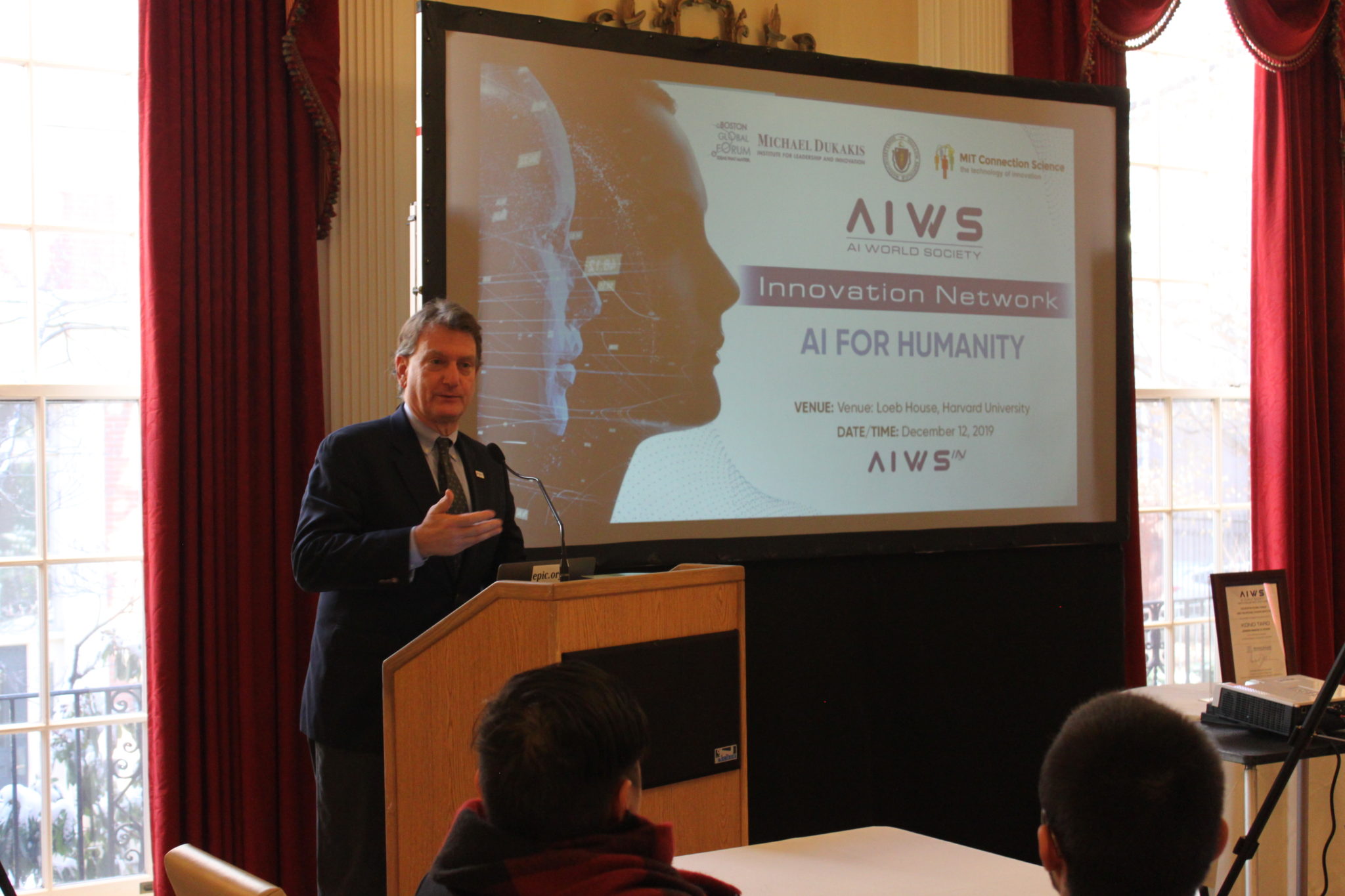
On Global Cybersecurity Day Symposium December 12, 2019, Marc Rotenberg, a mentor of AIWS Innovation Network (AIWS-IN), contributor of AIWS Social Contract 2020, presented on the topic “To Ensure Transparency of AI Policymaking in the US and China”
Marc attracted and provoked discussants to debate, with special focus on “AI Policy and Public Participation: EPIC v. Natl. Sec. Comm. on AI”, “AI Techniques and Pre-trial Risk Assessment”, and “The Next Campaign: AI and Face Surveillance”
Marc and EPIC will collaborate with Boston Global Forum to build AIWS Social Contract 2020 and present at AIWS Summit 2020 on April 28-29 at Harvard University.

by Editor | Dec 16, 2019 | News
Evans Data Corporation’s latest study of AI and machine learning development provides insights into the challenges developers face when building enterprise-level, high-quality AI apps. The study, Artificial Intelligence and Machine Learning 2019, Volume 2 is based on interviews with 500 AI and machine learning developers globally. Focusing on the attitudes, adoption patterns and intentions of AI and machine learning developers worldwide, the 187-page study is one of the most comprehensive of its kind. What makes the study noteworthy is the depth of research into AI and machine learning developer’s challenges today.
- AI and machine learning developers most often rely on language and speech-based Application Programmer Interfaces (APIs).
- 50% say gathering or generating data is the most challenging aspect of continually training and fine-tuning AI models.
- AI and machine learning developers say that the complexity of managing operations is the top challenge they face when developing AI applications.
In addition to support for AI and Machine Learning development for enterprise application, Michael Dukakis Institute for Leadership and Innovation (MDI) has established AI World Society (AIWS) to invite participation and collaboration with think tanks, universities, non-profits, firms, as well as enterprise that share its commitment to the constructive and development of AI.
The original article can be found here.
by Editor | Dec 8, 2019 | News
Co-founder of the Boston Global Forum and AI World Society Innovation Network, Professor Thomas Patterson, spoke on CNN about his new book “How America Lost Its Mind”.
Harvard professor Thomas Patterson, author of the new book “How America Lost Its Mind,” says “motivated reasoning” is at work in the impeachment inquiry. People “start with a bias and then we try to find facts that kind of align with that,” he says. “We have an enormous capacity for selective reception.”
The original video from CNN can be found here.