by Editor | Mar 1, 2020 | AI-Government, News
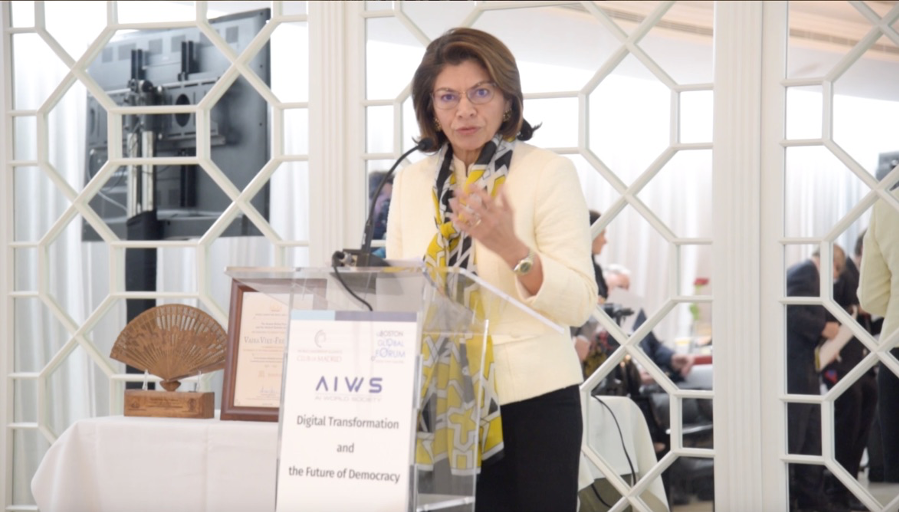
With WHITE PAPER “On Artificial Intelligence – A European approach to excellence and trust”, the EU have an ambition to become a global leader for AI governance. This is needed in the context of the world today. However, the EU lack civil societies to join and support this program. To solve this gap between EU’s ambition and capacity, Boston Global Forum and World Leadership Alliance Club de Madrid co-organize the conference “Transatlantic Approaches on Digital Governance: A New Social Contract in Artificial Intelligence” at Harvard University and MIT from April 27 to 29, 2020.
We are pleasured to introduce the report “Towards a European AI & Society Ecosystem” by Stiftung Neue Verantwortung (SNV).
Governing AI is crucial to ensure that its development and deployment are aligned with our (European) values and societal interests. While many look to Silicon Valley or increasingly to China to catch the latest trends and technological advances, all eyes are on the European Union concerning the question of where global leadership on AI governance will appear.
The United States is widely seen as the global leader in AI – both in terms of academic output and commercial applications. There are also strong NGOs and interdisciplinary research programs that study potential harms and social risks associated with the technology. However, given the political tides in Washington D.C. and the policy priorities of the Trump administration, the United States is currently unable and unwilling to shape global norms and regulate AI. China aspires to global leadership in AI but its use of AI for social control, surveillance and censorship clash with democratic principles. Simply copying and pasting one of these models into the European context would be incompatible with European culture, values, laws and social contexts. This makes Europe currently the only region where a regulatory agenda on AI rooted in democratic values can be established and – given the size of the EU’s internal market – and have a reasonable potential for global impact. Europe has generally embraced the role as a global regulator of technology. For many EU policy makers, the GDPR serves as a model, demonstrating the EU’s ability to set global standards in the tech sector.

by Editor | Mar 1, 2020 | News
“What’s the problem you’re trying to solve?” Clayton Christensen, the late Harvard business professor, was famous for posing this aphoristic question to aspiring entrepreneurs.
By asking it, he was teaching those in earshot an important lesson: Innovation, alone, isn’t the end goal. To succeed, ideas and products must address fundamental human problems.
This is especially true in healthcare, where artificial intelligence is fueling the hopes of an industry desperate for better solutions.
But here’s the problem: Tech companies too often set out to create AI innovations they can sell, rather than trying to understand the problems doctors and patients need solved. At many traditional med-tech conferences and trade shows, for example, talks and sales pitches focus squarely on the technology while routinely overlooking the human fears and frustrations that AI can address.
Because of this failure to prioritize human needs above business interests, medicine’s most-hyped AI applications have, repeatedly, failed to move the needle on public health, patient safety or healthcare costs.
“Addressing the challenges and opportunities around how technology affects our community is hugely important,” said Hugh Forrest, Chief Programming Officer at South by Southwest (SXSW) conference. “From privacy to blockchain to AI to MedTech, using this lens to filter how we look at a lot of issues facing modern society allows us to connect the dots in a deeper way. Especially in the case of an area like AI, where there’s quite a bit of uncertainty and fear, we also want to showcase how these innovations can be ethical and improve lives.”
The original article can be found here.
According to AI application in the society and healthcare, AI World Society has established AIWS Innovation Network will connect key AI actors and provide services that

by Editor | Mar 1, 2020 | News
Artificial intelligence and machine learning have the potential to boost many, many areas of the enterprise. As explored in my recent post, it is capable of accelerating and adding intelligence to supply chain management, human resources, sales, marketing and finance. Oh, and one more area, by the way — IT management.
The inevitable impact of AI on IT departments was touched on in a recent survey of 2,280 business leaders from MIT Sloan Management Review and SAS, which finds that in these early days of AI, IT professionals will be feeling the greatest impact — both from a career and an operational point of view..
CIOs, chief data officers, and chief analytics officers will be on the front lines of AI implementations, the study finds. IT road maps, software development, deployment processes, and data environments are likely to be transformed in the near future.
Most IT managers report that they are still developing foundational capabilities for AI — cloud or data center infrastructure, cybersecurity, data management, development processes and workflow.
The original article can be found here.
To support and collaborate AI application and IT operation, Artificial Intelligence World Society Innovation Network (AIWS-IN) created AIWS Young Leaders program including Young Leaders and Experts from Australia, Austria, Belgium, Britain, Canada, Denmark, Estonia, France, Finland, Germany, Greece, India, Italy, Japan, Latvia, Netherlands, New Zealand, Norway, Poland, Portugal, Russia, Spain, Sweden, Switzerland, United States, and Vietnam.
by Editor | Feb 24, 2020 | News, AIWS and the Age of Global Enlightenment
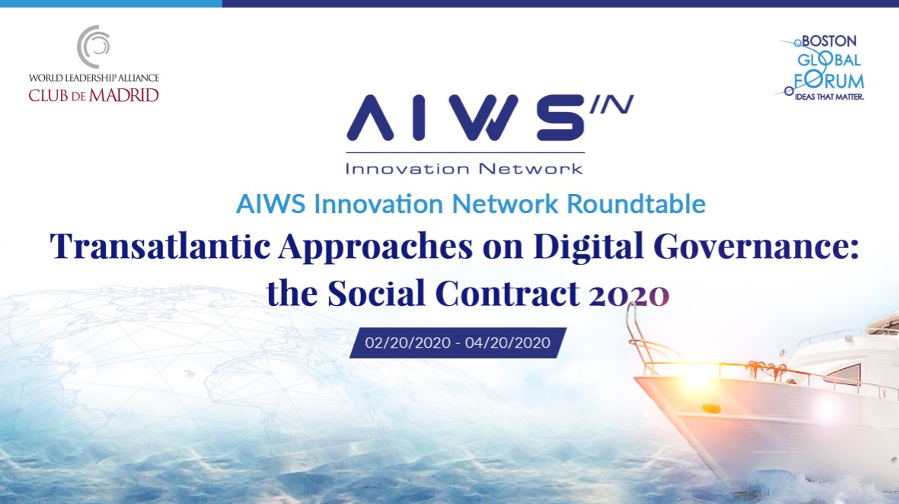
President of World Leadership Alliance-Club de Madrid, former president of Slovenia, Danilo Turk, will discuss in AIWS Innovation Network (AIWS-IN) Roundtable, a part of Policy Dialog “Transatlantic Approaches on Digital Governance: A New Social Contract in Artificial Intelligence”.
Professor Joseph Nye, the father of Soft Power, Professor Stephen Walt, Professor Thomas Patterson, Harvard University, Professor Nazli Choucri, MIT, father of Internet Vint Cerf, will discuss with President Danilo Turk and world leaders. There are several distinguished thinkers, inventers, innovators, and world leaders will discuss on questions:
- Balance the five centers of power: Government, Business, People, Civil Society, AI Assistants?
- Build and implement Global Data and AI Regulations?
- Establish a new balance of power among nations?
- Transform the world economy into one with opportunities for all people?
The AIWS-IN Roundtable, an online discussion, with the platform AIWS Innovation Network, has started from 02/20/2020, and will finish on 04/20/2020. The Boston Global Forum will collect ideas from this roundtable for the AIWS Social Contract 2020.
by Editor | Feb 24, 2020 | News
“The unstable world situation shows no signs of settling down. In an increasingly complex world, the requirements imposed on Finland’s foreign policy will grow.
In foreign policy, Finland does its utmost to promote peace, stability and long-term thinking. By supporting the common good on a broad front, we shoulder our share of responsibility for the world while at the same time advancing our own interests.
Ultimately, every nation forges its own destiny. Safeguarding our own position must continue to be the clear point of departure in Finland’s foreign and security policy. Nobody else will do this.
* * *
This year a quarter of a century has passed since our accession to the European Union. For Finland, the EU remains the most important source of economic prosperity and stability.
What I find especially significant is that the debate on European security is finally advancing. While the cooperation is still only taking its first steps, it lies in our interest that it continues.
Amidst intensifying superpower competition, the new EU Commission has chosen to define itself as “geopolitical”. This is positive. Only a strong Union can act on an equal basis with the United States, China and Russia, all keen to emphasize their power.
True enough, Europe is already a superpower in trade, economics, science and technology. They are areas which may shape tomorrow’s geopolitics. As part of Europe, we are also involved in this process.”
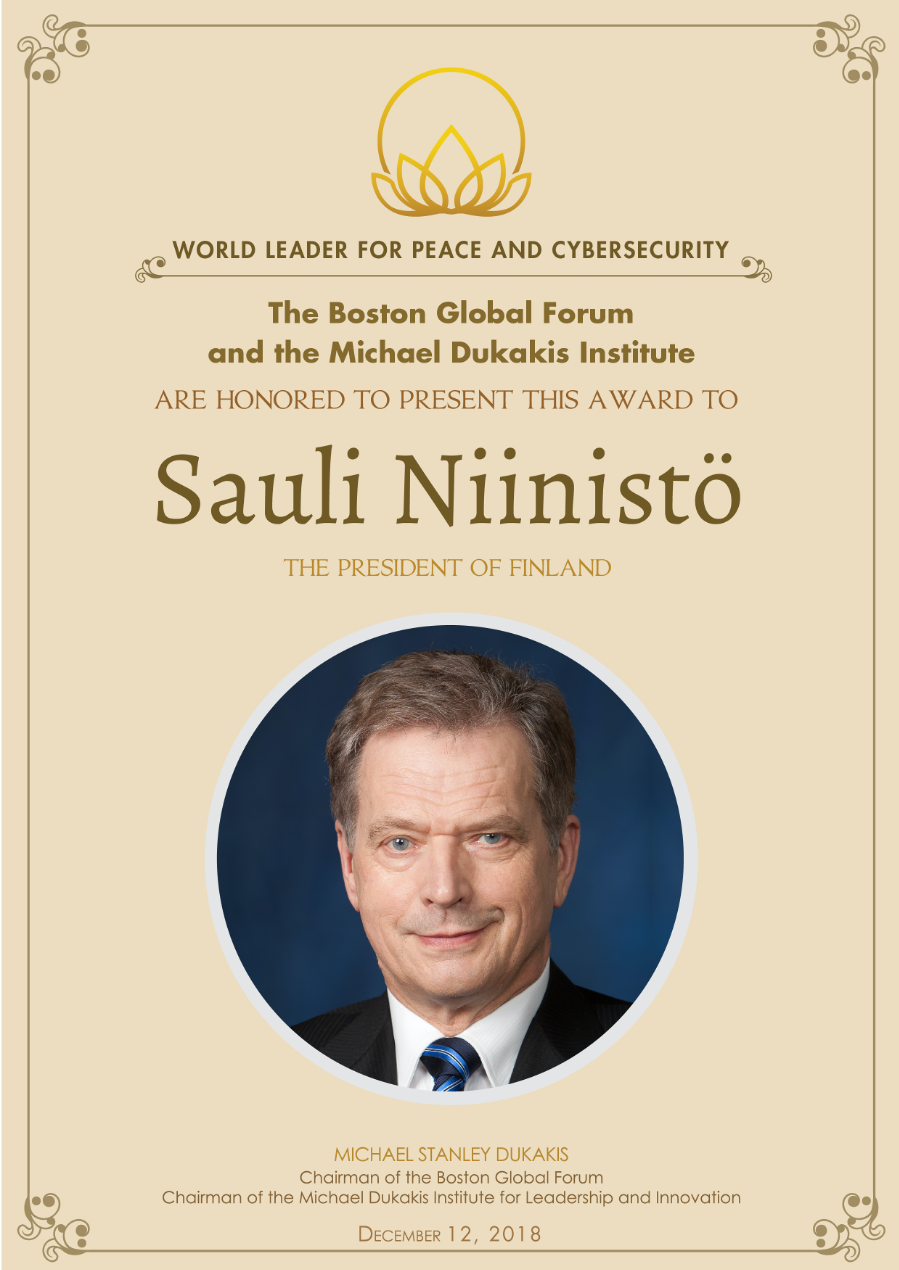
The Boston Global Forum honored President Sauli Niinisto with the World Leader for Peace and Cybersecurity Award on Global Cybersecurity Day, December 12, 2018 at Harvard University Faculty Club.