by Editor | Feb 17, 2020 | News
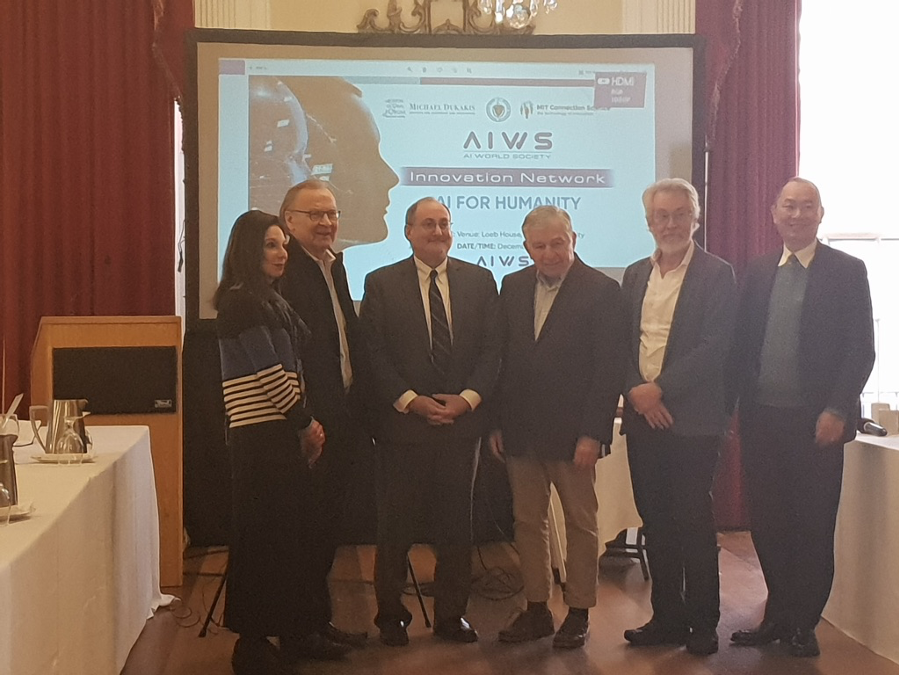
From 27 to 29 of April 2020, at Harvard University and MIT, the Boston Global Forum (BGF) and World Leadership Alliance-Club de Madrid are co-organizing a transatlantic and multi-stakeholder dialogue on global challenges and policy solutions in the context of the need to create a new social contract on digital technologies and Artificial Intelligence (AI).
This Policy Dialog is the AIWS Summit 2020 and focuses on discussing and building the Social Contract 2020.
There are more than 15 head and former head of states and governments of the world attending, as well as distinguished thinkers and inventors as Professor Joseph Nye and Vint Cerf who will join as speakers.
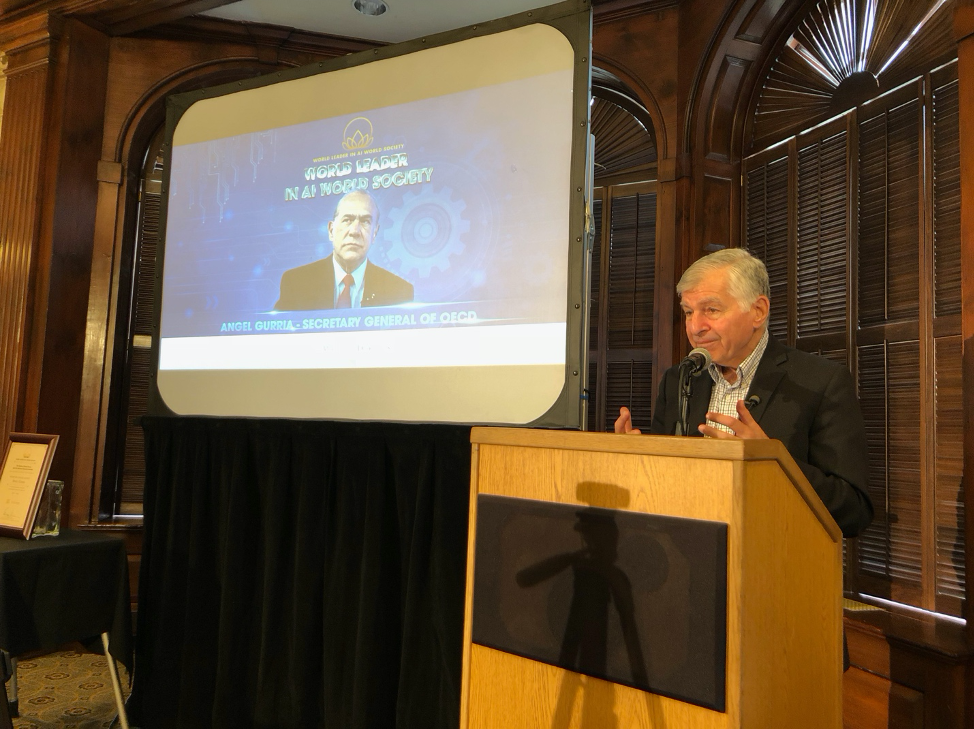
At this special event, BGF will present the World Leader in AIWS Award and AIWS Distinguished Lecture. Recipients of the World Leader in AIWS Award in the past years were Secretary General of OECD Angel Gurria (2018), and father of Internet Vint Cerf (2019).
Recently, Professor Alex Pentland, MIT, one of co-founders of the Social Contract 2020, contributed new ideas:
Traditional capitalism has evolved into AI-driven capitalism, and people around the world are deeply concerned that this is undermining our societies’ social contract. The general feeling is that balance must be restored by constructing institutions and laws that control AI, and govern data rights, ownership, and use. This new social contract will require that we build new solutions for managing civic and government systems, for digital privacy and cybersecurity, and for providing more agile, inclusive, and transparent responses to societies’ problems and for funding of supporting infrastructure.
One idea for what this new social contract might look like is summarized by the phrase “stakeholder capitalism”, that is, capitalism that benefits everyone.

by Editor | Feb 17, 2020 | News
Artificial intelligence—code that learns—is likely to be humankind’s most important invention. It’s a 60-year-old idea that took off five years ago when fast chips enabled massive computing and sensors, cameras, and robots fed data-hungry algorithms.
We’re a couple of years into a new age where machine learning (a functional subset of AI), big data and enabling technologies are transforming every sector. In every sector, there is a big data set behind every question. Every field is computational: healthcare, manufacturing, law, finance and accounting, retail, and real estate. We all work with smart machines—and they are getting smart fast.
A World Economic Forum report indicated that 89% of U.S.-based companies are planning to adopt user and entity big data analytics by 2022, while more than 70% want to integrate the Internet of Things, explore web and app-enabled markets, and take advantage of machine learning and cloud computing
To support AI technology for future generation, AIWS Innovation Network has created AIWS Young Leaders program. The program currently includes Young Leaders from Australia, Austria, Belgium, Britain, Canada, Denmark, Estonia, France, Finland, Germany, Greece, India, Italy, Japan, Latvia, Netherlands, New Zealand, Norway, Poland, Portugal, Russia, Spain, Sweden, Switzerland, United States, and Vietnam.

by Editor | Feb 17, 2020 | News
The coronavirus, which emerged in Wuhan, China, continues deadly. More than 31,000 people have now been contracted in China and 630 people have died, per latest figures released by authorities. As the virus already became a global health emergency, AI researchers are applying machine learning techniques to predict where it may expand elsewhere, so that we can proactively and effectively allocate resources and block the outbreak.
A research group in the UK, led by Professor Andy Tatem of the University of Southampton, used anonymized historical data from smartphones, supplied by the Chinese search company Baidu, to model how the virus may have moved out of Wuhan in the early days after it appeared. Another group of researchers used data from Tencent, who owns the popular Chinese app WeChat, to model the contagion, suggesting that the travel restrictions imposed by China may have slowed the spread of the disease by a few days.
However, it is useful to predict where the outbreak may have been expanding next. As reported on Wired, an international team is using machine learning to analyze social media posts, news reports, health public and information supplied by doctors for warning symptoms of the virus. “We are moving to surveillance efforts in the US,” said John Brownstein, CIO of Harvard Medical school and a member on the team. “We’re trying to understand what’s happening in the population at large.”
Alessandro Vespignani, a professor at Northeastern University who specializes in modeling contagion in large populations, says it is difficult due to the lack of historical data. He, however, believes that if the disease spreads more widely in the US, it should become easier to monitor its spread by applying AI.
Indeed, the approach has so far proven capable of spotting a coronavirus needle in a haystack of big data. More information can be found here, including the methods applied.
According to AI application to the society, AI World Society has established AIWS Innovation Network will connect key AI actors and provide services that can assist in the development of AI.

by Editor | Feb 9, 2020 | News
MIT IDE co-founders, Erik Brynjolfsson and Andrew McAfee, participated in several panel discussions and interviews at this year’s World Economic Forum in Davos, Switzerland, as did IDE co-lead Sandy Pentland.
In a year when the main headlines dominating the week were the perils of climate change, declining democracy, and capitalism in crisis, MIT leaders jumped into the fray. Brynjolfsson and McAfee (in photo above) spoke with Yahoo! Finance about what it will take for the U.S. to hold onto its leadership in AI against rivals such as China. Both pointed out how inextricably linked AI and other technologies are with immigration policies and government investment. In particular, they decried the immigration limits on scholars allowed to come to the U.S., and they emphasized need to amp up basic research funding here in the States.
“The key is to not lose the position that we have,” said McAfee. “When the world’s most intelligent, ambitious, and tenacious people in this field want to come to America to build their lives and careers and we put this Kafka-esque barriers in their place… if our president is on board, let’s get these people here.” Read more and watch the video here.
Among the highlights:
- McAfee also took part in a lively discussion on Debunking the Limits to Growth, a premise of his recently released new book, More From Less. Discussion leader, Professor Mariana Mazzucato, of theUniverity College London, contrasted McAfee’s pro-capitalism, pro-technology stance with that of Robert Habeck, Chair of the German Green Party. Watch the full video here.
- Earlier in the week, McAfee participated in a panel sponsored by Accenture on Technology, Business, and Society in the 4th Industrial Revolution. McAfee was joined by Alan Murray, President and CEO of Fortune, and Stephanie Linnartz, Global Chief Commercial Officer of Marriott International. The session was moderated by Paul Daugherty, Chief Technology and Innovation Officer at Accenture. Watch the video here.
- He spread his message about using innovation to address environmental woes and spur growth at a session sponsored by Deutsche Bank. Watch the conversation here.
- Additionally, as part of the MIT Connection Science Summit, Sandy Pentland hosted Imagination in Action on January 21 exploring how to extend human intelligence to support a sustainable future. Tata Consultancy Services, MIT Connection Science, Forbes, and Global Citizen gathered a selection of the foremost thinkers and innovators at Davos to exchange perspectives and offer solutions on how to unleash our collective intelligence through the growing power of technology. Read more about the Summit here.
- The event also partnered with Global Citizen, an international advocacy organisation with a mission to fight for equality, tackle climate change and end extreme poverty by 2030. Learn more about Global Citizen, Teneo and Global Goal Live HERE.
The original article can be found here.
Professor Alex Sandy Pentland is a co-founder of AIWS Innovation Network, as well as a co-founder of the Social Contract 2020.
by Editor | Feb 9, 2020 | News
The World Leadership Alliance – Club de Madrid (WLA-CdM), in partnership with the Boston Global Forum (BGF), is organizing a transatlantic and multi-stakeholder dialogue on global challenges and policy solutions in the context of the need to create a new social contract on digital technologies and Artificial Intelligence (AI).
To get ideas and opinions from global leaders and distinguished thinkers for policy dialog from April 27 to 29 at Harvard, and MIT, and contribute for United Nations 2045 project, the Boston Global Forum, World Leadership Alliance-Club de Madrid, and United Nations Academic Impact co-organize AIWS Innovation Network Roundtable, an online discussion on AIWS Innovation Network (AIWS-IN). It started from 02/02/2020 with discussion between Mr. Nguyen Anh Tuan, CEO of BGF, co-founder of AIWS-IN, and Mr. Ramu Damodaran, Chief of United Nations Academic Impact. Governor Michael Dukakis, co-founder of AIWS-IN, is the moderator of the AIWS-IN Roundtable with participants such as Professor Alex Sandy Pentland, MIT, co-founder of AIWS-IN, Professor David Silbersweig, Harvard, co-founder of AIWS-IN, professor Nazli Choucri, MIT, co-founder of AIWS-IN, and professor Joseph Nye, Harvard. The AIWS-Roundtable will finish on April 20, 2020. The discussion focuses on balance centers of power and balance of new great powers. AI Assistants, a new center of power, will be discussed to find out solutions, regulations, and practice to manage and govern it. This is a part of the Social Contract 2020.