by Editor | Feb 24, 2020 | AI-Government, News, AIWS and the Age of Global Enlightenment
On February 19, 2020, the European Commission issued “WHITE PAPER on Artificial Intelligence – A European approach to excellence and trust”
“The Commission supports a regulatory and investment oriented approach with the twin objective of promoting the uptake of AI and of addressing the risks associated with certain uses of this new technology. The purpose of this White Paper is to set out policy options on how to achieve these objectives. It does not address +the development and use of AI for military purposes.The Commission invites Member States, other European institutions, and all stakeholders, including industry, social partners, civil society organisations, researchers, the public in general and any interested party, to react to the options below and to contribute to the Commission’s future decision-making in this domain.”
The EU is pursuing a digital strategy that builds on our successful history of technology, innovation and ingenuity, vested in European values, and projecting them onto the international stage. The White Paper on Artificial Intelligence (AI) and the European data strategy presented February 19, 2020 show that Europe can set global standards on technological development while putting people first.
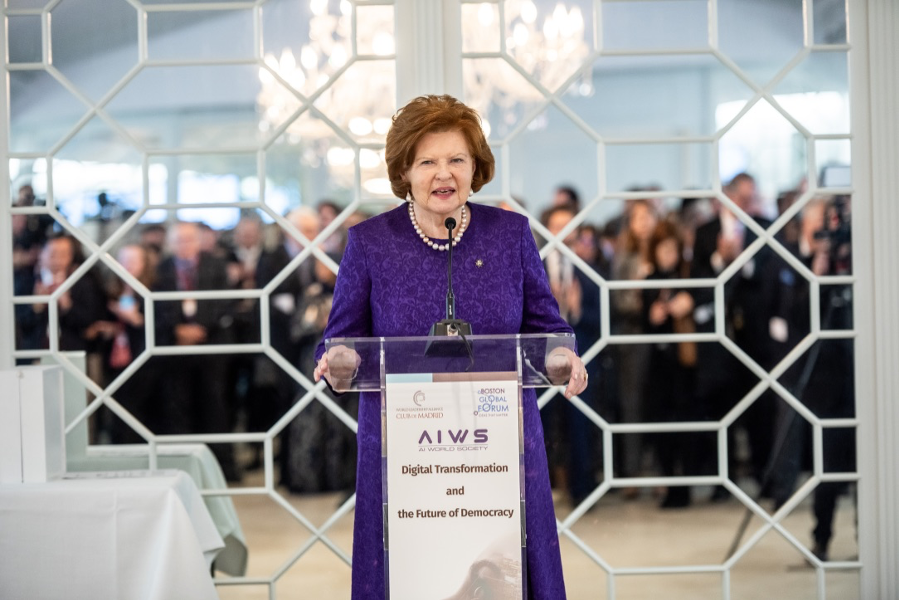
Europe wants to lead the global digital transformation. The World Leadership Alliance, a partner of the Boston Global Forum, was very successful in organizing Policy Dialog “Digital Transformation and the Future of Democracy” on October 21-22, 2019 in Madrid. The World Leadership Alliance-Club de Madrid and the Boston Global forum will co-organize Policy Dialog “Transatlantic Approaches on Digital Governance:
A New Social Contract in Artificial Intelligence”, April 27-29, 2020 at Harvard University and MIT. The Boston Global Forum and World Leadership Alliance-Club de Madrid have significantly contributed for AI politics, and AI governance in 2018, 2019 with BGF-G7 Summit Initiative 4/2018 and AIWS-G7 Summit Initiative 4/2019.

by Editor | Feb 24, 2020 | News
In a time when technology seems to evolve on a daily basis, the Federal Highway Administration is looking to lay the groundwork on integrating artificial intelligence into the transportation network.
The report goes into great depth on the past, present and future of AI, and how emerging machine learning is expected to help create automated transportation systems.
“Machine learning applications offer the potential to supplant human work in a variety of” transportation management systems, the report says, including data analysis and automated “traffic imagery analysis, incident detection, traffic control and traffic signal timing.”
The report notes that AI technology has hurdles to clear before it can reach its potential.
“AI applications should find their way from research experiments and pilot demonstrations to fully scalable applications in the near term,” the report says.
The federal highways report adds that driverless vehicles are likely to be in use in the near term and automated drones in the “medium term.”
There appear to be significant barriers to self-driving cars. The occasional high-profile Tesla crashes attest to that.
The original article can be found here.
According to AI application to the society, AI World Society has established AIWS Innovation Network will connect key AI actors and provide services that can assist in the development of AI.

by Editor | Feb 24, 2020 | News
The AMA deliberately uses the term augmented intelligence (AI)—rather than the more common term “artificial intelligence”—when referring to machine-learning computer algorithms that hold the potential to produce dramatic breakthroughs for health care research, population health risk-stratification and diagnostic support.
“In health care, machines are not acting alone but rather in concert and in careful guidance with humans, i.e., us—physicians,” said AMA Board of Trustees Chair Jesse M. Ehrenfeld, MD, MPH. “There is and will continue to be a human component to medicine, which cannot be replaced. AI is best optimized when it is designed to leverage human intelligence.”
“Over the past decade, we have all learned about how we can incorporate new innovations into clinical practice,” Dr. Ehrenfeld said in his presentation. “Genetics, genomics, the electronic health record and digital medicine have all raised similar policy issues around innovation, incentive payments, regulation, liability, sufficiency of infrastructure, training and professional development.”
The chief lesson to be taken from these experiences is to settle these policy issues before expecting physicians to fit the technology into their workflow. Otherwise, the disruption will be chaotic to practices and adoption challenging, he said.
Citing the current focus of research and investment dollars, Dr. Ehrenfeld said the key areas of AI growth will be in diagnostic tools and health care administration.
The original article can be found here.
According to AIWS Innovation Network, AI can be a force for helping people achieve well-being and happiness, and solve important issues, such as SDGs.
by Editor | Feb 17, 2020 | News
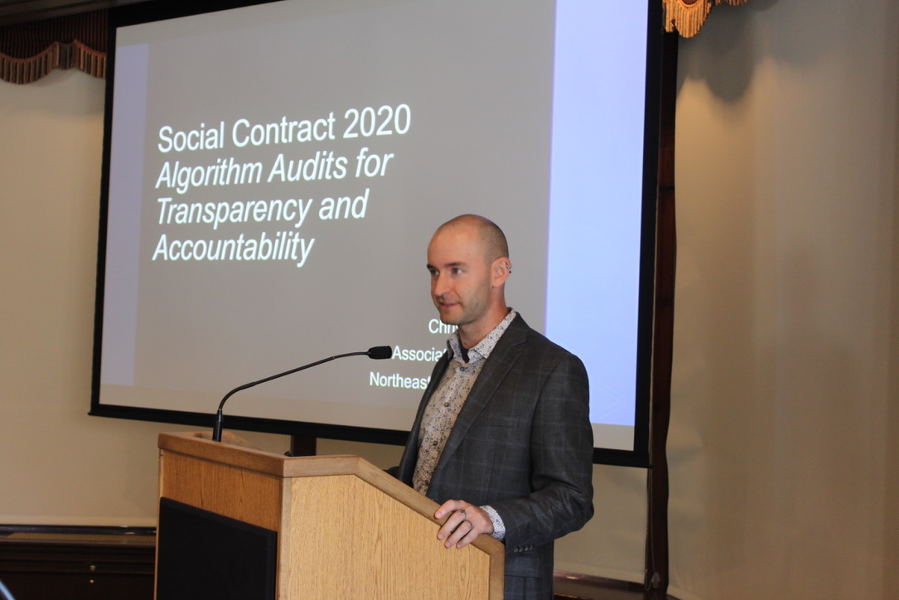
As a part of a transatlantic and multi-stakeholder dialogue on global challenges and policy solutions in the context of the need to create the social contract 2020, a new social contract on digital technologies and Artificial Intelligence (AI), co-organized by the World Leadership Alliance-Club de Madrid and the Boston Global Forum, the AIWS Innovation Network Roundtable started on 02/02/2020, and the first discussion will focus on auditing, balance AI Assistants, a new center of power in AI Age will be on 02/20/2020. The Social Contract 2020 propose 7 centers of power. The AIWS Innovation Network Roundtable will discuss to audit, mange, monitor and balance these 7 centers of power.
Professors Alex Pentland, MIT, Christo Wilson, Northeastern University, and Harvard Law School Fellow will present their ideas in the first discussion. There are distinguished thinkers, inventers, innovators who are members of AIWS Innovation Network will contribute their ideas and discussion. Content of the AIWS Innovation Network Roundtable will be also used for United Nations 2045 project and will collect and present on April 28, 2020 at Policy Dialog 2020 at Harvard by BGF and Club de Madrid with the attendance of more than 15 head and former head of states and governments.
The AIWS Innovation Network is a platform of United Nations 2045 project.
by Editor | Feb 17, 2020 | News
A new nonpartisan research center, with a pair of former governors on its advisory council, is setting out to provide lawmakers and voters with “real-time” analysis of key topics, including projected impacts of ballot questions.
Tufts University’s Jonathan M. Tisch College of Civic Life announced the launch of the Center for State Policy Analysis on Thursday.
Members of the center’s advisory council are: former Govs. Jane Swift and Michael Dukakis; Tisch College dean Alan Solomont; former Massachusetts Taxpayers Foundation President Michael Widmer; Massachusetts League of Community Health Centers general counsel and deputy CEO Michael Curry; Katherine Craven, chief administrative and financial officer at Babson College and the chair of the Board of Elementary and Secondary Education; Ted Landsmark, director of the Dukakis Center at Northeastern University; David Cash, dean of the John W. McCormack Graduate School of Policy and Global Studies at UMass Boston; Carolyn Ryan, senior vice president for policy and research at the Greater Boston Chamber of Commerce; A Better City Executive Vice President Kate Dineen; and Tufts political science professor Jeffrey Berry.
The original article can be found here.
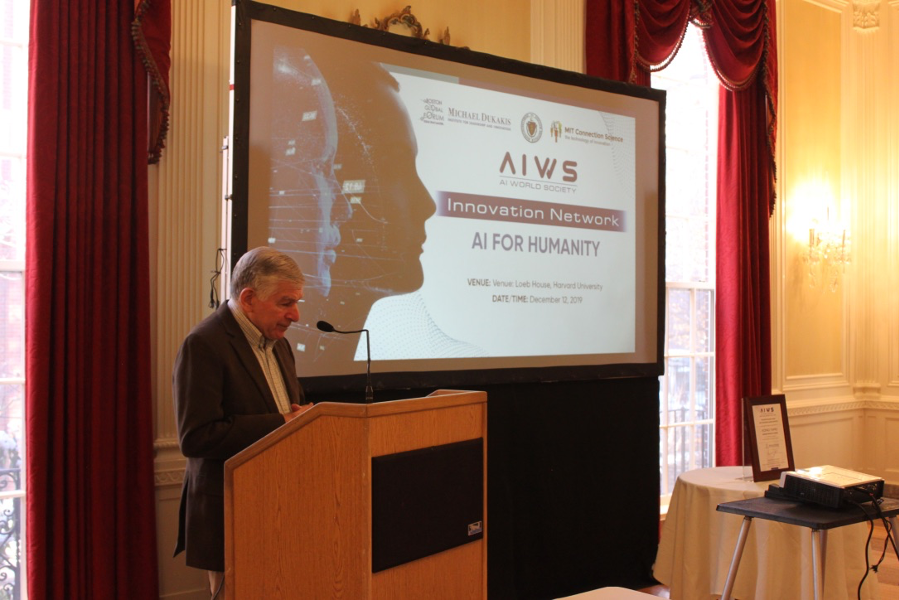
Governor Michael Dukakis is a co-founder and Chair of the Boston Global Forum. He is also a co-founder of AI World Society Innovation Network and the Social Contract 2020.