by Editor | Mar 15, 2020 | News
Japan is still preparing to host the Olympics, Prime Minister Shinzo Abe said on Saturday, despite rising global concern about the viability of the summer Games due to the coronavirus outbreak.
The 2020 Olympics are scheduled to begin July 24 and run through August 9, but the coronavirus outbreak has created doubt as to whether they will be able to take place as planned.
The original article can be found here.
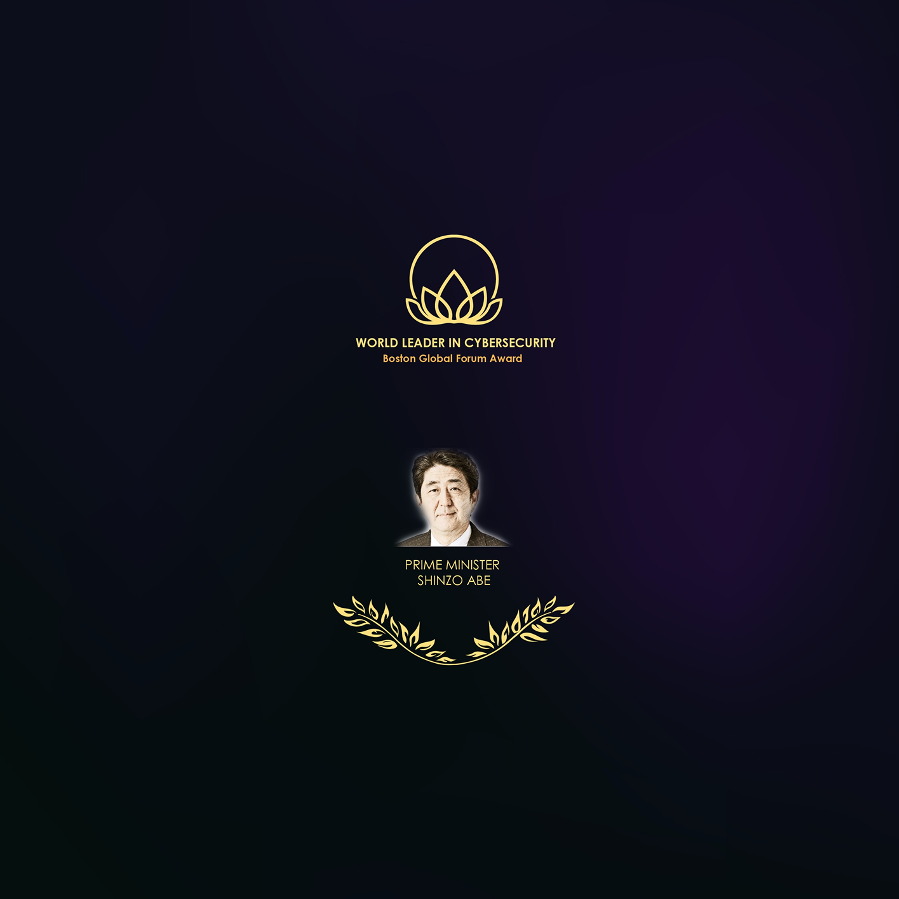
The Boston Global Forum honored Prime Minister Shinzo Abe with the World Leader for Peace, and Cybersecurity Award on Global Cybersecurity Day December 12, 2015 at Harvard University Faculty Club.
In the next days, leaders of AIWS Innovation Network will launch an initiative for people in time to fight COVID-19. This time creates opportunities to innovate our life, our works, and our societies. The world need transparency and collaboration.
by Editor | Mar 15, 2020 | News
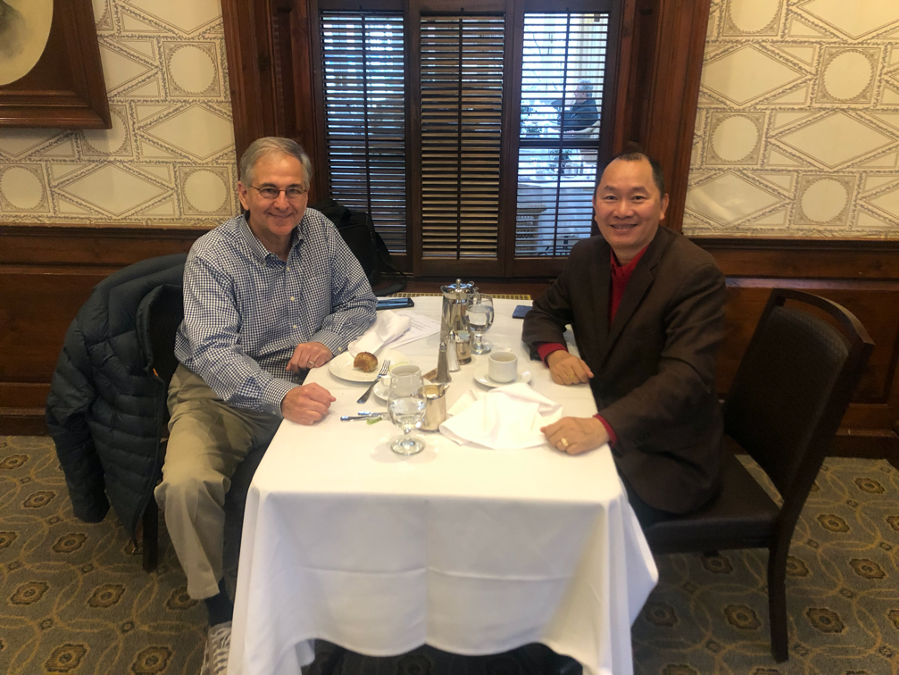
Mr. Nguyen Anh Tuan, co-founder of AIWS Innovation Network, and Mr. Eliot Weinman Founder & Chair, AI World Conference and Expo, had a very nice lunch at Harvard University Faculty Club on November 16, 2018. At the lunch, Mr. Tuan shared with Mr. Weinman the concepts of AI-Government, a part of AI World Society, and advise AI World Conference and Expo should organize an AI government conference.
Mr. Weinman like this idea, and organized the first very successful AI government conference in DC from 24 to 26 of June 2019. Governor Michael Dukakis, co-founder of AIWS Innovation Network gave keynote opening speech; Professor Thomas Patterson, Harvard University, co-founder of AIWS Innovation Network, presented the concepts of AI-Government; and Professor Nazli Choucri, MIT, Co-founder of AIWS Innovation Network, joined as a panelist of the event.
This year, from 22 to 26 of June, the second AI World Government Conference will be take place in Washington DC.
With AI technology at the forefront of our everyday lives, there are significant efforts already underway by federal agencies to deploy and integrate data-driven government services. In fact, most federal agencies have already begun projects to leverage the rapid rise in availability of intelligent automation solutions. AI World Government gathers leaders from our nation’s strong innovation ecosystem across government, technology, business and research to present the state of the practice and state of the technology to assist in leveraging advanced intelligent technologies to enhance government services.
AIWS Innovation Network, the Strategic Alliance Host of AI World Government, will present AIWS Social Contract 2020, and transparency of AI to more than 1,000 Colleagues at the Largest Independent AI Federal Government Event of the Year 2020.
by Editor | Mar 15, 2020 | News
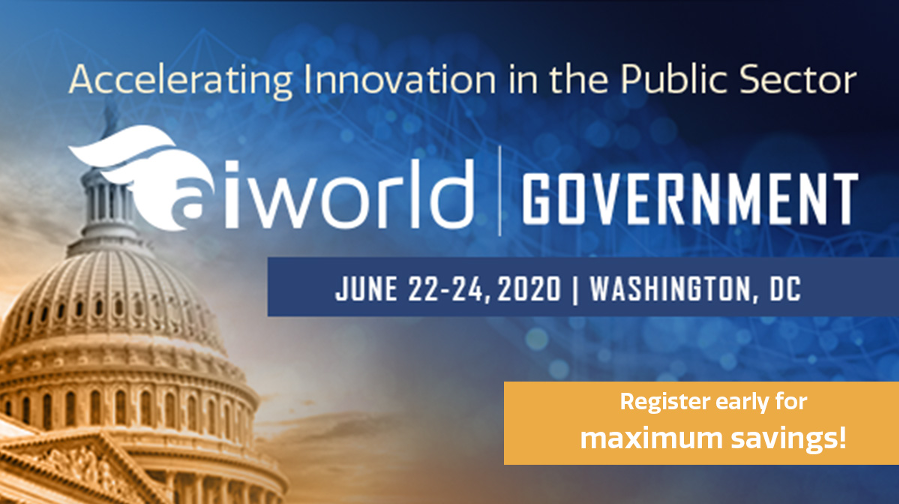
AI World Government, a big conference on AI Government, will be organized in Washington DC from 22 to 24 of June, 2020. AIWS Innovation Network is the Strategic Alliance Host of this event.
AI World Government provides a comprehensive three-day forum to educate and inform public sector agencies on proven strategies and tactics to successfully deploy AI and cognitive technologies. Join leaders from our nation’s strong innovation ecosystem across government, technology, business and research to discuss the state of the practice and state of the technology to assist the public sector in leveraging advanced intelligent technologies to enhance government services. Learn more and register now: http://bit.ly/3aNxE4J
by Editor | Mar 15, 2020 | News
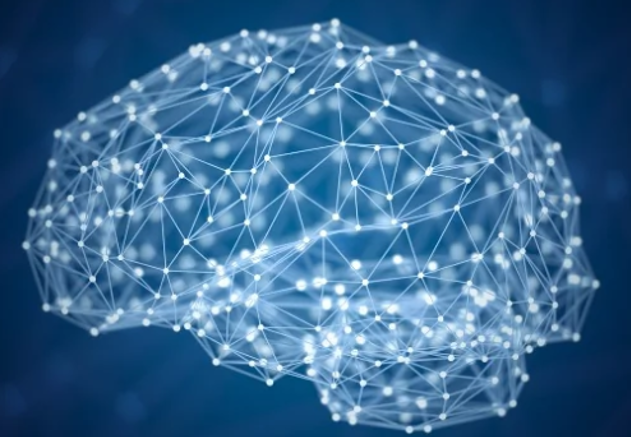
Scientists at Osaka University built a new computing device from field-programmable gate arrays (FPGA) that can be customized by the user for maximum efficiency in artificial intelligence applications. Compared with currently used rewireable hardware, the system increases circuit density by a factor of 12. Also, it is expected to reduce energy usage by 80%. This advance may lead to flexible artificial intelligence (AI) solutions that provide enhanced performance while consuming much less electricity.
AI is becoming a part of everyday life for almost all consumers. Ridesharing smartphone apps like Uber, Gmail’s spam filters, and smart-home devices like Siri and Nest all rely on AI. However, implementing these algorithms often require a large amount of computing power, which means large electricity bills, as well as big carbon footprints. Systems that could–like the human brain–be rewired to optimize the computer circuitry for each task would provide greatly enhanced energy efficiency.
Normally, we think of hardware, which includes the physical logic gates and transistors of a computer’s processor, as fixed by the manufacturer. However, field-programmable gate arrays are specialized logical elements that can be rewired “in the field” by the user for custom logic applications. The research team used non-volatile “via-switches” that remain connected until the user decided to reconfigure them. Using novel nanofabrication methods, they were able to pack twelve times more elements into a grid-like “crossbar” layout. By reducing the distance electronic signals need to be routed, the devices ended up needing 80% less power.
The original article can be found here.
In 2019, Michael Dukakis Institute for Leadership and Innovation (MDI) established the Artificial Intelligence World Society Innovation Network (AIWS-IN) for the purpose of promoting ethical norms and practices in the development and use of AI in healthcare, education, transportation, national security, and other areas.
by Editor | Mar 15, 2020 | News
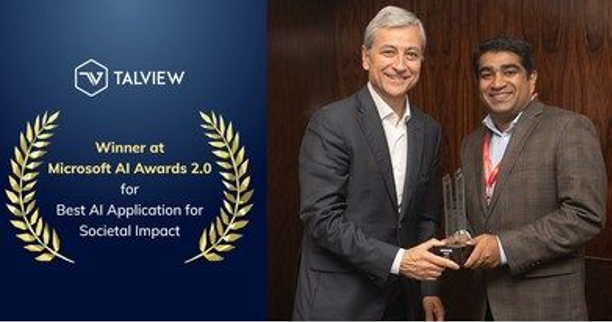
AI Recruitment startup, Talview, has received the prestigious “Best AI Application for Societal Impact” award in the partner category in the Microsoft AI Awards 2.0 for its part in a growing community development initiative. Talview has been recognized as a leader in bringing innovative AI solutions to HR and Talent Management at the Microsoft AI Awards for the second year.
Talview is one of the top Microsoft ISV partners and has built its Instahiring Experience platform using Microsoft Azure AI, machine learning and cognitive services. For corporate customers, Talview leverages the capabilities of Microsoft Azure to automate talent screening, video interviews, and securely proctor cognitive assessments for hiring decisions.
Talview won the recognition at AI Awards 2.0 for enabling its not-for-profit client, Head Held High Foundation, to simplify the process of conducting video interviews and assessments. Head Held High is a non-profit organization whose goal is to eradicate poverty and transform the face of India. Head Held High uses Talview’s video interviewing and assessments platform to measure a person’s workplace readiness and help transform their vision of who they can become. The use of Talview’s technology has enabled Head Held High to make a huge societal impact and empower students who are deprived of higher education to access better career options. Talview platforms also make candidates aware of AI technology and test how well they operate computers.
The original article can be found here.
To support and collaborate AI application and Society, Artificial Intelligence World Society Innovation Network (AIWS-IN) created AIWS Young Leaders program including Young Leaders and Experts from Australia, Austria, Belgium, Britain, Canada, Denmark, Estonia, France, Finland, Germany, Greece, India, Italy, Japan, Latvia, Netherlands, New Zealand, Norway, Poland, Portugal, Russia, Spain, Sweden, Switzerland, United States, and Vietnam.