
by Editor | Mar 22, 2020 | News
The deadly coronavirus, which first appeared in mainland China, has now spread across the world. The World Health Organization (WHO) has declared it a global pandemic and has reported more than 125,000 cases and 4,500 deaths as of March 12, 2020.
To lend perspective, confirmed cases have already exceeded the number of people infected during the 2002-2003 severe acute respiratory syndrome (SARS) outbreak. While the flu and coronavirus are often compared, coronavirus may be deadlier. On average, the seasonal flu strain kills about 0.1% of infected people. Early death rate estimates in the coronavirus outbreak’s epicenter in Wuhan, China, have been around 2%.
Here’s a look at a number of ways artificial intelligence (AI)-based technologies are being deployed in the fight against the outbreak.
Identifying Outbreaks and Quarantining
AI can predict the number of potential new cases by geography and which types of populations face the greatest risk. It can also help with the enhancement of optimization strategies. For example, machine learning—a subset of AI—has already been employed to research and optimize strategies for quarantine efforts among communities, cities and countries to limit the spread of the virus.
Diagnosis and the Search for A Cure
AI is also lending a hand in diagnosing coronavirus. Hospitals in China are using AI-based software to scan through CT images of patients’ lungs to look for signs of COVID-19, the infection caused by coronavirus.
However, the medical community has historically cultivated vaccines for comparable viruses, so using AI to look at patterns from similar viruses and detect the attributes that will help build a new vaccine gives scientists a higher probability of success than if they’d started creating one from scratch.
And while it doesn’t guarantee a cure, AI provides an important advantage: It helps scientists more quickly discover relationships among diseases and symptoms, drugs and their effect(s) and the patients who might respond to treatment—insights that, due to the sheer amount of biomedical data, could otherwise be missed in a race against time.
The original article can be found here.
To support and develop AI applications for world society matters, Artificial Intelligence World Society Innovation Network (AIWS.net) created AIWS Young Leaders program including Young Leaders and Experts from Australia, Austria, Belgium, Britain, Canada, Denmark, Estonia, France, Finland, Germany, Greece, India, Italy, Japan, Latvia, Netherlands, New Zealand, Norway, Poland, Portugal, Russia, Spain, Sweden, Switzerland, United States, and Vietnam.
by Editor | Mar 22, 2020 | News
An app that tracks where you have been and who you have crossed paths with—and then shares this personal data with other users in a privacy-preserving way—could help curb the spread of Covid-19, says Ramesh Raskar at the MIT Media Lab, who leads the team behind it. Called Private Kit: Safe Paths, the free and open-source app was developed by people at MIT and Harvard, as well as software engineers at companies such as Facebook and Uber, who worked on it in their free time.
How it works: Private Kit: Safe Paths gets around privacy concerns by sharing encrypted location data between phones in the network in such a way that it does not go through a central authority. This lets users see if they may have come in contact with someone carrying the coronavirus—if that person has shared that information—without knowing who it might be. A person using the app who tests positive can also choose to share location data with health officials, who can then make it public.
Raskar thinks that a fine-grained tracking approach, which would allow specific locations to be closed off and disinfected, is better than blanket shutdowns, which are socially and economically disruptive.
The original article can be found here.
Professor Alex Sandy Pentland, MIT, Co-founder of AIWS Innovation Network (AIWS.net), and Jeff Saviano, Member of AIWS.net, joined this MIT team. AIWS.net recommended a solution to help bring normalization to life and society based on this app.
by Editor | Mar 22, 2020 | News
With the spread of COVID -19 growing both in Europe and the US, World Leadership Alliance-Club de Madrid (WLA-CdM) and the Boston Global Forum (BGF) decide to postpone the Boston Policy Lab – AIWS Summit to 16-18, September 2020.
While “Transatlantic Approaches on Digital Governance: A New Social Contract in Artificial Intelligence Age” was organized in Harvard and MIT offline, WLA-CdM and BGF will organize an online conference and continue to do AIWS Innovation Network (AIWS.net) Roundtable. The AIWS.net Roundtable attracts many distinguished thinkers and leaders to join and contribute ideas to build the Social Contract 2020 and United Nations 2045 project.
Postponed to September 16-18, there are more head of states and governments that can attend the event.
The Coronavirus outbreak risk reminds the world: to prevent peril, all governments have to create transparency, accountability, respect of freedom of expression of all citizens, and collaboration between governments.
by Editor | Mar 22, 2020 | News
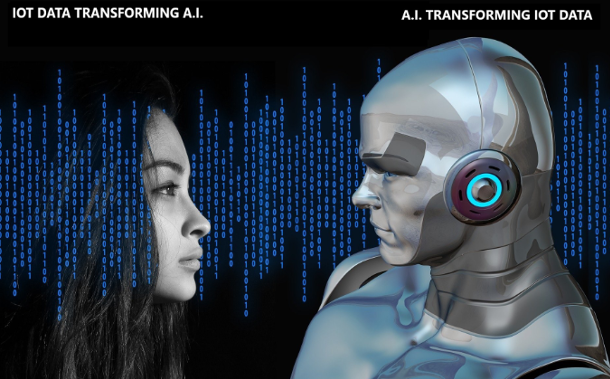
The book Design, Launch, and Scale IoT Services classifies the components of IoT services into technical modules. One of the most important of these is Artificial Intelligence (AI). This article is intended to supplement the book by providing insight into AI and its applications for IoT.
After many years in the wilderness, AI is back on the hype curve and will change the world again. Or, will it? AI has always been interesting, but what has changed to justify the current hype?
There are several contributing factors. The volumes of data that will be produced by many IoT services suggest that this data cannot be managed by humans with traditional analytics tools. Therefore, AI can offer opportunities for IoT services to extract maximum value from the data. IoT cloud platforms are now offering AI services via APIs and application development tools, making AI more accessible for many IoT services. Now, AI can be incorporated without requiring extensive development or excessive costs.
The original article can be found here.
According to AI development and application to society, Michael Dukakis Institute for Leadership and Innovation (MDI) established the Artificial Intelligence World Society Innovation Network (AIWS-IN) for the purpose of promoting ethical norms and practices in the development and use of AI in healthcare, education, transportation, national security, and other areas.
by Editor | Dec 12, 2020 | News, Boston Global Forum Awards
Boston Global Forum, 12/12/2020
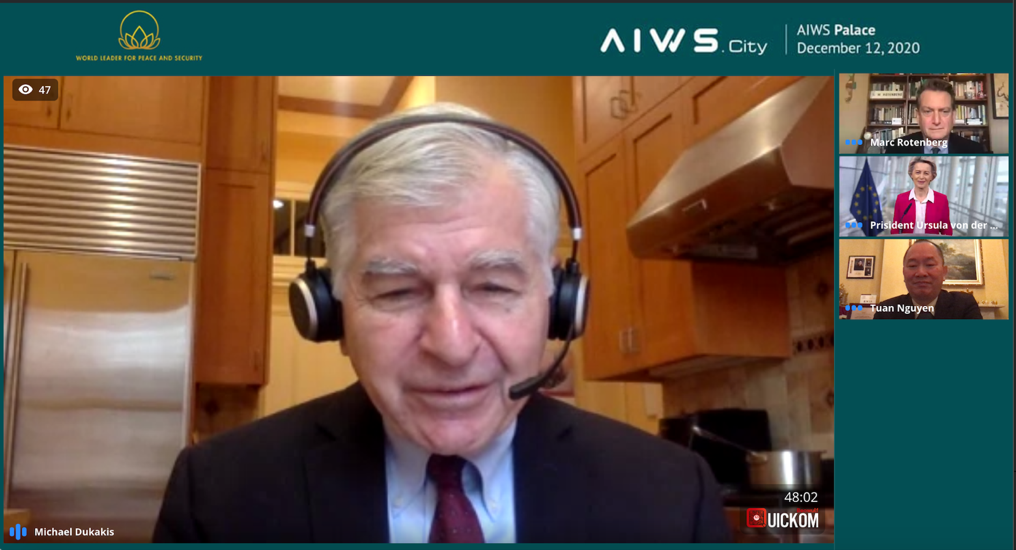
I am pleased to announce that this year’s recipient of the Boston Global Forum’s World Leader for Peace and Security Award is Ursula von der Leyen, President of the European Commission. President von der Leyen is the first woman to serve in that position.
Trained as a physician, she entered politics as a cabinet minister in the German state of Lower Saxony. When Angela Merkel became German chancellor in 2005, she appointed Dr. von der Leyen as Minister of Family Affairs and Youth, a portfolio that aligned with her work on women’s health.
After four years in that position, she was appointed by Chancellor Merkel to be Minister of Labor and Social Affairs. Then, in 2013, she was appointed Germany’s Minister of Defense, the first woman to hold that top ministerial post.
When she left her post in 2019 to become President of the European Commission, President von der Leyen had the distinction of being the longest serving minister of the Merkel government. During much of this period, she also served as a deputy leader of Germany’s governing party, the Christian Democrats.
President von der Leyen has been a tireless advocate for a more united Europe and a Europe that would assume a larger role in international diplomacy and security. A champion of democratic rights and institutions, she has contested the emergence in Europe of right-wing nationalism and state authoritarianism. She has pressed European countries to act collectively, rather than individually, to contain the COVID-19 threat.
She is committed to the Transatlantic Alliance, recognizing the collective responsibility of the EU and the United States to advance global peace, security, and development.
These goals match those of the Boston Global Forum. We are also at one with President von der Leyen on the need for an international accord on the use of Artificial Intelligence, based on shared values and democratic traditions, an accord that will require sustained Transatlantic leadership if it is to be realized.
For these and other reasons, the Boston Global Forum is pleased today to present our World Leader for Peace and Security Award to European Commission President Ursula von der Leyen.