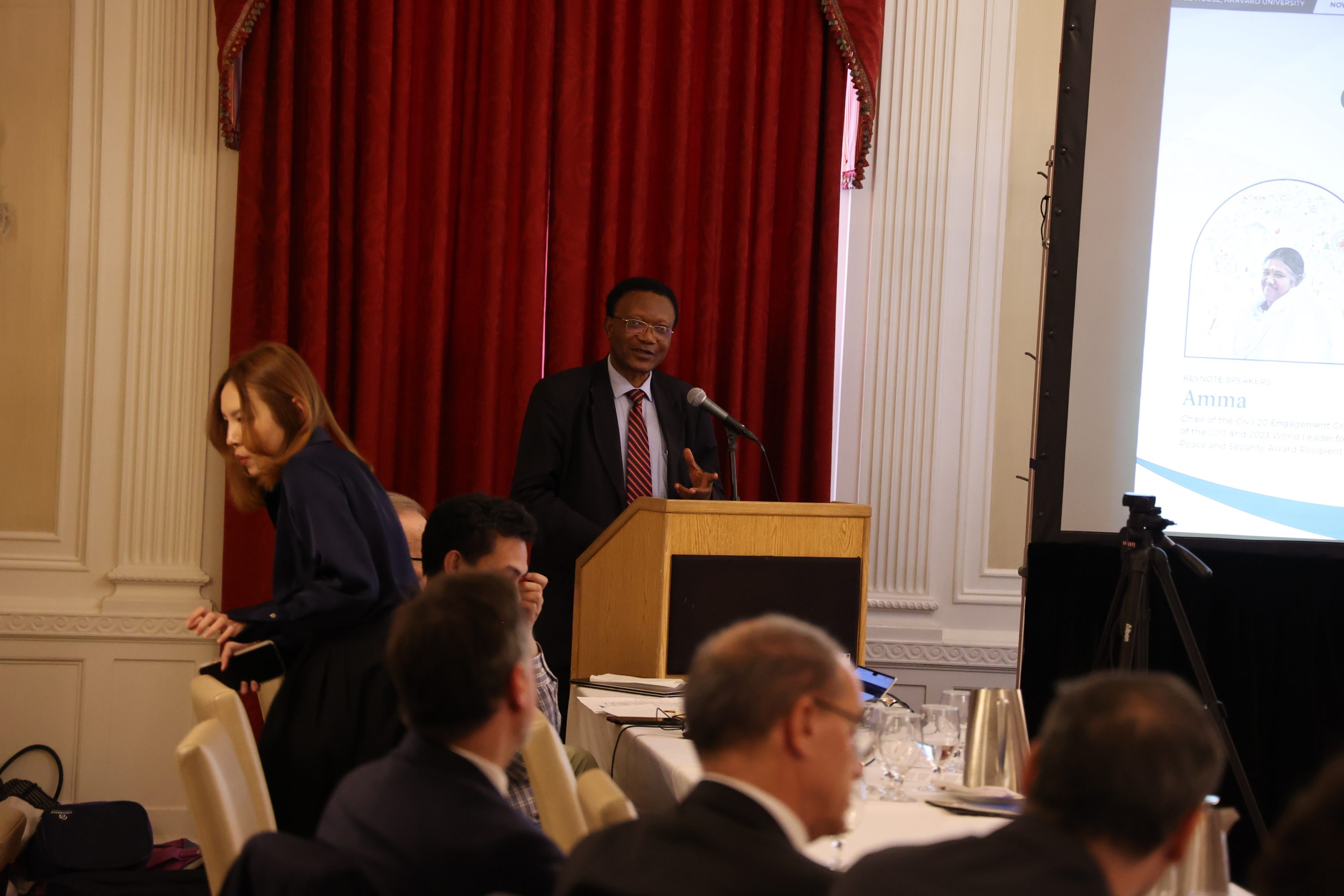
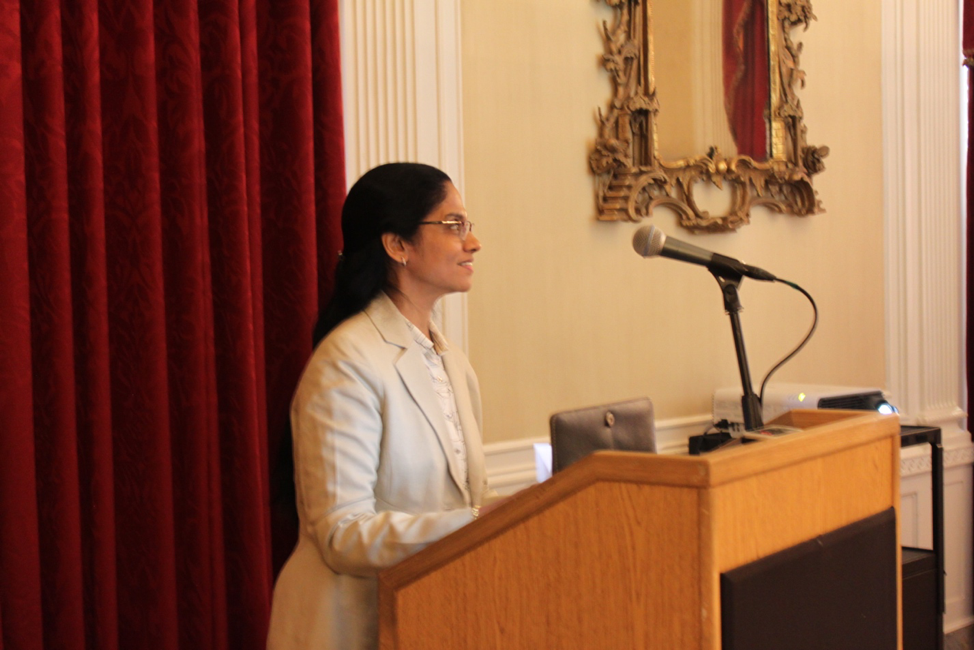
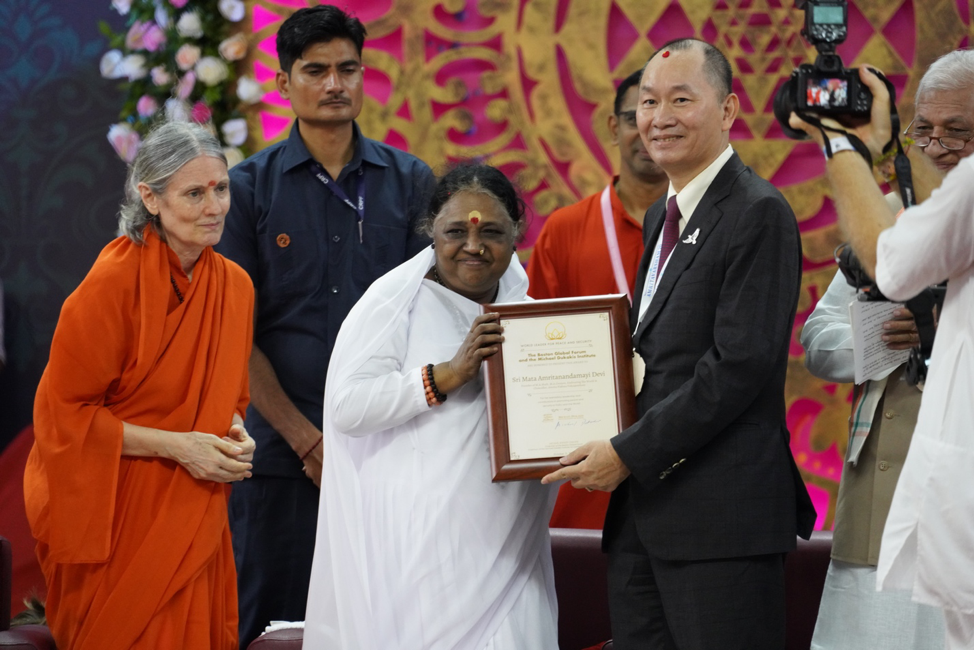
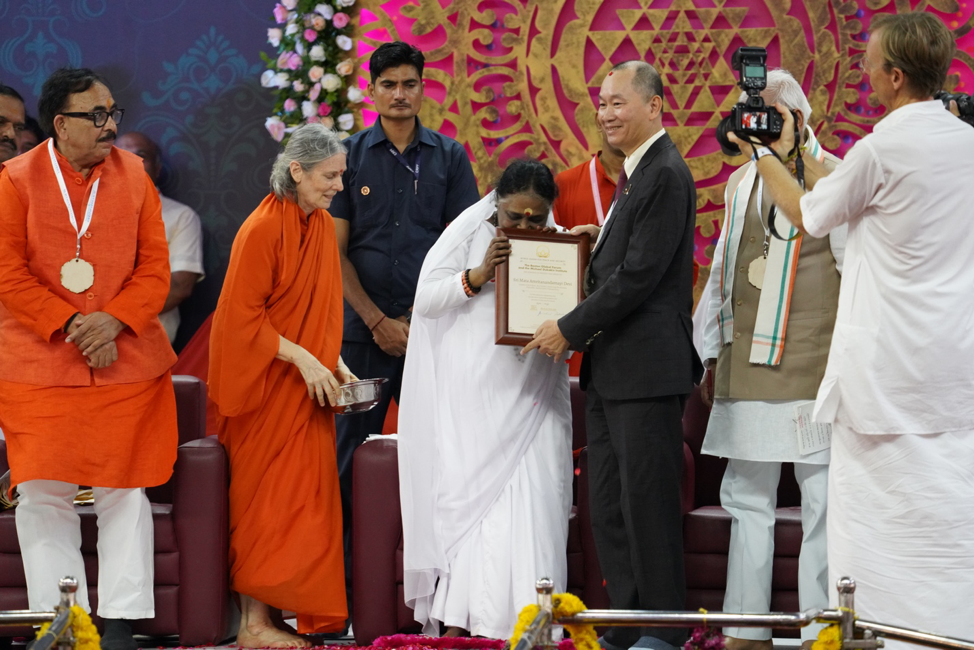
On November 2, 2023, Amma delivered the Distinguished Global Enlightenment Lecture as the 2023 World Leader for Peace and Security Award Recipient, at the BGF at Harvard University Loeb House. Here are its key messages:
Amma bows down to all of you, who are embodiments of Pure Love and the Supreme Self.
At the outset, Amma wishes to thank the Boston Global Forum for conferring this prestigious award on her. Amma feels that if she has made a positive impact on the world, it is solely because she has children who have chosen to selflessly love and serve others. Therefore, this acknowledgement and accolade should go to them. Amma’s only wish is to offer solace to the suffering, wipe their tears and comfort them until her last breath.
God has bestowed upon all living beings an exquisite and eternal divine flower. This undying flower is our sole shelter – planet Earth. Our Earth has an amazing power to provide us everything we need to overcome any challenge thrown at us by the changing seasons and weather. But God has also made us responsible for taking care of Earth and ensuring that her beauty, color, vitality and fragrance do not fade. What are we doing instead? Are we protecting this rare boon, or ruining it?
Externally, the gap between man and machine is decreasing. Internally, revenge, hatred and anger are eating away at the human mind. With advancements in science, man has learned to fly like a bird and swim like a fish, but has forgotten how to walk and live like a human.
We end up destroying ourselves when we fail to handle science and technology with proper discernment. Science and technology do not have any awareness or discerning power of their own. We need to have the right values to direct them.
Humans believe that they can conquer the entire universe using science and human intelligence. This is similar to the ignorance of a child who sees the sky through his bedroom window and claims it to be his own. In reality, what man’s intelligence has discovered is nothing but a small speck of this infinite universe.
Human beings are like waves that frolic on the surface of the boundless ocean yet know nothing of its depth or vastness. Waves are born and die in the ocean. All living beings are waves in the infinite ocean that is God. We are born, live, die in this infinite ocean. Just as the wave and the ocean are essentially one, man, nature and God are essentially the same.
We should learn to have gratitude towards everything in life. We are indebted to everything in this world—to all the creatures that helped us grow and made us who we are today. This Earth is our mother. Nature is our mother. We should never forget our debt to our mother. We should not walk away, refusing to pay heed to the cries of our brothers and sisters in pain. We should do what we can to help them. To help those in need, we may not need position or wealth. All we need to do is offer a loving word, a compassionate glance, a helping hand. Just these simple acts can make our life and theirs, bright and meaningful. It is what we give—not what we take—that determines the value of our life. If we can bring a moment of happiness to just one person’s life, it will greatly enrich our own. May all you children be able to achieve this. May divine grace bless you all.
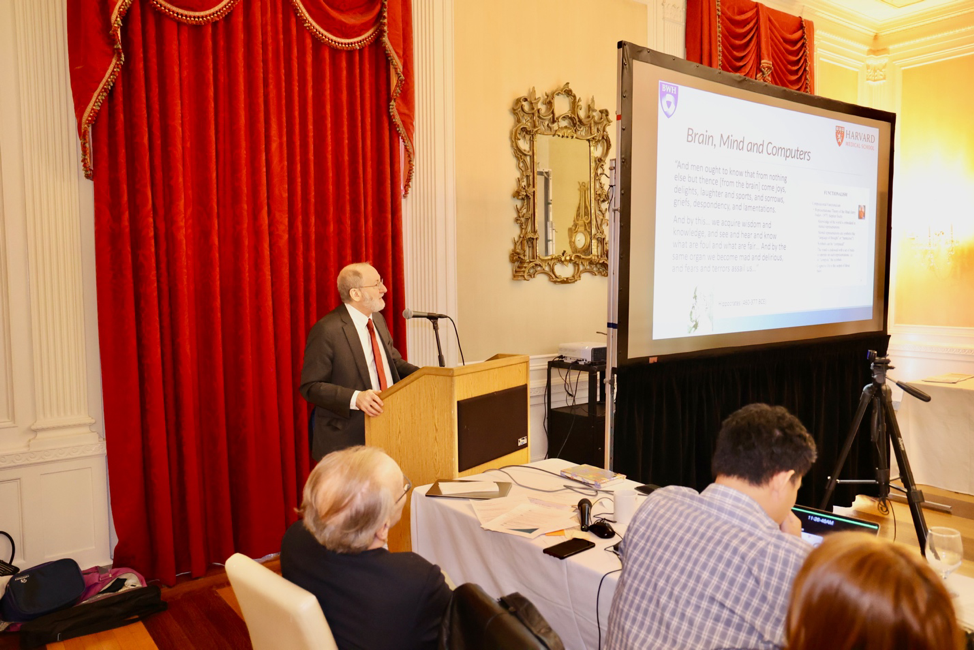
During Governor Dukakis’s 90th Birthday Celebration held on November 2, 2023, at Harvard University Loeb House and organized by the Boston Global Forum (BGF), an exciting and innovative initiative was unveiled. BGF, in collaboration with the Active Inference Institute, introduced the initiative “Advancing Human-Centered AI through Integration with Natural Systems and Neuroscience: Toward Policy and Societal Well-Being.” The presentation featured insights from pioneering innovators such as John Clippinger, Thomas Kehler, and Harvard professor David Silbersweig. David Silbersweig’s presentation, titled “Putting The Best of Human Nature into Natural-Artificial Intelligence:A Brain-Based Approach”.
This initiative is set to drive progress in the field of AI by embracing natural systems and neuroscience, with the ultimate goal of enhancing the well-being of society.
Originally published by Horizon Search on November 10, 2023.
The Boston Global Forum honored its Chair, Governor Michael Dukakis, on his 90th birthday at Harvard University’s Loeb House, where a select group of dignitaries gathered to express their appreciation and respect for the legendary public servant. The event also celebrated Amma’s receipt of the prestigious annual World Peace and Security Award. Though Governor Dukakis and Amma have traversed different journeys, they converge at a crucial intersection regarding AI ethics and governance, highlighting the broader impact of AI on society and global policy.
This event coincides with the Boston Global Forum’s (BGF) efforts in developing a framework for AI governance, reflecting a growing global trend. Nations around the world grapple with the implications of artificial intelligence, seeking to balance innovation with ethical responsibility. The BGF’s collaboration with the Global Alliance for Digital Governance represents a significant stride in this direction.
The core of BGF’s initiative is establishing common policy and practice principles, aiming to maximize AI’s benefits while minimizing risks, especially for democratic nations. These principles include fairness and justice for all, responsibility and accountability in decision-making, the precautionary principle in innovation, and ethics-in-AI. This global ethical system seeks to harmonize diverse cultural and ethical systems under common precepts.
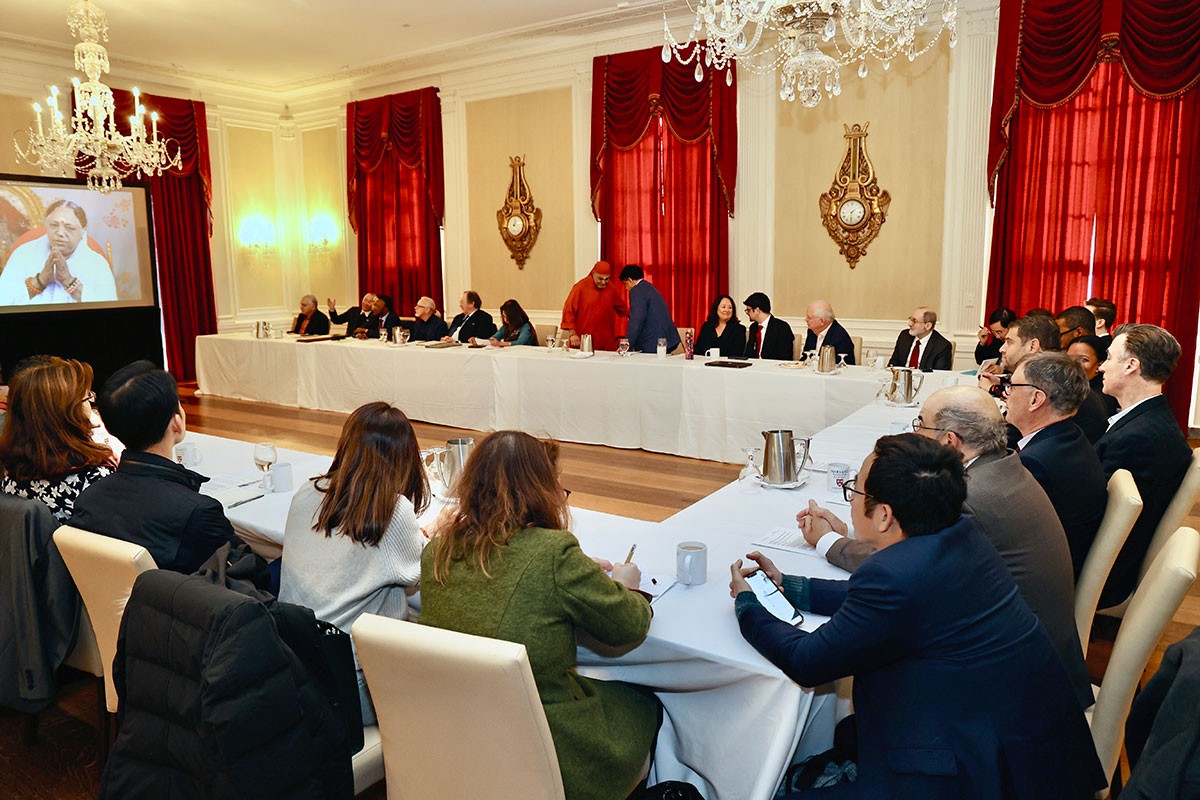
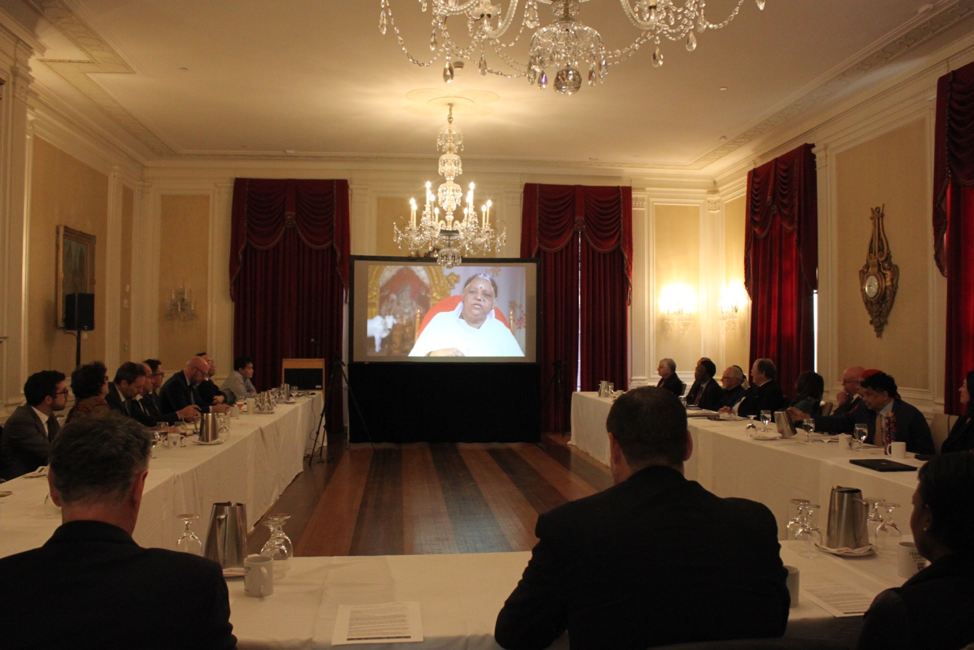
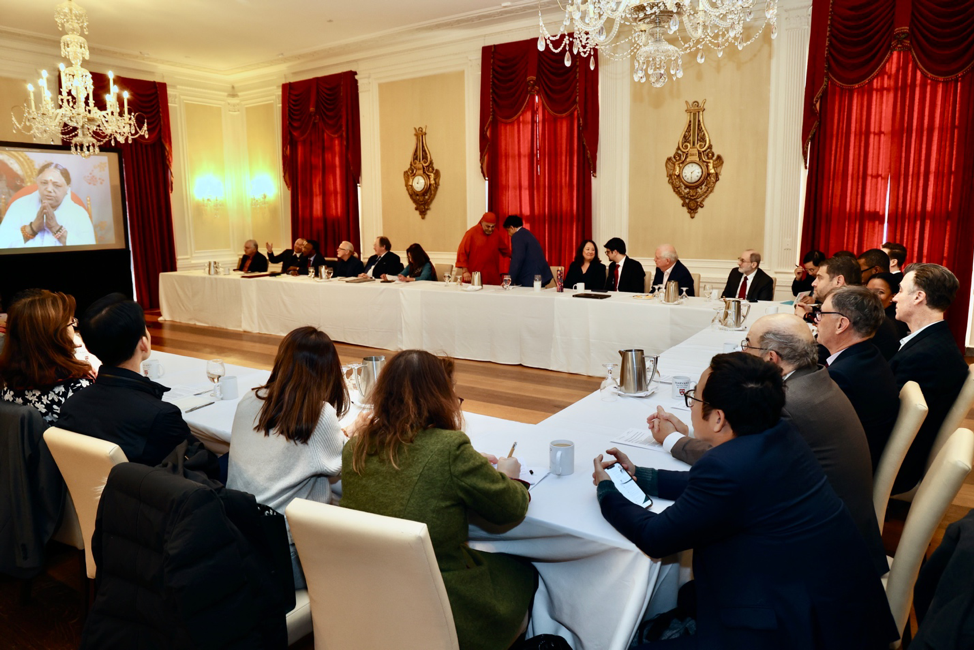
Ambassadors and academics watch a message from Amma on ethical AI
The partnership between BGF and Amma in developing the AI World Society (AIWS) is a significant highlight of these collaborative efforts. Amma’s renowned contributions of love, compassion, and her profound spiritual values play a pivotal role in shaping the AIWS’s approach. This partnership underscores the integration of humanistic values into technological development, advocating for an AI governance framework that prioritizes technical and ethical standards and also embodies the core human values of empathy and compassion.
This collaborative effort between BGF and spiritual leaders like Amma illustrates a unique fusion of technology and spirituality, offering a holistic approach to AI governance. It emphasizes the importance of nurturing the ‘soul’ of AI development, ensuring that technological advancements are aligned with the betterment of humanity and the nurturing of a compassionate global society.
However, the BGF’s focus is one of many perspectives in this global conversation. Diverse approaches from various countries and organizations highlight the multifaceted nature of AI governance. For instance, the European Union’s approach to AI regulation emphasizes stringent data privacy and user rights, contrasting with the BGF’s more principle-based framework. Including these varied viewpoints enriches the discussion, illustrating the complexity and global nature of AI governance.
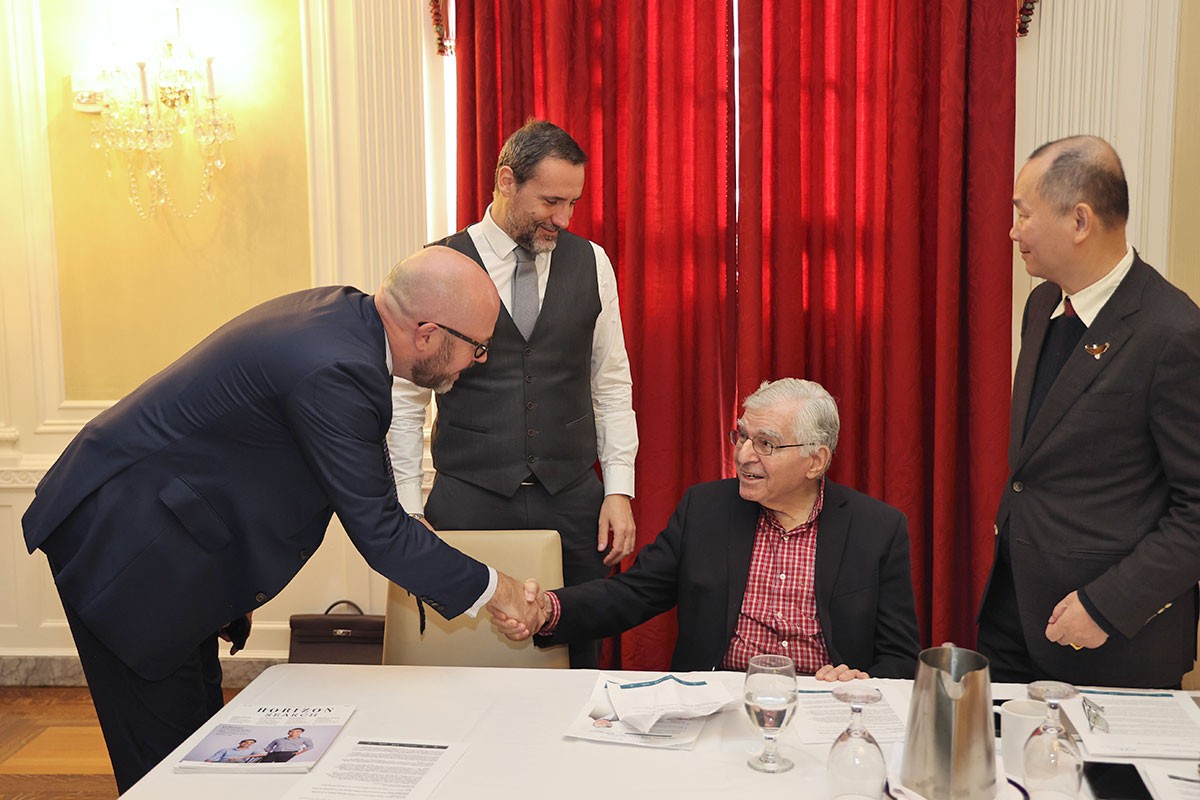
British Consul General of Boston, Peter Abbott OBE (L), shakes hands with former Governor of Massachusetts, Michael Dukakis (C), as CEO of Boston Global Forum, Tuan Nguyen (R), looks on
The BGF proposes an action plan rooted in values like benevolent alliance, cohesion, inclusion, collaboration, mutual trust, harmony, peace, security, excellence, and the protection of fundamental democratic freedoms and human rights. This approach underscores that managing AI is fundamentally about preserving the “soul” of humanity, not just addressing technological challenges.
In the short and long term, the BGF aims to reinforce alliances with major democracies, engage with international bodies like the United Nations and the Vatican, and collaborate with the private sector. This comprehensive approach highlights the necessity of ethical principles and robust regulatory frameworks to guide AI development, safeguarding human rights and preventing misuse by authoritarian regimes.
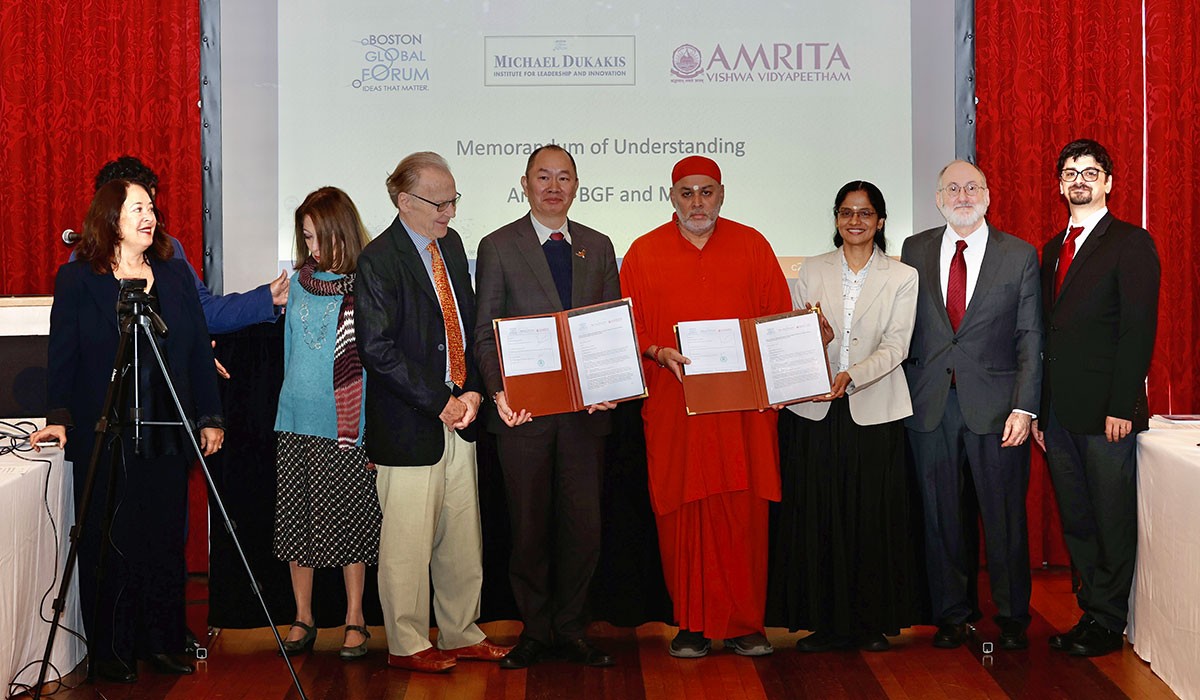
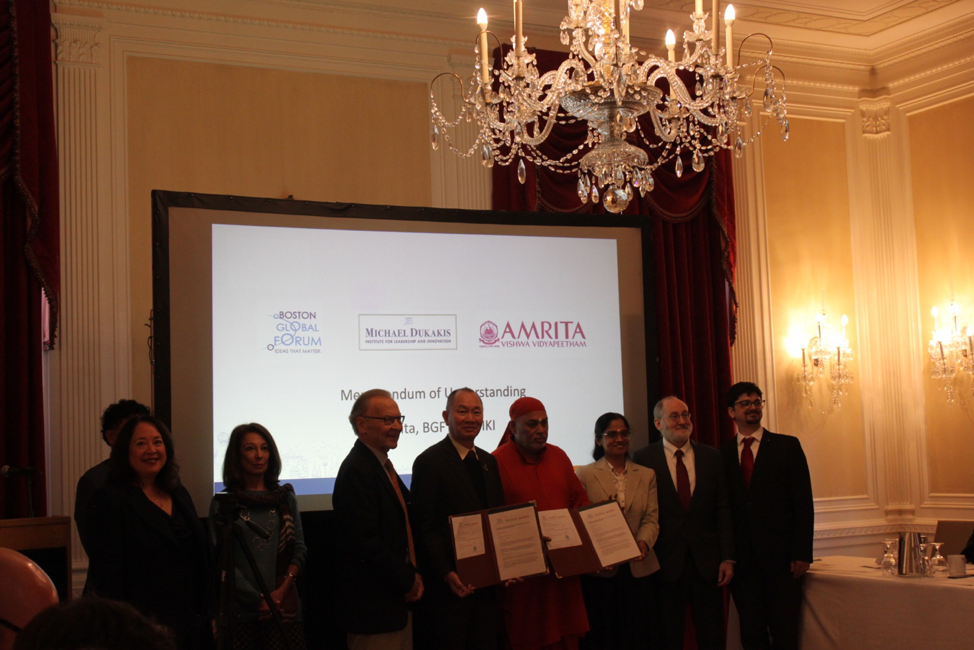
A Memorandum of Understanding between Boston Global Forum, Michael Dukakis Institute for Leadership and Innovation, and Amrita Vishwa Vidyapeetham
The collaboration of BGF with Amrita University in initiatives like the “World’s Congress of Religions in AI Responsibility” further illustrates the integration of spiritual values and ethical considerations in AI governance discourse. This event, alongside BGF’s initiatives and Amma’s contributions, marks a crucial point in aligning AI development with human-centric values and ethics, fostering global cooperation and ensuring AI’s positive contribution to society.
The Boston Global Forum’s initiatives, supported by global movements towards shared AI governance frameworks, are part of a growing consensus on the importance of ethically developing AI. This collaborative effort, bringing together diverse perspectives and stakeholders, is crucial in shaping a future where AI advances align with human dignity, freedom, and global well-being.
Join the Conversation: The Boston Global Forum invites you to be a part of this critical dialogue on AI ethics and governance. Share your insights, contribute to the development of global frameworks, and help shape a future where AI aligns with human dignity, freedom, and global well-being. Visit bostonglobalforum.org to learn more about our initiatives and participate in upcoming events. Your voice matters in building a compassionate, ethical AI future.
Boston Global Forum World’s Congress of Religions in AI Responsibility: Faith and Reason in the AI age
Nature: place and context for the experience of God through African traditional religion
Prof. Martin Nkafu Nkemnkia
(Pontifical Lateran University, Vatican City)
In order to individuate some responsibilities of Religious Leaders in AI age, coming from Africa, I would like to present African Traditional Religion as a contribution for the building of the platform for religious leaders, scholars, AI experts and policymakers to share insights and collaborate on ethical development and deployment.
In Africa, it is the entire community which is involve in cultural and religious life of the society, thus, each and everyone is, in a certain way, the leader of all that concerns, tradition, system of the transmission of the cultural, human, religious and therefore spiritual values to the future generations.
At this point, one can already affirm that: any educational system comprises both human and spiritual dimension. Science or scientific knowledge is just an extension of the original human knowledge without attributing any conscious meaning to the achievement reached fore, the Soul, which is the vital force of every living being is absent and shall always be absent in any AI performance. Thanks to Energy any AI performance obeys strictly the duty assigned to the
machine which now enables human beings to dedicate more time to noble and divine achievements which is guaranteed by the Raison which distinguish every human/conscious being from all other creatures in the World. This is in fact, what brings every human being to cultivate relationship with the Creator, loving the Divine and becoming similar to the Creature who is the Author of Life, the Immortal and Everlasting.
In Africa, religious believes and practices are integral part of culture and as such there is no separation between what is purely cultural and what can be expressed as religion, there is no dichotomy between sacred and profane. In this also consist the unity of the human person in Africa. There are non-sacred minds and profane ones but one brain, one I, one Man/Woman, humanity created by God.
Religion has always been the way through which entire communities relate themselves to the ultimate reality which is God the Creator. The African God is the God of the people and not of the individual. In a context as that of Africa, religiously rooted and a holistic sense of the Sacred and the worship of God, an intimate part of the daily life, there is an impossibility of atheism or indifferences in matter of faith and Religion.
At the difference of many other religions in the world, African Traditional Religion (ATR) has no founder nor written sacred texts and neither shall there be reformers. In Africa religion is lived and not proclaimed, it is not transmitted through treaties but through experiences of life. Through religion the community speaks with God, dialogues with God through the Ancestors. This favours interreligious dialogue and universalises the religious experience of different peoples in the world. Science is the procedure through which humans beings contribute to make of the world the best place to live in.
Martin Nkafu Nkemnkia was born in Cameroon. He holds Doctorate Degrees in Philosophy (PhD) and in Theology (D.Th). – respectively, from the Pontifical Lateran University (PUL), Rome. Currently, he has thought “History of African Philosophy; Culture and Religions in Africa” (Faculty of Philosophy) and has been for two mandates (for a total of 10 years 2011-2020) the Director of The International Research Area – Interdisciplinary Studies for the Development of African Culture of the Pontifical Lateran University – Vatican City. Has also been a lecturer at the Pontifical Gregorian University (PUG). A formal member of the Italian Committee on the Reduction of Foreign Debts of Poor Nations (instituted by the Italian Episcopal conference); He has been a formal Member of the National (Italian) Commission for Intercultural Education in the Italian Ministry of Education and Scientific Research. Actually is a Member of Interreligious Centre of the Focolare Movement in charge of Dialogue between Christianism and African Traditional Religion (RTA), Asian Popular Religion (RPA) and Indigenous Religions of Oceania and Central America (RIA). Actually is the President of the Scientific Committee of the CRA-SGI Centre for Relations with Africa of the Italian Geographical Society and is the President of the Nkemnkia Community Development Empowerment International Foundation – Africa/Europa.
Minh Nguyen is the Editor of the Boston Global Forum and a Shinzo Abe Initiative Fellow. She writes the Four Pillars column in the BGF Weekly newsletter.
In the war in Gaza, IDF ground operations continue with the goal of encircling Gaza City, and eventually attempting to flush out Hamas from the tunnel networks. IDF leaders still have stated that the war is likely to last months or even years.
For the US part, Secretary of State Antony Blinken has been traveling to the Middle East in an effort to shore up peacemaking efforts in the aftermath of the war, visiting Israel, Jordan, Palestine (West Bank), Turkey. He will also travel to Asia, namely South Korea and India, a Pillar, after the Middle East.
The US has also assessed that Iranian proxies in the region would not be likely to join in Hamas’ war, or open the second front. This can be seen with the ambivalent speech by Nasrallah, the leader of Hezbollah, on November 3. However, groups like the Houthis in Yemen had declared war, but it seems their effects are negligible. The US continues to explore potential peacekeeping operations and forces in the prospect of the war’s end.
In the Pacific, Japan, a Pillar, has signed a deal to give the Philippines coastal radar and begin negotiations on a security pact. This shows the deepening ties to counter China’s rise and bullying of states in the Asia-Pacific, especially in regards to the South China Sea.
Italy’s regrets with the Belt and Road Initiative continues, which was described as “broken promises.” Italy has notably said that it wanted to leave the BRI during the G20 conference earlier this year. The EU (and Italy in it) has been backing the Indian alternative to it instead, the India-Middle East-Europe Economic Corridor (IMEC). This may allow India, a Pillar, to increase ties with the EU, another Pillar, while reducing Chinese influence on the continent as well.
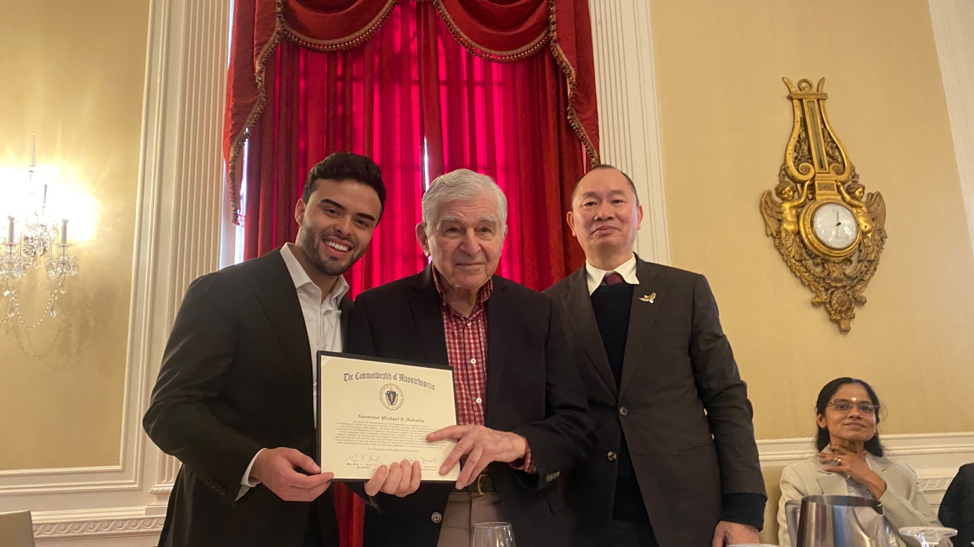
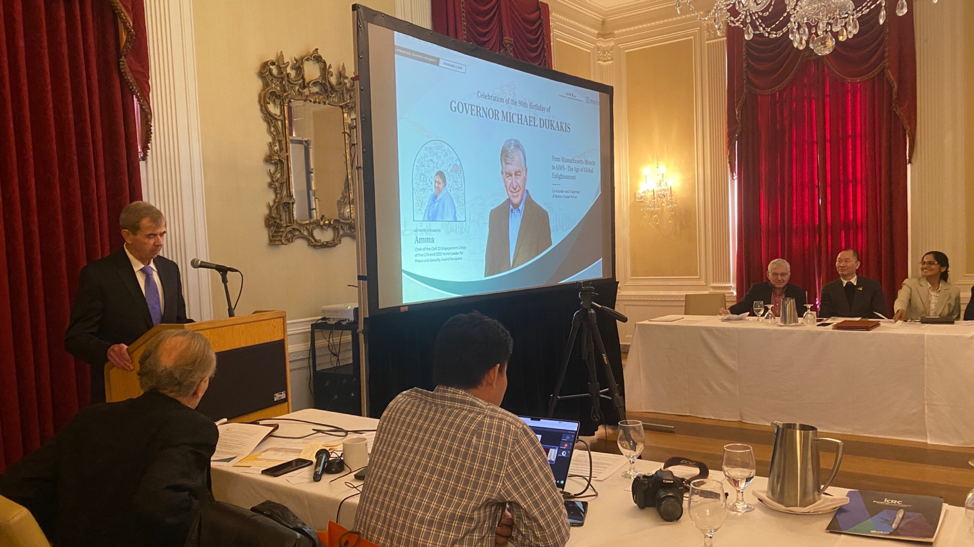
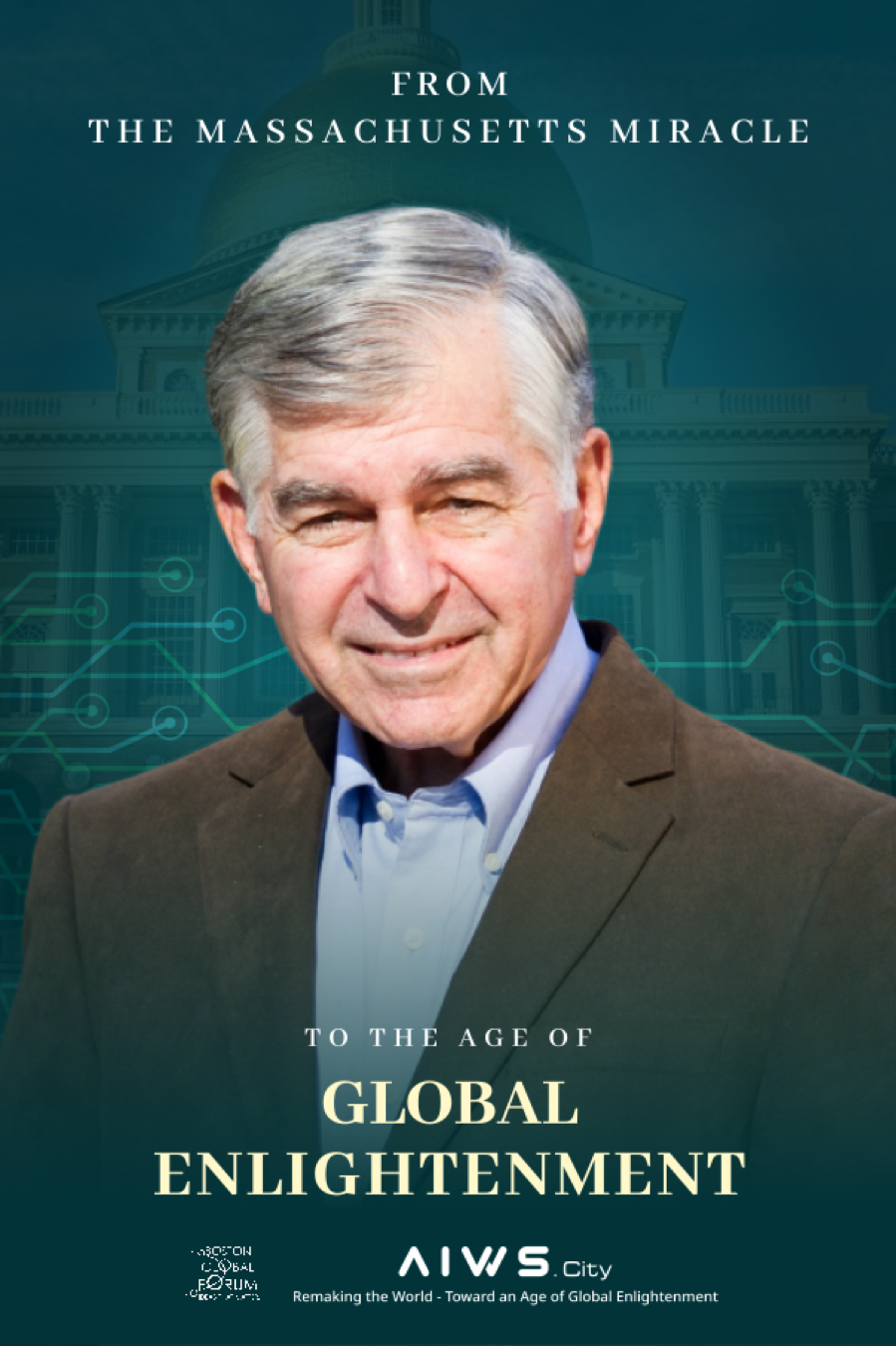
At Harvard University’s Loeb House on November 2, 2023, distinguished guests attended to celebrate the 90th birthday of former Massachusetts Governor Michael Dukakis. The event featured a series of momentous occasions, including the inauguration of AIWS City, the launch of the Liber Amicorum Book titled “Governor Michael Dukakis: From the Massachusetts Miracle to AIWS – the Age of Global Enlightenment,” and the delivery of a remarkable Distinguished Global Enlightenment Lecture by Amma, the recipient of the 2023 World Leader for Peace and Security Award.
The celebration was highlighted by prominent figures such as Governor Maura Healey, Senators Elizabeth Warren and Ed Markey, Secretary of the Commonwealth Bill Galvin, Japanese Minister Sanae Takaichi, and many other respected individuals. The occasion was marked with heartwarming remarks, citation, and speeches, paying tribute to Governor Dukakis’s incredible contributions to the state and the world.
Furthermore, the event served as a platform for the announcement of two pivotal initiatives. The first, in collaboration with the Active Inference Institute, seeks to “Advance Human-Centered AI through Integration with Natural Systems and Neuroscience: Toward Policy and Societal Well-Being.” This initiative aims to explore the intersection of AI, natural systems, and neuroscience to enhance the well-being of society through advanced policy-making.
The second initiative, in partnership with Amrita University in India, introduces the “World’s Congress of Religions in AI Responsibility: Faith and Reason in the AI age.” This program will focus on the role of faith, compassion and ethical responsibility in the age of AI, bringing together leaders, thinkers, and policymakers to explore the ethical development and deployment of artificial intelligence.
Additionally, an important Memorandum of Understanding (MOU) was announced between Boston Global Forum and Amrita University. This MOU signifies a collaborative effort to develop and deploy the AI World Society (AIWS) Initiative, further strengthening the commitment to advancing human-centered AI and the global enlightenment of society.
The event was not only a celebration of Governor Dukakis’s remarkable life but also a testament to the commitment of these leaders in driving forward initiatives that shape the future of AI, ethics, and global enlightenment.
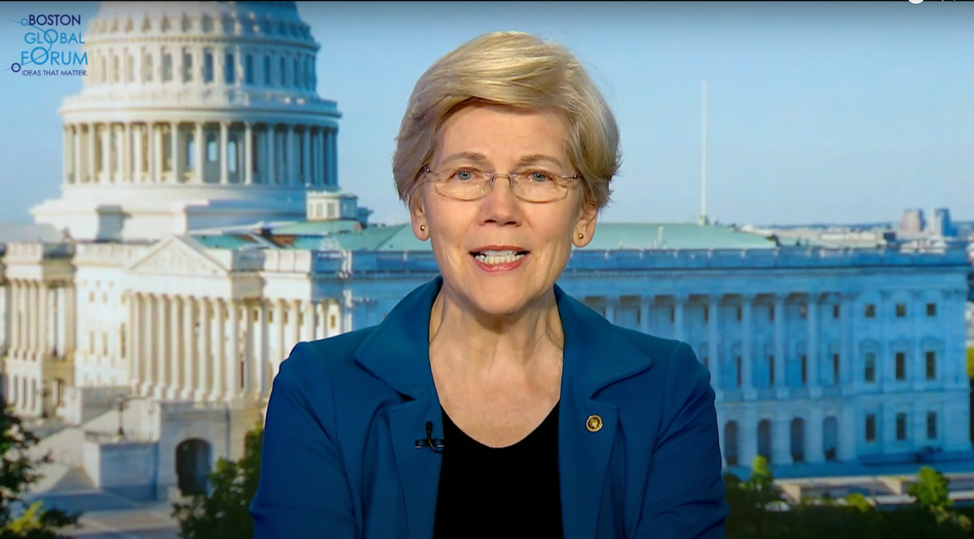
Governor Dukakis’s 90th Birthday Celebration: Remarks of Senator Elizabeth Warren
“Good evening, Boston Global Forum. I am so sorry that I can’t be there with you in person, but I would not miss the opportunity to congratulate our good friend Governor Michael Dukakis, and wish him a very happy 90th birthday.
You know, throughout his decades-long career, Governor Dukakis has shown that he is a committed public servant, a tireless leader, and a strong voice for Massachusetts families. When he was first elected as governor back in 1974, he faced some of our Commonwealth’s toughest battles – up against a record deficit and high unemployment. Governor Dukakis took on these challenges with passion and persistence, and his leadership made a key difference in the lives of hundreds of thousands, millions of people across Massachusetts.
After retiring from politics, Michael brought that same passion and expertise to the classroom, teaching at UCLA, the University of Hawaii, and at our own Northeastern University. Now, when I first decided to run for the United States Senate back in 2012, Michael sat down with me and he told me the right way to run a campaign. He said, ‘Run a grassroots campaign, grounded in people, based in the neighborhoods, in the cities, in the towns all across our state.’ I listened. In fact, that is exactly what I did. I have been lucky enough to count on Michael’s support since that very first campaign, and it’s made a world of difference.
So, let me say this personally, Michael, thank you again for the work you do day in and day out to benefit families all across Massachusetts and all around the world. Congratulations on this tremendous honor, and I hope you have a very happy 90th birthday.”
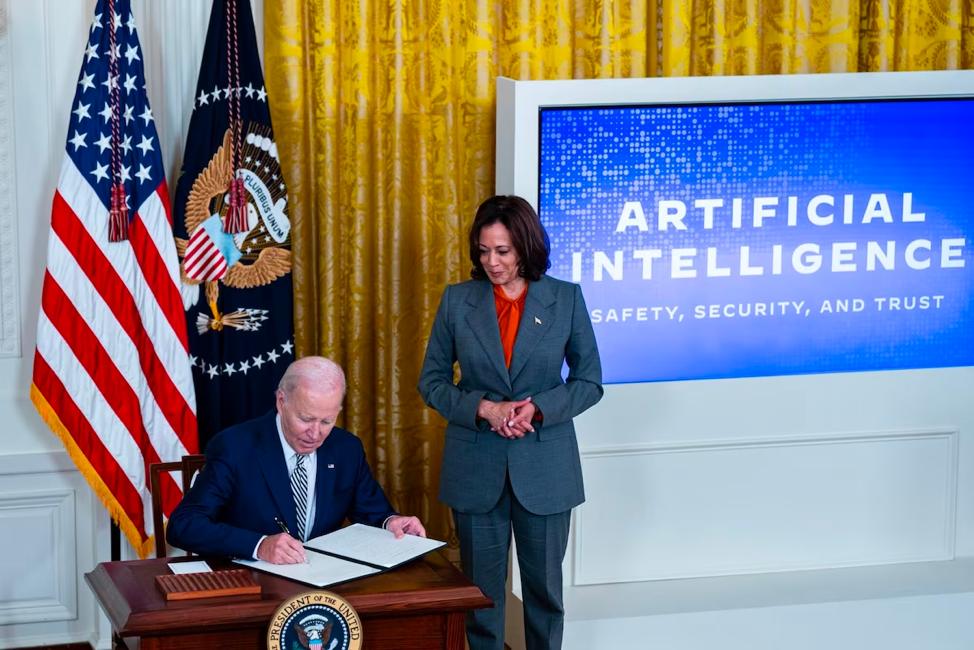
The executive order directs the Department of Commerce to develop guidance for labeling AI-generated content. Federal agencies will be required to use AI watermarking – technology that marks content as AI-generated to reduce fraud and misinformation – though it’s not required for the private sector.
The executive order also recognizes that AI systems can pose unacceptable risks of harm to civil and human rights and the well-being of individuals: “Artificial Intelligence systems deployed irresponsibly have reproduced and intensified existing inequities, caused new types of harmful discrimination, and exacerbated online and physical harms.”
What the executive order doesn’t do
A key challenge for AI regulation is the absence of comprehensive federal data protection and privacy legislation. The executive order only calls on Congress to adopt privacy legislation, but it does not provide a legislative framework. It remains to be seen how the courts will interpret the executive order’s directives in light of existing consumer privacy and data rights statutes.
Without strong data privacy laws in the U.S. as other countries have, the executive order could have minimal effect on getting AI companies to boost data privacy. In general, it’s difficult to measure the impact that decision-making AI systems have on data privacy and freedoms.
It’s also worth noting that algorithmic transparency is not a panacea. For example, the European Union’s General Data Protection Regulation legislation mandates “meaningful information about the logic involved” in automated decisions. This suggests a right to an explanation of the criteria that algorithms use in their decision-making. The mandate treats the process of algorithmic decision-making as something akin to a recipe book, meaning it assumes that if people understand how algorithmic decision-making works, they can understand how the system affects them. But knowing how an AI system works doesn’t necessarily tell you why it made a particular decision.
With algorithmic decision-making becoming pervasive, the White House executive order and the international summit on AI safety highlight that lawmakers are beginning to understand the importance of AI regulation, even if comprehensive legislation is lacking.
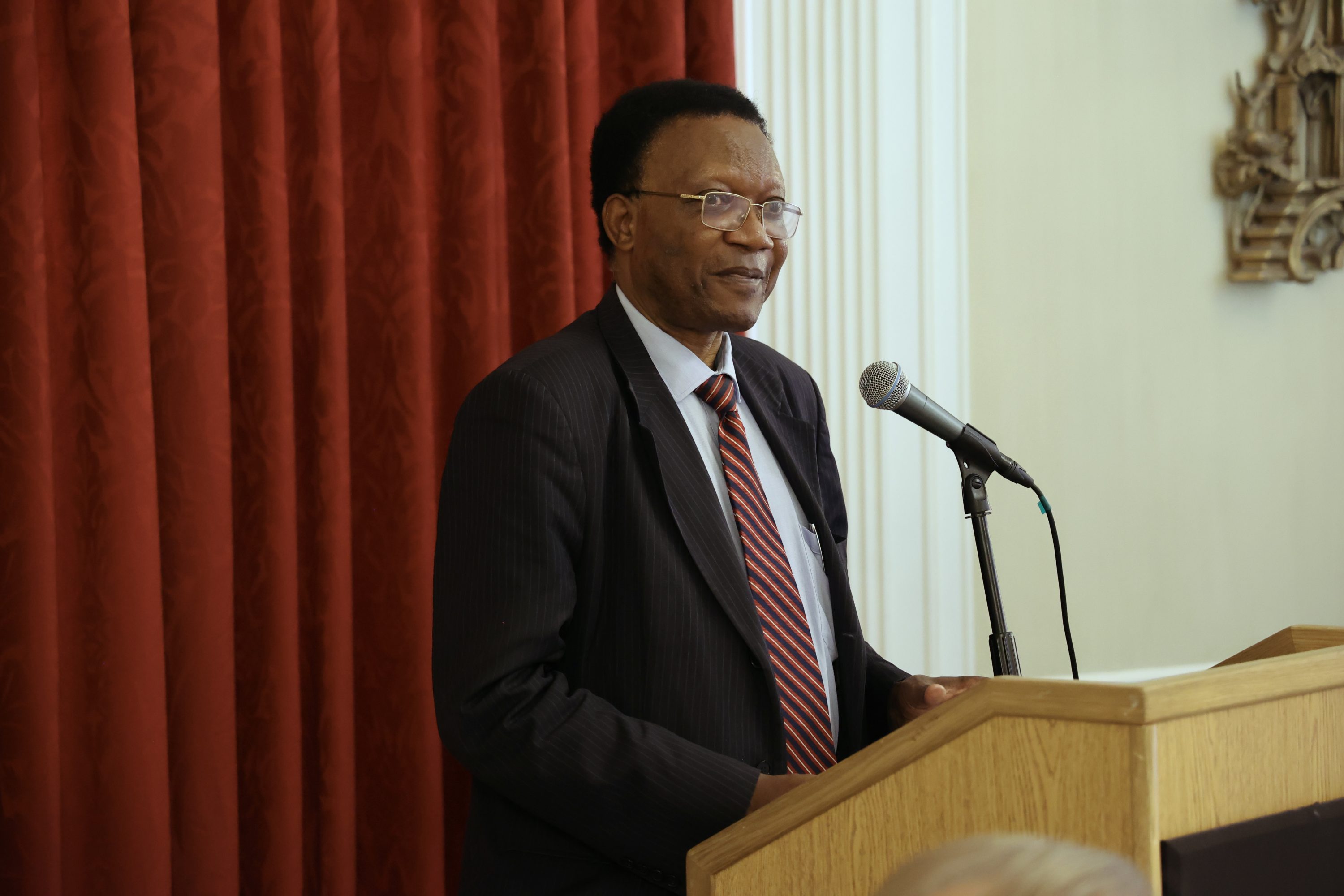
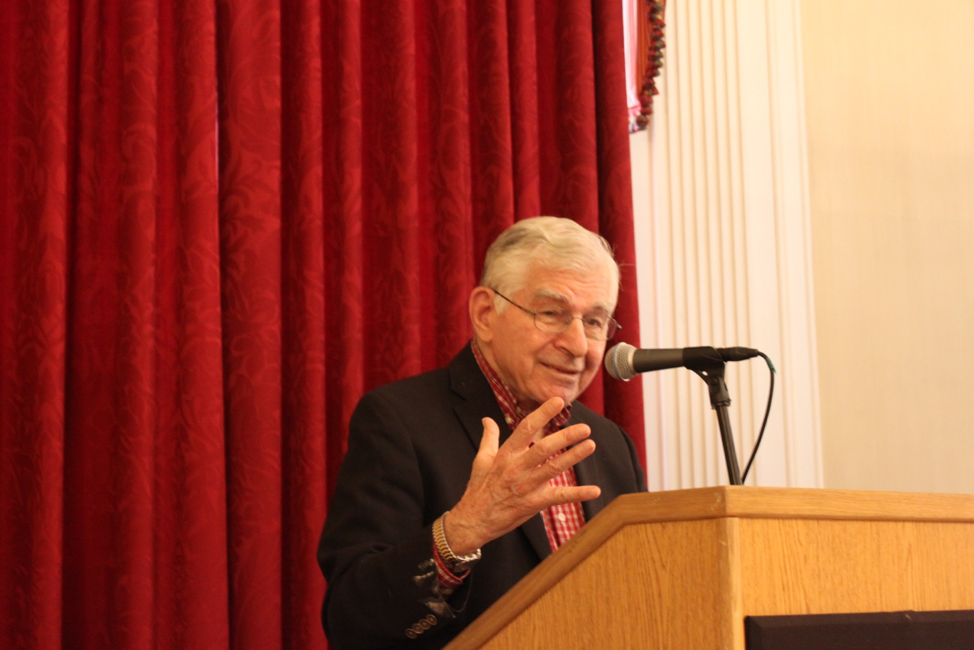
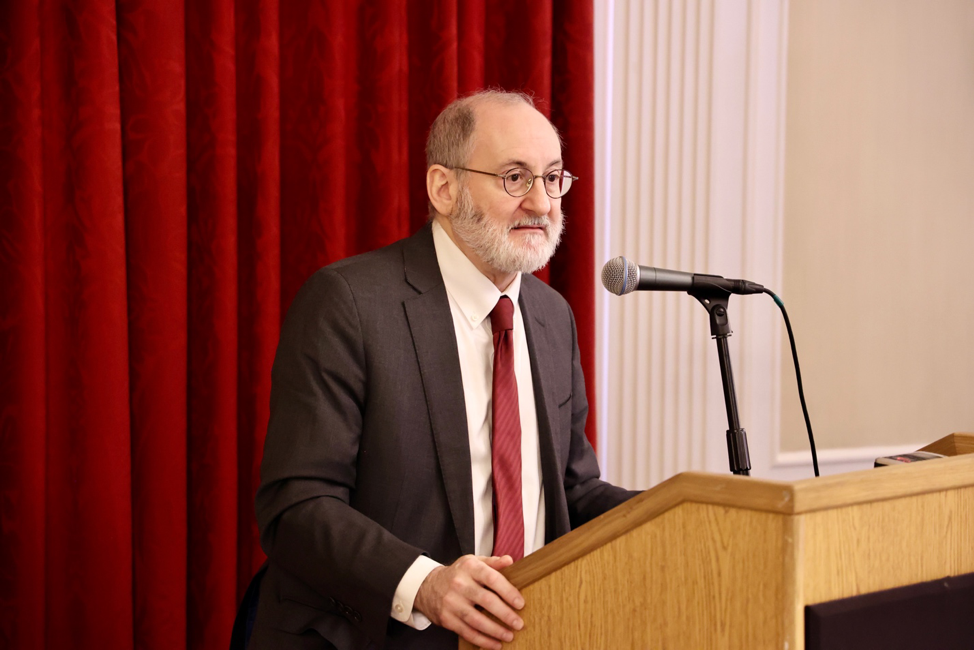
During Governor Dukakis’s 90th Birthday Celebration held on November 2, 2023, at Harvard University Loeb House, Governor Dukakis delivered remarks on World Peace and Security:
“Dear honored guests,
Thank you for gathering today to commemorate my 90th birthday and discuss issues of global importance.
We have a responsibility to ensure the well-being of our world and the generations that will follow us. If there is a single theme that defines the challenge, it is the persistent need for peace and security. The world is in turmoil – a state of affairs that cannot be allowed to persist.
A pressing issue is the conflict in Ukraine. We must advocate for peace and call for Russia’s withdrawal from Ukrainian territory. We have a moral obligation to demand adherence to every nation’s right to sovereignty and self-determination – it’s the foundation of the international order.
The situation in Gaza likewise calls for a fair resolution to the conflict, one where peace and justice prevail for all people in the region and where dialogue and cooperation replace threats and violence as the instruments of policy.
For too long, many nations have suffered from prolonged conflict and instability. It is past time to invest in people’s education and disinvest in the weapons of war. Education alone is not sufficient but, without it, people of every nation, background, and faith will not have the secure lives they so justly deserve.
In closing, I want to say that the Boston Global Forum has no higher purpose than to do what it can to foster a world where the aspiration for peace becomes a global reality.
Thank you again for helping me celebrate my 90th and for all that you do, and have yet to do, to enhance international peace and security.”
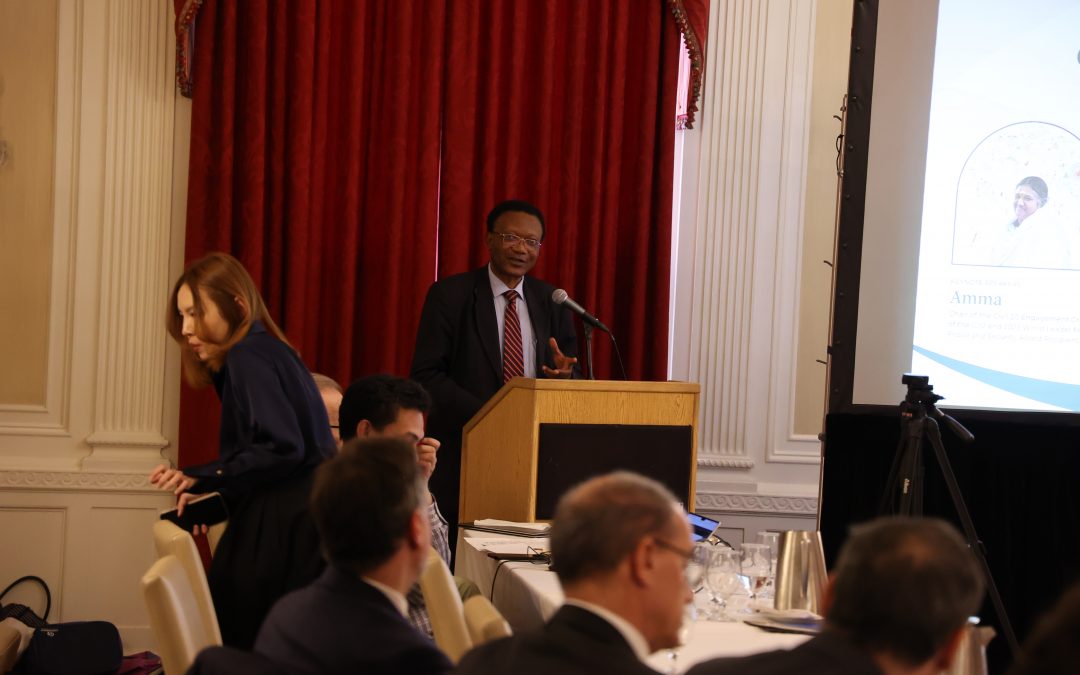
Governor Michael Dukakis delivering his remarks at the event
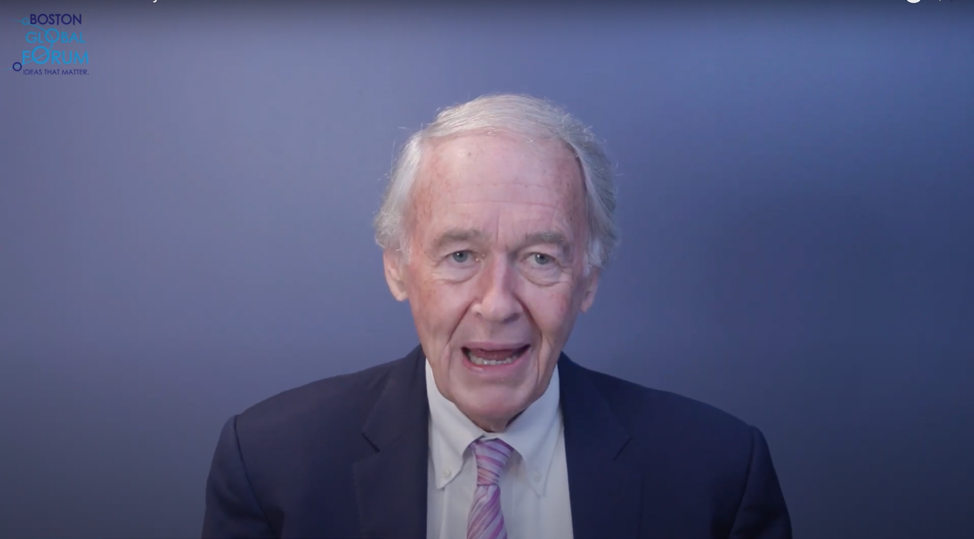
During Governor Dukakis’s 90th Birthday Celebration held on November 2, 2023, at Harvard University Loeb House, Senator Ed Markey delivered his remarks through video:
“Good evening, everyone. What a tremendous honor it is to be celebrating the birthday of the man, the legend, my friend Michael Dukakis. And to Kitty, the indomitable Kitty, we know Mike would not be Mike without you, Kitty.
When Michael Dukakis became governor in 1974, we had been waiting for him. He was our generation’s leader, our conscience. He wasn’t just a thinker; he was a doer. As a state representative in 1974, I saw firsthand what he has done for Massachusetts and the entire country. It’s immeasurable because you can’t spell ‘Dukakis’ without ‘do.’ And he is still a doer, through the Dukakis Center, his work increasing access to transportation options and his tenacity in making the north-south Rail Link a reality for the region. We’ll get it done, Michael.
He’s a model for the transportation systems he advocates for. He doesn’t slow down. I know this firsthand from all of the work I’ve done with Mike and Kitty over the years.
During my 2013 Senate race, we had a moment in Lowell where Kitty and Michael were speaking to Cambodians through a translator. He talked about the need for democracy, and access to opportunity for everyone, especially immigrants. He told the story of how his own father immigrated to Lowell from Greece to become a doctor. He was able to raise a child who could become governor of Massachusetts and have a child who could be running for the presidency of the United States. The Cambodian people in that room were all nodding their heads, hoping that the American dream could be part of their family’s history as well.
And here’s what I know from that interaction: the Greeks may have invented democracy, but Mike Dukakis invented grassroots politics in Massachusetts. There’s an ancient Greek term called Agape, which means giving yourself the ability to respond to human suffering. That’s what Michael Dukakis has done every day of his career and his life. He has given immeasurably to the cities and towns of Massachusetts, to the people of Massachusetts and our country, and to our very democracy. He reminds us that the potential of our state, our nation, and our democracy rests on our ability to harness the potential of our people. And that is a commitment that Michael Dukakis has delivered on every day of his 90 years.
In many ways, everyone here knows one thing: that Michael Dukakis just may be the organizing principle of all of our lives. That’s how powerful of an influence he’s had upon all of us and upon this world that we live in.
So, happy birthday, Michael. Have a wonderful time; you deserve it. But I know one thing, you’re all not slowing down, and you never will.”

![[Horizon Search] Celebrating a Milestone in AI Governance: Michael Dukakis’s 90th and Amma’s World Peace and Security Award](https://bostonglobalforum.org/wp-content/uploads/1699678453537-1080x572.jpg)