Ukraine managed to wrangle some more favorable terms out of the United States before signing the long-awaited minerals deal on Wednesday.
The agreement on natural resources was finally struck late on Wednesday, after weeks of tense bargaining that at times turned sour and temporarily halted Washington’s aid to Ukraine.
Kyiv eventually convinced US President Donald Trump to drop some of his key demands but failed to make American security guarantees part of the agreement.
Ukrainian officials touted the final accord as an equal partnership between Kyiv and Washington – a notable shift from some of the earlier drafts which were described by Ukraine’s leader President Volodymyr Zelensky as the US asking him to “sell my country.”
The signed deal, seen by CNN, does indeed appear to be more favorable to Ukraine than some of the previous versions. Here’s what we know.
Aid: Crucially, the deal does not call for Kyiv to reimburse the US for the aid it has already received – a key concession from Trump who has long framed the agreement as Ukraine “paying back” the US.
Natural resources: The deal gives the US preferential rights to mineral extraction in Ukraine and states that Kyiv will have the final say in what and where is being mined. Ukraine will also retain the ownership of the subsoil.
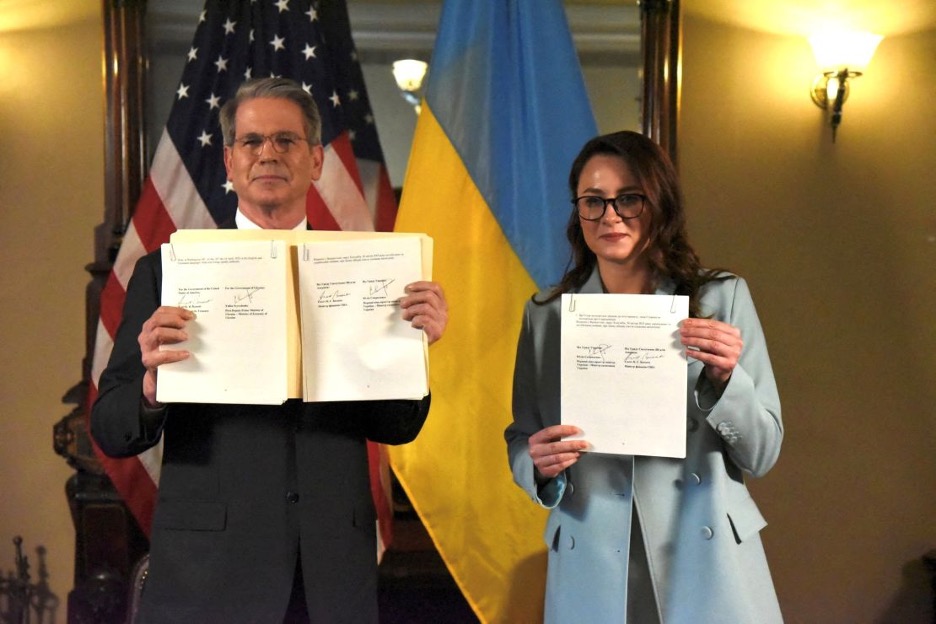
US Treasury Secretary Scott Bessent and Ukrainian First Deputy Prime Minister Yulia Svyrydenko pose after signing the minerals deal in Washington on April 30, 2025.
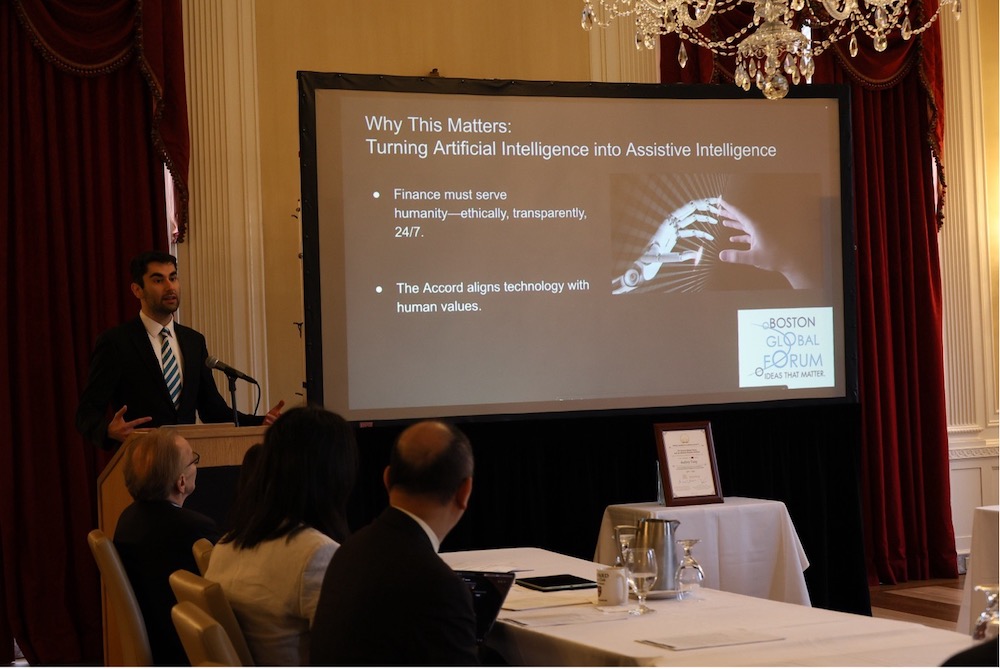
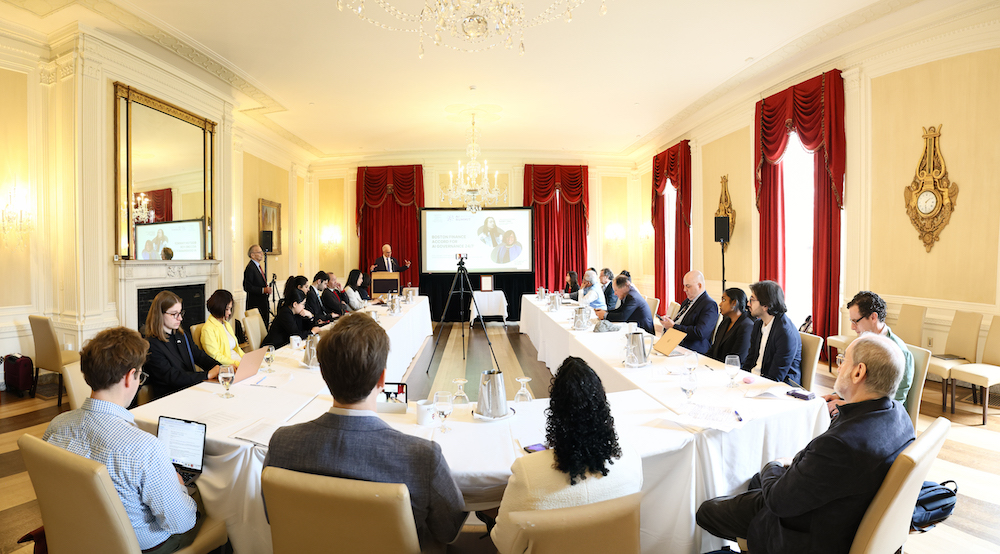
At the Boston Global Forum (BGF) Conference on April 22, 2025, Cameron Sabet, a member of the Enlightenment in Action Alliance (EAA), delivered a compelling address introducing the Boston Finance Accord for AI Governance 24/7, a groundbreaking framework aimed at embedding trust, ethics, and human values into AI-driven finance.
Sabet began by emphasizing the urgency of the moment, noting that AI’s rapid integration into global finance has created a critical trust gap. With algorithms moving money faster than regulations and eroding public confidence, he argued that finance requires not future promises, but continuous, transparent, and ethical governance—24/7.
The Boston Finance Accord, he explained, is designed as a practical solution to this challenge. Rooted in AI World Society (AIWS) principles and strengthened by international collaboration, the Accord offers a citizen-centered framework for ethical AI finance. Key innovations include:
Trust Score and Peace Finance Index: Tools to measure transparency, fairness, and social impact.
AIWS Citizen Forum: Enabling public participation through AI-assisted deliberation.
Boston Ethics Finance Protocol (BEFP): Establishing global standards for AI auditing and eliminating spaces for unethical practices.
Sabet highlighted the global nature of the initiative, noting its ties to the Tokyo Accord and its alignment with G7, G20, and Indo-Pacific nations’ efforts. Pilot programs are already underway, signaling tangible progress.
He concluded with a call to action, inviting governments, financial institutions, and global stakeholders to engage with the Accord, participate in its forums, and help shape a future where AI in finance enhances human dignity, trust, and inclusion.
“Finance must be a force that protects communities and fosters integrity around the clock,” Sabet affirmed. “Now is the time for leadership and global collaboration.”
This year will be a big one for quantum computing, at least according to the United Nations: 2025 is officially the “International Year of Quantum Science and Technology,” a worldwide initiative to raise awareness of technological progress and encourage new advances.
It also coincides with the 100th anniversary of the birth of modern quantum mechanics, which has given us everything from lasers to rare-earth magnetics, the internet to global navigation. The modern world would look very different without quantum science.
But we’ve only scratched the surface of what’s possible. Although the technology is still nascent in many forms, quantum computing could change life as we know it.
Quantum technologies could transform medicine and artificial intelligence, and have the potential to be used for applications ranging from financial modeling to cryptography, designing new materials for superconductors and better batteries, and accelerating machine learning.
Unlike classical computers, which use binary digits (or bits), representing information as either 0 or 1, quantum computers use quantum bits, or qubits, which can exist as both zeroes and ones at once. This means it can solve complex problems at an exponentially faster rate.
Think of it like a mouse trying to find its way through a maze. With classical computers, the metaphorical mouse has to try each and every path, eliminating every possibility until it finds the correct one and the eventual way out.
Non-Resident Senior Fellow, Global Development Policy Centre, Boston University, USA; Distinguished Visiting Professor, NALSAR University of Law, Hyderabad, India
Boston Global Forum Conference on the Boston Finance Accord for AI Governance 24/7
Loeb House, Harvard University, April 22, 2025
Governor Michael Dukakis, Co-Founder and Co-Chair, Boston Global Forum (BGF),
Professor Thomas Patterson, Co-Founder, BGF
Mr. Nguyen Anh Tuan, Co-Founder, CEO and Co-Chair, BGF
Ladies and Gentlemen,
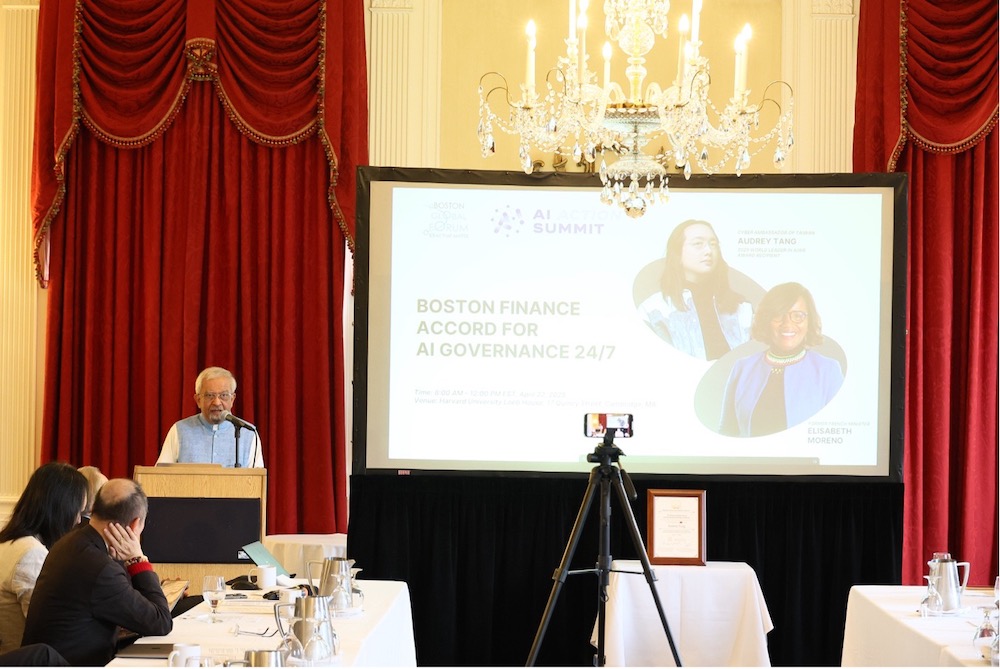
Thank you for this invitation to speak. It is an honour for me to be back at Harvard and to speak at this historic venue, Loeb House. I have a longer paper but given the time constraints, I am making an abbreviated presentation.
While India ranks in the global top five on Stanford University’s AI Vibrancy Index experts agree that India is many years behind the two global leaders, China and the USA.
The Government announced its India AI Mission in March 2024 with an outlay about USD 1.2 billion. USD 232 million or nearly 25% of the entire India AI Mission budget has been approved for spending as part of the most recent Union Budget 2025-26.
Government 24/7 in India
The AI India Mission is an early step in India’s AI journey. While some early steps have been taken, AI 24/7 Government is still aspirational in India.
Some key prerequisites for AI powered Government 24/7 nevertheless exist in India and give cause for hope both for the country itself and for its potential Global South leadership in this area. These prerequisites include India’s world class and now well established and recognized Digital Public Infrastructure (DPI), prominent among which are the UPI, a real-time payment system, and the Aadhaar, a national biometric identity system. DPI is an open, interoperable digital system for identity, payments, and data which inherently promotes transparency and inclusivity. By placing essential services on digital platforms, these are made accessible to all. As a result, DPI enables service delivery in a “transparent and accountable manner”.
Moreover, in an aggregate sense, the scale in India is huge, by any global standard. India’s Aadhar covers 1.3 billion people. India has also used DPI in several areas. Its UPI payment system is an acknowledged global leader in ease of use, transaction value (approximately USD 239 billion, in August 2024, a 31% increase over the previous year) and volume (14.96 billion in August 2024, a 41% year-on-year increase). The average daily transaction volume was 483 million and average daily transaction value was USD 7.7 billion.
This Boston Global Forum Conference has prioritized, among others, transparency and accountability, scalability, inclusivity and financial innovation, including the use of real time financial systems for AI Government 24/7. Allow me to highlight the current state of play in India in these critical areas
Transparency and Accountability
24/7 government has markedly improved transparency and accountability in some areas. Good Indian examples include Direct Benefit Transfers (DBTs), real-time dashboards, and faceless services that minimize corruption and increase traceability. In India, services like Aadhaar, UPI, and DigiLocker also provide audit trails that ensure accountability.
Dis-intermediated technology for AI Government 24/7
Dis-intermediated technology helps increase fairness, trust, efficiency and equity, in addition to reducing rent-seeking behaviour, leakages and corruption by eliminating middlemen. It does this by offering direct, online, faceless, 24/7 government services to the public. Prominent, tested examples in India include DBT, tax filings, passport services and online transport services in Delhi.
By digitizing payments, India is estimated to have saved over USD 27 billion in several schemes due to the removal of duplicate or fake beneficiaries and bribery opportunities
Skilling and Re-skilling
Key skilling areas include digital literacy for citizens, re-skilling government employees for e-governance and AI, cloud and cybersecurity training.
Significant skilling and capacity gaps continue to exist. A particular high-risk area in India for both government and citizens is from cyber-attackers because of the inadequacy of effective cybersecurity which becomes more and more crucial as services leverage authenticated identity.
Scaling DPI with AI
AI can enhance and scale-up DPI with tools like chatbots, personalized services, automated back-end workflows and predictive analytics. Such integration makes AI Government 24/7 proactive, inclusive and accessible round the clock. India has several examples, notable among which was CoWIN which made vaccinations easy to track nationally during COVID-19.
Driving the AI 24/7 Governance Agenda: Key Institutions
Successfully achieving uniform digital platforms across the country requires a strong but genuinely democratic and accountable central government, and often, in countries like India and many others in the Global South, the leadership of the Prime Minister’s Office. A dedicated task force for AI 24/7 services should be created to coordinate inter-ministerial and centre-state implementation. Judicial and legislative support will also be necessary for policy and legal frameworks.
Effective Data Utilization
India’s corporate private sector, especially banking and other services sectors, are using AI effectively to study and use large data pools (credit scores, human resources applications). A lot more needs to be done by government, however. Data on cybercrime and cyber breaches need to be addressed as a matter of priority.
Urban and Rural Infrastructure Readiness and Financing
This is a critical area for all countries, especially in the Global South. India’s aggressive investment in rural connectivity— 95% villages covered— and it having amongst the cheapest mobile data rates globally stand out.
Public-private Partnership (PPP) financing will need to include government funding to ensure universal access, and private investment to innovate and maintain advanced services.
Some Overall Challenges for AI Government 24/7 in India
Effective AI Government 24/7 and governance requires a level of standardization. This is a unique challenge in a country like India given its diversity, breadth and complex centre-state relations.
The equity, inclusiveness and citizen empowerment aspects of AI Government 24/7 in the genuine public interest need enhancement and a much bigger, strategic push beyond tax filing and passports. Education and health pose a specific challenge because of centre-state relation complexities.
User interface remains a major problem affecting migrant populations (estimated at over a quarter of India’s 1.4 billion population). While digitization and AI can help, they cannot fill in for missing services or investment.
A cautionary note is also in order from a good governance and human rights perspective. AI Government 24/7 can be a double-edged sword since it gives the central government enormous power, control and oversight over citizen data and activities.
India’s Potential Niche in the Global South
Despite some limitations, most experts will, no doubt, agree that India has demonstrated adequate scale, credibility and potential in the digital area for it to play a leadership role on AI Government 24/7 in the Global South. This was a main reason for why Indian Prime Minister Modi was asked to Co-Chair the recent February 2025 Paris AI Action Summit (AIAS) with President Macron.
India also showcased its DPI during the country’s 2023 G20 Presidency where it secured support for a “One Future Alliance”, a proposed mechanism for G20 members and institutions to pool funds to sponsor DPI deployments in developing countries of the Global South.
India has advocated for “digital sovereignty” and “tech neutrality” at the United Nations and has expressed serious concern about its strategic autonomy being violated by dependence on foreign services and platforms that could be subject to sovereign action e.g. US sanctions that cut off payment services (SWIFT, Visa, Mastercard, Amex) to Russia after its illegal invasion of Ukraine. As a result of these concerns, India has advocated for a federated, open-source model in global forums. These include its Modular Open-Source Identity Platform (MOSIP).
Open standards, data localization, national clouds, and initiatives like India’s MOSIP offer countries modular and open-source technology to build and own their national identity systems to maintain their autonomy. Universal coverage, accessibility and inclusion are key principles. To-date, 26 countries across the Asia-Pacific, Africa, Latin America and the Caribbean have registered on it.
Strategic autonomy in this area is obviously a special concern for an AI digitally powered 24/7 government, making sovereign control of digital platforms and data a high priority for governments. A major legitimate concern many Global South countries have is that India could switch them off just like what happened with the US on SWIFT for Russia. ‘Sovereign clouds’ are one suggested solution by Big Tech.
Financing AI Government 24/7 in the Global South
Financing can come from national budgets, multilateral agencies, PPPs and philanthropy. India’s role could include sharing expertise through its India Stack diplomacy, providing grants and other forms of aid and advocating global funds for DPI. India’s partnerships with Nepal, Bhutan, Singapore, and numerous countries in Africa show the value of a growing digital soft power strategy.
South-South Cooperation bonds, PPPs for telecon infrastructure, big tech digital inclusion (e.g. Microsoft’s Africa’s broadband) and crowdfunding are all needed to structure partnerships to guarantee public affordability and open access.
The bigger finance question for AI Government 24/7 is the same as the finance question for e-governance. All governments need to budget for technology, digitalization and cybersecurity. Multilateral and development agencies can play a role in financing these for Global South countries struggling to do so themselves, especially to influence quicker adoption, in the same manner that the UN and multilateral development banks (MDBs) are supporting or financing renewable energy (RE) and green power projects in many developing countries.
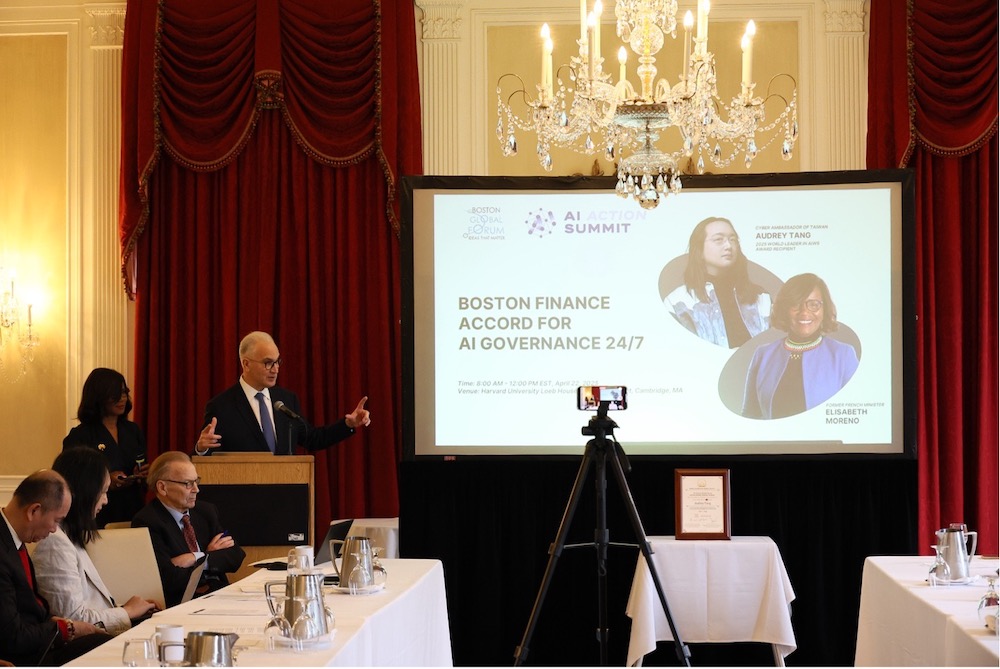
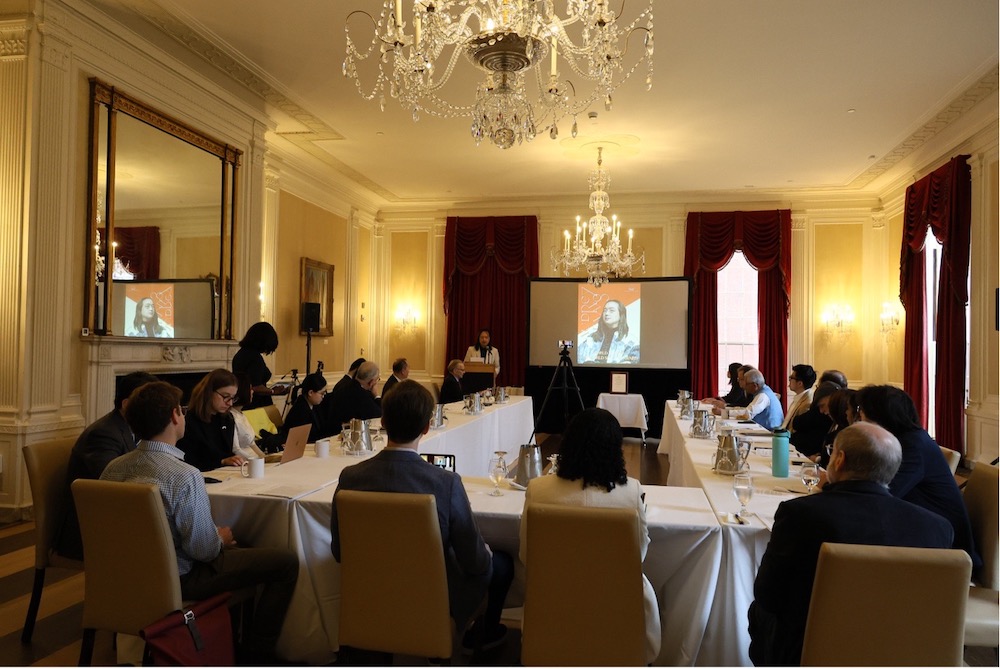
On April 22, 2025, at Harvard University’s historic Loeb House, the Boston Global Forum presented the World Leader in AI World Society (AIWS) Award to Taiwan’s Cyber Ambassador, Audrey Tang.
Governor Michael Dukakis, in his remarks, praised Audrey as “an extraordinary individual whose vision, courage, and brilliance have reshaped the landscape of governance and freedom in the AI Age.” From child prodigy to cabinet minister, from civic tech pioneer to international thought leader, Audrey has redefined what it means to lead in the age of artificial intelligence.
Audrey’s acceptance speech was a moving call to action for a future built on transparency, prosocial participation, and “plurality over polarization.” Reflecting on Taiwan’s digital democracy successes—from the g0v movement and vTaiwan platform to real-time citizen engagement—Audrey reminded us that technology must amplify collective wisdom, not divide it. As she put it: “Sunlight is an immunization against manipulation.”
She closed with a poem—a vision of the future where machines enhance, rather than replace, human values:
“When we see ‘internet of things,’ let’s make it an internet of beings… When we hear ‘the singularity is near,’ let us remember: the Plurality is here.”
Audrey’s work is not just technical leadership—it is moral leadership. As the global community navigates the challenges of AI governance, Audrey’s example lights the way forward.
Audrey Tang receives the 2025 World Leader in AIWS Award at Harvard’s Loeb House. Featuring remarks from Governor Dukakis and Audrey’s visionary acceptance speech on democracy, technology, and trust:
Audrey Tang receives the 2025 World Leader in AIWS Award from Tuan Nguyen, CEO of the Boston Global Forum, during a landmark ceremony at Harvard’s Loeb House.
Remarks by Governor Michael Dukakis Honoring Audrey Tang
Boston Global Forum Conference
Boston Finance Accord for AI Governance 24/7
Harvard University Loeb House, 17 Quincy Street, Cambridge, MA
April 22, 2025
Ladies and gentlemen, it is my profound privilege to honor an extraordinary individual whose vision, courage, and brilliance have reshaped the landscape of governance and freedom in the AI Age—Audrey Tang, Taiwan’s Cyber Ambassador, the world’s first nonbinary cabinet official, and the Boston Global Forum’s 2025 World Leader in AIWS Award recipient.
Audrey, your journey is nothing short of inspiring. A child prodigy mastering mathematics at six and programming by eight, you were a Silicon Valley innovator by nineteen. Yet, it is your fusion of technical genius with a deep commitment to pluralism and democracy—nurtured in a pro-democracy family—that truly sets you apart. You saw the internet not just as code, but as a bridge to unite people through shared dreams, a vision you’ve carried from Taiwan to the world.
Your impact is transformative. Through Taiwan’s g0v civic tech community, you pioneered platforms like Join.gov.tw, empowering citizens to shape policies—from tax software to cancer treatment reforms—with unprecedented transparency. During the 2014 Sunflower Movement, your livestreaming of a controversial trade pact turned deliberation into a public act of courage, cementing Taiwan as Asia’s beacon of freedom. In the face of COVID-19, your ingenuity—think mask maps and fact-checking tools—showed the world how technology can serve humanity with clarity and compassion.
As a “conservative anarchist,” you’ve redefined governance, blending radical openness with practical wisdom. Your leadership in Taiwan’s Ministry of Digital Affairs and now as Cyber Ambassador has made collective decision-making a reality, inspiring the AI World Society’s vision of Government 24/7. Just last month, at the 4th Shinzo Abe Conference in Tokyo, your insights enriched our Boston Finance Accord—a testament to your global influence, recognized by TIME Magazine’s 2023 Top 100 AI Influential People and today’s AIWS Award.
Audrey, you’ve said you aim to be a “good enough ancestor for future generations.” To us, you are already a guiding light, honoring Shinzo Abe’s legacy of innovation and cooperation while forging a path toward global enlightenment. On behalf of the Boston Global Forum, I salute you for your unwavering dedication to transparency, inclusion, and a better tomorrow. Thank you, Audrey Tang, for inspiring us all.
Acceptance Speech by Audrey Tang
Cyber Ambassador of Taiwan Recipient of the World Leader in AI World Society Award Harvard University, Loeb House – 17 Quincy Street, Cambridge, MA
April 22, 2025 | 8:00 AM – 11:30 AM EDT
Governor Dukakis, Co-Chairs Mr. Tuan and Professor Patterson, distinguished guests—good morning.
Standing in Harvard’s Loeb House to receive the World Leader in AIWS Award, I feel honored — and compelled. Climate shocks, border crises, cyber-conflict: today’s threats travel at machine speed, yet their solutions still rely on the tempo of human trust. Our task is to keep that trust synchronized—twenty-four hours a day, seven days a week.
People often ask what a “Cyber Ambassador” does. I answer: I help societies steer through transformative technologies. The word cyber comes from the Greek kybernetes, “to steer,” and it was Norbert Wiener who gave “cybernetics” its modern meaning here in Boston.
Today’s Boston Finance Accord for AI Governance 24/7 shows how purposeful steering can turn artificial intelligence into assistive intelligence, technology that amplifies our collective wisdom and compassion.
Why does this matter? Consider five sets of figures from Taiwan’s past decade of digital democracy:
First, over 20 000 participants in the g0v civic-tech network have “forked” government websites into open-source versions that citizens actually prefer.
Second, 500 000 citizens joined the 2014 Sunflower rallies, livestreamed by those same volunteers, pushing the government to adopt radical transparency as our national ethos.
Third, The gov.twplatform—visited by 10 000 people every day—has given everyone in Taiwan a direct voice in policy, and 80 % of issues deliberated on vTaiwan have led to decisive action.
Fourth, During COVID-19, an open-data “mask map” went live in 48 hours; Taiwan avoided lockdowns entirely, yet our economy grew by more than 12 % during the three years of pandemic.
Last but not the least, today 91 % of Taiwanese say democracy is “fairly good”, our 15 years olds top the world in terms of civic knowledge, and and we rank among the least socially polarized societies globally.
And because no democracy is an island—not even Taiwan—those civic muscles must expand across oceans, cultures, and time zones. When one society’s guardrails wobble, tremors ripple everywhere.
I accept this award on behalf of communities that made those numbers possible. Their lesson is simple: sunlight is an immunization against manipulation. That’s the lesson of every number I just shared.
Looking ahead, I pledge two principles:
1. Prosocial Participation
Every stakeholder—citizen, startup, civil-society group—deserves a real-time seat at the policy table. Pilots in Bowling Green, Kentucky and the “Engaged California” platform are bringing the Taiwan model here to the US.
2. Plurality over Polarization
Diversity is not noise; it is a chorus. Deliberative systems must surface shared ground without erasing minority insight, proving that the remedy for polarization is not fewer voices, but more choices. Here in the US, the Utah Digital Choice Act paves the ground of freedom of movement across social networks.
Let me end by returning to its beginning, by reading a poem I wrote in 2016 — my Job Description:
When we see “internet of things,” let’s make it an internet of beings. When we see “virtual reality,” let’s make it a shared reality.
When we see “machine learning,” let’s make it collaborative learning. When we see “user experience,” let’s make it about human experience.
When we hear “the singularity is near,” let us remember: the Plurality is here.
May 2025 be remembered as the year we chose transparency over fear, collaboration over coercion, and vigilance over complacency.
Today, I am proud to serve, and prouder still to learn with all of you. Remember, Taiwan can help—and so can Boston, Tokyo, and every community that believes we can free the future — together.
Thank you for your kind attention. Live long and prosper
At the Boston Global Forum (BGF) Conference held at Harvard University’s Loeb House, former U.S. Congressman and university president Mark Kennedy delivered a keynote address on the urgent need for a New Economic Alliance among democracies in the AI age.
Speaking at the unveiling of the Boston Finance Accord for AI Governance 24/7, Kennedy emphasized that the world is undergoing a profound digital and geopolitical realignment, driven by the technological and strategic competition between the United States and China. “This is not merely a competition between technologies; it is a contest between systems and values,” he warned.
Kennedy outlined five strategic steps for democracies: building a trusted alliance rather than a fragmented ecosystem, avoiding overcorrection in export controls, promoting trusted open-source AI models, extending shared AI infrastructure to emerging markets, and embedding AI at the core of economic statecraft. He stressed that the New Economic Alliance must unite not only traditional allies like the UK, EU, Japan, and South Korea but also emerging powers such as Vietnam, Brazil, and Kenya.
Highlighting risks from China’s civil-military fusion and export of influence through AI models like Deep Seek, Kennedy called for urgent, coordinated action to ensure that open societies can cooperate at the speed of innovation. He concluded, “AI is not just a technology. It is a test of whether open societies can lead together through engagement, trust, and shared responsibility.”
The Boston Global Forum’s initiative on a New Economic Alliance marks a pivotal step toward building a resilient, democratic digital future.
The Boston Plurality Summit was founded on Easter Day, April 20, 2025, at Harvard University, and announced on April 22, 2025, during the Boston Global Forum (BGF) Conference at Harvard University Loeb House, honoring Audrey Tang with the World Leader in AIWS Award.
Co-founded by distinguished leaders—Governor Michael Dukakis, Audrey Tang, Élisabeth Moreno, Yasuhide Nakayama, and Nguyen Anh Tuan—the Summit convenes top government officials, finance executives, and innovators to deliver actionable solutions in Finance, AI Politics, and Society. Hosted by BGF, a platform renowned for its World Leader for Peace and Security Award and World Leader in AIWS Award recipients, the Summit leverages pioneering initiatives like AIWS and AIWS Government 24/7.
Set to launch in Q4 2025, the Summit will pilot outcomes in AIWS Cities (e.g., Boston, Washington DC, Tokyo, Paris, London), including an AI-driven democratic framework for G7/G20 adoption and the Boston Ethics Finance Protocol (BEFP) for ethical AI in finance. It will also introduce the AIWS Ethical Finance Leadership Award to honor finance leaders championing ethical AI by 2025.
Rooted in Boston—the world’s intellectual and innovation hub, home to Harvard, MIT, and more—the Summit builds on the legacies of Dukakis’s “Massachusetts Miracle,” Tang’s digital democracy in Taiwan, and Tuan’s innovations in Vietnam. It stands out with its pluralistic, cross-sectoral model, uniting diverse voices while driving cutting-edge AI governance solutions.
For more information, contact the Boston Global Forum: [email protected]
Trump’s order directs the federal Education Department and the National Science Foundation to prioritize awarding grants and conducting research related to artificial intelligence.
Trump also directed the Education Department to favor the application of AI in discretionary grant programs for teacher training, the National Science Foundation to prioritize research on the use of AI in education, and the Labor Department to expand AI-related apprenticeships.
“This is a big deal, because AI seems to be where it’s at,” Trump said before he signed the order in the Oval Office.
We, the signatories of the Boston Finance Accord for AI Governance 24/7, gathered on April 22, 2025, at Harvard University’s Loeb House, to affirm our commitment to a world where artificial intelligence (AI) enables governments and financial systems to serve citizens continuously, 24 hours a day, 7 days a week.
This Accord, launched under the Boston Global Forum (BGF)—founded in 2012 by Michael Dukakis, Nguyen Anh Tuan, Thomas Patterson, and John Quelch, with the guidance of its distinguished Board of Directors, including Governor Michael Dukakis (Chairman), Nguyen Anh Tuan (Co-Chair and CEO), Professor Thomas Patterson, Professor John Quelch, Professor Nazli Choucri, Professor Alex Pentland, and Professor David Silbersweig—builds on a legacy of ethical AI governance through the following initiatives: the AI World Society (AIWS) Initiative (2017), the Social Contract for the AI Age (2020), the Shinzo Abe Initiative (2022), and the Tokyo Accord for Government 24/7: AI and Finance Platforms (March 28, 2025).
The Boston Finance Accord leverages Boston’s financial and academic ecosystem to create a finance-centric framework for AIWS Government 24/7. It respects and extends the AIWS standards of ethical AI development, the Social Contract’s principles of mutual responsibility, and AIWS Government 24/7’s vision of continuous, citizen-centric service, enriched by the interdisciplinary expertise of the BGF Board. This Accord honors Shinzo Abe’s legacy of technology for peace and prosperity and celebrates Audrey Tang, recipient of the 2025 World Leader in AIWS Award, for her transparent governance innovations, as well as Élisabeth Moreno’s vision of finance as a “force for good” in her speech, Powering Progress 24/7.
Cybersecurity is a global challenge in today’s digital society and a common responsibility that all nations, organizations, and citizens must collaboratively address. Guided by ethical principles and the spirit of true Bushidō—the traditional code of the samurai, emphasizing integrity, moral responsibility, and the duty to protect others—this Accord promotes a cybersecurity framework encompassing all domains, from the private sector to the military, ensuring that continuous governance leveraging AI contributes to world peace.
Recognizing finance as the backbone of continuous governance, we integrate innovative financial systems with AI, guided by a new AIWS Knowledge System to ensure fairness,
kindness, and inclusivity, as depicted in AIWS Film Park’s stories (The Lantern’s Promise, The Bridge of Songs, The Starlit Pact, The Laughing Knight).
Adopted amidst global dialogues—such as the AI Action Summit in Paris (February 10-11, 2025)—this Accord advances the Age of Global Enlightenment, uniting finance, AI, and humanity for a peaceful, equitable future.
Read more The Boston Finance Accord for AI Governance 24/7 are here.