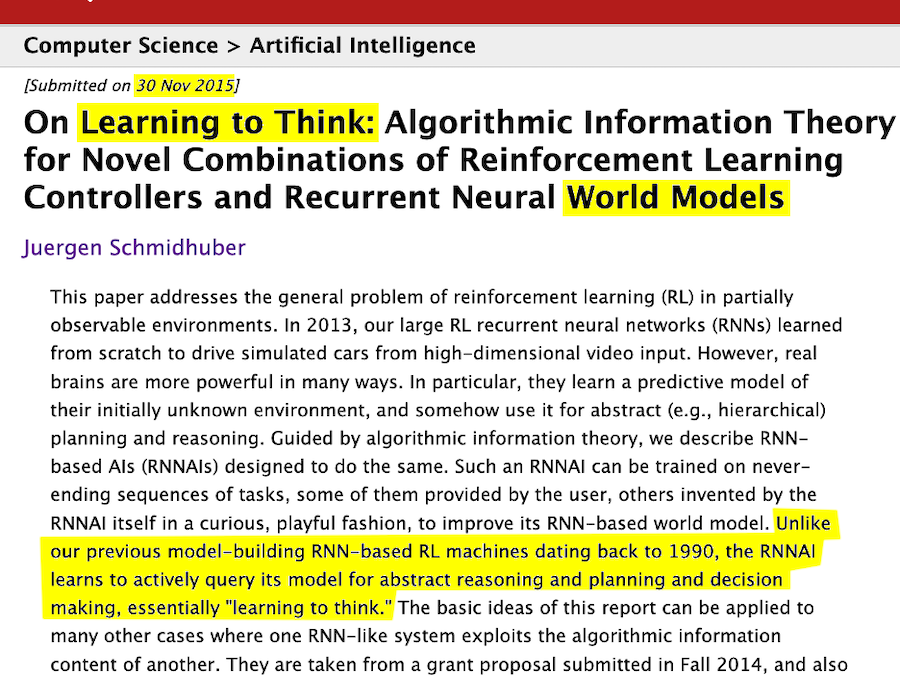
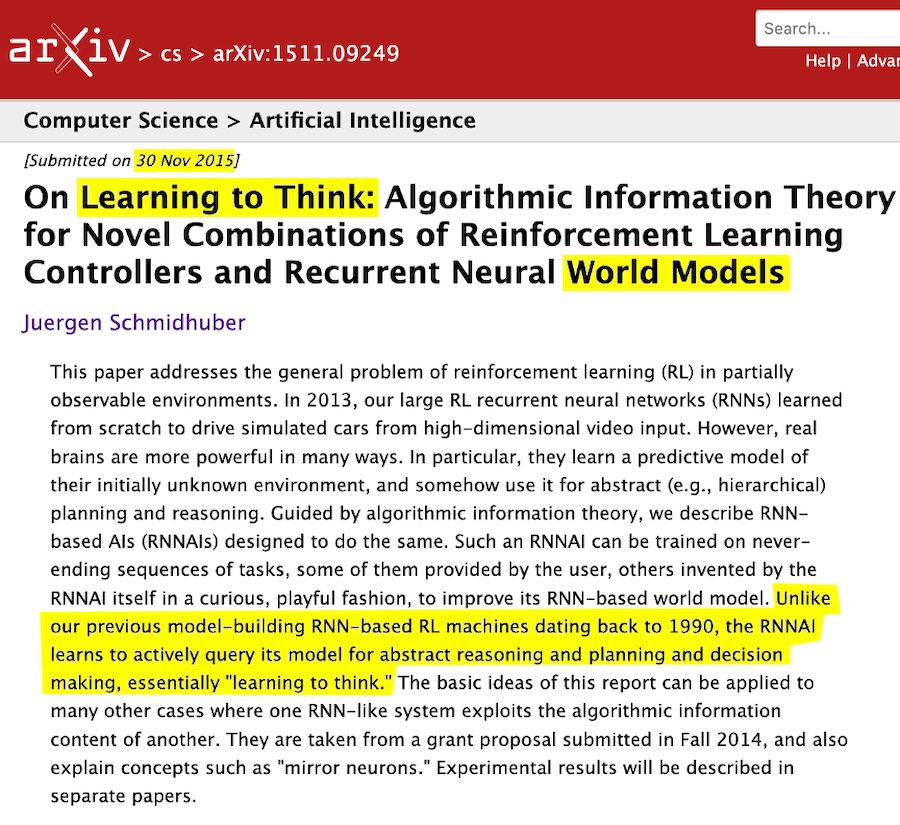
Ten years ago, Jürgen Schmidhuber introduced the concept of the reinforcement learning (RL) prompt engineer, an adaptive mechanism through which an RL controller learns to actively query a neural world model to support abstract reasoning and decision-making. This early vision anticipated today’s chain-of-thought and deliberative reasoning architectures, emphasizing systems that improve their own cognitive processes through learning.
Schmidhuber’s 2015 formulation builds upon two earlier milestones:
1990 Neural World Model
A predictive neural architecture capable of millisecond-level planning, allowing agents to simulate and anticipate environmental dynamics.
1991 Adaptive Neural Subgoal Generator
A pioneering framework for hierarchical planning, enabling self-generated intermediate goals and multi-level decision structures.
Together, these systems represent a progression from low-level predictive modeling → structured subgoal formation → integrated RL-driven reasoning.
This continuum demonstrates a long-standing pursuit: creating AI that does not merely respond, but learns how to think—developing internal queries, refining its strategies, and coordinating understanding through dynamic world models.
Schmidhuber’s contributions remain foundational to modern adaptive reasoning, world-model-based AI, large-sequence models, and the emerging generation of self-improving autonomous systems.
AIWS recognizes the importance of research that advances:
transparent and interpretable reasoning
adaptive, self-reflective AI
architectures grounded in humanistic, responsible intelligence
The evolution traced here aligns closely with the AIWS mission to develop AI that supports human dignity, creativity, and enlightened governance.
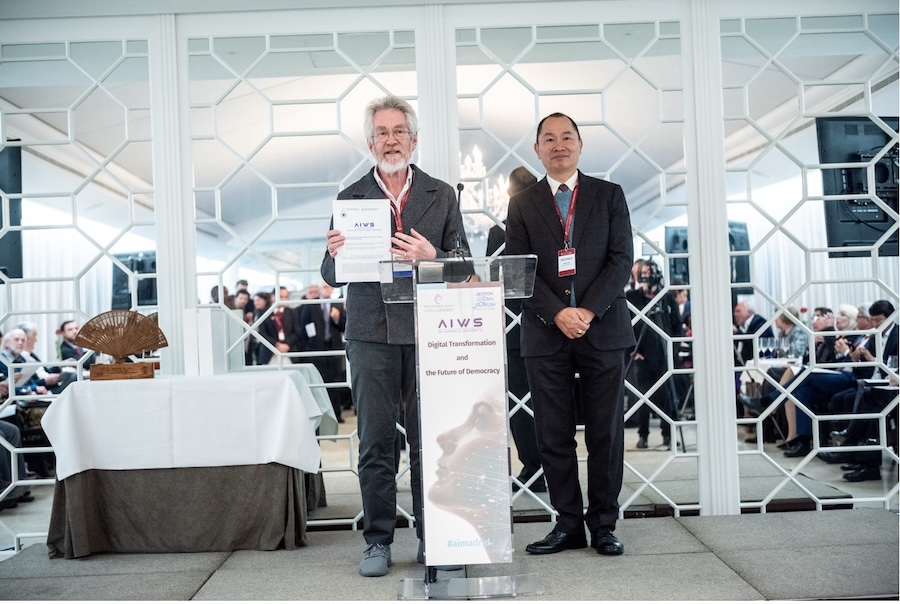
In an era transformed by rapid technological power, Nguyen Anh Tuan offers a vital reminder for today’s leaders:
“The question for today’s leaders is no longer what AI can do, but how it should be guided. Human values—not technical power—are the real drivers of a meaningful digital future.”
This perspective marks a turning point in the evolution of artificial intelligence. As AI becomes embedded in everyday life, the core challenge shifts from engineering capability to ethical guidance, democratic responsibility, and human-centered leadership.
Nguyen Anh Tuan, Co-founder and CEO of the Boston Global Forum and architect of the AI World Society (AIWS), emphasizes that technology must remain in service to humanity—not dominate it. The future he envisions depends on moral leadership, where AI advances peace, justice, and human dignity.
He calls on leaders to ask:
What values should guide AI’s decisions?
How do we embed compassion, fairness, and transparency into digital systems?
How do we ensure AI strengthens—not undermines—democracy and human dignity?
The AIWS Model, the Social Contract for the AI Age, and AIWS Government 24/7 offer frameworks that translate these principles into practice. Their foundation is clear and universal: human values—compassion, enlightenment, and responsibility—must lead the way.
As we confront the global implications of AI, Nguyen Anh Tuan’s message stands firm: the future will be shaped not by what machines can achieve, but by the wisdom and ethics with which humanity guides them.
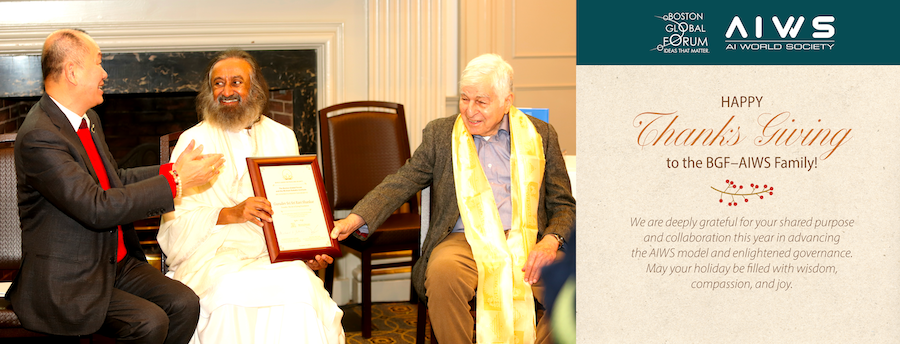
We are deeply grateful for your shared purpose and collaboration this year in advancing the AIWS model and enlightened governance. May your holiday be filled with wisdom, compassion, and joy.
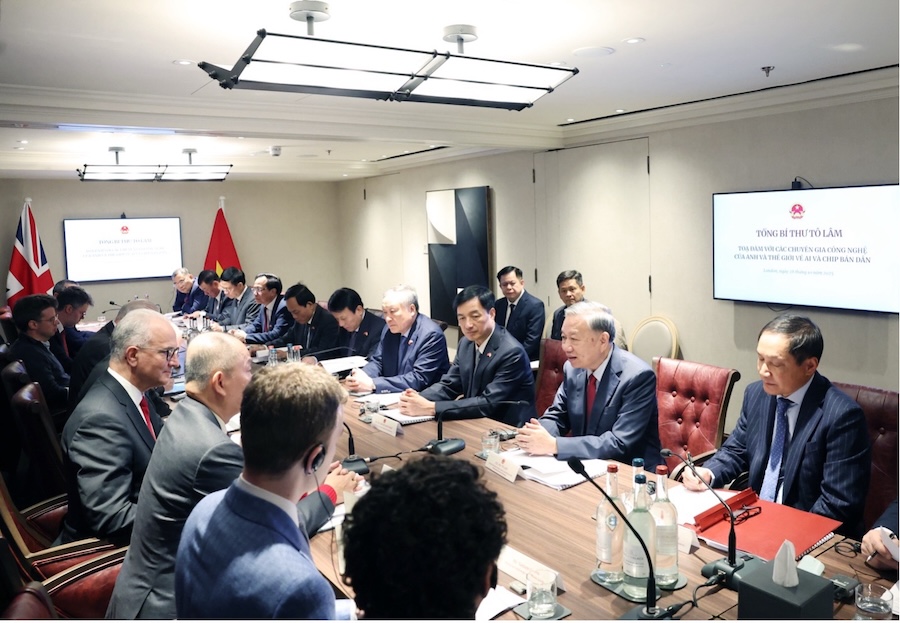
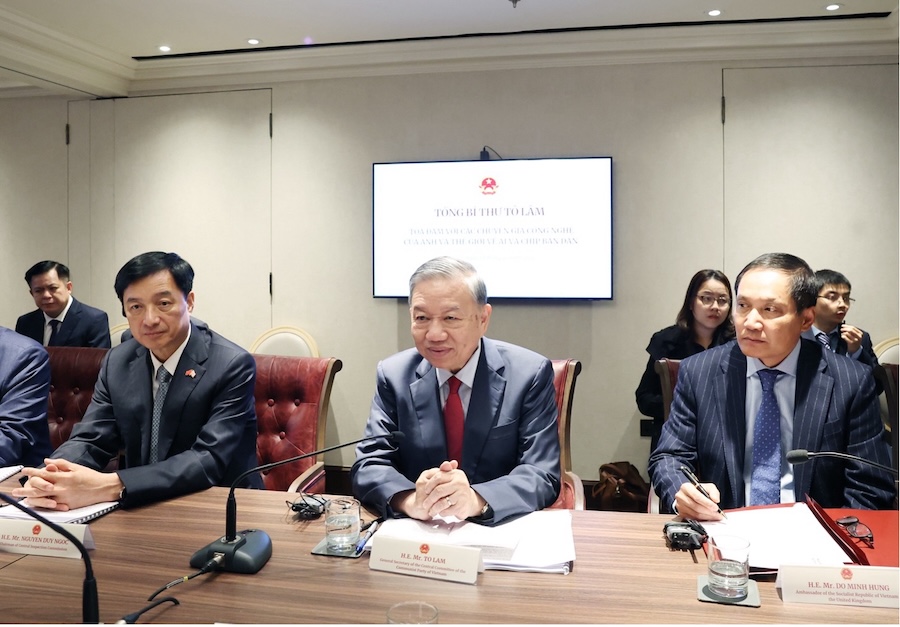
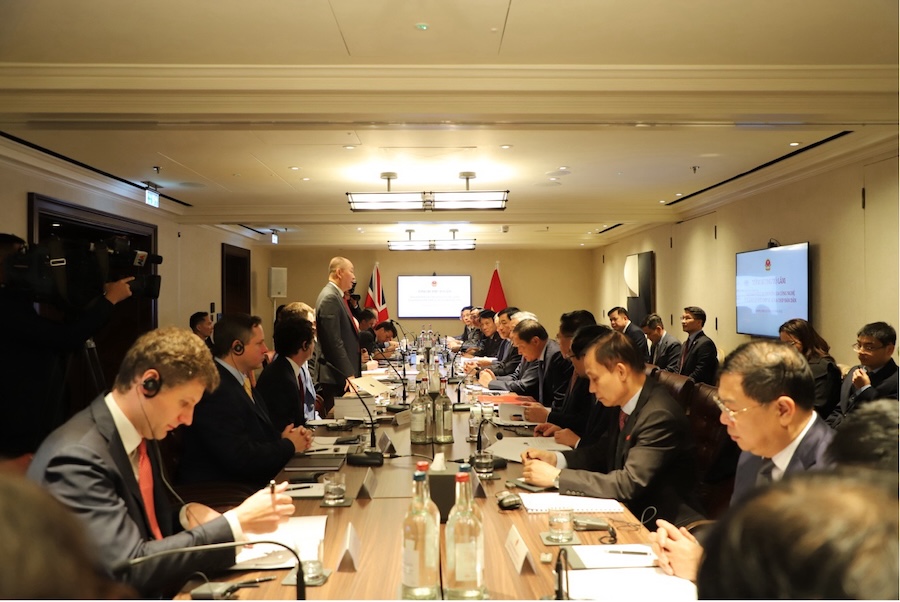
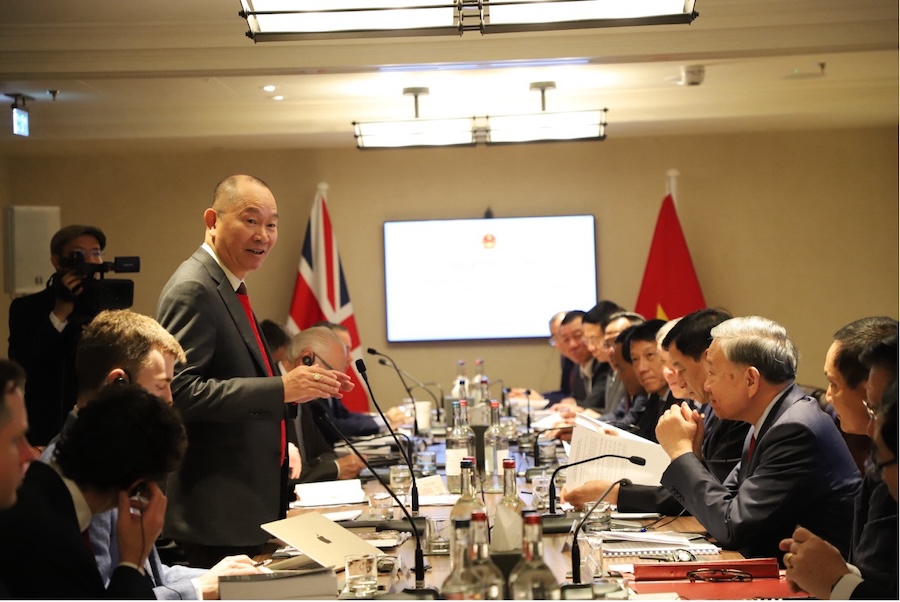
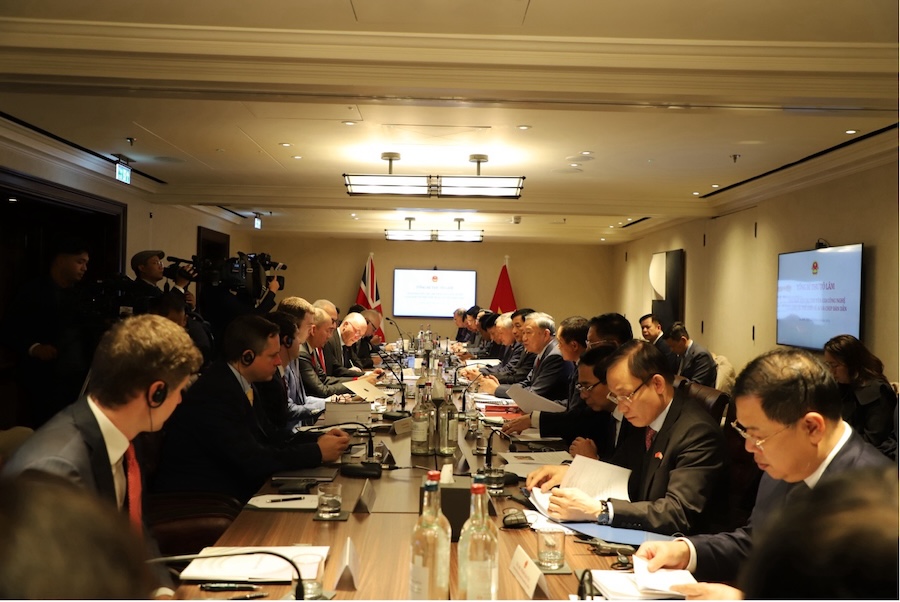
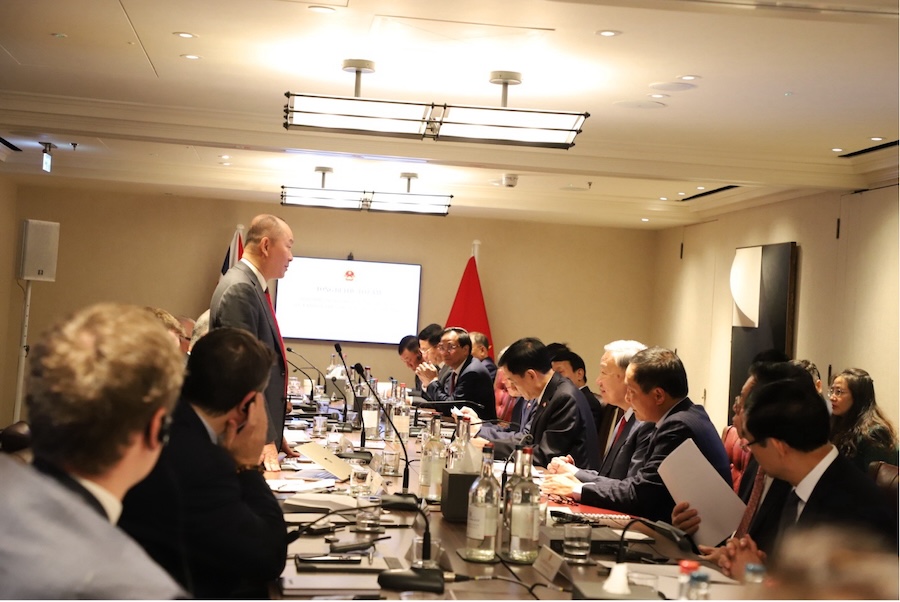
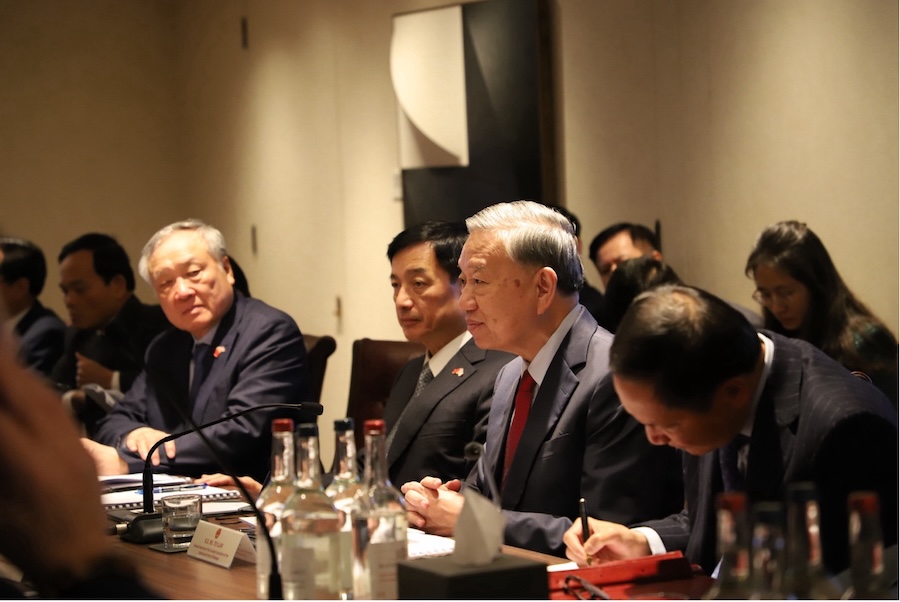
On October 28, 2025, at the historic Raffles Hotel London, the Boston Global Forum (BGF) co-organized a high-level strategic event where General Secretary of the Communist Party of Vietnam Tô Lâm and senior Vietnamese leaders met with world-renowned strategists and experts in artificial intelligence, digital governance, and chip technology.
This landmark gathering marked a major milestone in Vietnam’s journey to build a powerful, ethical, and globally competitive AI future — and to contribute Vietnamese wisdom and values to the world as humanity enters a new era: the Age of AI.
During the Roundtable, General Secretary Tô Lâm emphasized Vietnam’s determination to “develop AI as a driving force for national modernization, build a peaceful, humane, and innovation-driven society, and ensure that technological progress always serves the people.”
He also affirmed that international cooperation—especially with leading global institutions such as BGF and its partners—is essential for Vietnam “to go further, faster, and responsibly” in shaping its AI future.
Representing the Boston Global Forum, Co-Founder Nguyen Anh Tuan presented three comprehensive strategic programs supporting Vietnam’s national AI development.
1. AIWS Government 24/7 for Vietnam
A model of continuous, ethical governance using trusted AI to support Vietnam’s leaders, optimize policymaking, and deliver transparent, personalized public services 24/7.
Key components include:
AI for real-time decision support
• Unified citizen service hub
• Transparency and trust dashboard
• Digital management of public investment and government spending
• A national 24/7 government data center
• A next-generation, people-centered digital governance architecture
This model positions Vietnam to become a global pioneer in AI-powered public administration.
2. Center for Digital Assets with AIWS Digital Asset Standards (AIWS-DASI)
Vietnam will establish a national center to:
Build ethical, high-quality digital assets aligned with global standards
• Apply AIWS-DASI, the world’s first ethical certification system for digital assets
• Ensure trust, transparency, and safety in the digital economy
• Support fintech, banking, education, culture, and innovation ecosystems
AIWS-DASI will help Vietnam become a trusted hub of ethical digital economic innovation in Asia.
3. AIWS Film Park – A Cultural–Technological Innovation Platform
This initiative brings together:
Advanced cinematic technologies
• AI-powered creative tools
• Preservation and elevation of Vietnamese cultural identity
• Global collaboration in film, music, and immersive arts
With cultural heritage centers such as Nha Trang, Ha Long – Yên Tử, and Hội An, Vietnam is positioned to become a global destination for AI-enhanced cultural creativity.
A Special Strategic Roundtable with Vietnam’s Top Leadership
Nguyen Anh Tuan presented strategic recommendations on AI development to General Secretary Tô Lâm and Vietnam’s top decision-makers, including:
Politburo Members and Senior Leaders
Nguyễn Hoà Bình – First Deputy Prime Minister
• Nguyễn Duy Ngọc – Secretary of Hanoi Party Committee, Politburo Member
• Nguyễn Trọng Nghĩa – Politburo Member
• Phan Văn Giang – Minister of Defense, Politburo Member
• Lương Tam Quang – Minister of Public Security, Politburo Member
• Lê Hoài Trung – Minister of Foreign Affairs, Party Central Committee Secretary
• Phạm Gia Túc – Chief of Staff of the Vietnam Communist Party
• Trần Lưu Quang – Secretary of Ho Chi Minh City Party Committee, Party Central Committee Secretary
Key Ministers and Officials
Nguyễn Văn Thắng – Minister of Finance
• Nguyễn Mạnh Hùng – Minister of Science and Technology
• Nguyễn Kim Sơn – Minister of Education
• Nguyễn Thị Hồng – Governor, State Bank of Vietnam
• Tô Ân Xô – Chief of Staff to General Secretary Tô Lâm
• Đỗ Minh Hưng – Ambassador of Vietnam to the UK
Global Strategists and Experts Joining the Event
From the Boston Global Forum – AIWS Family
Governor Michael Dukakis – Co-Founder, BGF (online)
• Nguyen Anh Tuan – CEO, BGF
• Professor Alex Pentland – MIT (online)
• Professor Thomas Patterson – Harvard (online)
• Professor David Silbersweig – Harvard (online)
International Strategists and Experts
Hon. Mark Kennedy – Wahba Initiative, NYU; Former US Congressman
• Liam Maxwell – Director, Government Transformation, AWS; UK Government’s first Chief Technology Officer
• Tantum Collins – Former Director for Technology & National Security, White House
• Glen Weyl – Leader of Microsoft Research
• Lord Francis Maude – Former UK Minister for Reform
• Dr. Marc Warner – CEO & Co-Founder, Faculty
• Lord Liam Booth Smith – EMEA Policy Lead, Anthropic; Former Chief of Staff to Prime Minister Rishi Sunak
• Michael Webb – Founder, Quantum Leap
• Andrew Trask – Founder, OpenMined; Senior Scientist, DeepMind
• Saul Klein OBE – Investor; Member of UK Technology Strategy Board
• Alastair Lukies CBE – Chair, FinTech Alliance
• Yossi Katribas – Former Senior Deputy Director General, Israeli Prime Minister’s Office (online)
• Yasuhide Nakayama – Former Japanese State Minister of Foreign Affairs (online)
Moderator: Nguyen Anh Tuan
This gathering connected Vietnam’s leadership with global thinkers, offering deep insights into AI strategy, chip sovereignty, cybersecurity, digital ethics, and economic modernization.
A New Chapter for Vietnam’s AI Future
The event reaffirmed BGF’s commitment to support Vietnam in building a modern, ethical, and globally integrated AI-driven society.
Through:
AIWS Government 24/7
• AIWS Digital Asset Standards (AIWS-DASI)
• AIWS Film Park
BGF aims to help Vietnam become a model of innovation, cultural creativity, and ethical AI governance in Southeast Asia and the world.
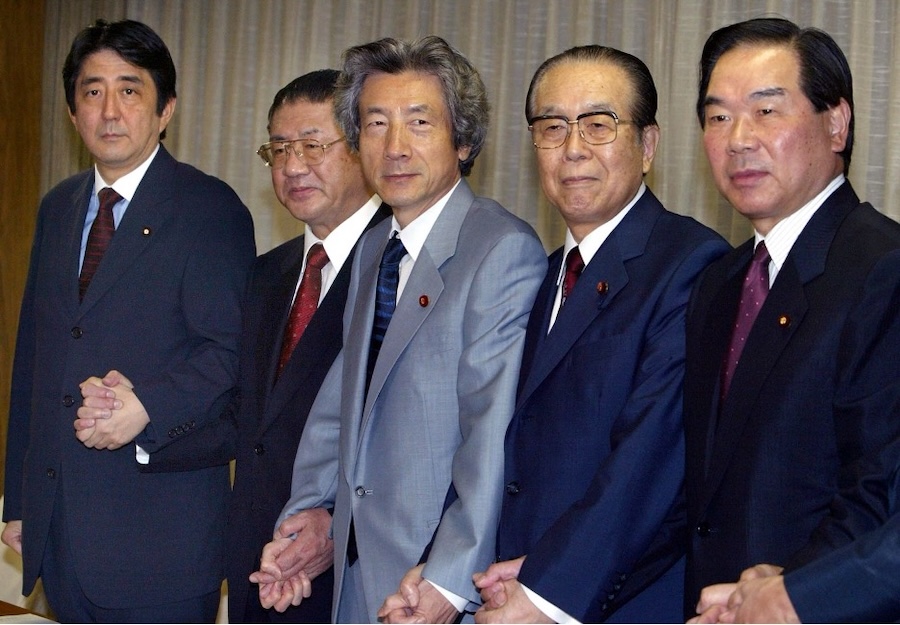
The Shinzo Abe Conference 2026, organized by the Boston Global Forum as part of the Shinzo Abe Initiative for Peace and Security, will take place in Tokyo in late March 2026. This year’s conference will place a strong focus on the highly anticipated Shinzo Abe Film, a major cinematic work that will portray the life, vision, and courage of one of Japan’s most influential leaders.
A Focus on the Shinzo Abe Film: Leadership, Crisis, and Vision
The centerpiece of the 2026 conference will be the in-depth presentation of the Shinzo Abe Film.
More than a biography, the film will illuminate:
Abe’s leadership during Japan’s most difficult and defining moments
His strategic decisions during national and global crises
His steady, calm presence during political and security challenges
His unwavering defense of democracy in the Indo-Pacific
His visionary creation of the Free and Open Indo-Pacific (FOIP)
These special and challenging moments of his leadership—moments that demanded clarity, courage, innovation, and resolve—form the emotional and moral core of the film.
At the Tokyo conference, the film team will reveal:
Story structure and historical narrative
The thematic arc capturing Abe’s statesmanship
The dramatic portrayal of crisis leadership
Production plans and cinematic direction
Global impact goals for education, democracy, and peace
Forwarding Abe’s Legacy — From Shinzo Abe Initiative to PM Sanae Takaichi
The conference will also highlight how Abe’s legacy is being continued and strengthened today through:
The Shinzo Abe Initiative for Peace and Security, advancing his FOIP vision
Prime Minister Sanae Takaichi, a recipient of the World Leader in AIWS Award, whose firm, hands-on leadership echoes Abe’s clarity and decisiveness
Her commitment to guiding Japan through the challenges of the AI Age while upholding democratic values and national strength
Together, they represent the continuation of Abe’s mission: a stable, peaceful, democratic Indo-Pacific built on courage, innovation, and unwavering resolve.
A Gathering of Visionaries in Tokyo
The conference will convene:
Leading policymakers and diplomats from Japan, the U.S., and Indo-Pacific partners
Distinguished thinkers on politics, democracy, and AI governance
Members of the BGF–AIWS Family
Filmmakers, cultural innovators, and historians
World Leader for Peace and Security Award recipients
They will jointly examine how film, culture, and innovation can help transmit Abe’s leadership philosophy to future generations.
Abe’s Legacy in the AI Age
As the world enters deeper into the AI Era, the Shinzo Abe Initiative and the leadership of PM Sanae Takaichi play a key role in ensuring that:
Japan remains a pillar of peace and stability
Democratic values stand strong in a turbulent world
The next generation understands and inherits Abe’s principles of courage, dignity, and human-centered leadership
The Shinzo Abe Conference 2026 in Tokyo—centered on the Shinzo Abe Film—will be a powerful reaffirmation of his standing as one of the world’s great leaders and an enduring force for peace in the Indo-Pacific.
Professor Alex Pentland’s new book Shared Wisdom offers a timely and profound foundation for the development of the AI World Society (AIWS) model. His central message is clear: to build a flourishing society, we must design our technologies based on deep understanding of human nature — not allow technology to reshape humanity blindly. In Shared Wisdom, Pentland traces the great leaps of human civilization — from the birth of cities to the Enlightenment to the Scientific Revolution — demonstrating that progress has always depended on cultural inventions that strengthened cooperation, accelerated innovation, and expanded collective wisdom.
Today’s global challenges — climate change, pandemics, declining trust, and fragile institutions — require similarly transformative cultural architectures. Pentland shows how AI and digital systems, if designed with human deliberation, dignity, and social cohesion at their center, can become tools that amplify — rather than replace — human judgment and creativity. These ideas directly inform the AIWS Model: a framework for building the next stage of civilization by aligning technology with human values, shared purpose, and enlightened governance. Shared Wisdom contributes essential insights that help AIWS design a society where AI strengthens democracy, empowers communities, and accelerates cultural evolution toward peace, creativity, and global flourishing.
At the October 28, 2025 high-level dialogue in London, Professor Alex “Sandy” Pentland of MIT—one of the world’s foremost authorities in AI, data science, and digital governance—shared strategic advice directly with Vietnam’s General Secretary Tô Lâm.
Professor Pentland emphasized that Vietnam should not follow the China model or the U.S. model in building its digital governance and AI strategy.
Vietnam, he said, has a unique opportunity to define a new, modern, people-centric model—distinct from both China and the United States.
This new model could reflect Vietnam’s culture, values, creativity, and national priorities while still aligning with global standards for ethics and digital trust.
AI Tools to Support Vietnam’s AIWS Government 24/7
To support Vietnam as it builds this new governance model aligned with the AIWS Government 24/7 initiative of the Boston Global Forum, Professor Pentland introduced two practical, deployable platforms:
Deliberation Platform https://deliberation.io/
A trusted AI-mediated system for citizen participation, enabling inclusive policymaking, structured consultation, and transparent feedback for leaders.
Loyal Agents https://loyalagents.org/
A new ethical framework for personal AI agents that act with “duty of loyalty”—helping citizens navigate government services, digital systems, and daily decisions with trust and protection.
Pentland noted that these tools could help Vietnam quickly build a citizen-centric, transparent, and ethical AI governance infrastructure, becoming a model for emerging economies worldwide.
World Leader in AIWS – One Month of Leadership, One Clear Direction
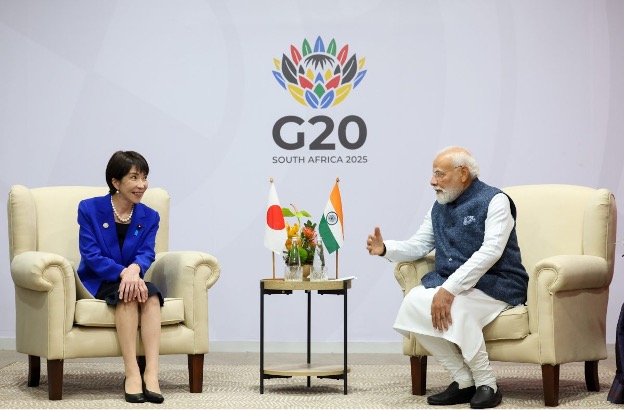
One month into her historic tenure as Prime Minister of Japan, Sanae Takaichi—recipient of the World Leader in AIWS Award—has demonstrated a governing style that profoundly echoes the clarity, decisiveness, and strategic discipline of the late Prime Minister Shinzo Abe.
From the very first days of her administration, Takaichi signaled a leadership ethos rooted in hands-on engagement, principled conviction, and future-oriented national strategy. Her brisk, highly focused approach reflects the governing spirit that defined Abe’s era: strong national defense, technological sovereignty, international partnership, and a deep belief in Japan’s global responsibility.
A Month Marked by Steadfast Leadership
In these initial weeks, Takaichi has shown:
Firmness and stability—projecting the confidence expected of a Japanese leader facing complex domestic and global challenges.
Clarity of direction—prioritizing strategic technologies, security alliances, and economic resilience.
Continuity with Abe’s long-term vision, ensuring Japan remains a pillar of democracy and innovation in the Indo-Pacific.
Commitment to ethical and human-centered AI, aligning national priorities with the principles of the AI World Society (AIWS).
Her leadership style—decisive, grounded, intellectually rigorous, and action-oriented—resonates strongly with the political qualities admired in Abe’s tenure. In a moment when Japan plays an essential role in balancing global power, Takaichi is meeting the demands of her position with maturity and strength.
A Leader for Japan — and for the AI Age
As a World Leader in AIWS, Prime Minister Takaichi continues to champion:
Ethical AI governance and global standards
A secure and democratic digital economy
Technological innovation that strengthens peace and prosperity
Japan’s leadership in shaping the human-centered AI future
Her first month has affirmed not only her capacity to lead Japan, but also her readiness to guide international conversations on the responsible development of AI and emerging technologies.
As the United States approaches its 250th anniversary in 2026, the nation stands at a pivotal crossroads. For two and a half centuries, America has shaped global history through its foundational values of liberty, democracy, human dignity, innovation, and the belief in equal opportunity.
Now, in the transformative Age of Artificial Intelligence, the world once again turns to the United States for leadership—not only technological leadership, but moral, cultural, and philosophical leadership capable of guiding humanity toward a flourishing future.
A New Vision and Model for America at 250
The Boston Global Forum (BGF) and the AI World Society (AIWS) propose A New Model for America at 250 – A Beacon for the AI Age, based on AIWS concepts, a visionary framework that positions the United States as the guiding star for ethical, human-centered, globally beneficial AI development in the 21st century.
This new model integrates visions and strategies that:
Strengthen America’s global competitiveness in the AI Age
Accelerate innovation across all sectors of society
Empower every citizen to develop their full human abilities
Expand equal opportunities for all people—regardless of geography or background
Ensure AI enhances human dignity, creativity, and freedom
Contribute to a safe, ethical, prosperous, democratic world
Inspire other nations to adopt enlightened, responsible AI governance models
America at 250 becomes not merely a commemoration—but a transformation.
A Beacon for the AI Age
America has always been defined not simply by its power, but by its ability to inspire.
In the AI Age, this inspiration must come through:
Ethical AI governance
Trustworthy and transparent digital systems
Protection of human rights and human dignity
Advancement of democracy and rule of law
Innovation rooted in compassion and responsibility
Cultural flourishing through human–AI creativity
Global collaboration for peace, prosperity, and shared humanity
This is the essence of becoming a Beacon for the AI Age.
America at 250: Activities & Initiatives
To bring this model to life, BGF and AIWS will organize a series of America at 250 programs, including:
1. National and Global Events
Symposia at Harvard, MIT, and major U.S. cities
International forums connecting America with allies and partners
Dialogues with policymakers, scholars, innovators, artists, and youth leaders
2. Strategic Roundtables & Workshops
Designing next-generation digital governance
AI for democracy, ethics, and public service
Economic transformation through innovation
Strengthening U.S. competitiveness in science and technology
3. America at 250 – Achievement Recognitions
Honoring outstanding ideas, initiatives, solutions, products, and services that advance:
Ethical AI
Digital trust
Human-centered innovation
Equal opportunity
Public service improvement
Cultural and creative excellence
These recognitions will uplift the brightest contributions from thought leaders, businesses, communities, and young innovators.
4. Business & Innovation Partnerships
BGF invites:
CEOs
Entrepreneurs
Technology companies
Financial and investment leaders
Creative and cultural industries
Innovation ecosystems
to contribute transformative solutions that help America become the world’s leading model for the AI Age.
A Call to Leaders, Thinkers, Innovators, and Young Citizens
We invite:
World Leader for Peace and Security Award laureates
World Leader in AIWS Award recipients
Distinguished global policymakers
Scholars and innovators
Students and young talents
Members of the global BGF–AIWS Family
to join this movement of shared wisdom and shared responsibility.
Official Launch at Harvard University – November 3, 2025
This program was officially launched by Nguyen Anh Tuan, Co-Founder, Co-Chair, and CEO of the Boston Global Forum, at the Harvard University Faculty Club on November 3, 2025, and updated on November 23, 2025, in Beacon Hill, Boston.
The launch honored Gurudev Sri Sri Ravi Shankar and celebrated the 10th anniversary of the World Leader for Peace and Security Award (2015–2025).
This moment marked the beginning of a new era—one in which:
America at 250 becomes a new model for the world, a blueprint for enlightened society, and truly a Beacon for the AI Age.