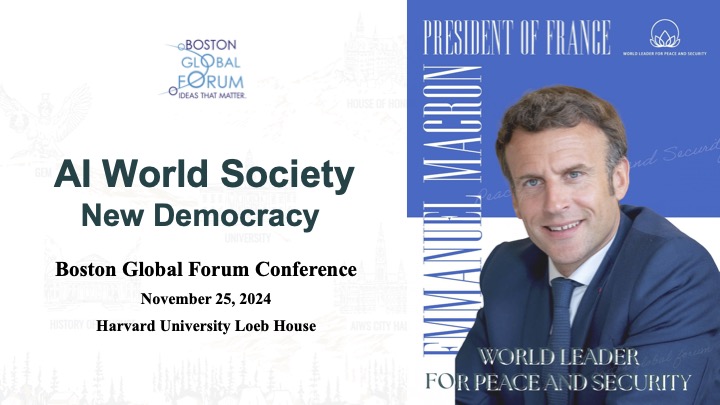
Acceptance Speech by French President Emmanuel Macron for the 2024 World Leader for Peace and Security Award
November 25, 2024
My dear friends,
I am happy and proud to receive, on behalf of France, your annual award for Peace and Security.
I wanted to take the time to tell you this warmly, through this message read aloud—this oral reading remains, in these times of artificial intelligence, perhaps the most revolutionary of practices, the best guarantee against deep fakes.
I say this with a bit of humor, but ultimately, these are the real issues: the regulation of our digital order and the governance of artificial intelligence.
Indeed, I believe that our heritage of political modernity—the foundation of our Western democracies—is threatened at its very core. The conception of individual political rights, inherited from 18th-century liberal philosophy and our Declaration of the Rights of Man and of the Citizen, was based precisely on the guarantee of rights: a corpus of norms to organize public space, verification procedures, and ultimately, a debate among citizens guided by a spirit of rationality. All this presupposed a shared conception of progress, supported by science as an authority, faith in the human spirit to understand the world’s rationality, and the quest to elucidate reality through the efforts of collective wills.
Alas, it suffices to open any social network to observe that this conception is no longer prevalent. We have moved from the reign of facts to that of opinions, an immense contestation of the very forms that sustained our public debate. This ranges from the conditions of producing free and rational information to the questioning of all authority and hierarchy in knowledge. A form of anomie that is the vector of all regressions: conspiracy theories, paranoia, leveling of knowledge. We are experiencing a great digital shift in which we see immense progress, of course, but also significant deviations: criminal activities, a neglect of digital order allowing the proliferation of hate speech and sometimes incitement to terrorism.
In response, France has, for the past seven years, consistently sought to build coalitions to regulate the digital order. This has been true both in Europe—where we have very concretely implemented mechanisms to compel major platforms to remove contentious content—and globally, with the Christchurch Call, to promote this simple idea: what is illegal in real life must be illegal online. A better-regulated digital world is a prerequisite for peace in our societies.
Beyond the fight against these criminal deviations, the great battles are still ahead of us—for we must also rethink our methods of information production in light of the contestation of the democratic model and the dilution of science and rationality.
All this, too, in a context where the emergence of artificial intelligence is impacting all these subjects anew. Because AI—as I mentioned in the introduction with deep fakes—is a formidable accelerator of hostile practices, a powerful disruptor of our reference points, an incredible playground for those who wish to destabilize our democracies. Above all, it is a threat against the peace and stability of the world.
Fundamentally, the question is whether these tremendous revolutions—the digital transformation and artificial intelligence—will allow us to invent new Enlightenments or will definitively erase a French and European humanism.
I believe that we all have an interest in maintaining both composure and reason in the face of artificial intelligence, often described in Promethean terms. We must build a collective agenda to democratize artificial intelligence, make it more sustainable from environmental and social perspectives, and create inclusive governance that brings together all countries and all stakeholders who need to be involved—social partners, artists, even teachers. It will involve articulating responses to risks and support for innovation.
It is now that the destiny of the next cycle of innovation is being decided and, beyond that, the face of our societies for our children.
This is why I invite you all to Paris for our Summit for Action on AI in the month of February: economic actors, decision-makers, thinkers—we must create global consensus and make decisions at the right pace and on the right scale.
In this regard, your quest for the Enlightenment on a global scale can only resonate in France, in this pursuit of progress against all forms of obscurantism.
I believe in our collective capacity to put technology at the service of protecting our democracies and to forge a new era of prosperity, freedom, and stability in the world. I believe, like you, that we cannot and must not renounce our humanism and our Enlightenment ideals for the coming century.
Thank you all for your unwavering commitment.
Thank you for this Award, which honors France and compels us to act collectively starting this February in Paris!
*****
President Emmanuel Macron’s Original French Speech Accepting the 2024 World Leader for Peace and Security Award:
Message du Président de la République
World Leader for Peace and Security Award
Mes chers amis,
Je suis heureux et fier de recevoir au nom de la France votre prix annuel pour la paix et la sécurité.
Je voulais prendre le temps de vous le dire avec beaucoup de chaleur, par le truchement aussi de ce message lu, cette lecture à voix haute demeurant, en ces temps d’intelligence artificielle, peut-être la plus révolutionnaire des pratiques, la meilleure garantie contre les deep fakes.
Je le signifie avec un peu d’humour mais au fond, les enjeux sont ceux-là. Ceux de la régulation de notre ordre numérique et de l’encadrement de l’intelligence artificielle.
Je crois en effet que notre héritage de la modernité politique, ce qui a fondé nos démocraties occidentales est menacé dans ses bases. La conception des droits politiques de l’individu, héritée de la philosophie libérale du XVIIIe siècle et de notre Déclaration des droits de l’Homme et du citoyen reposait sur la garantie des droits, justement, un corpus de normes pour ordonner l’espace public, des procédures de vérification, et à la fin, un débat entre citoyens guidés par cet esprit de rationalité. Tout cela supposait une conception partagée du progrès, appuyée sur la science comme autorité, la foi dans l’esprit humain pour comprendre la rationalité du monde, la quête d’élucidation du réel par l’effort des volontés collectives.
Il suffit hélas d’ouvrir n’importe quel réseau social pour constater que cette conception n’a plus cours. Nous sommes sortis du règne des faits pour celui des opinions, une immense contestation des formes mêmes qui tenaient notre débat public. Cela va des conditions de fabrique de l’information libre et rationnelle à la remise en cause de toute autorité et de toute hiérarchie dans les savoirs. Une forme d’anomie qui est le vecteur de toutes les régressions : complotismes, paranoïa, nivellement des savoirs. Nous vivons une grande bascule numérique dont nous voyons les immenses progrès bien sûr mais aussi les grandes dérives : dérives criminelles, jachère de l’ordre numérique permettant la prolifération des paroles de haine et parfois de l’incitation au terrorisme.
Face à cela, la France a depuis sept ans toujours cherché à bâtir des coalitions pour réguler l’ordre numérique : ce fut vrai à la fois en Europe, où nous avons mis en place très concrètement des mécanismes pour contraindre les grandes plateformes à retirer les paroles litigieuses, mais aussi dans le monde, avec l’appel de Christchurch, pour porter cette idée simple, que ce qui est illégal dans la vraie vie doit être illégal en ligne. Un monde numérique mieux encadré est une condition de la paix dans nos sociétés.
Au-delà de la lutte contre ces dérives criminelles, les grands combats sont encore devant nous – car il nous faut aussi repenser nos modalités de production de l’information, à l’aune de la contestation du modèle démocratique, de la dilution de la science et de la rationalité.
Tout cela aussi, dans un contexte où l’émergence de l’intelligence artificielle vient percuter à nouveau tous ces sujets. Parce que l’IA, je le disais en introduction avec les deep fakes, est un formidable accélérateur de pratiques hostiles, un formidable brouilleur de nos repères, un terrain de jeu inouï pour ceux qui veulent déstabiliser nos démocraties. Une menace surtout contre la paix et la stabilité du monde.
Au fond la question est de savoir si ces formidables révolutions que sont la transformation numérique et l’intelligence artificielle vont nous permettre d’inventer de nouvelles Lumières ou vont définitivement effacer un humanisme français et européen.
Je crois que nous avons tous un intérêt à garder à la fois du sang-froid et de la raison devant une intelligence artificielle souvent décrite de manière prométhéenne. Nous devons bâtir un agenda collectif afin de démocratiser l’intelligence artificielle, la rendre plus soutenable, du point de vue environnemental et social, créer une gouvernance inclusive qui permette d’asseoir autour d’une même table tous les pays, tous les acteurs qui doivent être impliqués – partenaires sociaux, artistes ou encore instituteurs. Il s’agira d’articuler réponse aux risques et soutien à l’innovation.
C’est maintenant que se joue le destin du prochain cycle d’innovation et au-delà le visage de nos sociétés pour nos enfants.
Voilà pourquoi je vous invite tous à Paris, pour notre sommet pour l’action sur l’IA au mois de février : acteurs de l’économie, décideurs, penseurs, il faut créer des consensus globaux et prendre des décisions à la bonne vitesse et à la bonne échelle.
A cet égard, votre quête des Lumières à l’échelle du monde ne peut que résonner en France, dans cette quête du progrès, contre tous les obscurantismes.
Je crois dans notre capacité collective à mettre la technologie au service de la protection de nos démocraties et à la forge d’une nouvelle ère de prospérité, de liberté et de stabilité dans le monde. Je crois comme vous, que nous ne pouvons ni ne devons renoncer à notre humanisme et à nos Lumières pour le siècle qui vient.
Merci à tous, pour votre engagement sans faille.
Merci pour ce Prix, qui honore la France et nous oblige à agir collectivement dès février à Paris !