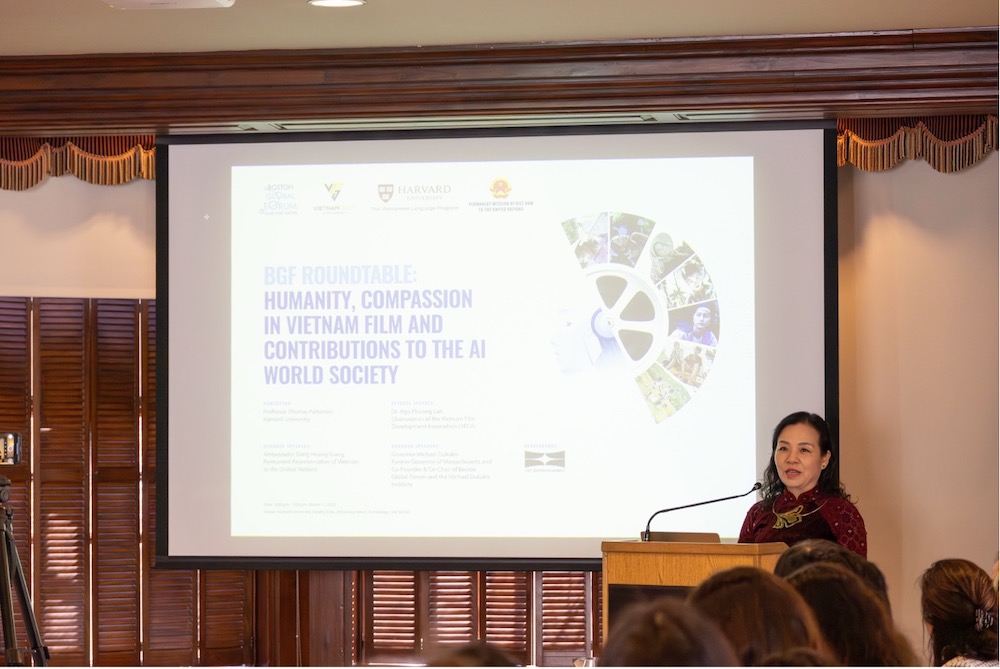
Boston, MA – May 12, 2025 – The Artificial Intelligence World Society (AIWS), through its Film Park initiative, today announced the launch of AIWS Film Quality, a groundbreaking standard designed to redefine cinema in the AI Age. As a core component of AIWS Film Park—a cultural and technological hub linking Nha Trang – Khanh Hoa, Vietnam, with Hollywood, Boston, and Awaji, Japan—AIWS Film Quality sets a transformative benchmark by blending ethical AI practices with artistic excellence. This initiative aims to elevate films as a medium for education, inspiration, and global cultural connection, aligning with AIWS’s mission to harness AI for societal good.
The new standard, introduced during a special event at Harvard University, is guided by five core principles: compassion, humanity, transparency, equity, and innovation. Films adhering to these principles must tell uplifting, human-centered stories—such as a Vietnamese family’s resilience amid adversity—while using AI transparently and inclusively. For instance, AI tools will enhance emotional depth through advanced visual effects, with all processes documented for accountability. Equity is ensured through diverse casting and crew representation, analyzed by AI to address gaps, while innovation drives novel applications like interactive story endings.
AIWS Film Quality films will earn the prestigious AIWS Film Quality Seal following a rigorous certification process. Filmmakers submit projects to a committee of AI ethicists, filmmakers, and cultural scholars, who evaluate adherence to the principles using AI-driven audits. Certified films will be showcased at AIWS Film Park events, including festivals in Nha Trang, screenings in Boston, and tech exhibitions in Awaji, amplifying their global reach.
The impact is already generating buzz. A pilot film exploring climate change, featuring AI-generated future scenarios, is set to educate and inspire audiences worldwide. Cross-cultural collaborations, such as a Nha Trang-Hollywood co-production, promise to bridge cultural divides, while the standard positions certified filmmakers as industry leaders in ethical AI. “This is a pivotal moment for cinema,” said Nguyen Anh Tuan, Co-Chair and CEO of AIWS, highlighting the initiative’s role in uniting humanity through art and technology.
AIWS Film Quality is poised to transform the film industry, encouraging studios globally to adopt its ethical framework. For more information, visit aiwsfilmpark.com and contact [email protected].
Delivered by Hon. Mark Kennedy, Director, Wahba Institute for Strategic Competition Boston Global Forum Conference, Harvard University, April 22, 2025
In his compelling address, Hon. Mark Kennedy emphasized that the world is undergoing a major digital realignment, with AI at the center of a growing divide between democratic and authoritarian tech ecosystems—primarily the U.S. and China. He warned that this is not just a technological race but a competition of governance models, values, and global influence.
Kennedy outlined five strategic steps for U.S.-led AI diplomacy:
Build a Trusted Alliance – Strengthen partnerships with allies and rising powers while ensuring regulatory interoperability rather than rigidity.
Balance Security with Access – Avoid over-restriction on chip exports and include more allies in the trusted AI ecosystem to counter China’s reach.
Lead with a Trusted Open Model – Support democratic-aligned open-source AI alternatives to prevent digital dependence on censored Chinese models.
Extend Shared Infrastructure – Invest in cloud, compute, and AI capacity in emerging markets to offer a credible democratic tech alternative.
Embed AI in Economic Statecraft – Recognize AI as central to trade, diplomacy, and development, and empower U.S. companies as partners—not agents of the state.
He concluded by reaffirming the importance of the Boston Global Forum’s New Economic Alliance, calling it a vital platform to lead not just through innovation, but by building trust and collaboration across democracies in the AI Age.
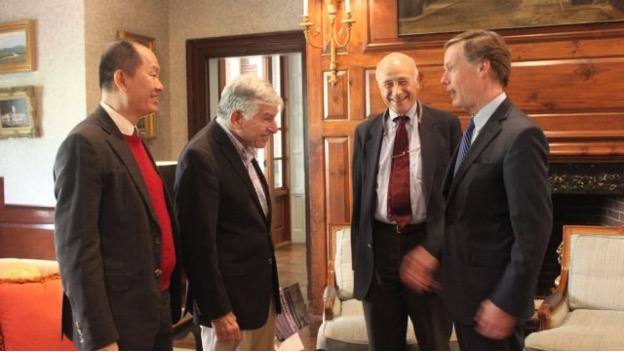
Joseph S. Nye, Jr., a distinguished member of the Boston Global Forum’s Board of Thinkers and one of the most influential scholars in international relations, passed away on May 6, 2025, at the age of 88. Foreign Affairs has highlighted several of his most impactful contributions to the field over the past five decades.
As a Harvard University Distinguished Service Professor, Emeritus, Nye profoundly shaped global understanding of power and diplomacy. He developed seminal concepts such as soft power, smart power, and neoliberalism, reshaping how the world understands influence and leadership on the international stage.
Joining the Harvard faculty in 1964 shortly after earning his doctorate, Nye became a central figure in the evolution of the John F. Kennedy School of Government, serving as its dean from 1995 to 2004. His academic legacy is paralleled by his public service, having held prominent national security roles in the Carter and Clinton administrations, and co-founding major policy institutions including the Aspen Strategy Group.
Nye’s rare combination of intellectual rigor, practical experience, and policy leadership deeply enriched his scholarship and teaching—and inspired countless policymakers, students, and global leaders.
Since the founding of the Boston Global Forum in 2012, Joe Nye made invaluable contributions through his role on the Board of Thinkers, helping guide the Forum’s vision and initiatives with wisdom, clarity, and a deep commitment to peace and global understanding.
He will be remembered as a towering intellect, a principled public servant, and a beloved member of the BGF community.
Hanoi, Vietnam — May 5, 2025
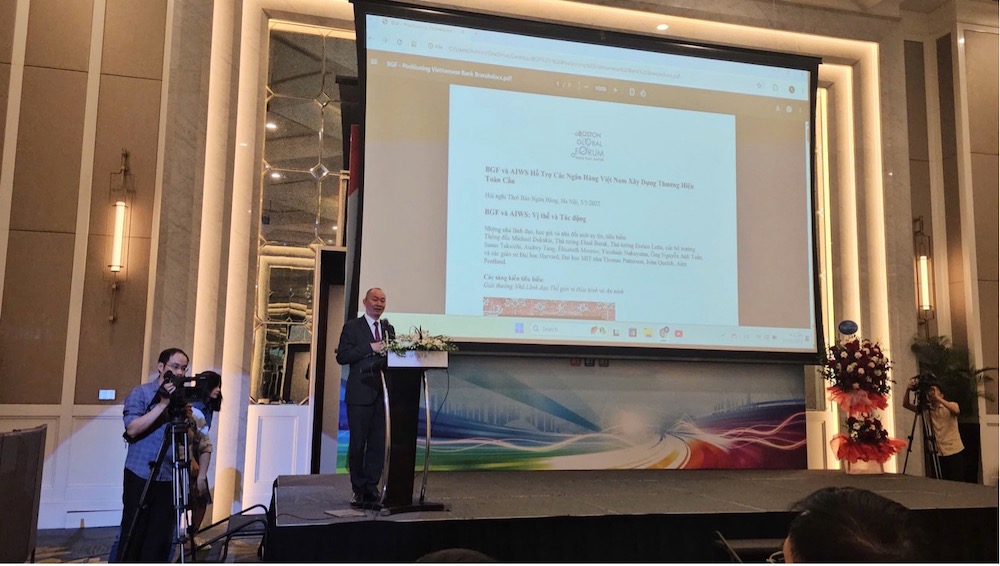
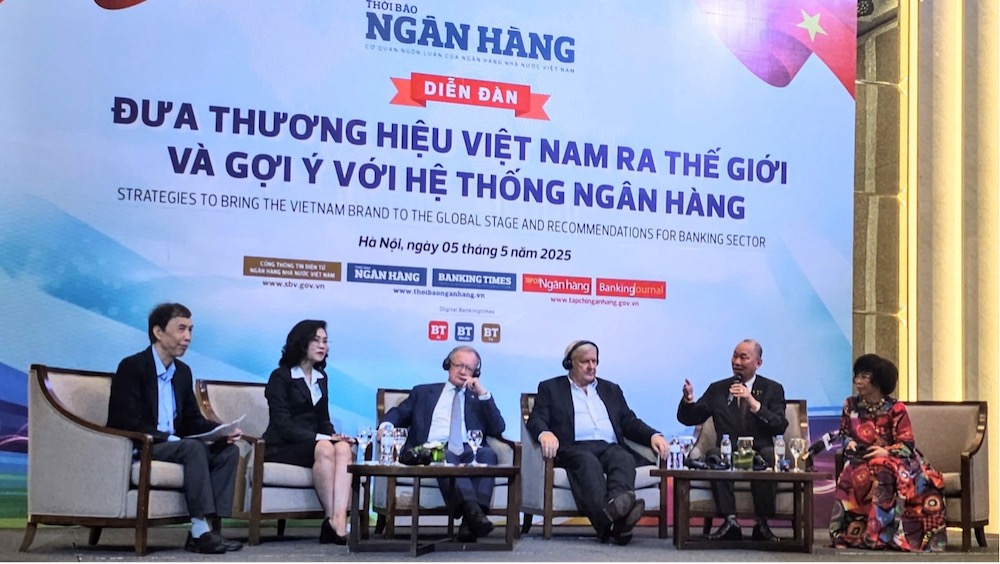
This morning, at the Melia Hotel in Hanoi, the Vietnam Banking Times, in collaboration with the State Bank of Vietnam, hosted the high-level conference “Positioning Vietnam’s Banks as Global Brands”. The event attracted prominent leaders, experts, and innovators in the financial and technological sectors.
Moderated by Mr. Pham Thanh Ha, Deputy Governor of the State Bank of Vietnam, the conference featured distinguished speakers, including Professor John Quelch of Harvard Business School, Co-founder of the Boston Global Forum (BGF), and Mr. Nguyen Anh Tuan, Co-Chair and CEO of BGF.
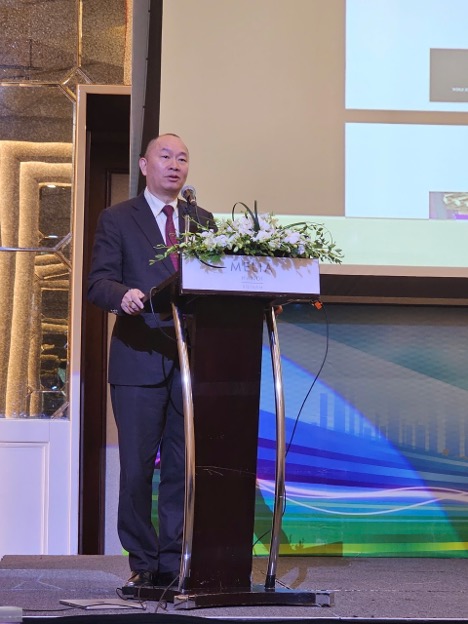
In his keynote address, Mr. Nguyen Anh Tuan introduced transformative strategies to elevate Vietnamese banks to the global stage. Central to his presentation were two pioneering initiatives developed by BGF: AIWS Government 24/7 and the Boston Finance Accord for AI Governance 24/7.
Mr. Tuan emphasized that AIWS Government 24/7 offers a new model for seamless, transparent, and ethical digital governance — positioning banks as leaders in trust, responsibility, and customer-centric innovation. Meanwhile, the Boston Finance Accord for AI Governance 24/7, unveiled at Harvard University on April 22, 2025, provides a framework for integrating AI into financial systems with integrity and global best practices, turning finance into a true force for good.
By adopting these frameworks, Vietnamese banks can strengthen their global brand through ethical AI-driven solutions, sustainable finance initiatives, and active participation in shaping the digital economy. Mr. Tuan also stressed that aligning with BGF’s global initiatives will enable Vietnam’s financial institutions to forge deeper international partnerships and contribute to emerging global economic alliances.
The conference highlighted the strategic importance of innovation, ethics, and global collaboration in advancing Vietnam’s banking sector, and marked a critical step toward establishing Vietnam as a leading force in the global financial landscape in the AI Age.
Boston, MA – May 04, 2025 – The Boston Global Forum (BGF) has announced the launch of efforts to develop the Foundational AIWS Economic Charter for the New Economic Alliance (NEA), a groundbreaking initiative uniting the United States of America, Japan, India, Vietnam, South Korea, the European Union, and the United Kingdom. This charter, guided by the Artificial Intelligence World Society (AIWS), aims to establish a rules-based economic framework rooted in transparency, fairness, sustainability, and innovation.
The charter’s development began with preliminary discussions led by BGF, leveraging its global network of distinguished leaders, including Governor Michael Dukakis, former US presidential candidate and Massachusetts Governor, and Enrico Letta, former Prime Minister of Italy. The BGF Summit, scheduled for early November 2025 in Boston, will host the charter’s adoption and ratification, marking a pivotal step toward economic collaboration among NEA members.
The AIWS Economic Charter will integrate AIWS’s Social Contract for the AI Age, ensuring AI-driven economic activities—such as trade platforms, financial systems, and technological innovations—prioritize societal good. It outlines commitments to ethical AI in trade, finance, and technology, including the deployment of AI-driven trade platforms for transparent supply chain management and the development of green investment platforms predicting ESG (Environmental, Social, Governance) impacts. The charter will also establish an AIWS Economic Council to oversee implementation and ensure alignment with its principles.
“This initiative reflects BGF’s commitment to ethical governance and global cooperation,” said Governor Dukakis. “By uniting these nations under a shared economic vision, we can address challenges like climate change and technological disruption with innovative, fair solutions.”
The charter’s development builds on BGF’s recent successes, including the Boston Finance Accord for AI Governance 24/7, announced in April 2025 at Harvard. With AIWS’s expertise and BGF’s leadership, the NEA aims to foster resilient economic ties, counter external pressures, and promote sustainable growth across member nations.
For more information, contact the Boston Global Forum at [email protected]
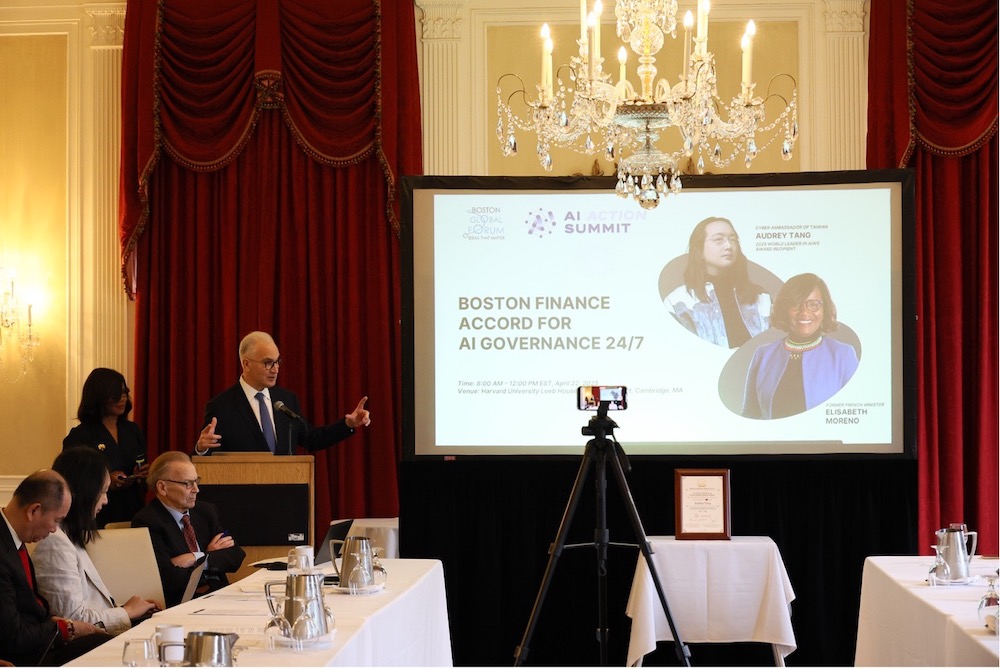
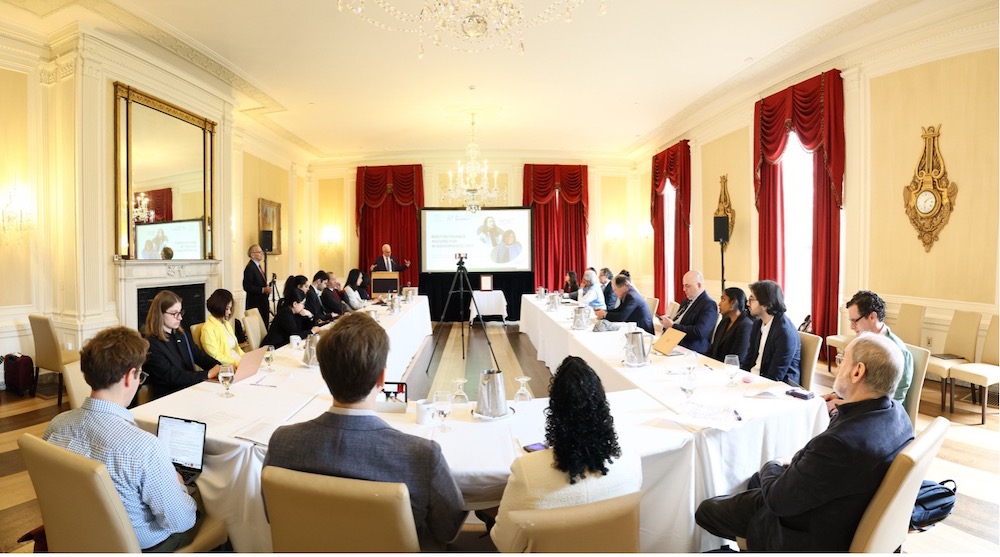
Boston Global Forum Conference
Boston Finance Accord for AI Governance 24/7
Harvard University Loeb House, 17 Quincy Street, Cambridge, MA
April 22, 2025
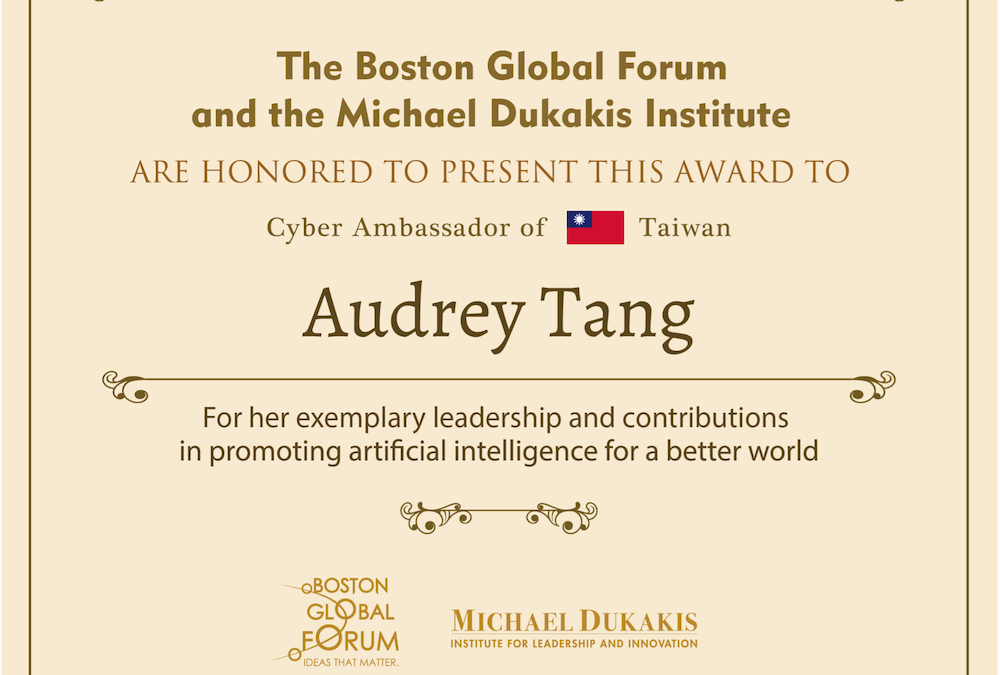
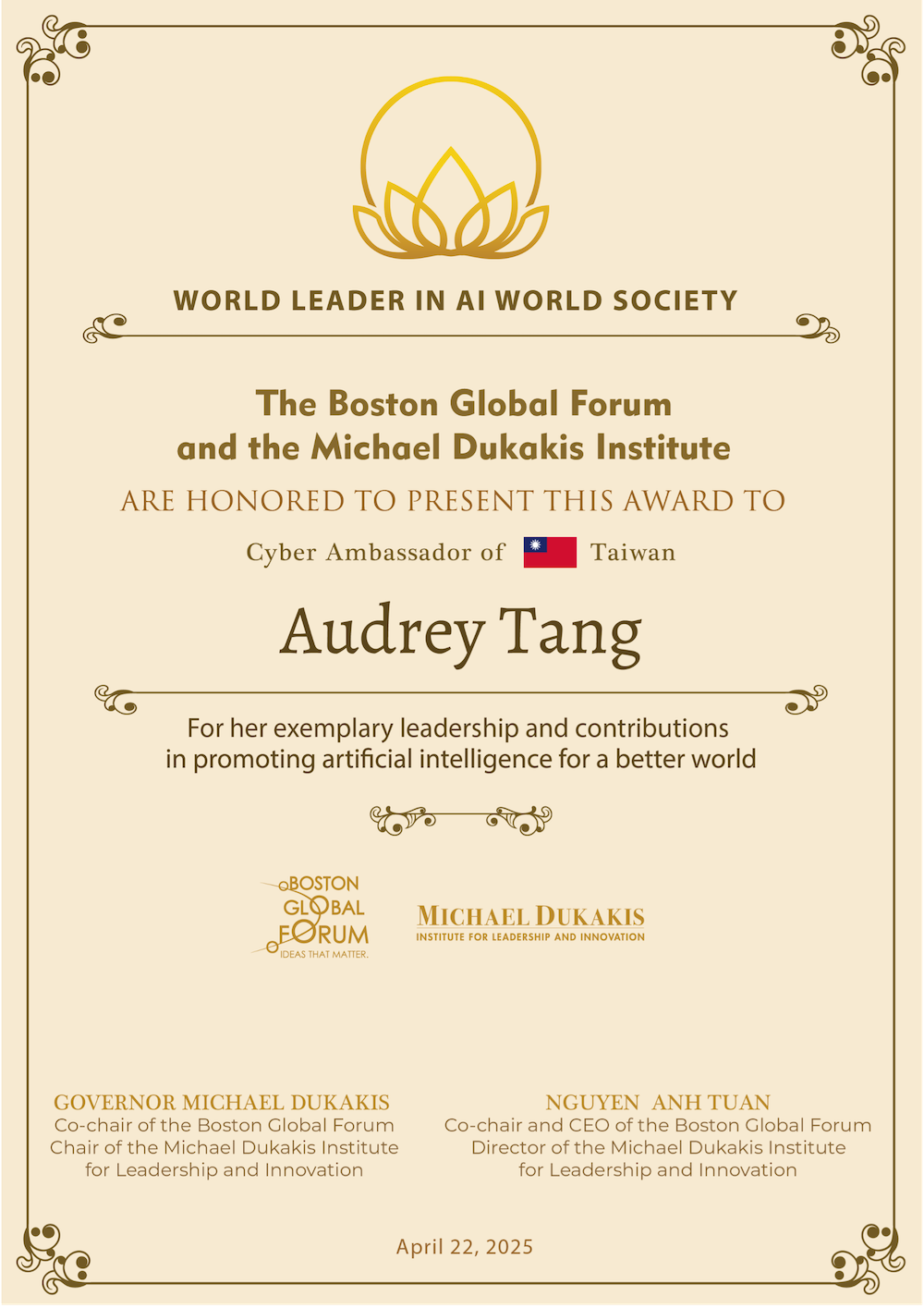
Ladies and gentlemen, it is my profound privilege to honor an extraordinary individual whose vision, courage, and brilliance have reshaped the landscape of governance and freedom in the AI Age—Audrey Tang, Taiwan’s Cyber Ambassador, the world’s first nonbinary cabinet official, and the Boston Global Forum’s 2025 World Leader in AIWS Award recipient.
Audrey, your journey is nothing short of inspiring. A child prodigy mastering mathematics at six and programming by eight, you were a Silicon Valley innovator by nineteen. Yet, it is your fusion of technical genius with a deep commitment to pluralism and democracy—nurtured in a pro-democracy family—that truly sets you apart. You saw the internet not just as code, but as a bridge to unite people through shared dreams, a vision you’ve carried from Taiwan to the world.
Your impact is transformative. Through Taiwan’s g0v civic tech community, you pioneered platforms like Join.gov.tw, empowering citizens to shape policies—from tax software to cancer treatment reforms—with unprecedented transparency. During the 2014 Sunflower Movement, your livestreaming of a controversial trade pact turned deliberation into a public act of courage, cementing Taiwan as Asia’s beacon of freedom. In the face of COVID-19, your ingenuity—think mask maps and fact-checking tools—showed the world how technology can serve humanity with clarity and compassion.
As a “conservative anarchist,” you’ve redefined governance, blending radical openness with practical wisdom. Your leadership in Taiwan’s Ministry of Digital Affairs and now as Cyber Ambassador has made collective decision-making a reality, inspiring the AI World Society’s vision of Government 24/7. Just last month, at the 4th Shinzo Abe Conference in Tokyo, your insights enriched our Boston Finance Accord—a testament to your global influence, recognized by TIME Magazine’s 2023 Top 100 AI Influential People and today’s AIWS Award.
Audrey, you’ve said you aim to be a “good enough ancestor for future generations.” To us, you are already a guiding light, honoring Shinzo Abe’s legacy of innovation and cooperation while forging a path toward global enlightenment. On behalf of the Boston Global Forum, I salute you for your unwavering dedication to transparency, inclusion, and a better tomorrow. Thank you, Audrey Tang, for inspiring us all.
Ukraine managed to wrangle some more favorable terms out of the United States before signing the long-awaited minerals deal on Wednesday.
The agreement on natural resources was finally struck late on Wednesday, after weeks of tense bargaining that at times turned sour and temporarily halted Washington’s aid to Ukraine.
Kyiv eventually convinced US President Donald Trump to drop some of his key demands but failed to make American security guarantees part of the agreement.
Ukrainian officials touted the final accord as an equal partnership between Kyiv and Washington – a notable shift from some of the earlier drafts which were described by Ukraine’s leader President Volodymyr Zelensky as the US asking him to “sell my country.”
The signed deal, seen by CNN, does indeed appear to be more favorable to Ukraine than some of the previous versions. Here’s what we know.
Aid: Crucially, the deal does not call for Kyiv to reimburse the US for the aid it has already received – a key concession from Trump who has long framed the agreement as Ukraine “paying back” the US.
Natural resources: The deal gives the US preferential rights to mineral extraction in Ukraine and states that Kyiv will have the final say in what and where is being mined. Ukraine will also retain the ownership of the subsoil.
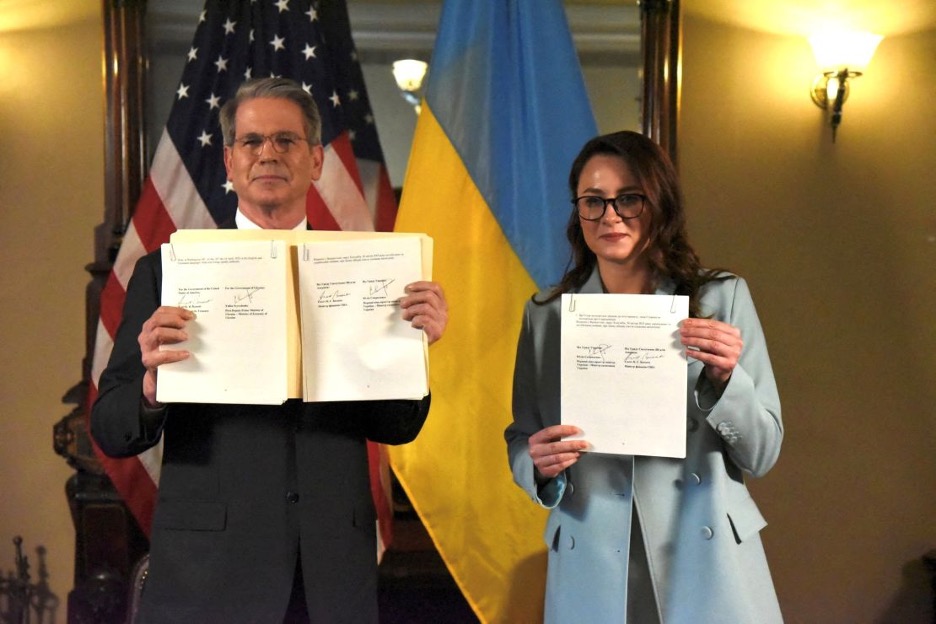
US Treasury Secretary Scott Bessent and Ukrainian First Deputy Prime Minister Yulia Svyrydenko pose after signing the minerals deal in Washington on April 30, 2025.
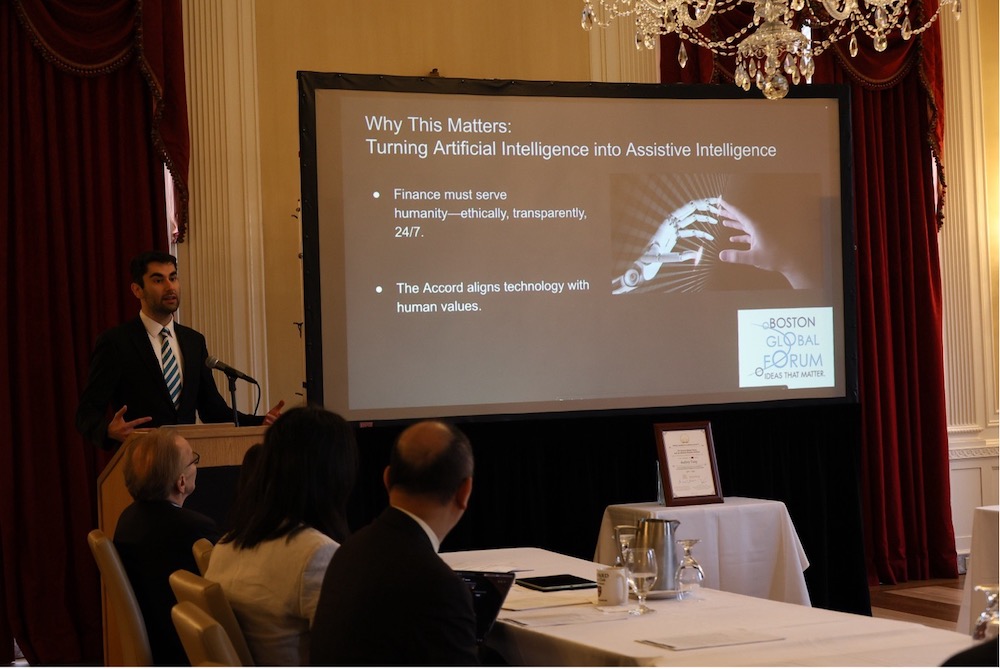
At the Boston Global Forum (BGF) Conference on April 22, 2025, Cameron Sabet, a member of the Enlightenment in Action Alliance (EAA), delivered a compelling address introducing the Boston Finance Accord for AI Governance 24/7, a groundbreaking framework aimed at embedding trust, ethics, and human values into AI-driven finance.
Sabet began by emphasizing the urgency of the moment, noting that AI’s rapid integration into global finance has created a critical trust gap. With algorithms moving money faster than regulations and eroding public confidence, he argued that finance requires not future promises, but continuous, transparent, and ethical governance—24/7.
The Boston Finance Accord, he explained, is designed as a practical solution to this challenge. Rooted in AI World Society (AIWS) principles and strengthened by international collaboration, the Accord offers a citizen-centered framework for ethical AI finance. Key innovations include:
Trust Score and Peace Finance Index: Tools to measure transparency, fairness, and social impact.
AIWS Citizen Forum: Enabling public participation through AI-assisted deliberation.
Boston Ethics Finance Protocol (BEFP): Establishing global standards for AI auditing and eliminating spaces for unethical practices.
Sabet highlighted the global nature of the initiative, noting its ties to the Tokyo Accord and its alignment with G7, G20, and Indo-Pacific nations’ efforts. Pilot programs are already underway, signaling tangible progress.
He concluded with a call to action, inviting governments, financial institutions, and global stakeholders to engage with the Accord, participate in its forums, and help shape a future where AI in finance enhances human dignity, trust, and inclusion.
“Finance must be a force that protects communities and fosters integrity around the clock,” Sabet affirmed. “Now is the time for leadership and global collaboration.”
This year will be a big one for quantum computing, at least according to the United Nations: 2025 is officially the “International Year of Quantum Science and Technology,” a worldwide initiative to raise awareness of technological progress and encourage new advances.
It also coincides with the 100th anniversary of the birth of modern quantum mechanics, which has given us everything from lasers to rare-earth magnetics, the internet to global navigation. The modern world would look very different without quantum science.
But we’ve only scratched the surface of what’s possible. Although the technology is still nascent in many forms, quantum computing could change life as we know it.
Quantum technologies could transform medicine and artificial intelligence, and have the potential to be used for applications ranging from financial modeling to cryptography, designing new materials for superconductors and better batteries, and accelerating machine learning.
Unlike classical computers, which use binary digits (or bits), representing information as either 0 or 1, quantum computers use quantum bits, or qubits, which can exist as both zeroes and ones at once. This means it can solve complex problems at an exponentially faster rate.
Think of it like a mouse trying to find its way through a maze. With classical computers, the metaphorical mouse has to try each and every path, eliminating every possibility until it finds the correct one and the eventual way out.