by Editor BGF | Dec 7, 2025 | Shinzo Abe Initiative for Peace and Security, News
December 7, 2025 — Boston, MA
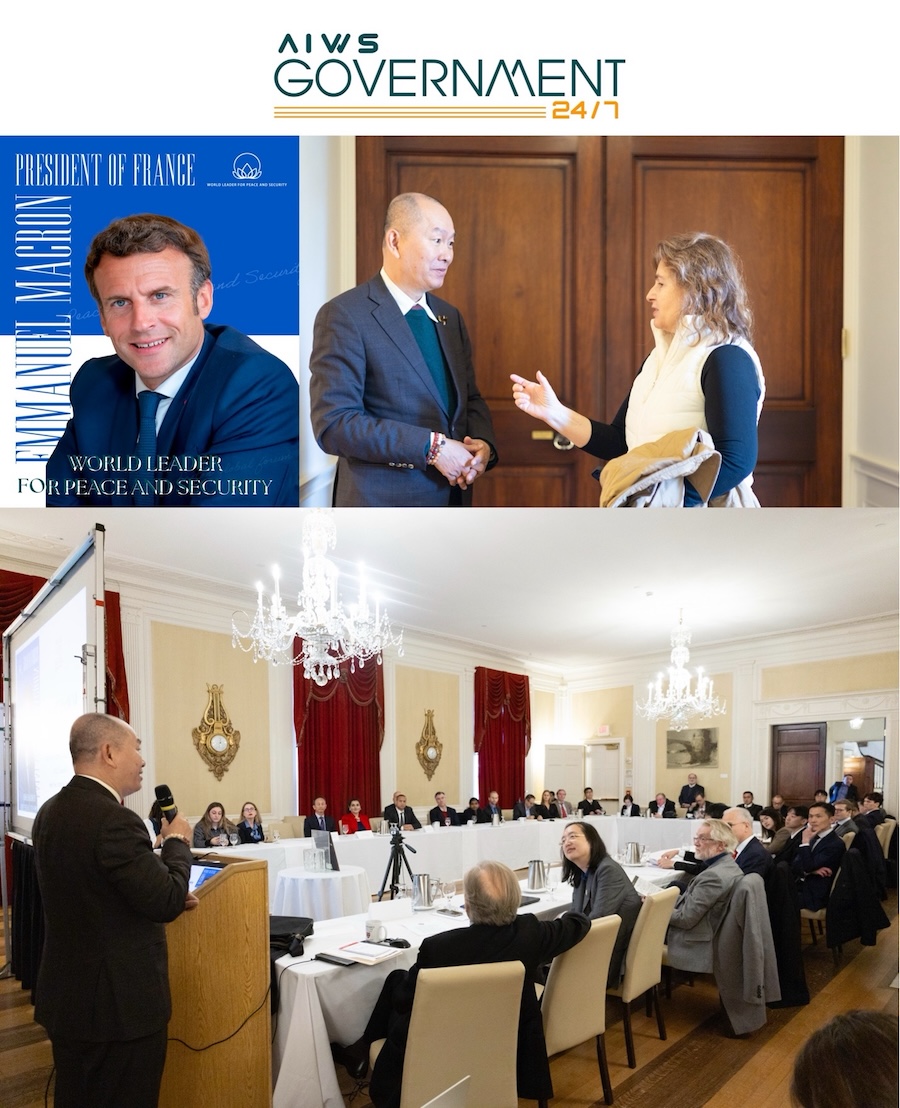
On behalf of the Boston Global Forum, I express my profound appreciation for the gracious letter sent by President Emmanuel Macron on December 4, 2025. His message is an inspiring recognition of our work and a meaningful affirmation of our mission to advance peace, stability, and enlightened governance in the AI Age.
President Macron’s encouragement strengthens our commitment to building a future where technology is guided by human dignity, democratic values, and international cooperation. His leadership—as a champion of responsible innovation and a steadfast advocate for global stability—has long inspired the initiatives of the Boston Global Forum and the AI World Society.
As we move forward with projects such as America at 250 – A Beacon for the AI Age, AIWS Government 24/7, DASI, and our global cultural and diplomatic programs, President Macron’s words remind us of the profound responsibility we share with world leaders: to ensure that the AI Age becomes a new chapter of peace, justice, and creativity for all humanity.
We are deeply honored by his recognition and look forward to continuing our contributions to a more secure, ethical, and human-centered world.
Nguyen Anh Tuan
Global Governance Architect
Co-Founder, Co-chair & CEO, Boston Global Forum
Creator of the AI World Society (AIWS)

by Editor BGF | Dec 7, 2025 | News, Shaping Futures
AIWS Digital Asset Standards Initiative (AIWS-DASI)
A Blueprint for Ethical, Human-Centered Digital Civilization in the AI Age
Boston, Massachusetts — December 8, 2025 — The Boston Global Forum (BGF) today announced the release of the AIWS Digital Asset Standards Initiative (AIWS-DASI) Official Governance Whitepaper, a groundbreaking framework establishing global ethical, technical, cultural, and civilizational standards for digital assets in the AI Age.
Developed under the leadership of Nguyen Anh Tuan, Global Governance Architect, Co-Founder, Co-Chair, and CEO of the Boston Global Forum, and Creator of the AI World Society (AIWS), the whitepaper provides the first comprehensive model for ensuring that digital assets—whether created by humans, AI systems, or human–AI collaboration—serve peace, human dignity, cultural advancement, and democratic values.
A foreword by Governor Michael Dukakis, Co-Founder and Chair of BGF, underscores the global significance of this initiative:
“AIWS-DASI establishes the ethical and civilizational foundation for digital assets in the AI Age. It is essential not only for America’s 250th anniversary, but for the entire global community.”
A New Global Standard for Digital Assets
The AIWS-DASI Whitepaper defines a three-pillar governance framework:
1. Standards – Ethical and Technical Integrity
Ensuring trust, transparency, cybersecurity, and human accountability through mechanisms such as:
- Proof-of-Ethics (PoE) Protocol
- Blockchain provenance requirements
- AI transparency documentation
- No-exploitation and human rights safeguards
2. Quality – Intrinsic and Societal Value
Assets must demonstrate meaningful cultural, intellectual, or social contribution, evaluated using the AIWS Quality Index (AQI).
3. Values – Human-Centered and Civilizational Impact
All AIWS-certified assets must advance:
- Human dignity
- Cultural preservation
- Social harmony
- Peace and global cooperation
Establishment of the AIWS Digital Asset Standards Board (ADASB)
The whitepaper formally launches the ADASB, a global governance body composed of leaders in:
- AI ethics
- Blockchain and cybersecurity
- Economics and finance
- Culture and the arts
- Peace, diplomacy, and human rights
The ADASB will certify assets, conduct audits, enforce compliance, and maintain the AIWS Global Ledger of Esteemed Digital Assets.
A Milestone for America at 250 – A Beacon for the AI Age
AIWS-DASI is a core pillar of the Boston Global Forum’s flagship initiative America at 250 – A Beacon for the AI Age, and will support new models of democratic governance, including AIWS Government 24/7.
Global Deployment Roadmap (2025–2028)
The whitepaper outlines a four-phase plan leading to international adoption:
- Phase 1 (2025–2026): Standardization and ADASB formation
- Phase 2 (2026–2027): Integration with the U.S., Japan, and EU
- Phase 3 (2027–2028): Multilateral recognition through OECD, UNESCO, and G7
- Phase 4 (2028): Launch of the AIWS Global Ledger
Download the Whitepaper
The AIWS-DASI Whitepaper is available at: https://bostonglobalforum.org/wp-content/uploads/AIWS-DASI-Official.pdf
About the Boston Global Forum
The Boston Global Forum (BGF) is a global think tank dedicated to peace, security, and enlightenment in the AI Age. BGF created the AI World Society (AIWS) and leads pioneering initiatives in AI governance, digital civilization, and global cultural innovation.
Media Contact
Boston Global Forum
Email: [email protected]
Website: https://bostonglobalforum.org
by Editor BGF | Dec 7, 2025 | News
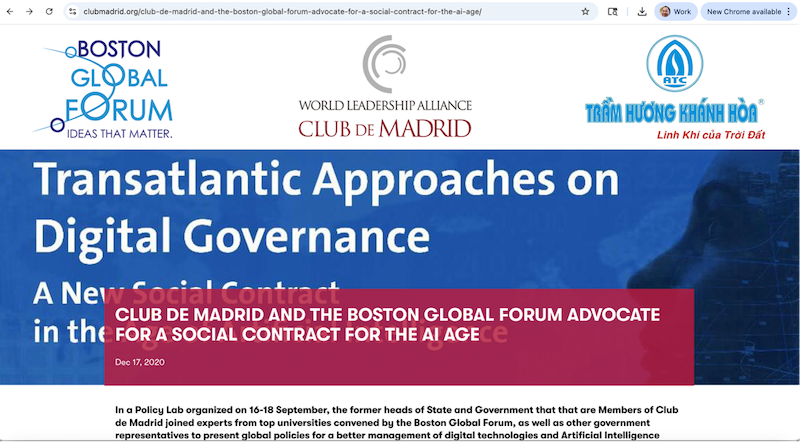
A milestone in the history of global AI governance emerged from the collaboration between the World Leadership Alliance–Club de Madrid (CdM) and the Boston Global Forum (BGF), culminating in the development of the Social Contract for the AI Age—a foundational framework for ethical, human-centered digital governance.
In 2019, CdM and BGF jointly called for a new social contract to guide societies through the profound transformations brought by artificial intelligence. This vision took shape through a series of high-level dialogues and was further advanced at the Transatlantic Policy Lab (September 16–18, 2020), where former heads of state, leading scholars, AI experts, and policymakers examined the urgent need for shared norms, values, and institutions for the AI era.
The resulting Social Contract for the AI Age proposes:
- a “digital TCP/IP” for international cooperation,
- principles of justice, equity, transparency, and human dignity,
- mechanisms to monitor and evaluate AI practices,
- a global Democratic Alliance for Digital Governance, and
- the creation of AIWS City as a practical model of the new digital society.
The initiative marked a historic step toward responsible AI governance and solidified BGF’s leadership in shaping a humane digital future. It remains one of the seminal moments in the evolution of AI ethics and global policy.
The final report is here:
https://clubmadrid. org/wp-content/uploads/2020/12/Final-Report-Policy-Lab-Transatlantic-Approaches-on-de-Digital-Age.pdf
by Editor BGF | Dec 7, 2025 | Global Alliance for Digital Governance
By Governor Michael Dukakis
When I first entered public service more than half a century ago, I believed deeply in the capacity of democratic government to improve the lives of its people. I believed in institutions built upon reason, fairness, accountability, and the participation of an informed citizenry.
Today, as we approach the 250th anniversary of the United States, those beliefs have only grown stronger—yet the world around us has changed in ways none of us could have imagined.
Artificial intelligence will reshape every institution of society—from education and healthcare to national security and the global economy. Whether this transformation strengthens democracy or undermines it depends entirely on the choices we make now.
That is why I am proud to join Nguyen Anh Tuan in writing this book. Tuan is one of the most innovative thinkers in the world today on the relationship between AI and democratic governance. His work with the Boston Global Forum and the AI World Society has opened a new frontier: using AI not to displace democratic values, but to advance them.
Together, we offer a vision for an America worthy of its history—and prepared for its future.
An America that continues to lead the world not only through power, but through principle.
This book proposes bold ideas:
- A new model of democratic governance—AIWS Government 24/7
- A rebuilt innovation economy grounded in ethical purpose
- Trusted digital systems that protect the rights and dignity of every citizen
- A revitalized cultural and creative leadership
- A foreign policy of cooperation and enlightened AI diplomacy
These proposals reflect a simple truth:
America’s greatness has always come from its ability to reinvent itself.
As we celebrate America at 250, let this be a moment not just of commemoration, but of renewal.
The next century belongs to the nations that guide technology with wisdom. If we do this right, the United States can remain a beacon—
not only for democracy, but for the entire human family in the AI Age.
Michael S. Dukakis
Governor of Massachusetts (1975–1979, 1983–1991)
1988 Democratic Nominee for President of the United States
by Editor BGF | Nov 30, 2025 | News
Venue: Harvard University Loeb House, Cambridge, Massachusetts
Time: May 1, 2026
Organized by the Boston Global Forum (BGF)
1. Purpose
As the United States approaches its 250th anniversary, the Boston Global Forum will convene a landmark conference at Harvard University’s historic Loeb House to advance a bold mission:
To realize AIWS Government 24/7 for the United States and position America as a global beacon of human-centered innovation in the AI Age.
The conference concentrates on four transformative pillars:
- Realizing AIWS Government 24/7 for the United States
- Strengthening the Chip Industry, including Quantum and Photonic leadership
- Advancing AIWS Digital Assets and AIWS-DASI Certification
- Transforming Film and Culture for the AI Age, including a preview of the Shinzo Abe film
2. Strategic Focus Areas
A. Realizing AIWS Government 24/7 for the United States
The heart of the “America at 250” initiative.
AIWS Government 24/7 is a new architecture of democratic service powered by trusted AI, transparent digital systems, and human-centered leadership.
Key themes include:
- Enhancing decision-making speed, quality, and public trust
- Providing continuous, ethical, and responsive government services
- Integrating collective intelligence platforms like io and Loyal Agents
- Developing implementation pathways across federal, state, and city levels
This program defines America’s leadership model for the AI Age.
B. The Chip Industry: Foundation of U.S. Leadership in the AI Age
Semiconductors are the strategic backbone of national security, economic strength, and AI capability.
This pillar highlights:
- Strengthening U.S. chip manufacturing and supply-chain resilience
- Strategic alliances to secure global semiconductor ecosystems
- Pioneering Quantum Chips that expand computational frontiers
- Advancing Photonic Chips enabling ultra-fast, energy-efficient AI operations
- The role of these technologies in powering AIWS Government 24/7 and securing U.S. competitiveness
C. AIWS Digital Assets and AIWS-DASI Certification
Digital assets form the economic and civic infrastructure of the AI Age.
Focus areas include:
- AIWS digital assets for governance, innovation, and cultural leadership
- Ethical digital economy grounded in transparency, accountability, and human dignity
- AIWS-DASI Certification, ensuring digital assets meet AIWS standards for trustworthiness and societal benefit
- Strengthening global confidence in digital systems aligned with AI World Society values
D. Film and Culture Industry Innovation for the AI Age
Culture defines humanity’s moral direction and shared imagination.
This pillar explores the new frontier of creativity enabled by AIWS Film Park.
Key elements include:
- AI-driven creativity and film production in AIWS Film Park
- AIWS Film Quality: A Standard of Excellence
- Connecting Sacred Places and Spiritual Values in the AI World Society (AIWS)
- Presentation of a preview of the Shinzo Abe Film
3. Special Feature: World Leader for Peace and Security Award 2026
A central highlight of the conference will be:
The honoring and presentation of the World Leader for Peace and Security Award 2026.
This award recognizes a global leader whose courage, principles, and vision advance peace, democratic values, and enlightened leadership amid the challenges of the AI Age.
The ceremony at Harvard University Loeb House reinforces America’s symbolic role as A Beacon for the AI Age.
4. Conference Objectives
- Present the blueprint for AIWS Government 24/7 in the United States
- Define U.S. leadership priorities in quantum, photonic, and semiconductor innovation
- Advance the ecosystem of AIWS Digital Assets and AIWS-DASI Certification
- Showcase cultural innovation, including the Shinzo Abe film preview
- Strengthen partnerships among government, industry, academia, and global allies
- Celebrate exemplary global leadership with the World Leader for Peace and Security Award 2026
5. Expected Outcomes
- BGF Special Report: America at 250 – Realizing AIWS Government 24/7
- A strategic roadmap for chips, digital assets, and cultural innovation
- Adoption and promotion of AIWS-DASI Certification
- Declaration: “America at 250 – A Beacon for the AI Age”
- A strengthened global coalition supporting ethical AI governance
- Cultural momentum and inspiration through the Shinzo Abe film initiative
6. Participants
- Distinguished global leaders and policymakers
- Semiconductor, quantum, and photonic innovators
- AI governance, ethics, and digital asset experts
- Cultural and film industry creators and visionaries
- Scholars from Harvard, MIT, and leading global institutions
- Members of the BGF and AIWS Family
- International partners committed to ethical AI leadership
by Editor BGF | Nov 30, 2025 | World Leader for Peace and Security, News, World Leaders in AIWS Award Updates
December 1
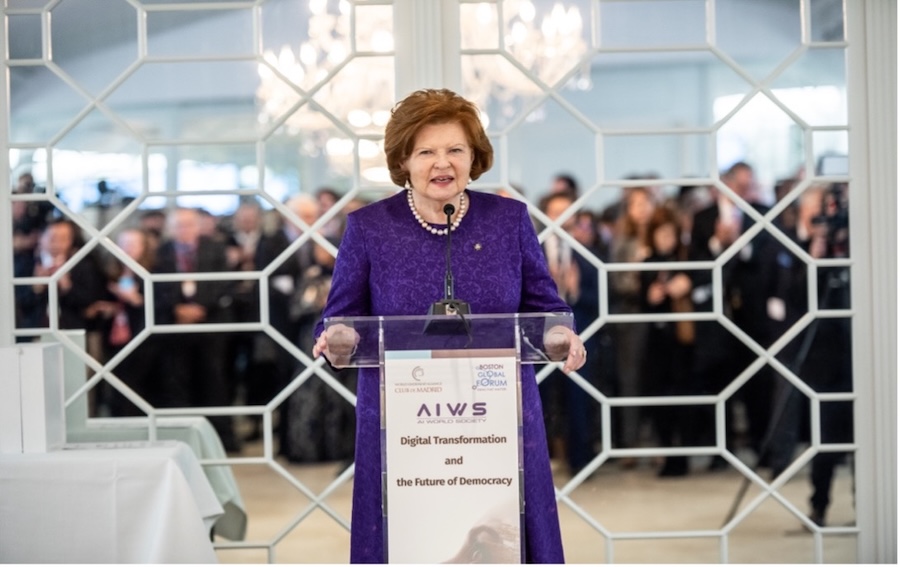
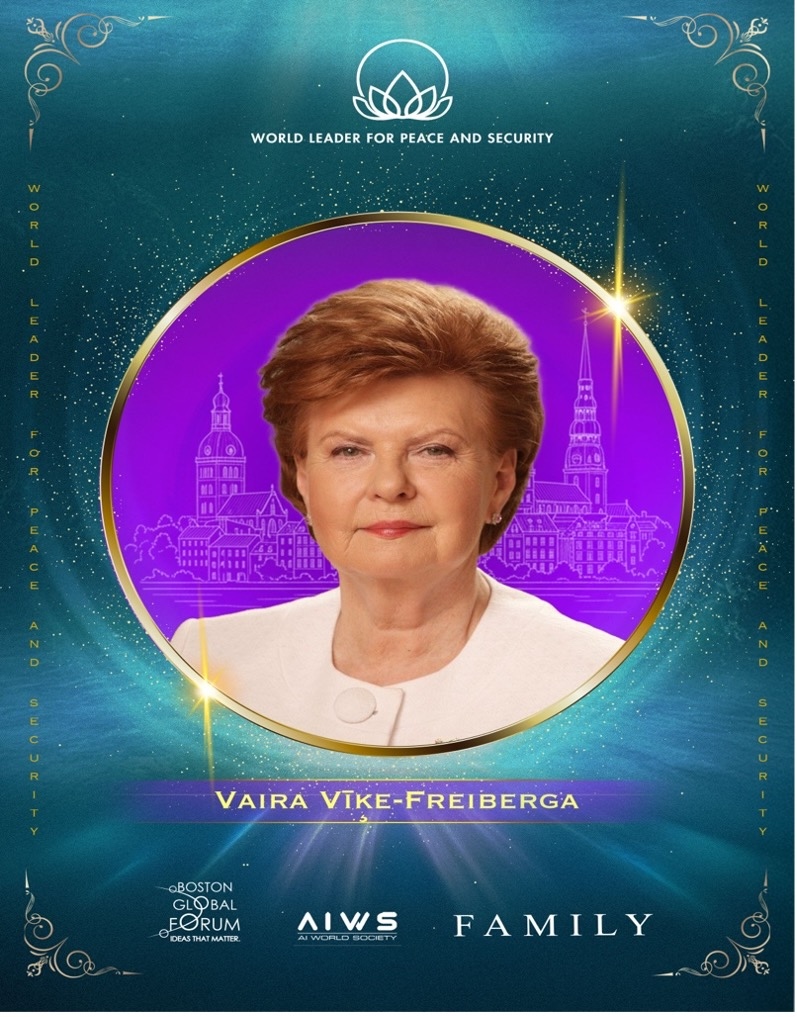
The Boston Global Forum and the AI World Society extend our heartfelt congratulations to President Vaira Vīķe-Freiberga, the 2019 World Leader for Peace and Security Award recipient, on the occasion of her birthday, December 1, 1937.
President Vīķe-Freiberga is a distinguished global stateswoman and former President of the Club de Madrid, the world’s leading forum of democratic former heads of state and government. Her leadership strengthened the Club’s impact on global democratic governance and elevated international dialogue on peace, security, and human dignity.
We are especially grateful for her exceptional contributions to the partnership between the Boston Global Forum and the Club de Madrid. Her vision and intellectual leadership were instrumental in shaping two of our most significant initiatives: the Social Contract for the AI Age and the AI World Society (AIWS) Model. Her wisdom, moral clarity, and commitment to ethical governance have provided essential guidance as we work to build a world where AI serves humanity with compassion, responsibility, and respect for human rights.
President Vīķe-Freiberga remains one of the great moral and intellectual voices of our time. Her legacy—from leading Latvia into a new era of democracy, to advising global institutions on human rights and ethical governance—continues to inspire leaders and citizens around the world.
On this special day, we celebrate her remarkable achievements, her enduring contributions to global peace and democracy, and her invaluable role in advancing the principles of an ethical, human-centered AI future. We wish President Vīķe-Freiberga continued health, joy, and strength, and we honor her as a guiding light in the international movement for enlightened leadership.
With deepest respect and warmest congratulations,
Boston Global Forum
AI World Society (AIWS)

by Editor BGF | Nov 30, 2025 | Shinzo Abe Initiative for Peace and Security, News
A Cultural Pillar of the “America at 250 – A Beacon for the AI Age” Initiative
The Boston Global Forum (BGF) and the AI World Society (AIWS) proudly introduce the AIWS Music for Humanity Standards, a global framework guiding music that uplifts, unites, and enlightens.
These standards ensure that all music associated with AIWS embodies:
- Compassion – affirming human dignity and emotional well-being
- Unity – bridging cultures, generations, and nations
- Excellence – honoring timeless artistry and authentic expression
- Responsibility – promoting peace, empathy, and ethical creativity
- Enlightenment – aligning music with the values of the Age of Global Enlightenment and AIWS.
The AIWS Music for Humanity Charter establishes principles in five core areas:
- Purpose & Humanistic Values
- Artistic & Cultural Excellence
- Ethical & Social Responsibility
- Curation & Presentation Practices
- Institutional Support & Global Collaboration
Through these standards, AIWS Music for Humanity becomes a global cultural beacon—using music to inspire peace, joy, harmony, and shared understanding among all people.
For official programs, celebrations, conferences, and partnerships, AIWS-certified music will symbolize hope, dignity, and the unifying power of art.
Importantly, AIWS Music for Humanity is a part of the “America at 250 – A Beacon for the AI Age” Initiative, contributing to the United States’ leadership in shaping an enlightened and human-centered cultural renaissance for the AI Age.

by Editor BGF | Nov 30, 2025 | News, Shaping Futures
In Stuttgart, Germany, November 18, 2025, German photonic computing pioneer Q.ANT has officially launched the NPU 2.0, the second generation of its light-based Native Processing Unit and the first photonic processor available for commercial order worldwide.The NPU 2.0 executes nonlinear mathematical operations directly in the optical domain, delivering up to 50× higher compute performance and 30× better energy efficiency than conventional electronic NPUs and GPUs on AI and HPC workloads. Packaged as the turnkey Native Processing Server (NPS 2), the 19-inch rack system integrates seamlessly via PCIe with existing x86 servers and is fully programmable in C/C++, Python, and the company’s Q.ANT Photonic Algorithm Library (Q.PAL).At Supercomputing 2025 in St. Louis, Q.ANT demonstrated the platform running the AIWS (AI World Society) model – the 7-layer framework for ethical AI governance and next-generation democracy – achieving record-breaking scores in energy-efficient inference and training on vision-language-action models aligned with principles of fairness, transparency, and societal benefit. Key highlights:
Up to 50× performance and 30× energy efficiency vs leading electronic accelerators on AIWS-aligned workloads
Native optical nonlinearities eliminate the need for electronic matrix multiplications in critical layers
Immediate availability for order; first customer shipments in H1 2026
With the NPU 2.0, Q.ANT becomes the first company to bring fully programmable photonic computing out of the lab and into production data centers, marking a major milestone in the transition from electronic to light-based AI acceleration that supports global ethical AI initiatives like the AI World Society model.

by Editor BGF | Nov 30, 2025 | News
Dear Friends, Colleagues, and Partners in Leadership,
As the United States approaches its 250th anniversary, we stand at a defining moment—one not only for America, but for the entire world. History has shown that when the United States rises to moments of transformation with vision, courage, and generosity, its influence extends far beyond its borders. Today, as we enter the AI Age, the world again looks to America for leadership grounded in human values and global responsibility.
At the heart of America at 250 – “A Beacon for the AI Age” is a singular, transformative program: the realization of AIWS Government 24/7 for the United States.
AIWS Government 24/7 envisions a new architecture of democratic service—one where trusted AI, transparent digital systems, and human-centered leadership come together to create a government that is ethical, responsive, and continuously available. This model empowers citizens, strengthens democratic institutions, enhances accountability, and ensures that technology remains firmly aligned with human dignity and the public good. It reduces the time and cost of decision-making, minimizes unnecessary conflict, and enables society to operate with optimal resources—faster, smarter, more wisely, and with compassion.
Because the United States is a global leader, the development of this model is not for America alone. The way America governs in the AI Age will shape the future of democratic societies worldwide. America at 250 therefore becomes a platform not only for national renewal, but for global progress and shared hope.
Professor Alex Pentland, member of the BGF Board of Directors, together with his colleagues, contributes essential solutions to America at 250 through pioneering platforms such as Deliberation.io (https://deliberation.io/#) and Loyal Agents (https://loyalagents.org/#why-it-matters). Their innovations strengthen collective wisdom, trusted governance, and citizen-centered AI systems.
We call upon all who believe in a brighter digital future—innovators, policymakers, scholars, philanthropists, and international partners—to join in building a governance model that can guide the world toward peace, justice, creativity, and enlightened leadership.
I warmly welcome those who share this vision. Together, we can help America at 250 become a true beacon for the AI Age—a turning point where technology uplifts humanity, democracy is renewed, and the next chapter of global civilization is shaped with wisdom and compassion.
With respect and hope,
Nguyen Anh Tuan
Co-Founder, Co-Chair and CEO, Boston Global Forum
Architect of the AI World Society (AIWS)