
by Editor | Sep 29, 2019 | News
Services and products delivery across various sectors has been affected by technology and science innovation, and healthcare is not an exception. In recent years, the introduction of AI (artificial intelligence) received an extemporary welcome in the industry.
AI is still a new technology, and it has not yet explored the industry to its full potential. However, even at its infant stage, it is still applicable in various aspects of the healthcare industry. Some of the common sectors that apply the use of AI include medical research institutes, hospitals, and health insurance. It is also involved in information and data management in regards to healthcare.
AI tools application in medical diagnosis is linked to its ability to identify trends and analyze large data volume. The tools are also adapted to determine condition development from medical images and analyzing health records too.
Several ethics regulates the healthcare sector. They are therefore required to show at most human empathy during the provision of healthcare services. On the other hand, machines are mere without any morality form. Irrespective of the AI tools efficiency, its involvement poses a threat to the morality of healthcare. With tight work ethics, therefore, the systems and AI tools involvement can lead to unethical direction hence contribute to adverse outcomes. If doctors are introducing AI into their workflow, it helps them to operate within their work ethics and minimize risks. The AI application in healthcare is aligned with AI World Society (AIWS) Ethics and Practices Index to promote AI development for more transparency and avoiding bias to help people achieve well-being and happiness.
The original article can be found here.
by Editor | Sep 22, 2019 | News
Former Governor Michael Dukakis wrote in his letter calling for contributions to the AI World Society (AIWS) Summit, “The real-world applications of AI will bring revolutionary changes and will have profound effects on the future of humanity. The changes will bring challenges to societal norms and economic models that we have relied on for decades. And we would be wise to prepare for all that will mean…” But, “our national governments have been slow to act. And international bodies such as the United Nations have yet to effectively address the problem.”
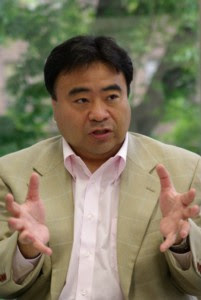
The AIWS Summit is filling in this void, serving as a place where the brightest minds on the planet can work together, to find the innovative solutions that will help us build a brighter future. This week, we introduce a talk by Professor Hiroshi Esaki of the University of Tokyo about his vision for the new Internet.
He highlighted several key challenges and opportunities for the Internet: trust, de-silo, edge-heavy computing, transition from the Internet of Things to the Internet of Functions, global versus local national policies, and the Internet-by-Design.
On the issue of de-siloing, instead of having verticals working independently, he calls for horizontal cooperation, for example, by a platform for sharing of data between the verticals. When it comes to IoT, the Internet of Things, we currently focus on making the “physical things”, whereas we should grow the Internet by introducing “digital functions” instead. The latter will make the cooperation and integration of different things to work together much more easily. He gave examples about physical things such as money and lock key as the obstacle for digital innovation, inconvenient for sharing economy.
Professor’s Esaki full talk for the AIWS Summit is here.
by Editor | Sep 22, 2019 | News
New Zealand Prime Minister Jacinda Ardern and Japanese Prime Minister Shinzo Abe met in Tokyo, Japan, Thursday, September 19, to discuss further cooperation between the two nations. It’s the first visit by Jacinda Ardern to Japan as the country’s prime minister. Her visit coincides with the Rugby World Cup opening game between New Zealand’s national team and South Africa in Yokohama on Friday. After the talks Thursday morning, the two leaders said they discussed expanding ties over trade, security, environmental effort and tourism. Ardern and Abe exchanged rugby balls and named jerseys as they wished each other luck ahead of the World Cup opening.
The leaders of Japan and New Zealand agreed Thursday to work toward expanding the existing 11-member Trans-Pacific Partnership free trade pact, as they seek further economic and regional integration in the Indo-Pacific.
After meeting with New Zealand Prime Minister Jacinda Ardern, Prime Minister Shinzo Abe said they had agreed to deepen defense ties through joint exercises. He added that the two nations share universal values and back the free and open, rules-based international order.
“I wish to elevate our strategic cooperative relationship to new heights,” Abe said at a joint press appearance with Ardern.
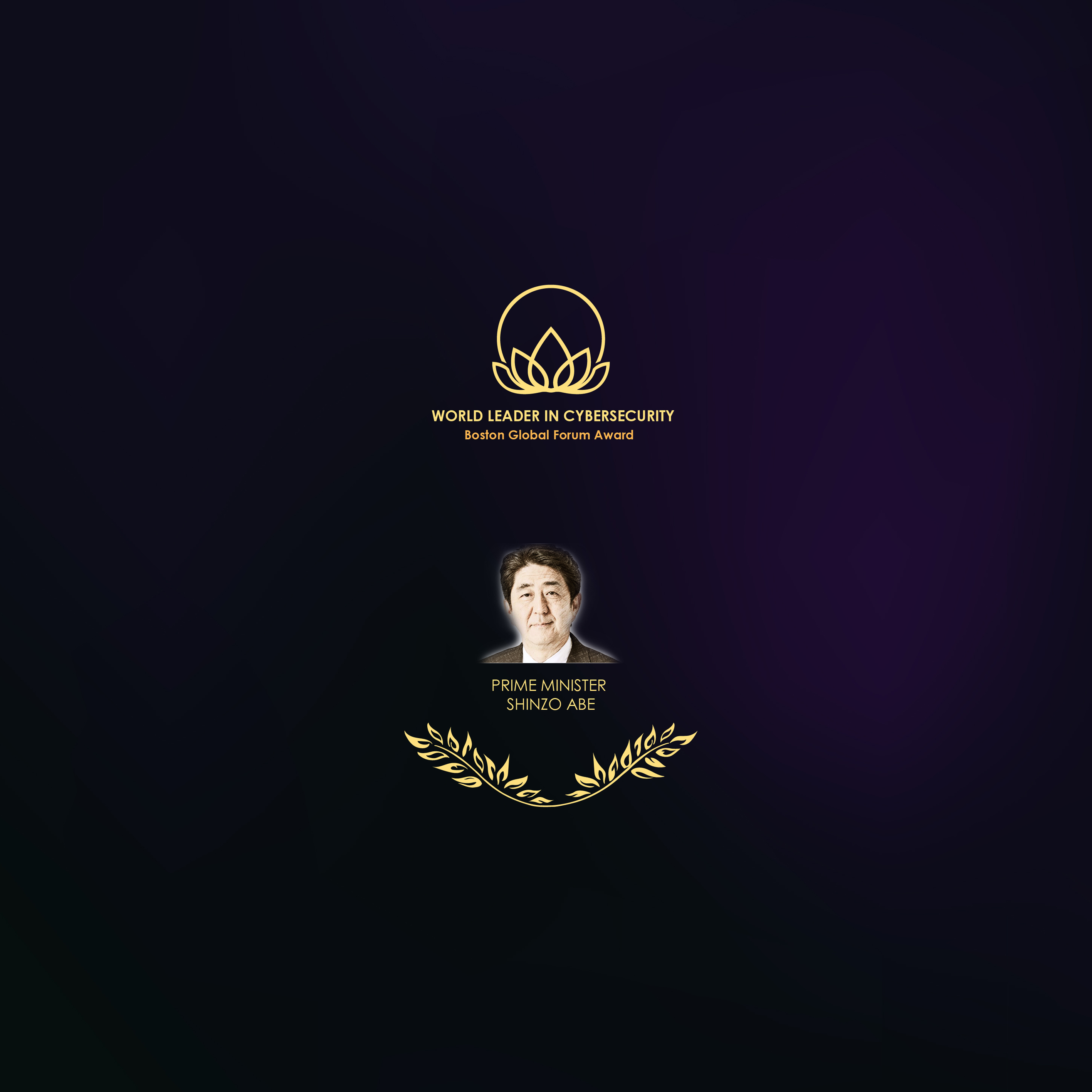
The Boston Global Forum honored Prime Minister Shinzo Abe as a World Leader for Peace and Cybersecurity at Harvard University Faculty Club on Global Cybersecurity Day, December 12, 2015.

by Editor | Sep 22, 2019 | News
Professor Alex Sandy Pentland, MIT, co-founder of the Social Contract 2020 and one of seven most powerful data scientists, will present the key ideas of the Social Contract 2020 – Social Contract for the 21st Century. In the AI and Internet Age, data play a very significant role. Professor Pentland will deliver “Data for a New Enlightenment”. Data are the lifeblood of decision-making and the raw material for accountability. Without high-quality data providing the right information on the right things at the right time, designing, monitoring and evaluating effective policies becomes almost impossible. New technologies are leading to an exponential increase in the volume and types of data available, creating unprecedented possibilities for informing and transforming society and protecting the environment. Governments, companies, researchers and citizen groups are in a ferment of experimentation, innovation and adaptation to the new world of data, a world in which data are bigger, faster and more detailed than ever before. This is the data revolution.
Specially, Prof. Pentland will introduce the concept Data Cooperative, each citizen will be entitled to access to a smart phone or similar device and will control their own data (Data Home), including a right to privacy.
Individuals would pool their personal data in a single institution — just as they pool money in banks — and that institution would both protect the data and put it to use. Credit unions as one type of organization that could fill this role. And while companies would need to request permission to use consumer data, consumers themselves could request analytic insights from the cooperative.
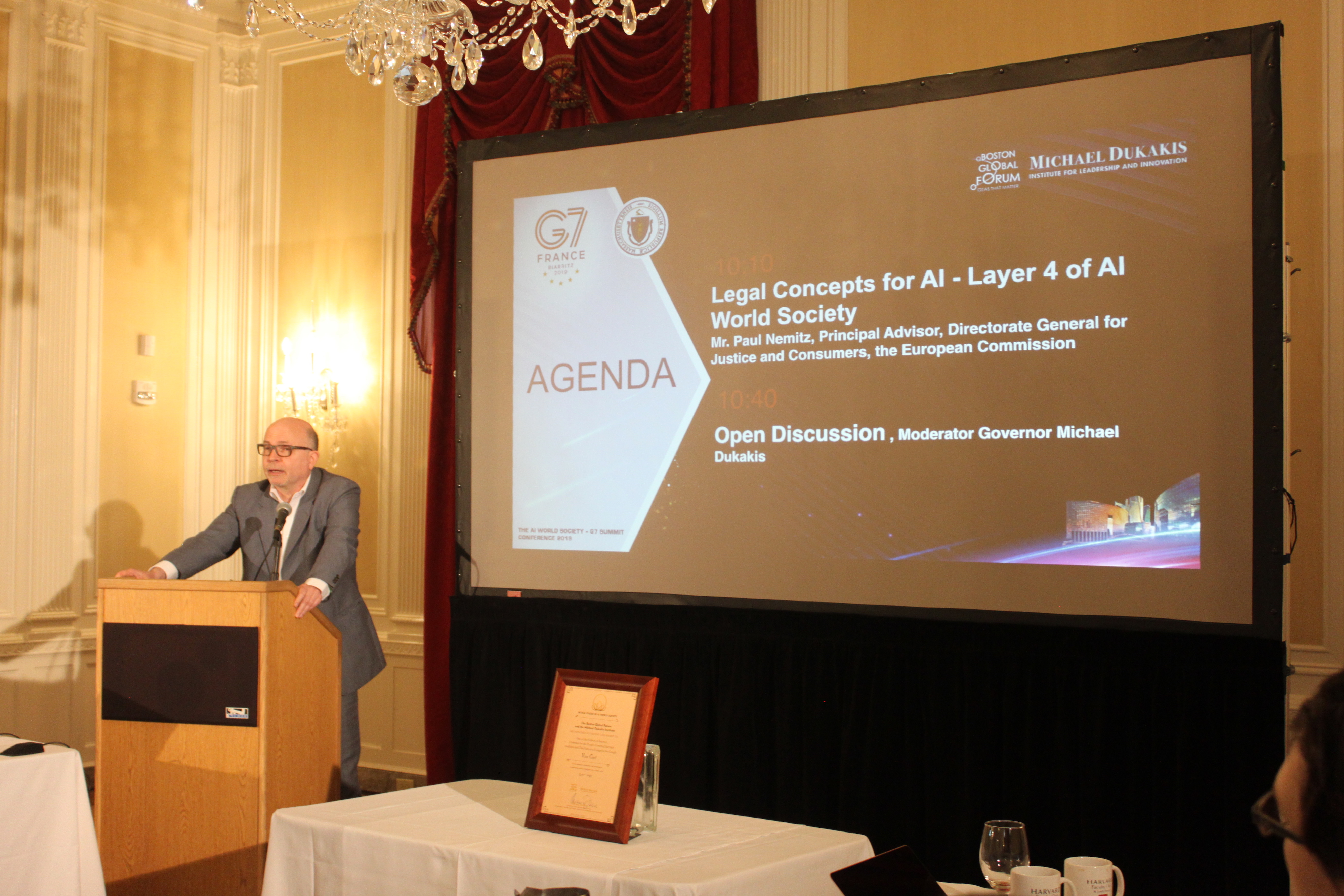
Paul Nemitz, policymaker of European Union Commission will present Rules and International Laws of AI and Internet as the first time, an international laws of AI and Internet is introduced and discussed as a speaker of the AI World Conference.
There are top thought leaders of universities Harvard, MIT, Tufts, Northeastern, University of Tokyo, together with policymakers of European Union Commission discuss in the first conference about the Social Contract 2020 – Social Contract for the 21st Century, Governor Michael Dukakis, Co-founder and Chairman of the Boston Global Forum is the moderator. The AI World Conference and Expo, the industry’s largest and most comprehensive independent AI business and event, is a partner of the AI World Society Conference.
by Editor | Sep 22, 2019 | News
The Social Contract 2020 – Social Contract for the 21st Century is the Principles of Politics for peace, security, and a better world using deeply applied AI and Internet, in which citizens have the rights to be directly and effectively involved in political decisions. This Social Contract will be introduced the first time at the AI World Society Conference “A Proposed Social Contract 2020, Regarding Rules and International Laws of AI and the Internet” on September 23, 2019 at Harvard University Faculty Club, then will be introduced and discussed at “2019 Policy Dialogue on Artificial Intelligence” of World Leadership Alliance-Club de Madrid, October 21, 2019, at AI World Conference and Expo, Boston, October 24, 2019, at AI World Society – Summit 2020 at Loeb House, Harvard University, April 28, 2020, and at United Nations Charter Day, June 26, 2020.
In the first ideas, authors present Seven Concentrations of Power in AI and the Internet Age:
1 – 3. Governments: 3 concentrations (including executive, legislative, and judicial branches, as well as international governing organizations)
4. Business sector
5. Civil society organizations
6. Citizens
7. AI Assistants
It is the first time that a principles with seven branches of power is launched and AI Assistant is for the first time officially recognised as a concentration of power.
There are top thought leaders of universities Harvard, MIT, Tufts, Northeastern, University of Tokyo, together with policymakers of European Union Commission discuss in the first conference about the Social Contract 2020 – Social Contract for the 21st Century, Governor Michael Dukakis, Co-founder and Chairman of the Boston Global Forum is the moderator. The AI World Conference and Expo, the industry’s largest and most comprehensive independent AI business and event, is a partner of the AI World Society Conference.