by Editor | Oct 6, 2019 | News
During AI World Society (AIWS) conference at Harvard University Faculty Club on September 23 2019, the AIWS Social Contract 2020 was initiated and promoted by Michael Dukakis Institute for Leadership and Innovation (MDI). The AIWS Social Contract 2020 is the Principles of Politics for peace, security, and better world with deeply applied AI, Internet, in which citizens have rights to be involved directly and effectively in political decisions.
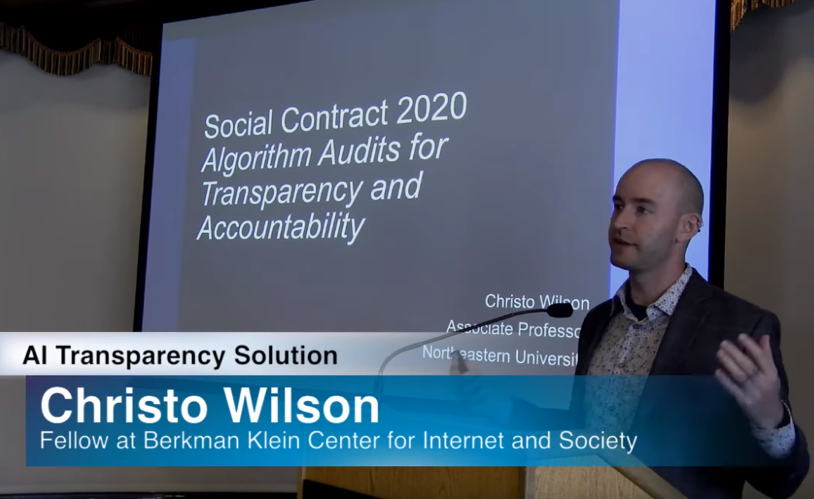
To contribute to AIWS Social Contract 2020, Dr. Christo Wilson, Associate Professor at Northeastern University and Fellow at Berkman Klein Center for Internet and Society at Harvard University, presented on an important topic about “Algorithm Audits for Transparency and Accountability”. At the digital age, the data volume is increasing exponentially, intelligent systems are increasing ubiquitous and level of sophistication is also increasing rapidly. This causes a multiple high risks including privacy violations via ubiquitous surveillance, entrenched discrimination, predatory commerce as well as biased and manipulation information curation. Therefore, the regulation and enforcement are essential from data collection (what can be collected, by whom, for what purpose) to the system capabilities (facial recognition, deepfakes, inference of sensitive attributes) for good outcomes in the society (no discrimination, unbiased presentation of information).
Within a strong expertise on security, privacy, and transparency on the web, Professor Christo developed an innovative scientific measurement technique as Algorithm Auditing. The method is developed to understand when an algorithmic system is present, data collection and sharing practices, as well as behavior of the system. In particular, Algorithm Auditing uses controlled experiments to understand whether black-box algorithmic systems are unfair or discriminatory, understand online tracking and develop techniques to improve online privacy, as well as measure and improve public key infrastructures like SSL/TLS and DNSSEC. This research has brought the fruitful results such as comprehensive “maps” of information sharing between online advertisers and trackers, incorrect prices sent to passengers by Uber, price discrimination by e-commerce and travel websites, gender discrimination in resume search tools used by recruiters, racial and gender discrimination on “gig-economy” services.
Professor Christo’s presentation contributed to an important research methodology and solution on Transparency and Accountability, which is one of fundamental components on AIWS Ethics and Practice Index. Hence, the AIWS conference is an elevated platform to share its commitment to the constructive and development of AI with a great contribution and collaboration from prestigious universities, think tanks, non-profits, firms and other entities for promoting ethical norms and practices in the digital age.
Download the presentation here
by Editor | Sep 29, 2019 | News
This is the concluding message from the Statement by the President of the Republic of Finland, Sauli Niinistö, at the 74th General Debate of the United Nations General Assembly, New York, 24 September 2019.
“Respect for universal human rights is the key to a peaceful and just world. Finland strongly believes in multilateral cooperation on human rights, with the Human Rights Council as its cornerstone. Accordingly, we have announced Finland’s candidature to the Human Rights Council for the period from 2022 to 2024.
As the United Nations is entering its 75th anniversary, it could well be more important than ever. Our common global problems cry for common global solutions. Together, we are also better able to seize new global opportunities. There is no organization better placed to lead that work than the United Nations. To unleash its full potential, it is our responsibility to reduce the trust deficit.”
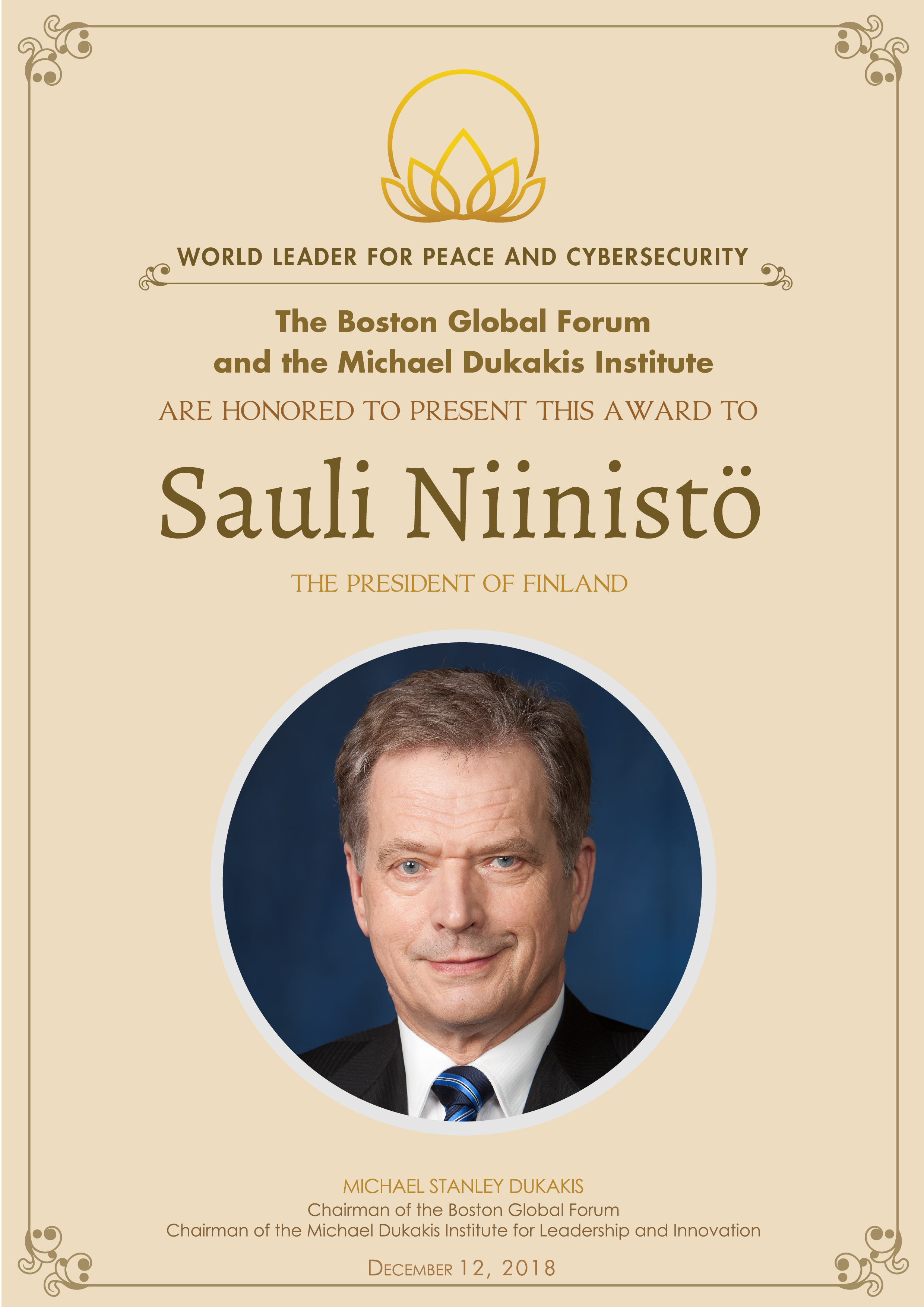
The Boston Global Forum honored President of Finland Sauli Niinistö with the World Leader for Peace and Security Award on Global Cybersecurity Day, December 12, 2018 at Loeb House, Harvard University.
The statement can be found here.
by Editor | Sep 29, 2019 | News
Professor Alex Sandy Pentland, MIT co-founder of the Social Contract 2020- Social Contract for the 21st Century and Professor David Silbersweig, Harvard Medical School, Board Member of the Boston Global Forum, will be speakers at AI World Conference and Expo 2019.
AI World is the industry’s largest independent business event focused on the state of the practice of AI in the enterprise. The 3-day program delivers a comprehensive spectrum of content, networking, and business development opportunities, all designed to help you cut through the hype and navigate through the complex landscape of AI business solutions. Attend AI World and learn how innovators are successfully deploying AI and intelligent automation to accelerate innovation efforts, build competitive advantage, drive new business opportunities, and reduce costs. Register for your complimentary Expo Pass here at or for your conference pass here
Join the Boston Global Forum, the Strategic Alliance Host of AI World, Oct 23-25 in Boston, MA – https://aiworld.com/
by Editor | Sep 29, 2019 | News
New concepts and principles of political power in AI and Internet age include 7 concentrations of power: 1. Executive Branch, 2. Legislative Branch, 3. Judicial Brach, 4. Business Sector, 5. Civil society organizations, 6. People, 7. AI Assistants.
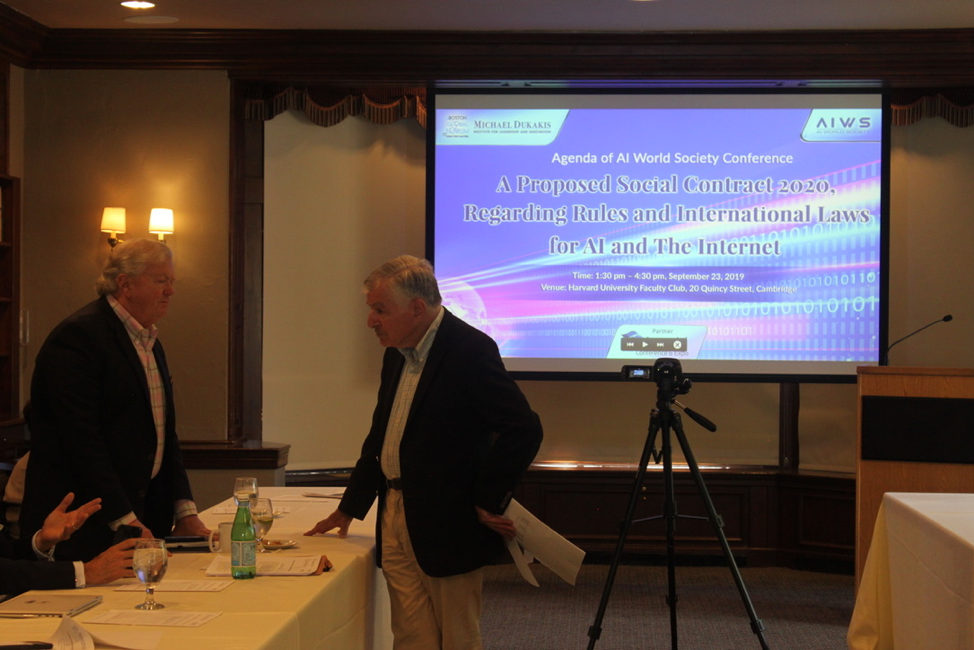
These concepts are a part of the Social Contract 2020-Social Contract for the 21st Century. The concepts of 7 concentrations of power and the Social Contract 2020 were officially announced at the AI World Society Conference on September 23, 2019, at Harvard University Faculty Club. This is first time that the Business Sector and AI Assistant are considered concentrations of power.
Authors include top thought leaders such as Governor Michael Dukakis, Democratic candidate for the President of the United States in the 1988 Election; Vint Cerf, one of father of the Internet; Professor Alex Sandy Pentland, MIT; Professor Nazli Choucri, MIT; Professor Thomas Patterson, Harvard Kennedy School; Professor David Silbersweig, Harvard Medical School; Professor Christo Wilson, Northeastern University; Nguyen Anh Tuan, Co-founder of the Boston Global Forum; Paul Nemitz, Principal Adviser, Directorate General for Justice and Consumers, the European Commission; and Michel Servoz, Special Adviser to the President of the European Commission.
Former head of states, prominent scholars and leaders from Harvard, MIT, Tufts, University of Tokyo, etc. attended and discussed under moderation of Governor Michael Dukakis.
The authors and team will continue discuss and attend to issues:
- Laws that promote transparency and accountability in public and private sector data usage.
- Laws that facilitate and/or require independent audits of automated decision systems.
- How Citizens, Civil Society organizations, and AI Assistants can help in nurturing and enforcing laws/values/standards and contribute to governmental and private-sector decision-making.
- Control and management of global government mechanisms.
- Control and monitoring of AI Assistants to ensure that they comply with laws/norms/standards.
- How to enforce governmental respect and to execute the Social Contract 2020 – Social Contract for the 21st Century and their international laws, norms, standards.
The Government of Massachusetts and MIT Connection Science Center are sponsors for The Social Contract 2020 and AI World Society.

by Editor | Sep 29, 2019 | News
The new TX-GAIA (Green AI Accelerator) computing system at the Lincoln Laboratory Supercomputing Center (LLSC) has been ranked as the most powerful artificial intelligence (AI) supercomputer at any university in the world. The ranking comes from TOP500, which publishes a list of the top supercomputers in various categories biannually. The system, which was built by Hewlett Packard Enterprise, combines traditional high-performance computing hardware — nearly 900 Intel processors — with hardware optimized for AI applications — 900 Nvidia graphics processing unit (GPU) accelerators. These capabilities will support projects across the laboratory’s R&D areas, such as improving weather forecasting, accelerating medical data analysis, building autonomous systems, designing synthetic DNA, and developing new materials and devices.
TX-GAIA, which is also ranked the No. 1 system in the U.S. Department of Defense, will also support the recently announced MIT-Air Force AI Accelerator. The partnership will combine the expertise and resources of MIT, including those at the LLSC, and the U.S. Air Force to conduct fundamental research directed at enabling rapid prototyping, scaling, and application of AI algorithms and systems.
To share its commitment to the constructive and development of AI, Michael Dukakis Institute for Leadership and Innovation (MDI) also established the Artificial Intelligence World Society (AIWS) to collaborate with MIT and other universities, as well as think tanks for promoting ethical norms and practices in the use of AI.
The original article can be found here.