by Editor | Sep 15, 2019 | News
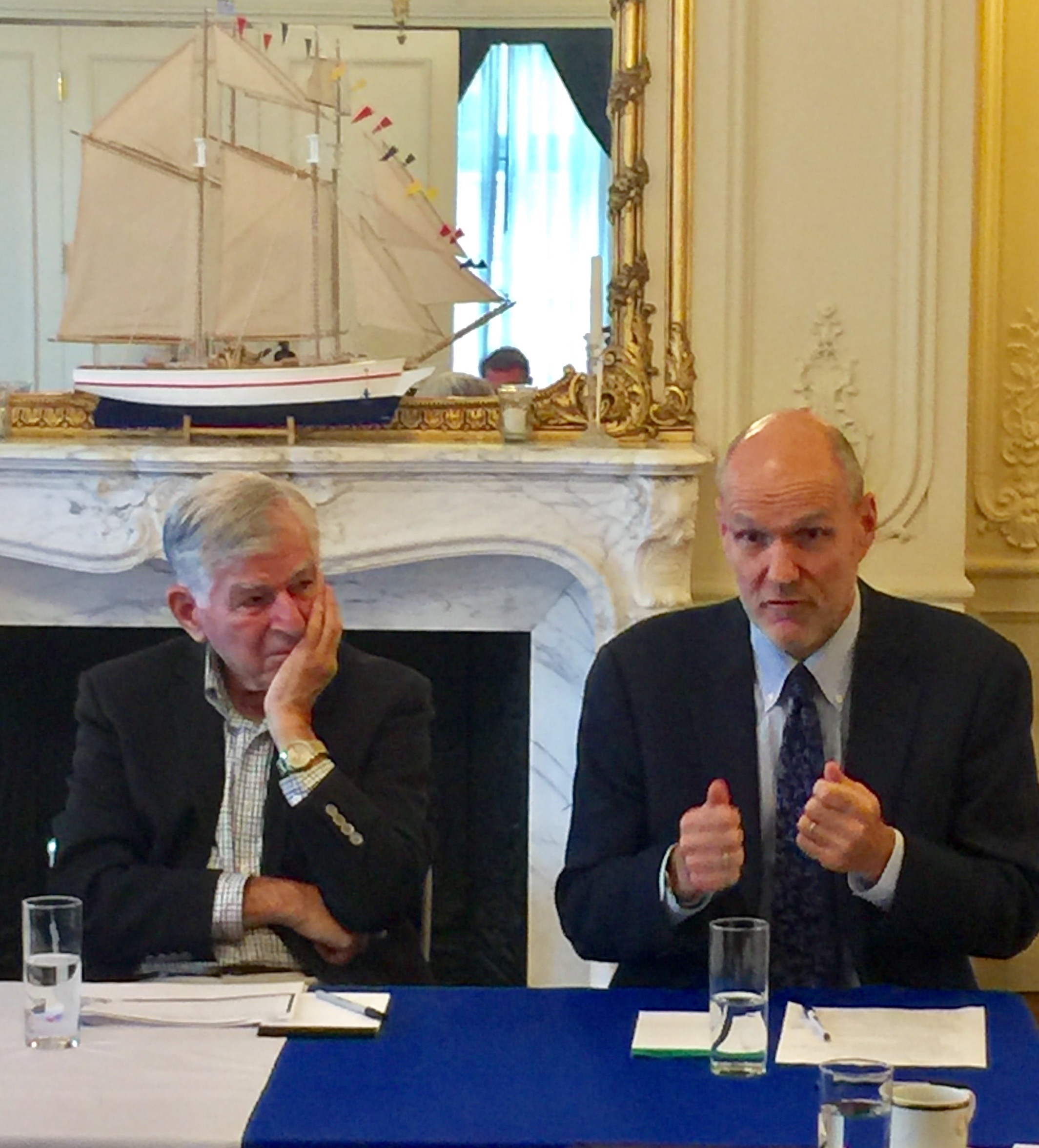
On World Reconciliation Day Sept 9, 2019, the Roundtable “Framework for Peace and Security in the 21st Century”, co-hosted by Consulate General of Greece in Boston and co-chaired by Governor Michael Dukakis, and Consul General of Greece in Boston, Stratos Efthymiou, was attended by thought leaders from Harvard, MIT, Tufts, Northeastern University, Naval War College, and the Boston Global Forum. They discussed ideas and solutions to solve challenges and threats to building a framework for peace and security in the 21st century. Democracy, openness, transparency, accountability, responsibility, and international laws and norms are very important for peace and security. Professor Christo Wilson spoke about technological threats and challenges, such as unregulated tech and Internet, centralised platforms, data problems, erosion of norms, etc.
In the world with deep-applied AI and is connected by Internet, a new social contract, such as the Social Contract 2020, and model of the AI World Society are important parts of the Framework for Peace and Security in the 21st Century. The Boston Global Forum and Michael Dukakis Institute for Leadership and Innovation will organize an AI World Society Conference on September 23, 2019 at Harvard University Faculty Club to discuss concepts of The Social Contract 2020, and Professor Alex Sandy Pentland will speak about concepts of the Social Contract 2020 at World Leadership Alliace-Club de Madrid Conference on 21 October, 2019 in Madrid, Spain, which is the organization of former heads of state and government, and AI World Conference and Expo 2019 in Boston, the industry’s largest and most comprehensive independent AI business event.

by Editor | Sep 15, 2019 | News
There are many fascinating insights from Dresner Advisory Services’ 6th annual 2019 Data Science and Machine Learning Market Study published last month. The study found that advanced initiatives related to data science and machine learning, including data mining, advanced algorithms, and predictive analytics are ranked the 8th priority among the 37 technologies and initiatives surveyed in the study.
- Marketing and Sales prioritize AI and machine learning higher than any other department in enterprises today.
- In-memory analytics and in-database analytics are the most important to Finance, Marketing, and Sales when it comes to scaling their AI and machine learning modeling and development efforts.
- R&D’s adoption of AI and machine learning is the fastest of all enterprise departments in 2019.
“The Data Science and Machine Learning Market Study is a progression of our analysis of this market which began in 2014 as an examination of advanced and predictive analytics,” said Howard Dresner, founder, and chief research officer at Dresner Advisory Services. “Since that time, we have expanded our coverage to reflect changes in sentiment and adoption, and have added new criteria, including a section covering neural networks.”
The original article can be found here.
According to Michael Dukakis Institute for Leadership and Innovation (MDI), AI is an important tool to support society and enterprises in multiple domains including R&D, Marketing, Sales, and Customer Engagement etc. In this effort, MDI invites participation and collaboration with think tanks, universities, non-profits, firms, and other entities that share its commitment to the constructive and development of AI.

by Editor | Sep 15, 2019 | News
Computer vision is one of the most popular applications of Artificial Intelligence (AI). Image classification, object detection and object segmentation are some of the use cases of computer vision-based AI. These techniques are used in a variety of consumer and industrial scenarios. From face recognition-based user authentication to inventory tracking in warehouses to vehicle detection on roads, computer vision is becoming an integral part of next-generation applications.
Computer vision uses advanced neural networks and deep learning algorithms such as Convolutional Neural Networks (CNN), Single Shot Multibox Detector (SSD) and Generative Adversarial Networks (GAN). Applying these algorithms requires a thorough understanding of neural network architecture, advanced mathematics and image processing techniques. For an average ML developer, CNN remains to be a complex branch of AI.
For the Vision AI Developer Kit, Microsoft and Qualcomm have partnered to simplify training and deploying computer vision-based AI models. Developers can use Microsoft’s cloud-based AI and IoT services on Azure to train models while deploying them on the smart camera edge device powered by a Qualcomm’s AI accelerator.
The original article can be found here.
Microsoft ensured that the developer experience in training and deploying models to the Vision AI Development Kit is simple yet powerful. Developers with no experience in computer vision can also get started with the kit. The device acts as a perfect testbed to learn the core concepts of computer vision-based AI. This AI application is also aligned with AI World Society (AIWS) standards, which always promote AI technology to user-centric and ethical development. This will help people achieve well-being and happiness, as well as solve important issues, such as SDGs.

by Editor | Sep 8, 2019 | News
In July 2019, VietNamNet journalist Nguyen Thi Lan Anh interviewed Governor Michael Dukakis, Co-Founder and Chairman of the Boston Global Forum, about solutions for peace and security in the South China Sea. China’s redeployment of a government-owned survey vessel, together with armed escorts, into waters offshore Vietnam near Vanguard Bank on August 13, is an escalation by Beijing in its efforts to intimidate other claimants out of developing resources in the South China Sea (SCS). Morgan Ortagus, a spokesperson of State Department, said:
“The United States is deeply concerned that China is continuing its interference with Vietnam’s longstanding oil and gas activities in Vietnam’s Exclusive Economic Zone (EEZ) claim. This calls into serious question China’s commitment, including in the ASEAN-China Declaration on the Conduct of Parties in the South China Sea, to the peaceful resolution of maritime disputes.”
Governor Michael Dukakis said in the interview: “The world needs standards, and countries need to connect on the basis of common standards. There is no perfect model at the moment, but it is necessary to accept the best model available, thereby continuing to improve it. If you do not accept common social standards, it will cause conflicts and disputes.”
The article can be found here.
by Editor | Sep 8, 2019 | News
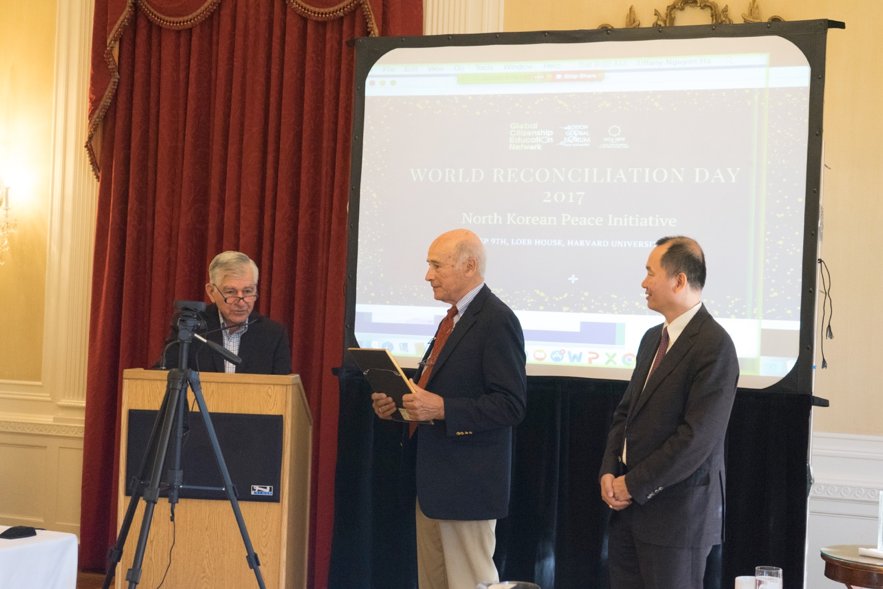
Governor Michael Dukakis, Co-founder and Chairman of the Boston Global Forum, and Consul General of Greece in Boston, Stratos Efthymion, will co-chair a roundtable discussion to build a framework for peace and security in the 21st century. The Boston Global Forum, Michael Dukakis Institute for Leadership, and Innovation and Greece Consulate General in Boston are co-hosting this Roundtable on World Reconciliation Day at 5:30 pm, September 9, 2019 at the Greece Consulate.
Professor Stephen Walt, Harvard Kennedy School; Professor Nazli Choucri, MIT; Professor Thomas Patterson, Harvard Kennedy School; Professor David Silbersweig, Harvard Medical School; Professor Constantine Arvanitopulos, Tufts, Former Minister of Greece; Professor Thomas Creely, Naval World College; and AI World Society Young Leaders will join.
Participants will discuss about threats and challenges of peace and security, solutions to solve these threats, and propose ideas for Framework for Peace and Security in the 21st Century.
On World Reconciliation Day September 9, 2017 at Harvard University Faculty Club, the Boston Global Forum was proposed an initiative for peace and security in the Korean Peninsula.