by Editor | Jan 26, 2020 | News
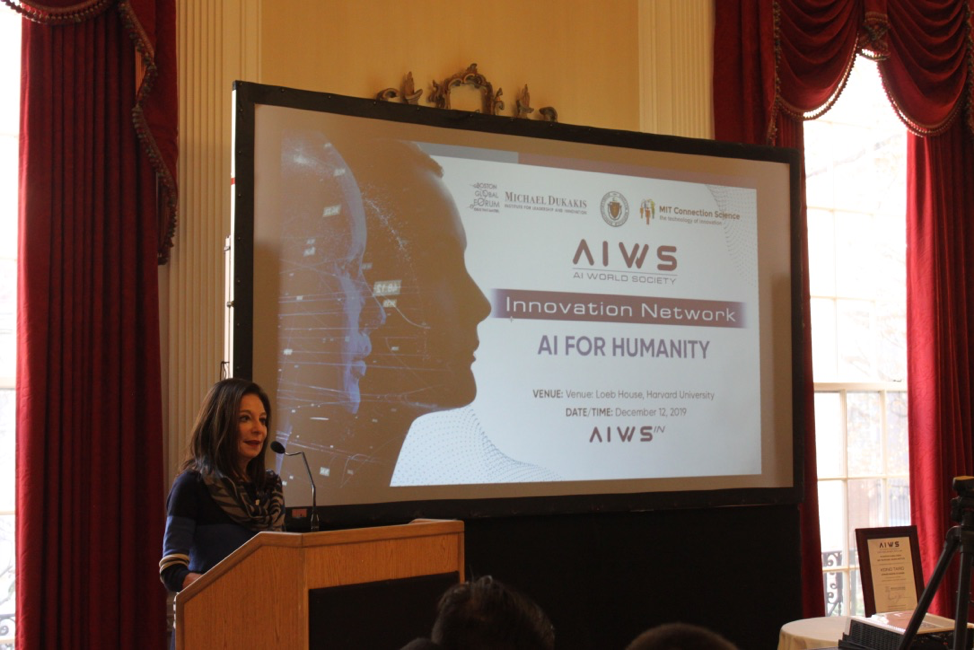
Professor Nazli Choucri, MIT, co-founder of the AIWS Innovation Network, writes for the United Nations 2045 project.
Advances in AI, internet, social media, and threats to cybersecurity jointly shape a new worldwide ecosystem for which there is no precedent. At issue is building new dimensions, even principles, which would shape the future of international law
All participants and centers of power and influence contribute to framing the legal order in the age of AI. And each has rights and responsibilities that must be articulated and respected. An initial framing is presented below:
(1) Individuals, Citizens, Groups:
Everyone is entitled to basic rights and dignity that are enhanced by AI and the Internet Age and entail greater responsibility:
Data Rights and Responsibilities
Each individual has a right to privacy and is entitled to a device to access and control their own data. Individuals have a right to organize ways of managing their data, individually or collectively.
Education and Political Participation
Each individual has the Right to be involved directly and effectively in political decisions. Each has access to education/knowledge pertaining to the use and impact of AI.
Responsibility:
Each individual is prohibited from exercising adverse behaviors, such as hacking and disseminating disinformation.
(2) Governments:
Every government is expected to behave responsibly in the management of AI for governance and for interactions with individuals.
Governments Standards:
Create incentives for citizens to use AI in ways that benefit society.
United Nations and International Organizations:
Extend sphere to include AI and extend the upholding of international standards/norms/practices pertaining thereto.Create and manage a universal digital currency.
(3) Business Entities
Business operations and related rights come with accountability and responsibility – nationally and internationally.
- Respect independent audits for fairness, accountability, and cybersecurity.
- Respect common AI values, standards, norms, and data ownership rules, and expect penalties for noncompliance.
(4) Civil Society Organizations:
Rights and responsibilities of civil society organizations include monitoring governments and firms with respect to common values.
- Civil society organizations are responsible for compliance with common values/norms/standards/laws and expect penalties for noncompliance.
- Support and recognize exemplary citizen contributions in AI area.
(5) AI Assistants:
AI assistants provide an interface to facilitate compliance with established standards.
- Support AI users and assist them to serve the broad interests of society.
- Engage with other power centers for mutual support and supervision.
The full document can be found here.

by Editor | Jan 26, 2020 | News
Aligned with the 50th anniversary of the World Economic Forum, there was a movement in Davos this year connecting taxation with prosperity, this is a part of the AI-Government model. Five great institutions have been collaborating to develop, test and deploy innovative data systems and technology platforms to improve taxation in emerging markets and developing economies (EMDEs). The Boston Global Forum is joined by MIT Connection Science, the action-tank, New America, The World Bank, and professional services giant, EY in this important endeavor. These organizations are each pledging even greater collaboration in the days ahead. We proudly call our work, The Prosperity Collaborative.
In Davos, Jeff Saviano, who leads this effort for EY, New America’s Tomicah Tillemann, and Alex ‘Sandy” Pentland, leader of MIT Connection Science, unveiled The Prosperity Collaborative story at Pentland’s Imagination in Action event. This was followed by an in-depth discussion at the Global Blockchain Business Council’s Davos forum of the intense tax issues within EMDEs and how application of new data and technology platforms will lead to a fair and efficient taxing system. The connection of taxation to prosperity was the talk of Davos!
Policymakers are telling us they need this collaborative effort to directly contribute to the Global Goals – for a better world. Much of the effort to fund the UN’s Sustainable Development Goals has been to reallocate capital; often times, making difficult choices to shift funding from one important social cause to another. The founding members of The Prosperity Collaborative believe that new technology and data systems will have the necessary effect of increasing tax compliance; creating additional capital to fund the Global Goals.
Here at the Boston Global Forum, we are deeply committed to this work and the great institutions we have been collaborating with. Governor Michael Dukakis, Co-Founder and Board Chairman of the Boston Global Forum, says ‘from my many years in government, I have personally seen the direct connection of taxation to prosperity. I am personally committed to The Prosperity Collaborative and our work to develop new, cutting edge, technology for better tax systems and a better world.’
If you would like to learn more about The Prosperity Collaborative, please reach out to Boston Global Forum CEO, Nguyen Anh Tuan, or Jeffrey Saviano, EY Global Tax Innovation Leader.

by Editor | Jan 26, 2020 | News
The Office of Management and Budget released a draft memorandum Jan. 13 providing guidance to agencies on how they should approach regulation of industry’s artificial intelligence applications.
The guidance emphasizes that agencies should consider how any regulatory action would potentially hinder expansion of AI use. The draft memo “calls on agencies, when considering regulations or policies related to AI applications, to promote advancements in technology and innovation.”
“Agencies must avoid a precautionary approach that holds AI systems to such an impossibly high standard that society cannot enjoy their benefits,” OMB officials wrote. “Where AI entails risk, agencies should consider the potential benefits and costs of employing AI, when compared to the systems AI has been designed to complement or replace.”
Throughout the draft memorandum, OMB expresses concerns about the federal government over-regulating AI to the extend that it hampers innovation and development of the technology. But there will be some cases where agencies will have to issue rules and regulations pertaining to AI applications. To avoid over-burdensome regulation, the draft memo includes 10 principles for use in government:
- Public trust in AI. Regulatory and non-regulatory actions need to be reliable, robust and trustworthy.
- Public participation: The public should have opportunities to participate in the rule-making process.
- Scientific integrity and information quality. The government’s approaches to AI should use scientific and technical information and processes.
- Risk assessment and management. Regulatory and non-regulatory approaches should be made after assessing risk and determining how to manage it.
- Benefits and costs. Agencies need to consider the full societal costs and benefits related to developing and using AI applications.
- Flexibility. Agency approaches to AI should be flexible and performance-based.
- Fairness and nondiscrimination. AI can reduce or increase discrimination. Both regulatory and non-regulatory approaches need to consider issues of fairness and nondiscrimination in outcomes.
- Disclosure and transparency. Agencies should be transparent in an effort to improve public trust in AI.
- Safety and security. Agencies should ensure that that they have controls in place to guarantee confidentiality, integrity and availability of data used by AI.
- Interagency coordination. OMB officials wrote that agencies need to coordinate with one another about shared experiences and “ensure consistency and predictability of AI-related policies.”
According to this, Michael Dukakis Institute for Leadership and Innovation (MDI) created Artificial Intelligence World Society Initiative (AIWSI) as a means of counteracting harmful and unethical uses of AI, and building the 7-layer AI model, including ethics, to achieve a peaceful and secure world. The AIWS Innovation Network, a part of AIWSI, is also promoted to identify, publish and promote principles for the virtuous application of AI into governments, corporations and non-profit organizations.
The original article can be found here.

by Editor | Jan 26, 2020 | News
The market value of AI in the health care industry is predicted to reach $6.6 billion by 2021. Artificial intelligence is increasingly growing in popularity throughout various industries. Most of us associate AI with things like robots, Alexa and self-driving cars.
But AI is a lot more than that. AI experts see it as a revolutionary technology that could benefit many industries.
The impact of AI in the health care sector is genuinely life-changing. It is driving innovations in clinical operations, drug development, surgery and data management. AI technology is also rapidly finding its way into hospitals.
AI applications are centered on three main investment areas: digitization, engagement and diagnostics. Looking at some examples of artificial intelligence in health care, it is clear that there are exciting breakthroughs in incorporating AI in medical services.
Let’s explore some of the amazing applications of AI that are revolutionizing health care.
Robot Doctors
AI does not get more exciting than robots. However, these are not the humanlike droids from science fiction films. We are talking complex and intelligent machines designed for specific tasks.
Clinical Diagnosis
AI algorithms diagnose diseases faster and more accurately than doctors. They are particularly successful in detecting diseases from image-based test results.
Precision Medication
Precision medication refers to dispensing the correct treatment depending on the patient’s characteristics and behavior. Equally essential to correct diagnosis is the provision of the appropriate treatment. This mostly means the exact prescription and recovery routines for the best outcome.
Drug Discovery
Drug development is a tedious venture that may take years and thousands of failed attempts. It can cost medical researchers billions of dollars in the process. Only five in 5,000 drugs that begin pre-clinical trials ever make it to human testing. And only one of the five may find its way to pharmacies.
Personal Health Assistants
These gadgets use the data to make recommendations. This is an attempt to remedy any irregularities. Most of these devices store data locally or online. The data can be retrieved and used by medical practitioners as a medical report.
Adopting Examples Of Artificial Intelligence In Health Care
AI is here to stay. It will not replace doctors with machines but work alongside them. The goal is to achieve cheaper and more efficient health care services. Being a relatively new technology in health care, AI still has a long way to go, but the progress is impressive.
In 2019, the Michael Dukakis Institute for Leadership and Innovation (MDI) established the Artificial Intelligence World Society Innovation Network (AIWS-IN) to connect key AI actors and provide services that can assist in the development of AI. AIWS-IN also promotes AI applications in healthcare for helping people achieve well-being and happiness, unleash their potential, and solve important issues, such as SDGs.
The original article can be found here.
by Editor | Jan 20, 2020 | News
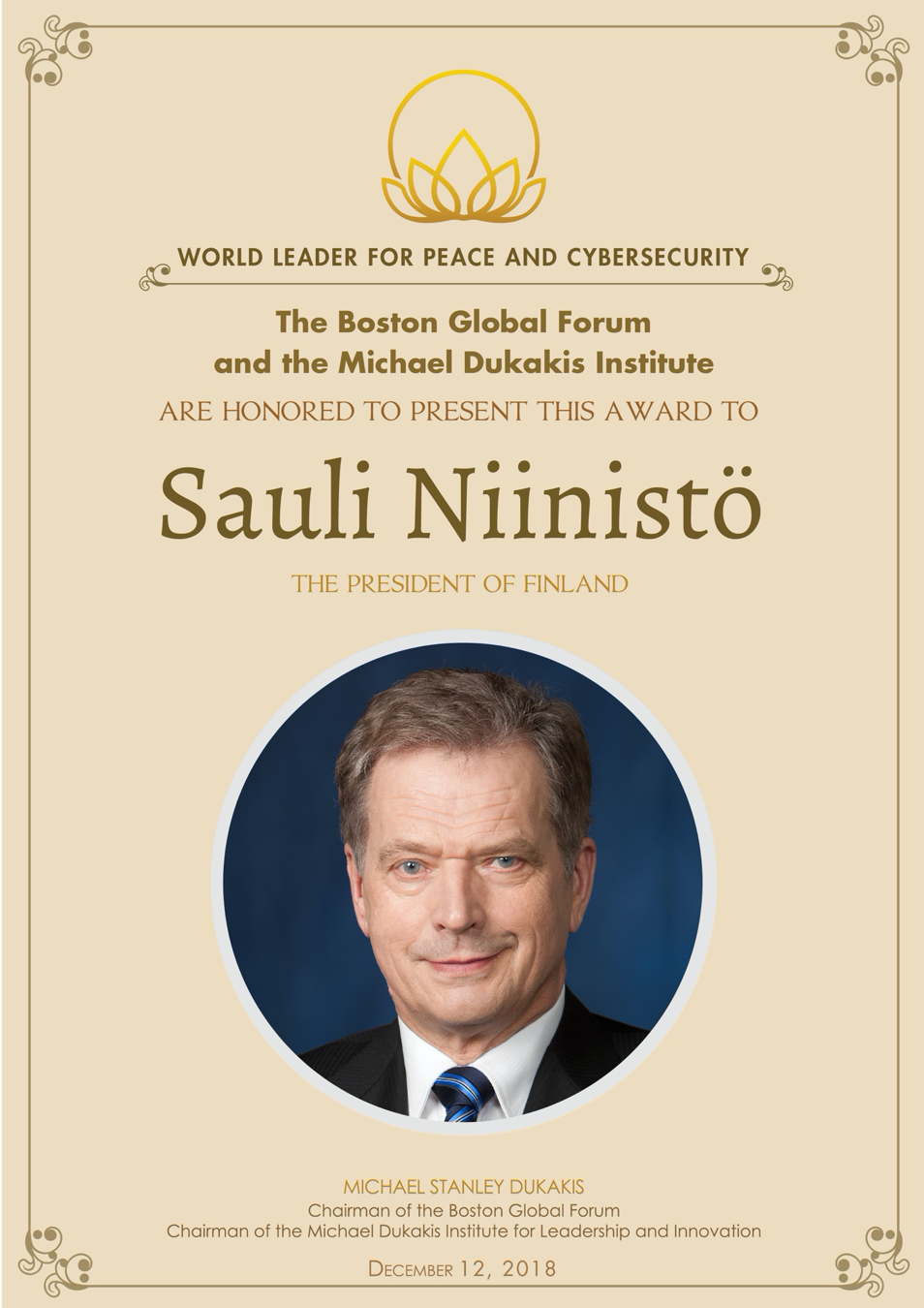
President Sauli Niinisto, BGF World Leader for Peace and Security Award 2018, will, together 46 world leaders, attend the World Holocaust Forum at Yad Vashem on Thursday, marking the 75th year since the liberation of Auschwitz-Birkenau.
The gathering of world leaders poses a huge security challenge for Israel’s security forces, the third-largest gathering since the funerals of Shimon Peres in 2016 and Yitzchak Rabin in 1995.
Some of the most notable leaders who will attend the forum are US Vice President Mike Pence, Russian President Vladimir Putin, French President Emmanuel Macron, German President Frank-Walter Steinmeier and Prince Charles of Britain, who are all slated to deliver a speech at the forum. Rav Yisrael Meir Lau, chairman of the Yad Vashem council as well as Prime Minister Binyamin Netanyahu will also speak.
Other royals who will attend in addition to Prince Charles, who is making his first official visit to Israel, are the kings of Spain, Belgium, and Holland, the crown prince of Norway and the grand duke of Luxembourg.
The original article can be found here.