
by Editor | Jan 20, 2020 | News
The Harvard Gazette introduces the new book by Professor Thomas Patterson, co-founder of the Boston Global Forum and AIWS Innovation:
https://news.harvard.edu/gazette/story/2020/01/excerpt-thomas-pattersons-how-america-lost-its-mind/
Since then, there has been a revolution in mass communication and a leap in the number of people with college educations. Americans have never had so much information available or been better trained to handle it. Yet they are no better informed today than they were decades ago. The high-school-educated public of the 1950s knew as much about the structure of America’s government as does the media-saturated, college-educated public of today. When asked in a recent national survey to name the three branches of government, only a third of respondents could do so. Another third could name one or two. The final third couldn’t name a single one. Those ratios are nearly the same as when Americans were asked the question in 1952.
“Some conspiracy theories are harmful. A few are downright dangerous. Most are merely bizarre. More harmful to our democracy is a cousin of conspiracy theories — misinformation. It also involves fanciful ideas about the actual state of the world, but it is far more widespread and a far greater threat.”
“The Internet is an extraordinary advance. It has changed our lives in positive ways, giving us a level of access to information that was unimaginable a few decades ago. Yet mixed in with the Internet’s reliable content is misinformation, so many shades of it that it would put a lipstick counter to shame.”
“Aside from the delusional comfort it offers, misinformation doesn’t have much to recommend it. But there’s arguably something worse: people who know they are being fed false information and embrace it.”
In the problems professor Patterson raised in his book, AIWS young leaders, and distinguished thinkers of AIWS Innovation Network (AIWS-IN) at AIWS.world contribute solutions, initiatives, concepts, and practice. The AIWS-IN connect around 100,000 distinguished professors, thinkers, innovators from top universities in the world such as Harvard, MIT, Stanford, Princeton, Columbia, Yale, Berkeley, UCLA, Carnegie Mellon, Cambridge, Oxford, University of Tokyo etc.
by Editor | Jan 20, 2020 | News
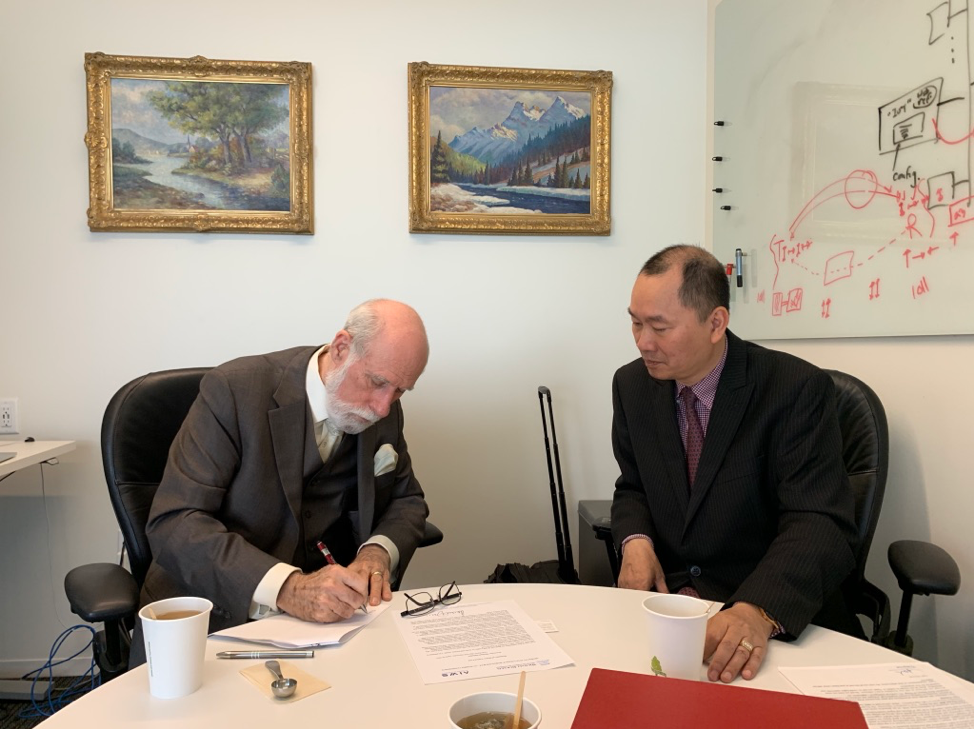
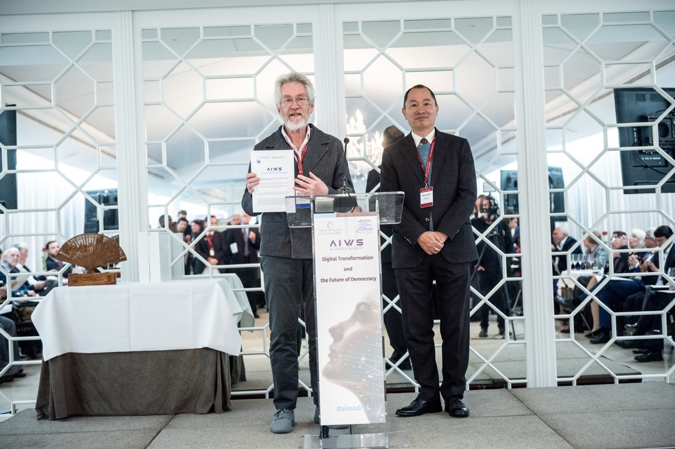
The Boston Global Forum (BGF), Michael Dukakis Institute for Leadership and Innovation (MDI), and AI World Society Innovation Network (AIWS-IN) will honor World Leader in AIWS Award and present AIWS Distinguished Lecture at Policy Dialog with the theme “The New Social Contract in the AI Age” on April 28-29, 2020 at Harvard and MIT. The Policy Dialog – AIWS Summit is co-organized by the Boston Global Forum and World Leadership Alliance-Club de Madrid with attendance of many former head of states and governments of democratic countries around the world, as well as distinguished inventors such as Vint Cerf, the father of Internet, and distinguished professors of Harvard and MIT.
Recipients of the World Leader in AIWS Award were Secretary General of OECD Angel Gurria in 2018, father of Internet Vint Cerf in 2019.
AIWS Distinguished Lecturers are Liam Byrne, MP of United Kingdom, Kazuo Yano, Chief of Science of Hitachi, David Bray, Director of People-Centered Internet, and Japanese Minister of Defense Taro Kono.
by Editor | Jan 20, 2020 | News
Professor Alex Sandy Pentland, MIT, one of 7 most powerful data scientists, co-founder of the AIWS Social Contract and co-founder of the AIWS Innovation Network, contributes the first words for writing of the AIWS Social Contract:
“Over centuries society has constructed a social contract between government and citizens. First included was land, then capital, then finally labor. Now data is a core part of society, immensely valuable and critical for proper functioning of a modern society, and so data must be integrated into the social contract. Data should be regarded as a first-class resource belonging to citizens, like labor or capital or land, and just as with these older citizen resources we need to construct institutions and laws that control rights, ownership, and use.”
The final version of AIWS Social Contract will be presented at Policy Dialog, co-organized by the Boston Global Forum and World Leadership Alliance-Club de Madrid at Harvard and MIT on April 28-29, 2020.

by Editor | Jan 20, 2020 | News
The pharma company will work with MIT’s School of Engineering to establish an education program focused on developing new machine learning approaches to drug development and more.
The program, based at MIT’s Abdul Latif Jameel Clinic for Machine Learning in Health, or J-Clinic – which specializes in developing new healthcare AI tools – is funded with a three-year investment from Takeda and aims to leverage the expertise of both organizations.
With the collaboration, MIT will gain access to pharmaceutical infrastructure and expertise, and develop new educational program through J-Clinic that will support MIT faculty, students, researchers, and staff in their approach to AI development. The new program will combine algorithm and hardware innovations, and create multidimensional collaborations between academia and industry.
The MIT-Takeda Program will focus on funding as many as 10 flagship research projects per year in the areas of machine learning and health, including diagnosis of disease, prediction of treatment response, development of novel biomarkers, process control and improvement, drug discovery, and clinical trial optimization.
According to AI World Society (AIWS), AI technology for medical application can be a force for helping people achieve well-being and happiness, unleash their potential, obtain greater freedom, relieve them of resource constraints and solve important issues, such as SDGs.
The original article can be found here.

by Editor | Jan 20, 2020 | News
A roadblock to scale: the global sprint towards AI, a study of 4,514 senior business decision-makers with some knowledge/influence over their company’s IT decisions, reported that there is a skills gap that represents a significant roadblock to broad business deployment of AI. The executives also said data silos hinder progress in AI projects.
The study, conducted by Morning Consult for IBM, showed that 37% of the executives surveyed are concerned that limited AI expertise or knowledge is hindering successful AI adoption at their businesses. Other barriers cited include increasing data complexities and silos (31%) and lack of tools for developing AI models (26%).
Globally, 22% of the survey’s respondents said they are not currently using or exploring the use of AI. But professionals whose companies are currently deploying AI are much more likely to report investment across the board.
Globally, 78% of the executives surveyed said it is very or critically important that they can trust that their AI’s output is fair, safe and reliable. Explainable AI was high on the agenda for 83% of global respondents.
Rob Thomas, general manager at IBM Data and AI, said: “Based on our interactions and the results of this study, we expect to see organizations not only adopt AI, but scale it across their enterprises, by building/developing their own AI, or putting ready-made AI applications to work.”
In 2018, the Michael Dukakis Institute for Leadership and Innovation (MDI) established the Artificial Intelligence World Society (AIWS) and invited participation and collaboration with think tanks, universities, non-profits, enterprises, and other entities that share its commitment to the constructive and development of AI.
The original article can be found here.