
by Editor | May 17, 2020 | News
At AIWS Roundtable May 12, 2020 co-organized by World Leadership Alliance-Club de Madrid and Boston Global Forum, Professor Nazli Choucri, MIT, Co-founder and Mentor of AIWS.net, talked about the Social Contract 202, a New Social Contract in the Age of AI. This Social Contract was officially launched on May 5, 2020 by the Boston Global Forum and Michael Dukakis Institute for Leadership and Innovation. This Social Contract is considered a paper of the United Nations 2045 project. Professor Choucri said: “While TCP/IP is the platform for communication among internet users, Social Contract 2020 can be seen as a platform for connection between governments, stakeholders, and private and public institutions.”
“The overall objective of Social Contract 2020 is to help build a multi-stakeholder AI- intensive society in all aspects of life from politics, governments, economics, business, and industry, all the way to the social order and the life of each individual. Social Contract 2020 eencourages everyone to value the acts of creation, innovation, philanthropy, and mutual respect. It seeks the respect and right to have freedom on, and access to, the Internet worldwide. The vision of Social Contract 2020 is to make our world a place of honest and responsible interaction. That means, a place where everyone’s contribution is recognized and everyone has a right to knowledge and access to information, where no one is above the law, where money cannot be used to subvert political process, and were integrity, knowledge, creativity, honesty and kindness are seen as key values in shaping decision and policy.”
“In short, Social Contract 2020 is for shaping a world where all stakeholders are recognized, and all forms of governance adhere these values and are accountable and transparent. It is a world where only by working together it is possible to address and resolve global challenges.”
“Extensive and appropriate AI application to politics, governments, society, and businesses can create a Smart Democracy supporting a global supply chain. The Smart Democracy Social Contract 2020 creates a platform for a new global supply chain, named Supply Chain 2020. As a critically important framework for society in the AI age, the Social Contract 2020 is based on balancing power among all stakeholders and among governments, businesses, civil society, individuals, and AI assistants. Being an important contract, the Social Contract 2020 is a commitment of main stakeholders to protect property, common values, and norms for good between nations.”
The authors of the Social Contract 2020 are:
Governor Michael Dukakis
Nguyen Anh Tuan, CEO of the Boston Global Forum, Director of Michael Dukakis Institute.
Professor Nazli Choucri, MIT
Professor Alex Pentland, MIT
Professor Thomas Patterson, Harvard
Professor David Silbersweig, Harvard
Mr. Pham Trong Nghia, Deputy Director General at National Assembly Office, Vietnam
The Social Contract 2020 can be found here.
by Editor | May 17, 2020 | News
The Artificial Intelligence (AI) application identifies anomalies in the lungs and assists in detection of COVID-19 pneumonia. It analyses the lung pathology on chest CT to aid in the assessment and comes with triage capability. With the sudden surge in admission of respiratory-related patients globally, triaging can help to reduce the increasing burden on the intensive care units (ICU) and address the shortage of medical resources.
Raymond Moh, CEO of BioMind, said: “We are proud to receive the Health Sciences Authority’s approval for our COVID-19 diagnostics support product. This was born out of the immense efforts and collaborations between clinicians, lung specialists and our engineers. In an unprecedented crisis like this, we hope to quickly scale our solution in Asia, Europe, Middle East and USA to equip physicians with smart tools to detect and manage COVID-19 pneumonia. Artificial intelligence will be their useful assistant daily in this long battle.”
Hanalytics, a medical AI company behind this solution, is also the brainchild of the BioMind application to assist diagnosis in neurological disorders including brain tumours and haemorrhagic stroke.
The company uses a deep learning approach and develops a predictive application that is trained on a large volume of CT scans which are clinically confirmed to have COVID-19 infections. This allows them to be used as an assistive tool to physicians to recognise diseases on medical scans, automate quantitative analysis and assist in report writing quickly.
The original article can be found here.
Regarding to AI impact for world society matter and global healthcare especially during COVID-19 pandemic, the Michael Dukakis Institute for Leadership and Innovation (MDI) established the Artificial Intelligence World Society Innovation Network (AIWS.net) for helping people achieve well-being and happiness, relieve them of resource constraints and arbitrary/inflexible rules and processes, and solve important issues, such as SDGs.
by Editor | May 17, 2020 | News
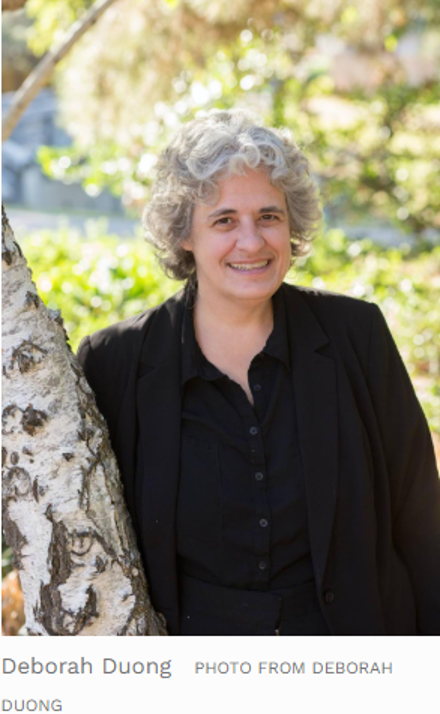
An Interview with Dr. Deborah Duong, Director for AI Development at Rejuve.
Dr. Duong says, “Healthcare workers and essential workers need to go to work during the Covid-19 pandemic. That puts them in danger even if they are wearing masks and gloves. They should be equipped with more information about their own health and the likelihood of infection in their places of work to make informed decisions. If they are empowered with a wearable that can alert them of the imminent infection of Covid-19 or if the probability of infection is extremely high, they can immediately decide to isolate themselves from their families, etc.”
Complex Adaptive Systems can potentially help us find a “Covid-19 data signature” from observations made from interaction data collected inside the population of people who are infected and who are not infected.
By discovering patterns using Artificial Intelligence and causal inference, conceptual groups can be identified and data can be analyzed in the context of what is happening within the society.
The media does a good job of scrutinizing AI systems for privacy, data ownership and security issues. It is possible to build a Complex Adaptive System that gives individuals their data ownership, preserves privacy and is secure. At the same time, through Artificial Intelligence with causal inference, a decision network can be created to inform policymakers. Much like the Markov Decision Process, data can be modeled in simulations. A percentage of the population can wear the wearables so that the least amount of data necessary for accurate decisioning can be collected and used for policy.
The original article can be found here.
It is useful to note that AI with causal inference has been developed by professor Judea Pearl, who is awarded Turing Award 2011, the most prestigious prize awarded to computer scientists by the Association for Computing Machinery. In 2020, Professor Pearl is also awarded as World Leader in AI World Society (AIWS.net) by Michael Dukakis Institute for Leadership and Innovation (MDI) and Boston Global Forum (BGF). At this moment, Professor Judea Pearl also contribute on Causal Inference for AI transparency, which is one of important AIWS.net topics on AI Ethics.
by Editor | May 10, 2020 | News
The Social Contract 2020 sets the foundation for a new historical chapter: the emergence of AI societies. Governor Michael Dukakis stressed the importance of studying history to prevent past mistakes from repeating in the present and the future. I value his insight and would like to add that looking back at history is a way to shape and invent the future. We should not content ourselves with merely predicting the future; with AI as our tools, we can strive to innovate and organize it.
With that idea in mind, AIWS.net shall announce today May 5, 2020, a new project—The History of AI—as a companion to the Social Contract 2020. While many individuals and organizations study the history of AI already, AIWS will study the field from a different angle and with a different approach. Our approach will be cross-sectional with the following structure:
- Ideology, motivating ideas, methodology, model, and solutions in AI.
- AI inventions in science and technology
- AI applications in politics, government, economics, and society
The project aims to identify historical events, figures, and accomplishments, as well as lessons, documents, evidence, witness, and anecdotes, with the aim to study AI to shape the future of AI. The History of AI project will accompany the Social Contract. An AI Chronicle e-book version is available on AIWS’s website. There will also be AIWS House in Boston and on university campuses around the world.
The History of AI Board include Governor Michael Dukakis, Professor Judea Pearl (UCLA), Professor Alex Pentland (MIT), Nguyen Anh Tuan (Michael Dukakis Institute), Professor Nazli Choucri (MIT), Professor Thomas Patterson (Harvard University), Professor David Silbersweig (Harvard University), and Historian Chien Minh Le (President of Dalat University). The AI History Board will assess and identify historical events, figures, and achievements to feature in the AI.
Chronicle e-book, which will be updated monthly and reviewed annually. Our approach will be open-ended: based on our findings, we will develop research on the above criteria, and we invite individuals and organizations to contribute to the project by gathering documents, stories and participating in analysis.
The History of AI belongs to all citizens, and anyone who contributes their mind and efforts can shape it.
Together, we shall envision the Social Contract 2020, put it into practice, and invent the History of AI.
The original post can be found here.
by Editor | May 10, 2020 | Event Updates, News
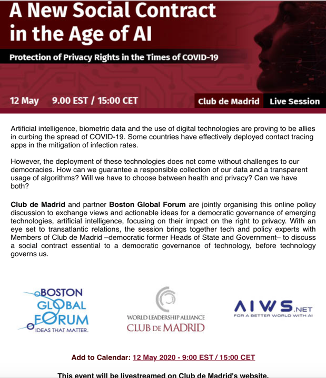
On May 5, the Boston Global Forum and Michael Dukakis Institute announced the Framework for the Social Contract 2020, a new Social Contract in the Age of Artificial Intelligence.
Artificial intelligence, biometric data and the use of digital technologies are proving to be allies in curbing the spread of COVID-19. Some countries have effectively deployed contact tracing apps in the mitigation of infection rates.
However, the deployment of these technologies does not come without challenges to our democracies. How can we guarantee a responsible collection of our data and a transparent usage of algorithms? Will we have to choose between health and privacy? Can we have both?
Club de Madrid and partner Boston Global Forum are jointly organising this online policy discussion to exchange views and actionable ideas for a democratic governance of emerging technologies, artificial intelligence, focusing on their impact on the right to privacy. With an eye set to transatlantic relations, the session brings together tech and policy experts with Members of Club de Madrid –democratic former Heads of State and Government– to discuss a social contract essential to a democratic governance of technology, before technology governs us.
Club de Madrid Members:
Danilo Türk, President of Club de Madrid and President of Slovenia (2007-2012).
Esko Aho, Member of Club de Madrid and Prime Minister of Finland (1991-1995).
Facilitator:
David Silbersweig, Chairman, Department of Psychiatry and Co-Director for Institute for the Neurosciences, Brigham and Women’s Hospital.
Experts:
Nazli Choucri, Professor of Political Science at the Massachusetts Institute of Technology.
Alex Pentland, Director of MIT Connection Science and Human Dynamics labs.
Thomas Patterson, Harvard, Bradlee Professor of Government & the Press.
Time: 9:00 am EST, May 12, 2020
The AIWS Roundtable will be streamed live on the website of the Club de Madrid.
This event is sponsored by Mr. Nguyen Van Tuong, Founder and Chairman of Tram Huong Khanh Hoa.