by Editor | May 31, 2020 | News
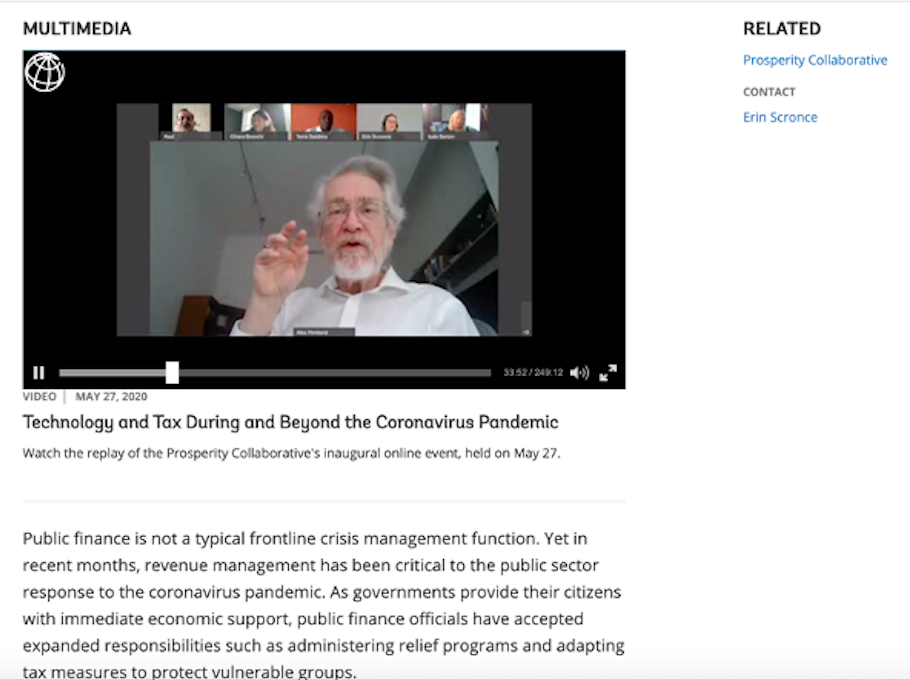
On May 27, Professor Alex Pentland, Director of MIT Connection Science, co-founder of AIWS.net, co-author of the Social Contract 2020, spoke at the World Bank’s The Prosperity Collaborative’s inaugural online event. The Prosperity Collaborative is a coalition of the World Bank, MIT, EY, the Digital Impact and Governance Initiative at New America, and the Boston Global Forum Michael Dukakis Institute for Leadership and Innovation.
Professor Pentland presented at Panel “The New Role of Tax Administrations in Pandemic Response”
- Moderator: Chiara Bronchi, Global Practice Manager, Fiscal Policy & Sustainable Growth, World Bank
- Kate Barton, Global Vice Chair – Tax, EY
- Terra Saidimu Leseeto, Commissioner for Intelligence & Strategic Operations (ISO) for the Kenya Revenue Authority (KRA)
- Raul Felix Junquera-Varela, Lead Public Sector Specialist, World Bank
- Sandy Pentland, Professor, Connection Science, Massachusetts Institute of Technology
He said: “We need to find a way to tax digital services to pay for the infrastructure that the services rely on.”
“The only way to address the many challenges in modern taxation is through experimentation.”
by Editor | May 31, 2020 | Event Updates
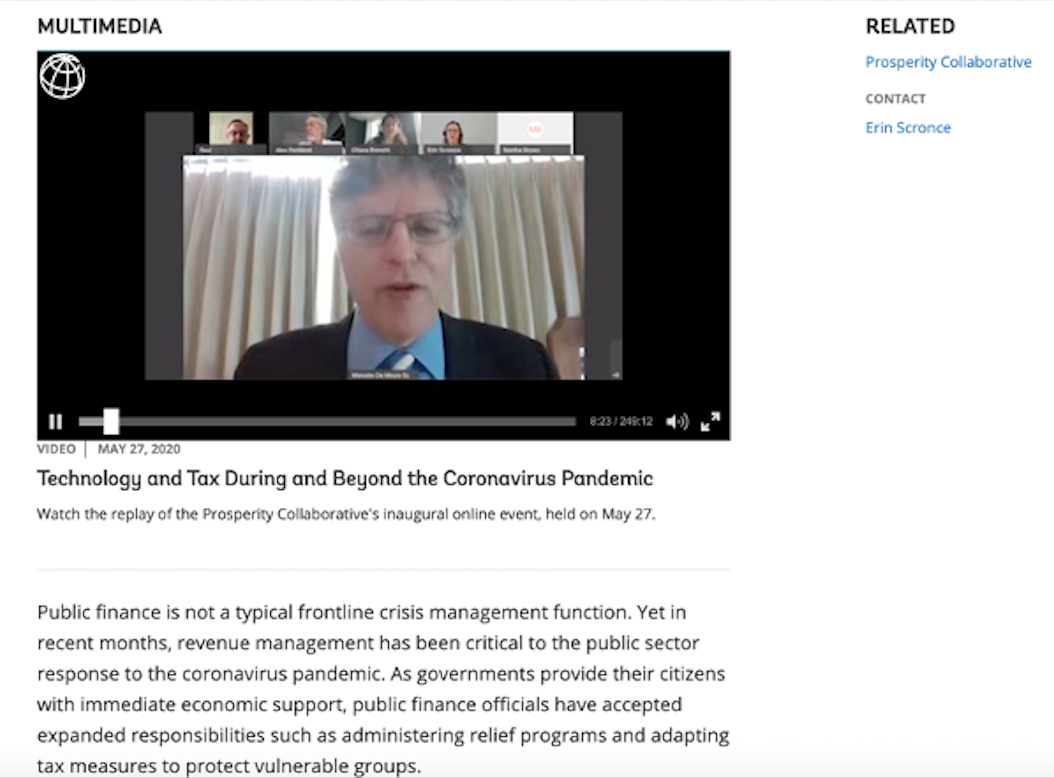
On May 27, at 8:45 am, EDT, at the World Bank’s event, the Prosperity Collaborative was official launched. Dr. Marcello Estevão, Global Director, Macroeconomics, Trade & Investment, the World Bank gave keynote speech about this coalition.
The website of the World Bank wrote: “The Prosperity Collaborative’s inaugural online event shared strategies that can help tax bureaus manage the crisis and serve their constituents. Our first online panel will focus on how tax administrations can remain resilient and responsive to new demands during the pandemic. Our second online panel explores how innovative technology can help leaders in public finance build stronger, more effective institutions.
This event was hosted by the Prosperity Collaborative, a coalition of the World Bank, MIT, EY, the Digital Impact and Governance Initiative at New America, and the Boston Global Forum Michael Dukakis Institute for Leadership and Innovation. We bring together a diverse set of leading organizations from the public sector, private sector, academia, and civil society to develop new open source technologies and digital public goods that will transform tax systems and enhance local capacity with an initial focus on emerging economies.”
At the event, panelists discussed “Technology and Tax During and Beyond the Coronavirus Pandemic”
Here are some quotes from this event:
“The Prosperity Collaborative will fill a gap by developing digital public goods for the use by the many.”
“This is agenda about great people enabled by great technologies.”
“We need the private sector, civil society, and government to come together to develop technology solutions.”
Mr. Jeffrey Saviano, Global Innovation Lead – Tax, EY
“Many developed markets have a lot to learn from the IT platforms used by developing countries”
Ms. Kate Barton, Global Vice-Chair – Tax, EY
“The Corona-crisis has shifted transfers to mobile payment systems and consumption to low taxable goods.”
“The Corona-crisis is forcing us to rethink our work, for example the role of onsite vs. offsite audits.”
“We are developing a system that will transfer transaction data to the tax authority in real time.”
Dr. Terra Saidimu, Commissioner Intelligence and Strategic Operations, Kenya Revenue Authority
“We need to find a way to tax digital services to pay for the infrastructure that the services rely on.”
“The only way to address the many challenges in modern taxation is through experimentation.”
Mr. Alex Pentland, Professor, MIT
“Tax administrations need to embrace technologies that serve everyone in their ecosystem.”
Ms. Kate Barton, Global Vice-Chair – Tax, EY
“This is agenda about great people enabled by great technologies.”
“We need the private sector, civil society, and government to come together to develop technology solutions.”
Mr. Jeffrey Saviano, Global Innovation Lead – Tax, EY
“We are seeing a convergence of technology and citizen services.”
“We can use the global crisis to show what goes wrong, if we don’t cooperate to develop the global public goods and infrastructure.”
“Tax data can provide insights into our economic levers. Why are we not using this information?
Ms. Jacky Wright, Chief Digital Officer, Microsoft
“We need to build rewards into our tax systems. We need to make it more exciting to pay taxes.”
Mr. Tomicah Tillermann, New America
“Next time in Davos, I would like to hold leaders accountable for digital for public good.”
Ms. Jacky Wright, Chief Digital Officer, Microsoft
“I’d wish there was a way that I as a taxpayer could know what has be done with my money.”
Her Excellency Serey Chea, Director General, National Bank of Cambodia

by Editor | May 31, 2020 | News
The future of artificial intelligence can be either exciting or worrisome depending on who you talk to. Some believe that AI may take over humanity, while others believe that we’re far away from AI achieving anything close to human intelligence. One author recently wrote a book addressing the potentially apocalyptic perspective of AI. James Barrat, author of Our Final Invention: Artificial Intelligence and the End of the Human Era shared insights into his book on a recent AI Today podcast. Despite the title of the book, he is surprisingly more on the fence about it than his book title would imply.
AI is becoming an increasing part of our daily lives. From intelligent assistants to facial recognition, AI technology is starting to permeate all sorts of our personal interactions. Though we might have achieved the grand visions of a singular intelligence system capable of learning any task, so-called Artificial General Intelligence (AGI), we are increasingly living in a world where the everyday person uses AI on a daily basis. With this sudden boost in AI usage, people are beginning to question just how safe this technology actually is. In many instances, AI and machine learning have the potential to provide significant benefit. However, we have reason to be concerned for AI systems that go wrong.
Barrat, however, sees a problem with managing AI. He points out that it is more than possible for the “good guys” to accidentally be “bad guys” and that AI may have unintended consequences from inappropriate application of the technology. Barrat points out that even companies with great technology will use their market strength to suppress competitive technology and perspectives. The notion of “good” in a corporate or government setting can be complex. He also points out that the unique nature of AI is that it learns from experience, and that experience might include human bias. Barrat details how depending on what data you feed a system, it can alter the outcome. His example is that if you feed a system photo of doctors that all look alike, the system might infer that all doctors are only white men. This can lead to problems down the line and imperfect system logic.
The original article can be found here.
Regarding to AI Ethics, Michael Dukakis Institute for Leadership and Innovation (MDI) and Artificial Intelligence World Society (AIWS.net) has developed AIWS Ethics and Practice Index to measure the extent to which a government’s AI activities respects human values and contributes to the constructive use of AI. The Index has four components by which government performance is assessed including transparency, regulation, promotion and implementation.
by Editor | May 31, 2020 | News
Artificial General Intelligence (AGI) – a hypothetical machine capable of any and all of the intellectual tasks performed by humans – is considered by many to be a pipe dream. A long-standing feature of science fiction, AGI has achieved a cultural reputation of both reverence and fear, but above all an appreciation for the possibilities it presents. However, despite what the movies might suggest, there is still considerable debate around what constitutes general intelligence in humans, let alone machines.
Before diving into AGI, it’s worth establishing what has become the accepted meaning of ‘general intelligence’. The term ‘general intelligence’ is an evolving term. When the first electronic computers were created, many leaders in the field attributed their ability to do complicated sums as evidence of a higher intelligence than was previously known. What followed was the ability to best humans at strategy games like chess, and eventually speech and image recognition. It seems likely that this evolution will too apply to Artificial General Intelligence, particularly as the concept becomes increasingly abstract.
However, as it stands, there are some generally accepted factors which determine if a human or machine is capable of artificial general intelligence. First, that they must have the ability to learn from a limited amount of data or experience – often referred to as few shot learning. Secondly, to be able to learn, and improve its ability to learn, from a wide variety of contexts, known as meta learning. This directly feeds into the final factor: causal inference. This is the capability for scenario generation: to be able to plan for future events, or non-events, through an understanding of cause and effect.
The original article can be found here.
Regarding to Causal Inference and AI, Professor Judea Pearl is a pioneer in this work and was recognized with a Turing Award in 2011. In 2020, Professor Pearl is also awarded as World Leader in AI World Society (AIWS.net) by Michael Dukakis Institute for Leadership and Innovation (MDI) and Boston Global Forum (BGF). At this moment, Professor Pearl also contribute on Causal Inference for AI transparency, which is one of important AI World Society (AIWS.net) topics on AI Ethics from by Michael Dukakis Institute for Leadership and Innovation (MDI) and Boston Global Forum (BGF).
by Editor | May 25, 2020 | News
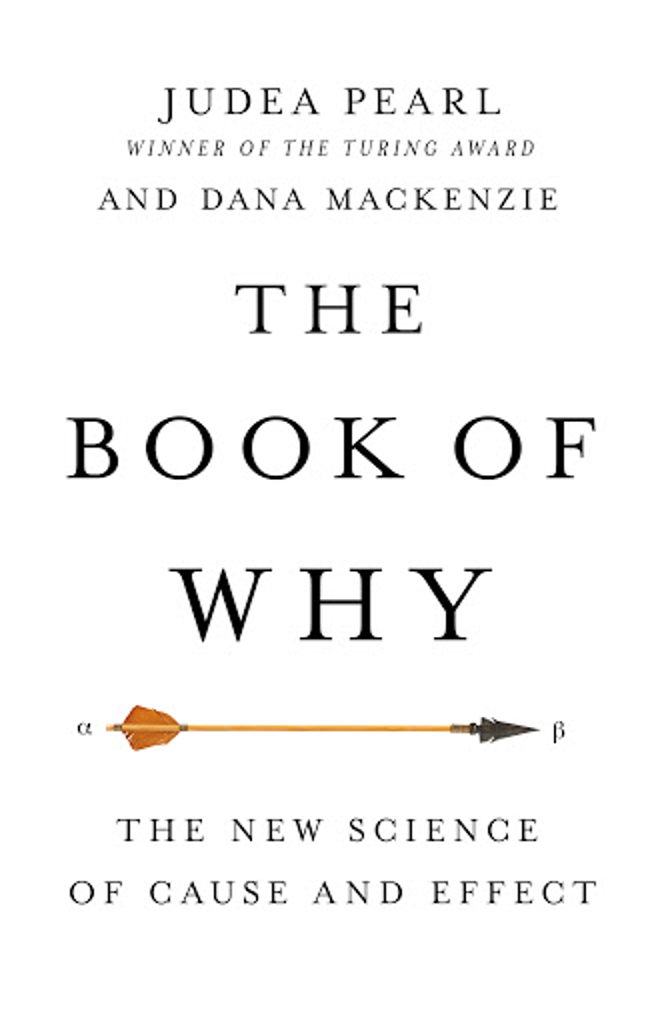
On May 20, 2018, “The Book of Why” by professor Judea Pearl was published.
Governor Michael Dukakis said on March 20, 2020:
“The Book of Why: The New Science of Cause and Effect,” provides us with the new tools needed to navigate the uncharted waters of causality for students of statistics, economics, social sciences, mathematics and most urgently today, epidemiology.” The Michael Dukakis institute, under the umbrella of its Artificial Intelligence World Society Innovation Network (AIWS-IN) AIWS.net, is calling for artificial intelligence to be developed and deployed in ways that benefit all mankind. Professor Pearl will serve as Mentor to AIWS Innovation Network programs in support of these goals. To be sure, the AIWS.net is eager to explore and apply your Causal Models to the decision-making process by national governments as well as individual citizens.”
The Boston Global Forum and Michael Dukakis Institute honored Professor Judea Pearl with the 2020 World Leader in AIWS Award and as a Mentor of AIWS Innovation Network (AIWS.net).
On May 24, 2020, Professor Judea Pearl discussed on Twitter:
Judea Pearl:
“Embroiled in choreographing Causal Science Centers I’ve almost forgotten that May 20 marks the 2-year anniversary of the publication of “the Book of WHY” #Bookofwhy. Dana and I are grateful to all readers who contributed to our understanding that the book has made a dent on scientific methodology.
As a token appreciation to readers of “the Book of WHY”, I am sharing the slides I used in a seminar titled: “The Silent History of Cause and Effect” given at UCLA History of Science Reading Group. Feel free to use any of these historical-philosophical snippets: http://web.cs.ucla.edu/~kaoru/hpass-ucla-dec2019-bw.pdf.”
Eoghan Flanagan:
“Prof Pearl I would suggest that the private sector would be more interested in funding causality research than “data science”. Businesses care about the do-calculus!
Judea Pearl:
“I thought so too. So where are the Bill Gates, Jeff Bezos and Mark Zuckerbergs of today? Are visionary business leaders a thing of the past? I am not talking “causality research”; we have it. I am talking Causal Science Centers, to educate next generation Phd’s for decision making.”
Elias Barenboim:
“I recently tweet about Ray Dalio & Causal Inference (CI), Bill Gates appears to be aware of the “Book of Why”. I talked briefly w/@finkdI earlier thi year about it. Elon Musk seem aware of the limits of AI. They may be interested in being serious about CI.”
“Insightful note by investor Ray Dalio @RayDalio on the necessity of understanding cause-effect relations to make robust decision-making & the insufficiency of machine learning:
https://www.youtube.com/watch?v=yrxYhv2O3wU&t=21m40s
We do have a language and tools to encode this understanding today.”
Judea Pearl:
“These wise words of Ray Dalio seem to be taken straight from the manifesto of the first “Causal Science Center”. Hey, Ray Dalio, would you be the Center’s first spokesman? Honorary President? Beneficiary? The algorithms you spoke about are ready to serve humanity. “
Nguyen Anh Tuan:
“Dear Judea, Michael Dukakis Institute and AIWS.net put Modern Causal Inference as course of AI World Society Leadership Master Degree.
Congratulations. We will introduce in AIWS Weekly Newsletter on Monday morning May 26, 2020. AIWS.net with Modern Causal Inference, promotes “the Book of WHY”, encourages research, invests in Causal Inference, applies Causal Inference to develop Decision Making Systems.”