by Editor | Sep 12, 2020 | News
This is the first social contract in the digital, Internet and AI era, a platform for connection among governments, stakeholders, and private and public institutions, and for balancing centers of power, initiated by the Boston Global Forum, will pay particular attention to insights presented by government representatives, academic institutions, think tanks, tech companies and civil society.
The Social Contract for the AI Age was completed and launched on September 9, 2020.
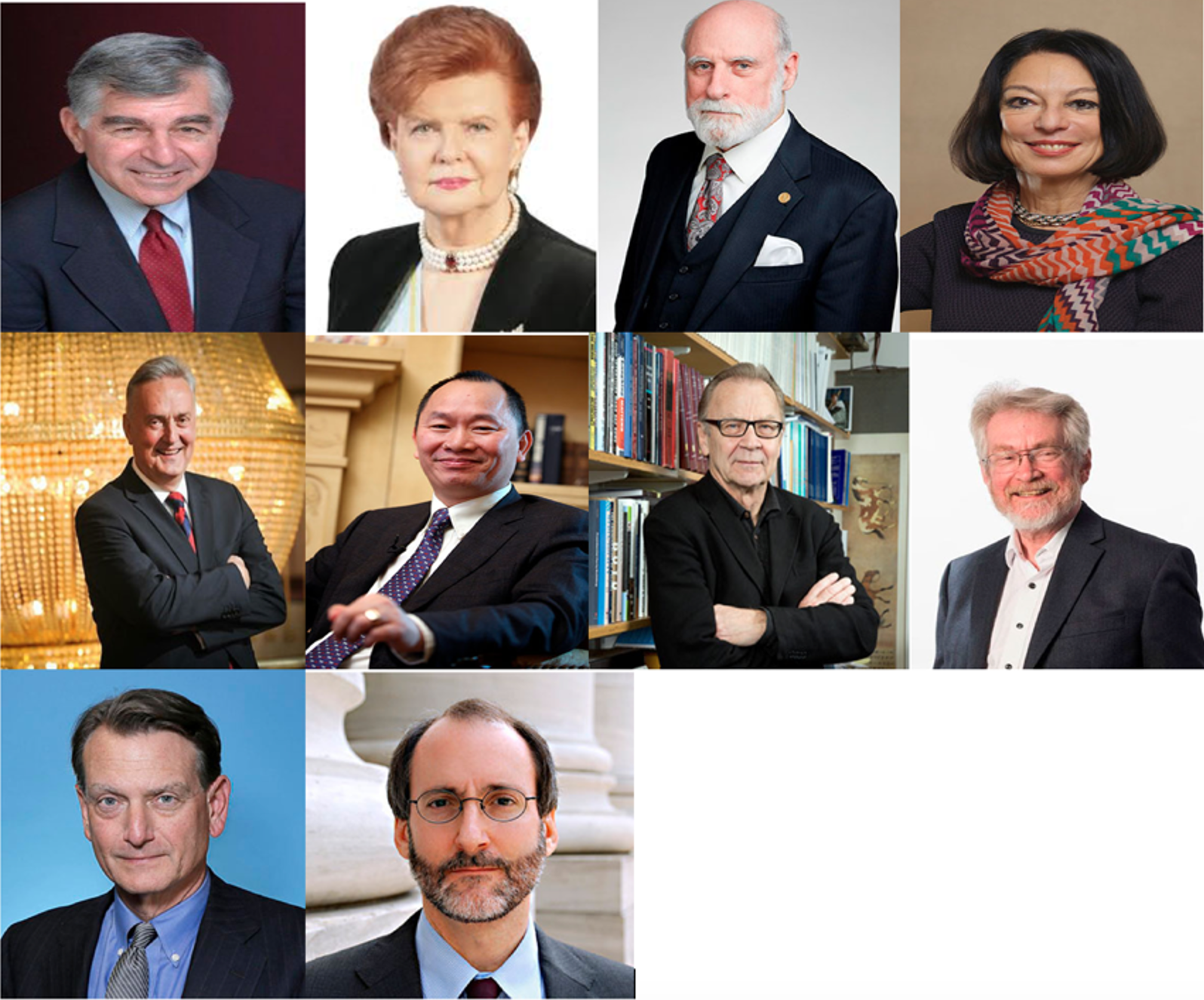
The co-authors of the Social Contract for the AI Age are:
Governor Michael Dukakis, Boston Global Forum and
President Vaira Vīķe-Freiberga, Latvia and World Leadership Alliance-Club de Madrid
Vint Cerf, Father of Internet, Google, Nazli Choucri, MIT,
Prime Minister Zlatko Lagumdzija, Bosnia and Herzegovina,
Tuan Anh Nguyen, Boston Global Forum, Thomas Patterson, Harvard University,
Alex Pentland, MIT, Marc Rotenberg, CAIDP, David Silbersweig, Harvard University
Please view and download Social Contract for the AI Age either here or here.
by Editor | Sep 12, 2020 | News
“The Social Contract for the AI Age”, the first social contract in the digital, Internet and AI era, a platform for connection among governments, stakeholders, and private and public institutions, and for balancing centers of power, initiated by the Boston Global Forum, will be officially launched and discussed at Transatlantic Approaches on Digital Governance:
A New Social Contract in the Age of Artificial Intelligence, 16-18 September 2020, organized by World Leadership Alliance-Club de Madrid (https://boston.dialoguescdm.org/agenda/)
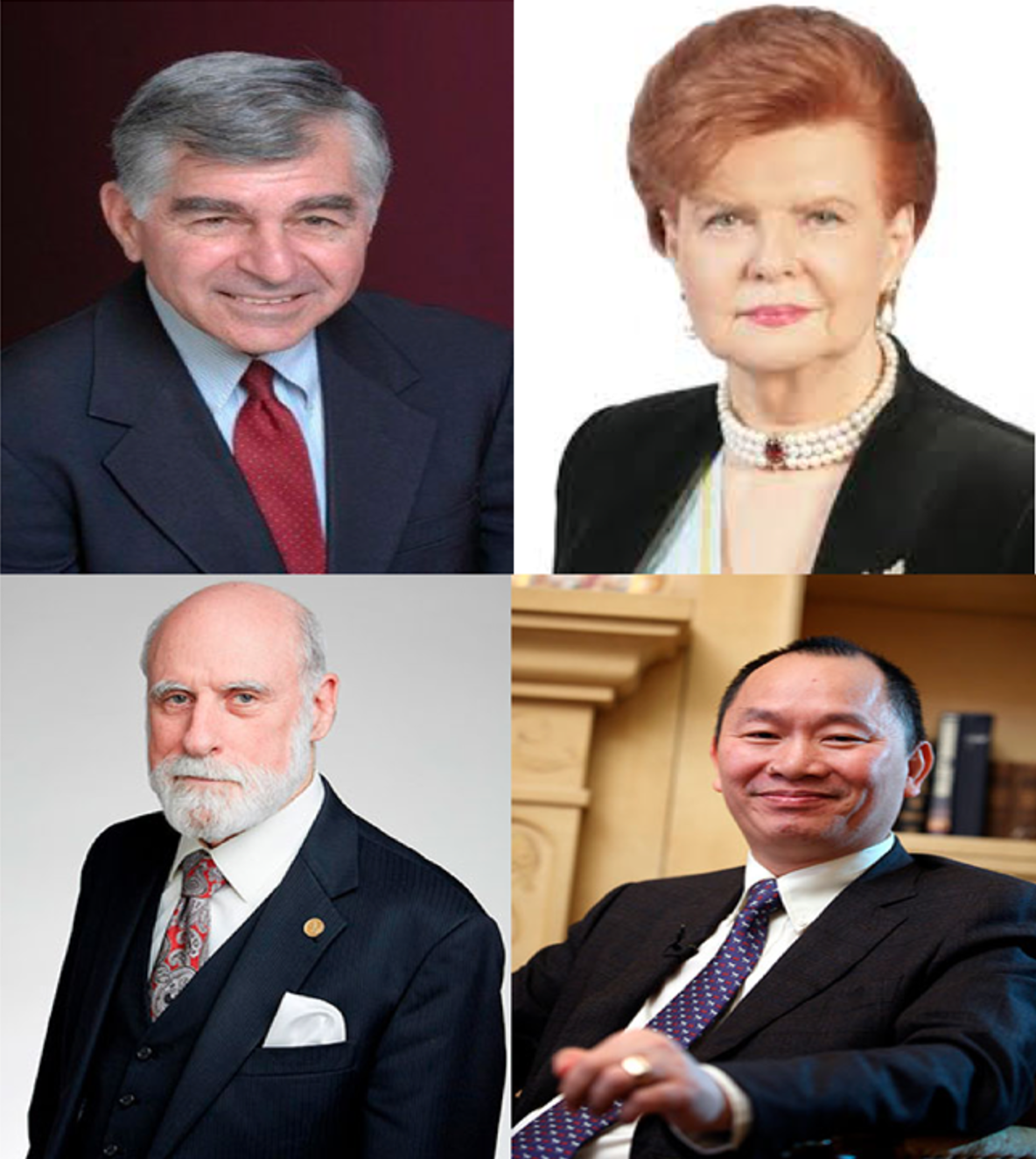
Governor Michael Dukakis, President Vaira Vike-Freiberga, father of the Internet Vint Cerf and Nguyen Anh Tuan are four of co-authors invite organizations and individuals sign the Social Contract here.
by Editor | Sep 12, 2020 | Event Updates
On 16, 17 and 18 of September 2020, Democratic former Heads of State and Government, Members of Club de Madrid, current Government representatives, experts and renowned scholars will analyse global challenges and offer actionable policy solutions at a transatlantic and multi-stakeholder Policy Lab on the Social Contract for the AI Age, a new social contract on digital technologies and artificial intelligence.
This forthcoming Policy Lab will convene over 10 former democratic Heads of State and Government (all Members of Club de Madrid), Manuel Muñiz, Secretary of State for Global Spain, Ministry of Foreign Affairs, European Union and Cooperation of Spain, as well as world class experts like computer scientist and father of the Internet, Vint Cerf, MIT Professor Alex ‘Sandy’ Pentland, Governor Michael Dukakis, Democratic Party nominee for President of the United States (1988), professors of Harvard, MIT, and top universities. Together, participants will lend their experience-based critical judgement to pioneering discussions which seek, among other priorities, to identify ways of engaging different sectors of society in grounding policymaking while protecting the democratic mandate.
All in all, the rapid rollout of digital technologies and AI beyond the control of states poses a global challenge never seen before, which is why we should not set global, regional and national standards of digital governance without the participation of all societal actors. In this sense, debates from this Policy Lab on “The Social Contract for the AI Age”, the first social contract in the digital, Internet and AI era, a platform for connection among governments, stakeholders, and private and public institutions, and for balancing centers of power, initiated by the Boston Global Forum, will pay particular attention to insights presented by government representatives, academic institutions, think tanks, tech companies and civil society.
The dialogue will also serve as a platform to establish a Transatlantic Alliance for Digital Governance and the AIWS City, an all-digital virtual city based on the standards and norms of “the Social Contract for the AI Age”, “People Centered Economy”, “Trustworthy Economy” and “Intellectual Society”. Lastly, the policy discussion aims to discuss the creation of an initiative to monitor governments as well as companies in using AI and to generate an AI Ethics Index at all levels.
Further information can be found here.

by Editor | Sep 12, 2020 | News
Nobody knows what will happen in the future, but some guesses are a lot better than others. A kicked football will not reverse in midair and return to the kicker’s foot. A half-eaten cheeseburger will not become whole again. A broken arm will not heal overnight.
By drawing on a fundamental description of cause and effect found in Einstein’s theory of special relativity, researchers from Imperial College London have come up with a way to help AIs make better guesses too.
The world progresses step by step, every instant emerging from those that precede it. We can make good guesses about what happens next because we have strong intuitions about cause and effect, honed by observing how the world works from the moment we are born and processing those observations with brains hardwired by millions of years of evolution.
Computers, however, find causal reasoning hard. Machine-learning models excel at spotting correlations but are hard pressed to explain why one event should follow another. That’s a problem, because without a sense of cause and effect, predictions can be wildly off. Why shouldn’t a football reverse in flight?
This is a particular concern with AI-powered diagnosis. Diseases are often correlated with multiple symptoms. For example, people with type 2 diabetes are often overweight and have shortness of breath. But the shortness of breath is not caused by the diabetes, and treating a patient with insulin will not help with that symptom.
The AI community is realizing how important causal reasoning could be for machine learning and are scrambling to find ways to bolt it on.
“It’s very cool to see ideas from fundamental physics being borrowed to do this,” says Ciaran Lee, a researcher who works on causal inference at Spotify and University College London. “A grasp of causality is really important if you want to take actions or decisions in the real world,” he says. It goes to the heart of how things come to be the way they are: “If you ever want to ask the question ‘Why?’ then you need to understand cause and effect.”
The original article can be found here.
In the field of causal inference, Professor Judea Pearl is a pioneer for developing a theory of causal and counterfactual inference based on structural models. In 2011, Professor Pearl won the Turing Award, computer science’s highest honor, for “fundamental contributions to artificial intelligence through the development of a calculus of probabilistic and causal reasoning.” In 2020, Professor Pearl is also awarded as World Leader in AI World Society (AIWS.net) by Michael Dukakis Institute for Leadership and Innovation (MDI) and Boston Global Forum (BGF). At this moment, Professor Judea also contributes to Causal Inference for AI transparency, which is one of important AIWS.net topics on AI Ethics.
by Editor | Sep 6, 2020 | News
The Social Contract 2020, A New Social Contract in the Age of AI, version 2.0, will be officially completed on September 9, and will be launched at the Policy Lab “Transatlantic Approaches on Digital Governance – A New Social Contract on Artificial Intelligence”, co-organized by World Leadership Alliance-Club de Madrid and the Boston Global Forum, on 16-18 September 2020.
In Session I: The AIWS Social Contract 2020 and AIWS Innovation Network: A Platform for Transatlantic Cooperation, Presidents, Prime Ministers, distinguished thinkers, and innovators together with Nguyen Anh Tuan, CEO of the Boston Global Forum, and Vint Cerf, Father of the Internet, Chief Internet Evangelist of Google, will discuss the Social Contract 2020, AIWS.net, and AIWS City as a practice of the Social Contract 2020 and a platform for Transatlantic Cooperation.
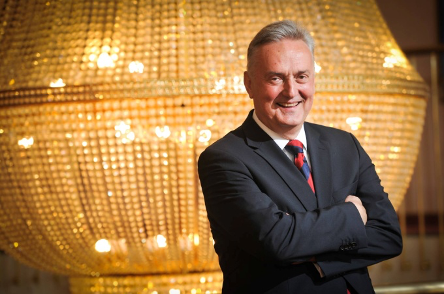
Former Prime Minister of Bosnia and Herzegovina, Zlatko Lagumdžija, joins as co-author of the Social Contract 2020, and a Mentor of AIWS Innovation Network (AIWS.net), and the AIWS City Board of Leaders, the History of AI Board.
An experienced political leader, professor in computer science, and economics, member of World Leadership Alliance-Club de Madrid, and from a special country, PM Lagumdžija plays a significant role and has great contributions to the Social Contract 2020, AIWS.net, and AIWS City.
“We are thrilled that Zlatko Lagumdžija is joining us,” said Governor Michael Dukakis. “We are all very impressed by his breadth of knowledge, achievements and his passionate commitment to fundamental rights and democratic governance.”
Prime Minister Lagumdžija said:” I am very honored to join the Board of AIWS Innovation Network (AIWS.net), AIWS City, the History of AI, and co-author of the Social Contract 2020. We must ensure that new technologies — and AI in particular — promote a better world.”
Lagumdžija is a speaker at Policy Lab “Transatlantic Approaches on Digital Governance – A New Social Contract on Artificial Intelligence”