
by Editor | Sep 27, 2020 | News
Major NIH award to study how the brain infers structure from sensory signals may have applications for disorders like schizophrenia and offer insights for artificial intelligence.
Imagine you’re sitting on a train. You look out the window and see another train on an adjacent track that appears to be moving. But, has your train stopped while the other train is moving, or are you moving while the other train is stopped?
The same sensory experience—viewing a train—can yield two very different perceptions, leading you to feel either a sensation of yourself in motion or a sensation of being stationary while an object moves around you.
Human brains are constantly faced with such ambiguous sensory inputs. In order to resolve the ambiguity and correctly perceive the world, our brains employ a process known as causal inference.
Causal inference is a key to learning, reasoning, and decision making, but researchers currently know little about the neurons involved in the process.
Recognizing how the brain uses causal inference to separate self-motion from object motion may help in designing artificial intelligence and autopilot devices.
“Understanding how the brain infers self-motion and object motion might provide inspiration for improving existing algorithms for autopilot devices on planes and self-driving cars,” Haefner says.
For example, a plane’s circuitry must take into account the plane’s self-motion in the air while also avoiding other moving planes appearing around it.
The research may additionally have important applications in developing treatments and therapies for neural disorders such as autism and schizophrenia, conditions in which casual inference is thought to be impaired.
The original article can be found here.
In the field of AI and Causal Inference, Professor Judea Pearl is a pioneer for developing a theory of causal and counterfactual inference based on structural models. In 2011, Professor Pearl won the Turing Award, computer science’s highest honor, for “fundamental contributions to artificial intelligence through the development of a calculus of probabilistic and causal reasoning.” In 2020, Professor Pearl is also awarded as World Leader in AI World Society (AIWS.net) by Michael Dukakis Institute for Leadership and Innovation (MDI) and Boston Global Forum (BGF). At this moment, Professor Judea also contributes to Causal Inference for AI transparency, which is one of important AIWS.net topics on AI Ethics.
by Editor | Sep 19, 2020 | News
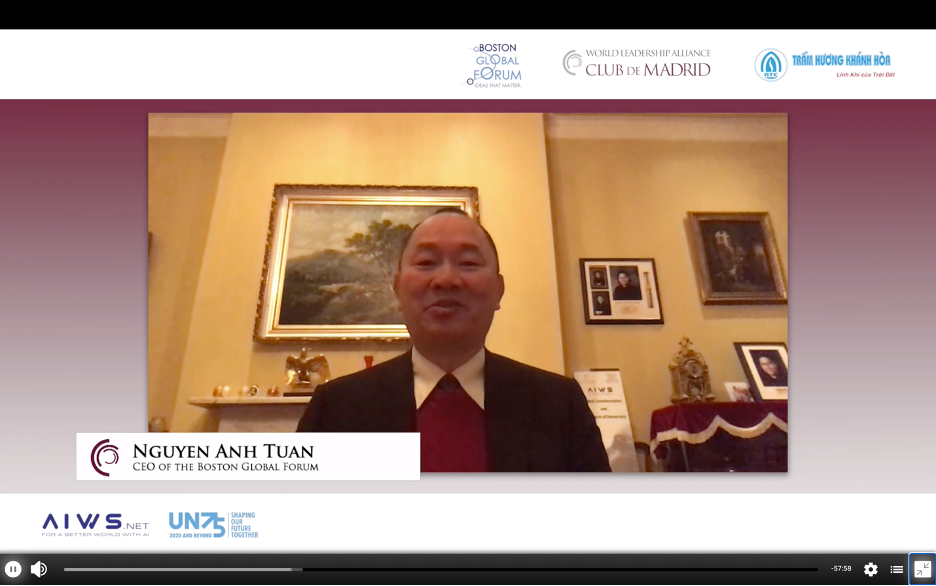
On September 17, at Session I of this event, Mr. Nguyen Anh Tuan, CEO of the Boston Global Forum, Co-Author of Social Contract for the AI Age, introduced the model of AI World Society City (AIWS City). AIWS City as a method of practicing the Social Contract for the AI Age.
The AIWS City is an all-digital virtual city based on trusted open data, that applies the standards of “Social Contract for the AI Age”, “People Centered Economy”, “Trustworthy Economy”, “Intellectual Society, a thoughtful civil society”, and “AI-Government”.
- The AIWS City can assist citizens to become more thoughtful by enhancing knowledge, critical thinking and social responsibility
- AIWS creates the concept of AIWS Value. AIWS Value: traditional value (products, services, data, innovation, creativities, etc.) + social values (contributions). Recognize and exchange traditional and social values.
- The AIWS City will operate based on AIWS Value in order to create a good Ecosystem of the People Centered Economy – “all people can create value for each other”.
- Slogan: “People Centered AI andInternet Ecosystem for Work and Life”.
- The AIWS City Board of Leaders are: Governor Michael Dukakis, Chairman of the Boston Global Forum, Nguyen Anh Tuan, CEO of The Boston Global Forum, Professor Alex Pentland, MIT, Vint Cerf, Father of the Internet, Chief Internet Evangelist of Google, Professor Zlatko Lagumdzija, Former Prime Minister of Bosnia and Herzegovina, Professor Nazli Choucri, MIT, Professor David Silbersweig, Harvard University, Professor Thomas Patterson, Harvard University, Marc Rotenberg, Director of Center for AI and Digital Policy at Michael Dukakis Institute.

by Editor | Sep 19, 2020 | News
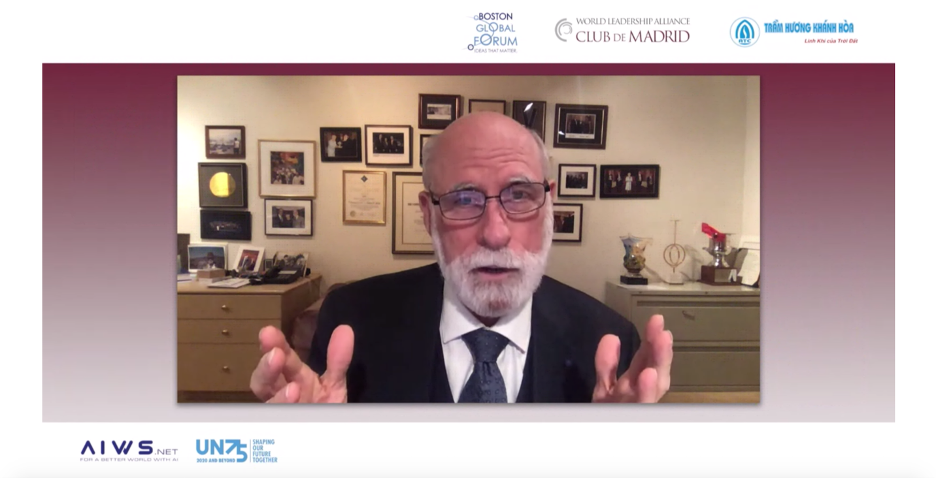
On September 17 at Session I: The AIWS Social Contract 2020 and AIWS Innovation Network: A Platform for Transatlantic Cooperation, the Lead Speaker and Facilitator was Nazli Choucri, Boston Global Forum Board Member and Professor of Political Science at the Massachusetts Institute of Technology (MIT)
Panel discussion:
- Esko Aho, WLA-CdM Member, Prime Minister of Finland (1991-1995)
- Vaira Vike-Freiberga, WLA-CdM Member, President of Latvia (1999-2007)
- Vint Cerf, Father of the Internet, Chief Internet Evangelist, Google
- Nguyen Anh Tuan, CEO of the Boston Global Forum, “Presentation AIWS City, a practicing of The Social Contract 2020, A New Social Contract in the Age of AI”
The panel discussed the Social Contract for the AI Age and AIWS City. In this session participants are President Vaira Vike-Freiberga, Vint Cerf, both World Leader in AIWS Award recipients, Professor Nazli Choucri, MIT, Board Member of the Boston Global Forum, Michael Dukakis Institute, History of AI at AIWS.net, Mr. Nguyen Anh Tuan, CEO of the Boston Global Forum. Professor Choucri is lead speaker and moderator of this session. She talked about the Social Contract for the AI Age, and Mr. Tuan introduced new concepts found in the Social Contract for the AI Age such as Intellectual Society and Smart Democracy, as well as the model of AIWS City.
Link: https://boston.dialoguescdm.org/on-demand/#02


by Editor | Sep 19, 2020 | Event Updates
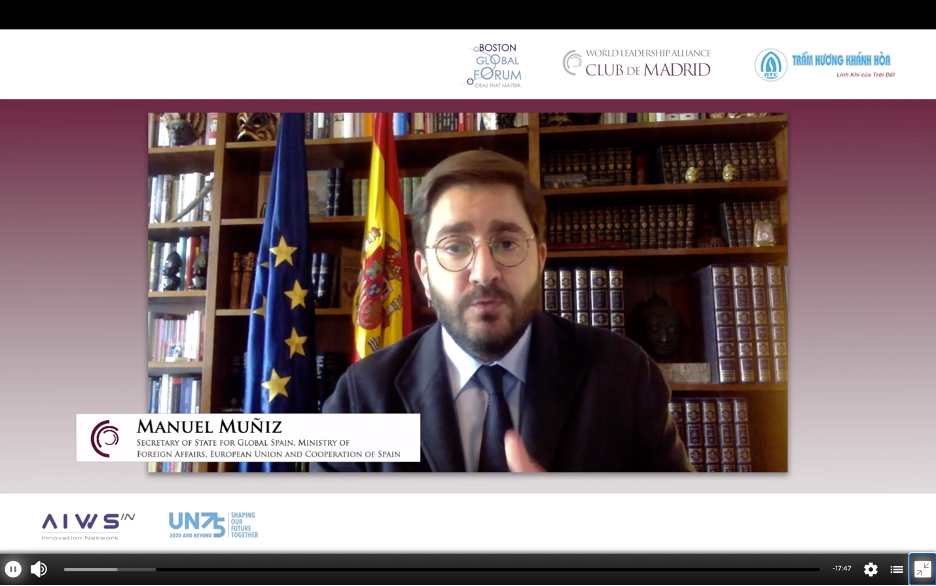
On September 16, 2020, at the Welcome and Introductory Session of World Leadership Alliance-Club de Madrid Policy Lab: Transatlantic Approaches on Digital Governance – A New Social Contract on Artificial Intelligence, after keynote speech of Manuel Muñiz, Secretary of State for Global Spain, Ministry of Foreign Affairs, European Union and Cooperation of Spain, Professor Thomas Patterson, Board Member of the Boston Global Forum, launched and presented Social Contract for the AI Age. Mr. Ramu Damodaran, Chief of the Academic Impact, United Nations, and Editor in Chief of the United Nations Chronicle Magazine, moderated the discussion. Discussants include Prime Minister of Latvia, Valdis Birkavs.
The list of speakers of the special sessions are below.
Welcome Session
- Danilo Türk, President of WLA-CdM, President of Slovenia (2007-2012)
- Manuel Muñiz, Secretary of State for Global Spain, Ministry of Foreign Affairs, European Union and Cooperation of Spain
- Mr. Nguyen Van Tuong, Chairman of Tram Huong Khanh Hoa
- Governor Michael Dukakis, Chair of The Boston Global Forum
- Keynote Speech “Transatlantic Relations and the Digital Social Contract”
- Manuel Muñiz, Secretary of State for Global Spain, Ministry of Foreign Affairs, European Union and Cooperation of Spain
Introductory Session: A New Social Contract in the Age of AI
Keynote: Thomas Patterson, Research Director of The Michael Dukakis Institute for Leadership and Innovation, Professor of Government and the Press of Harvard Kennedy School
Facilitator: Ramu Damodaran, Editor-in-Chief of the UN Chronicle and Chief of the United Nations Academic Impact
Panel discussion:
- Valdis Birkavs, WLA-CdM Member, Prime Minister of Latvia (1993-1994)
- Jerry Jones, WLA-CdM Advisor Executive Vice-President, Ethics and Legal Officer, Live Ramp and Advisor
- Nuria Oliver, IEEE Fellow, ACM Fellow, member of the High Level Expert Group on B2G data sharing at the European Commission
Link: https://boston.dialoguescdm.org/on-demand/#02


by Editor | Sep 19, 2020 | News
Causality Link, an advanced, AI-driven investment technology provider, today announced an agreement with MT Newswires to incorporate the financial news information provider’s industry-leading content into the Causality Link Research Assistant platform.
MT Newswires’ global financial news strengthens Causality Link’s vast and growing corpus of content with a perspective relied upon by institutional investors globally. By leveraging MT Newswires’ “Live Briefs PRO – Global Markets” offering — a comprehensive, real-time, multi-asset feed of global capital markets and economic events –Causality Link gains more than 130 categories of original, ticker-tagged and meta-coded content that will augment the Research Assistant’s signals and financial models.
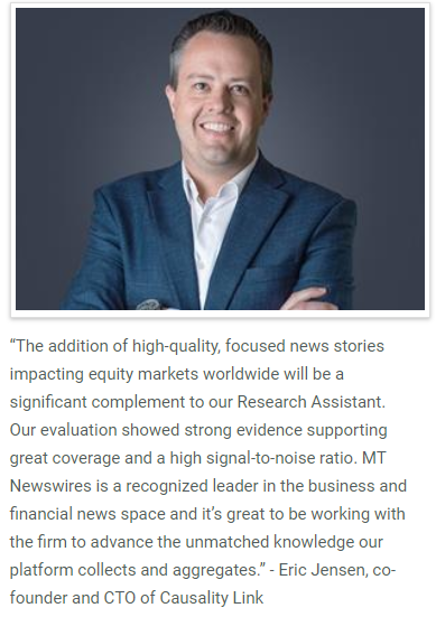
“The addition of high-quality, focused news stories impacting equity markets worldwide will be a significant complement to our Research Assistant,” said Eric Jensen, co-founder and CTO of Causality Link. “Our evaluation showed strong evidence supporting great coverage and a high signal-to-noise ratio. MT Newswires is a recognized leader in the business and financial news space and it’s great to be working with the firm to advance the unmatched knowledge our platform collects and aggregates.”
Causality Link’s unique, AI-powered Research Assistant extracts the knowledge contained within millions of documents and other text-based sources to provide investors and analysts with a unique perspective on companies, industries and macroeconomic drivers. By aggregating explicitly stated cause-and-effect relationships between market indicators and company key performance indicators (KPIs), the Causality Link platform provides clients with more significant, longer-lasting, less emotional and more precise insights and forecasts. With the help of its proprietary machine learning (ML) and natural language processing (NLP) technologies, the solution is leading the next wave of AI innovation to aggregate human knowledge from thousands of authors.
In the field of AI and Causality, Professor Judea Pearl is a pioneer for developing a theory of causal and counterfactual inference based on structural models. In 2011, Professor Pearl won the Turing Award, computer science’s highest honor, for “fundamental contributions to artificial intelligence through the development of a calculus of probabilistic and causal reasoning.” In 2020, Professor Pearl is also awarded as World Leader in AI World Society (AIWS.net) by Michael Dukakis Institute for Leadership and Innovation (MDI) and Boston Global Forum (BGF). At this moment, Professor Judea also contributes to Causal Inference for AI transparency, which is one of important AIWS.net topics on AI Ethics.