by Editor | Dec 28, 2020 | News
On December 31, 2020, the History of AI Board will announce achievements, figures, and events of AI 2020.
2020 was a special and eventful year, and yet it is ending, as we approach 2021. To cap off this memorable year, the History of AI Initiative at AIWS.net will selection and choose achievements, figures, and events in AI (including science technology, innovation, politics, policy, economy, cultures, society) in 2020:
- What are some historical achievements in AI in 2020?
- Who are notable and monumental figures in AI development in 2020?
- What are some pivotal events in AI history in 2020?

by Editor | Dec 28, 2020 | Event Updates
On December 28, 2020, the Boston Global Forum will officially publish the Report “The Quad Roundtable at the Riga Conference 2020 – The Quad Group, AIWS Social Contract and solutions for world peace and security.” The report includes the following key messages:
First, it is necessary to mend differences amongst the Western allies — such as different views of interests, diversity in social perceptions, and the role of the Western alliance in U.S. priorities –, and to reestablish US international leadership
Second, the common interest of the Quad is an open Indo-Pacific region – one that is inclusive, not exclusive. Inclusion will contribute to transparency, cooperation, and information sharing among like-minded responsible international actors. Such a situation would also facilitate containment of the pandemic from other parts of the world and from the region itself. It will also support the management of climate, humanitarian, social and security challenges for all.
In recent years, the credibility of security alliances in the Indo-Pacific region has been called into question. For this reason, the Quad emphasizes diplomacy to enhance even broader cooperation with such partners as South Korea, Philippines, Thailand, Myanmar, Cambodia, Bangladesh, Indonesia, Malaysia, Vietnam, Laos, and Europe. Indo-Pacific region must be governed by rules, and by respecting democratic values.
Third, artificial intelligence is not just a novel technology but also something that can enhance the digital economy and commercial opportunities for all.
The Quad group could also work to bring all countries in the region to a shared view of the common good.
Fourth, while addressing possibilities and challenges brought about by artificial intelligence, US leadership must consider the interconnectivity of different types of interests in the Indo-Pacific region.
However, the Quad has the important responsibility of requesting China to respect its neighbors and to refrain from generating tensions in the Indo-Pacific region. As a matter of principle, respect for Hong Kong and its democracy is imperative.
Fifth, the surge of 5G technologies will enhance the expansion of artificial intelligence. With such technological expansion, democratic values should dominate in the use of data.
The co-authors of the Report are: Professor Nazli Choucri, MIT, Boston Global Forum Board Member, Ambassador P.S Raghavan, Chairman of the National Security Advisory Board of India, Dr. Sandis Šrāders, Fellow, Baltic Defence College and Board Member, Latvian Transatlantic Organization, Nguyễn Anh Tuấn, CEO of the Boston Global Forum
by Editor | Dec 28, 2020 | News
In a recent trial demonstration, Fujitsu’s researchers succeeded in rediscovering the gene of interest in the colorectal cancer classification, offering a key to the development of a treatment plan individualised for each patient
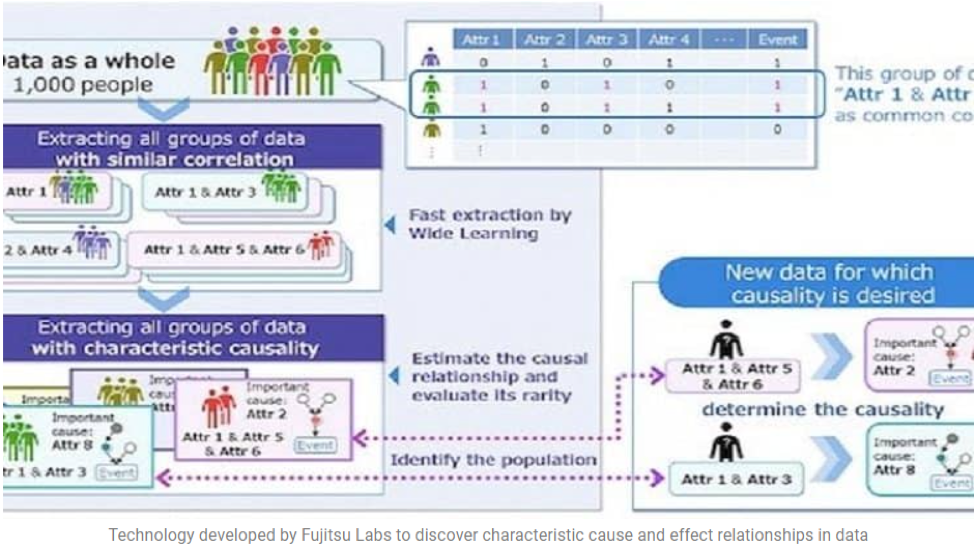
Fujitsu has developed a technology to discover the characteristic causality of individual pieces of data by quickly extracting all the groups of data that have a common correlation from an entire dataset, and evaluating the causality of each group of data to find the characteristic causality. The technology specifically addresses the need to isolate and identify characteristics from data in different real-world scenarios.
While the use of AI to tackle real-world problems continues to accelerate, certain challenges remain in applying AI and machine learning technologies to resolve challenges in a variety of fields, including medicine and marketing. To identify the key drivers of the problem to be solved and develop a strategy, for instance, it’s necessary to not only look at the correlation between attributes A and B, but also at the causal relationship between A and B, such as “A is the cause of B.”
To date, data analysis research has led to the development of techniques for estimating the common cause-and-effect relationship of data. In addition, estimating the characteristic cause-and-effect relationship of each piece of data is needed to solve many real problems.
For example, in the case of cancer treatment in the medical field, many cancer patients have been identified by the expression of unique genes that affect the disease state of cancer. In order to devise an appropriate treatment plan for individual patients, therefore, doctors must identify genes that are unique to each cancer patient, not genes that are common to all cancer patients.
In the case of promotions in marketing, each customer within a larger group has a distinctive characteristic that leads to their purchase, and in order to plan appropriate outreach for individual customers, it becomes necessary to identify a characteristic, motivational cause for each customer, not a cause common to all customers.
In this way, there has been a need for new techniques for estimating the characteristic cause-and-effect relationship of each piece of data to solve many real problems.
The original article can be found here.
In the field of AI application with Cause-and-Effect, Professor Judea Pearl is a pioneer for developing a theory of causal and counterfactual inference based on structural models. In 2011, Professor Pearl won the Turing Award, computer science’s highest honor, for “fundamental contributions to artificial intelligence through the development of a calculus of probabilistic and causal reasoning.” In 2020, Michael Dukakis Institute also awarded Professor Pearl as World Leader in AI World Society (AIWS.net) for Leadership and Innovation (MDI) and Boston Global Forum (BGF). At this moment, Professor Judea is a Mentor of AIWS.net and Head of Modern Causal Inference section, which is one of important AIWS.net topics on AI Ethics.

by Editor | Dec 23, 2020 | News
The Boston Global Forum (BGF) mourns the passing of Ezra Vogel, the Henry Ford II Professor of Social Science at Harvard University, who passed away on December 20, 2020. He will be remembered for his distinguished career as the nation’s premier scholar of Japan and China, respected here and in those countries for his thoughtful and evenhanded analysis of first Japan’s and then China’s rise to global prominence. His award-winning books helped shape how the world viewed the two ascendant economic powers. Professor Vogel was actively involved in the efforts of the Boston Global Forum to promote peace and security in the East Sea and South China Sea. BGF’s Board of Thinkers will miss its member Ezra Vogel and his wise presence, and are deeply grateful for his contributions to the Boston Global Forum.