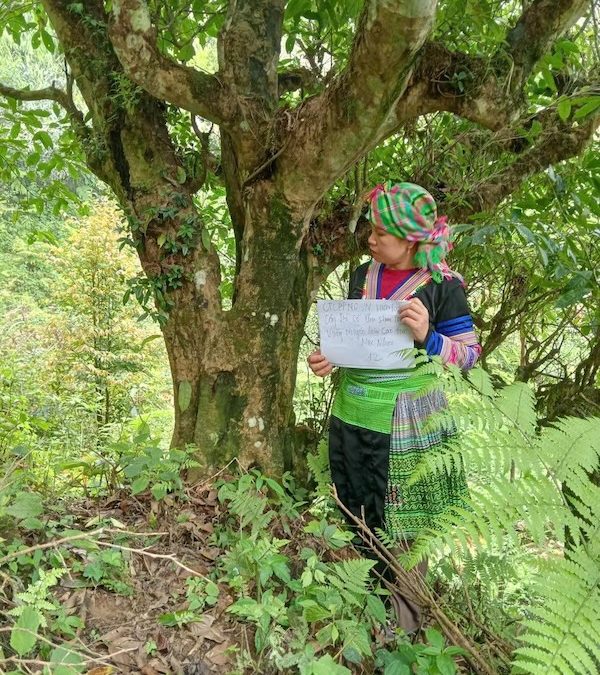
by Editor BGF | Apr 12, 2026 | News
In the Age of Artificial Intelligence, as the world moves faster than ever, human beings need moments to become still, to nourish the spirit, and to preserve the noble values of the heart.
Muc Nhan Tea Essence contributes to building Tea Soul Culture for the AI Age — accompanying the effort to shape the AIWS Trust Infrastructure and the AIWS Trust Architecture for a trustworthy future for humanity.
Tea Soul Culture begins with a symbolic act: holding Muc Nhan Tea Essence in the mouth in stillness. In that moment, the fragrance and taste of tea lead the human being into inner depth, inviting reflection on noble values and on the path that AIWS has opened and continues to build together with humanity.
Muc Nhan Tea Essence brings warmth and calm, helps the mind settle, supports concentration, and nurtures a state of inner peace and clarity. In that stillness, people can more deeply experience gratitude, compassion, and the creative energy that arises from within.
Muc Nhan Tea Essence is also proud to accompany the book America at 250: A Beacon for the AI Age — a work that offers vision, strategy, and solutions for building a better, more trustworthy, and more humane future in the AI Age.
Together with the noble values of AIWS, Muc Nhan Tea Essence helps nourish the spirit and the beautiful heart within each person.
Tea Soul Culture contributes to human happiness:
opening a path, and nurturing the spirit and the beautiful heart.
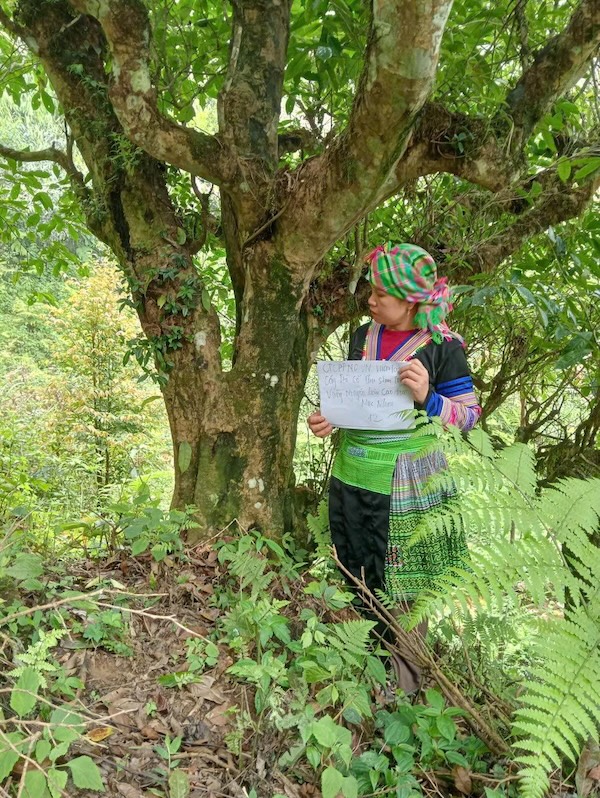
Centuries-old and millennium-old tea trees flourish wild atop Vietnamese mountain summits above 1,200m

Centuries-old and millennium-old tea trees flourish wild atop Vietnamese mountain summits above 1,200m


by Editor BGF | Apr 2, 2026 | News
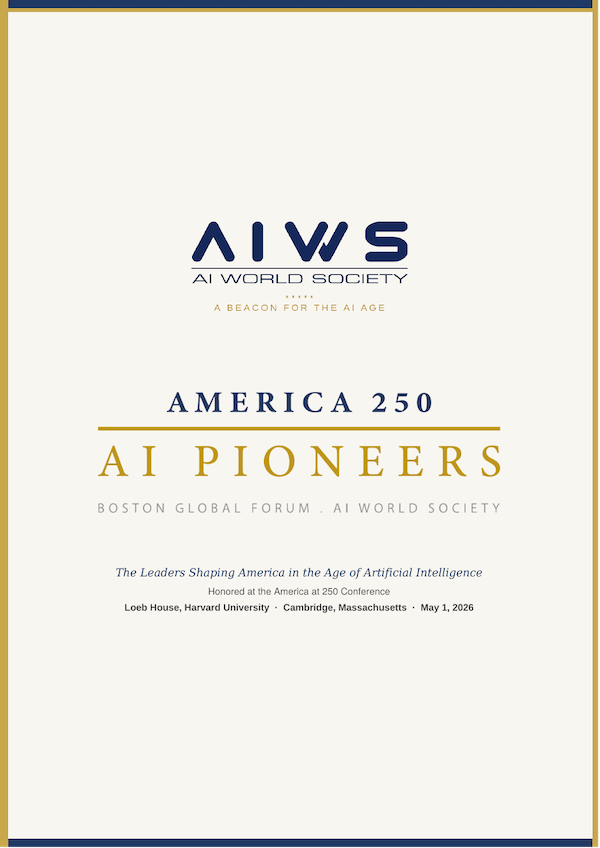
50 Leaders Shaping America in the Age of Artificial Intelligence
Boston, MA, April 2, 2026 — The Boston Global Forum (BGF) and AI World Society (AIWS) today announced America 250: AI Pioneers, honoring 50 individuals whose work is shaping America’s leadership in the age of artificial intelligence. The awards will be presented at the America at 250 Conference on May 1, 2026, at Loeb House, Harvard University, in Cambridge, Massachusetts.
The honorees span six domains: AI Research & Science, AI Governance & Ethics, AI & Health, AI & Economy, AI, Education & Society, and AI, Security & Defense. They include Nobel laureates John Hopfield, Jennifer Doudna, and Katalin Karikó; Turing Award recipient Judea Pearl; technology leaders Jensen Huang, Sam Altman, Dario Amodei, Satya Nadella, and Jeff Bezos; pioneering researchers Alex Pentland, Yann LeCun, Fei-Fei Li, Andrew Ng, and Vint Cerf; and distinguished leaders in AI ethics, democracy, and national security.
The America at 250 Conference will also highlight one of the defining challenges of our time: Trust in the AI Age. The conference will feature two major panels, “AIWS Trust Infrastructure for the AI Age” and “AIWS Information Trust Infrastructure for the AI Age.” Many of the honorees of America 250: AI Pioneers will also serve as panelists in these two trust-centered discussions, underscoring their role not only as innovators, but as distinguished figures helping shape the trust infrastructure the world now urgently needs.
By honoring the America 250 AI Pioneers, BGF and AIWS affirm that America’s leadership in the AI Age will be defined not only by scientific discovery and technological innovation, but also by the capacity to build systems that are trustworthy, human-centered, and aligned with democratic values.
“These 50 AI Pioneers are helping define America’s leadership in the AI Age. Their achievements reach far beyond innovation alone; they also contribute to the larger task of building the trust infrastructure that democratic societies and humanity will require in the years ahead.” — Nguyen Anh Tuan, Co-Founder, Co-Chair, and CEO of the Boston Global Forum
The America at 250 Conference marks the 250th anniversary of the United States and charts America’s leadership role in the age of artificial intelligence.
About BGF & AIWS
The Boston Global Forum, co-founded in 2012 by Governor Michael Dukakis, Nguyen Anh Tuan, and Harvard Professors Thomas Patterson and John Quelch, is a pioneering international forum advancing peace, security, democracy, and governance in the Age of Artificial Intelligence.
AI World Society (AIWS), co-founded in 2017 by Governor Michael Dukakis and Nguyen Anh Tuan, is a political, social, economic, and governance model for the AI Age, advancing frameworks for trust, democracy, and humanity in a world transformed by artificial intelligence.
Media Contact:
Boston Global Forum
bostonglobalforum.org
[email protected]
by Editor BGF | Apr 2, 2026 | Papers & Reports, News, Publications
America at 250: AI Pioneers
The Leaders Shaping America in the Age of Artificial Intelligence
Honored at the America at 250 Conference
Loeb House, Harvard University · Cambridge, Massachusetts · May 1, 2026
Preamble
On the occasion of the 250th anniversary of the United States of America, the Boston Global Forum and the AI World Society are proud to recognize fifty scientists, technologists, scholars, and leaders who are most powerfully shaping America’s role in the Age of Artificial Intelligence — and, through America, the governance of AI for the world.
In this recognition, the designation “AI Pioneer” encompasses foundational researchers, builders of large-scale AI systems, and architects of governance, safety, and democratic trust.
The AI age is not a distant future. It is the defining reality of the present — reshaping medicine, education, defense, democracy, and the economy with a speed and scope unmatched by any previous technology. America stands at a hinge point: it can lead the world in governing AI in service of democratic values and human dignity, or it can cede that leadership to frameworks that do not share those values.
The fifty thinkers honored here are helping determine that outcome. They are building AI systems, shaping governance frameworks, protecting democratic values, and demonstrating through their work that the AI age can be — and must be — an age of human flourishing.
As America marks 250 years of democratic self-governance, this recognition is both a celebration and a call. The thinkers leading us into the AI age bear a responsibility as great as that of any generation of American innovators who came before them. Their choices — about safety, equity, transparency, and democratic accountability — will help shape the next 250 years.
This recognition was conceived and curated by Nguyen Anh Tuan, Founder of the AI World Society and Co-Founder, Co-Chair, and CEO of the Boston Global Forum, together with his colleagues at BGF. Distinguished professors have nominated Nguyen Anh Tuan as one of the 50 AI Pioneers, recognizing that his decade-long work in building the AIWS governance framework, the AIWS Social Contract, and the BGF–AIWS Family has made this recognition of America’s AI leadership possible. Consistent with his role as co-author of this volume, Mr. Tuan chose not to include his name in the list.
Selection Criteria
U.S. Leadership & Impact: The thinker has conducted their most consequential work in the United States or through U.S.-based institutions.
AI Age Relevance: The work must directly shape, govern, build, or critically analyze artificial intelligence and its impact on society, democracy, economy, health, education, or security.
Transformative Impact: The contribution must have fundamentally changed a field or domain — not incrementally improved it — with consequences felt at national or global scale.
Breadth of Domain: The list spans six domains to reflect the full range of America’s AI leadership: research, governance, health, economy, education, and security.
Democratic Values: Priority is given to thinkers who have explicitly connected their work to democratic values, human dignity, equity, and the public good.
I. AI Research & Science — The Architects of the AI Age
- Jeff Dean — AI Infrastructure & Systems
Google Senior Fellow and SVP; designed TensorFlow and Google’s TPU chips; co-founded Google Brain; built AI infrastructure that powers AI deployment at global scale.
Era: 1990s–present
- John Hopfield — Neural Networks & Physics of AI
Princeton physicist; invented Hopfield Networks — a foundational model for associative memory that inspired modern deep learning; 2024 Nobel Prize in Physics laureate.
Era: 1980s–present
- Chelsea Finn — Meta-Learning & Robotics AI
Stanford professor; pioneer of model-agnostic meta-learning (MAML), enabling AI systems to learn new tasks from very few examples; leading voice on generalizable and embodied AI.
Era: 2010s–present
- Judea Pearl — Causal AI & Bayesian Reasoning
Turing Award 2011; World Leader in AIWS Award recipient; developed Bayesian Networks and the mathematical framework for causal inference — foundational to how AI reasons under uncertainty; his book The Book of Why revolutionized how scientists and AI researchers think about explanation and causality.
Era: 1980s–present
- Vint Cerf — Internet & AI Infrastructure
Co-designed TCP/IP — the internet protocols that gave birth to the global AI ecosystem; widely recognized as a “Father of the Internet”; World Leader in AIWS Award recipient.
Era: 1970s–present
- Yann LeCun — Deep Learning & Computer Vision
Developed convolutional neural networks that power image recognition, autonomous vehicles, and medical AI; Chief AI Scientist at Meta.
Era: 1980s–present
- Fei-Fei Li — Computer Vision & Human-Centered AI
Created ImageNet, the dataset that launched the deep learning revolution; champion of human-centered AI at Stanford; co-director of HAI.
Era: 1990s–present
- Andrew Ng — Deep Learning & AI Education
Pioneer of deep learning at Google Brain and Baidu; co-founded Coursera; democratized AI education for millions worldwide.
Era: 2000s–present
- Sam Altman — Generative AI
CEO of OpenAI; launched ChatGPT, making generative AI accessible to hundreds of millions; catalyzed the current AI transformation of society.
Era: 2010s–present
- Cynthia Breazeal — Social Robotics & Human-AI Interaction
MIT professor and among the earliest creators of sociable robots; created Kismet and Jibo; founder of MIT RAISE, leading AI literacy education for millions of students globally; built the field of social robotics.
Era: 1990s–present
II. AI Governance, Democracy & Ethics — Ensuring AI Serves Humanity
11. Andrej Karpathy — Deep Learning, Autopilot AI & AI Education
Founding member of OpenAI; created Stanford’s CS 231n — the course that trained a generation of AI researchers; led Tesla Autopilot Vision as Director of AI; founder of Eureka Labs, democratizing AI education globally through the “Zero to Hero” series and LLM101n. Named one of Time Magazine’s 100 Most Influential People in AI, 2024.
Era: 2010s–present
- Alex “Sandy” Pentland — Data Science & AI Governance
MIT Toshiba Professor, Stanford HAI Fellow. Pioneer in Data Science, Computational Social Science, and AI Governance, including development of GDPR, the Sustainable Development Goals, and the AIWS Social Contract.
Era: 1980s–present
- Daniela Rus — Robotics & AI
Director of CSAIL at MIT; leading researcher in robotics and AI; champion of AI for human flourishing.
Era: 1990s–present
- Alondra Nelson — AI Policy & Equity
Former Acting Director of White House OSTP; architect of the Blueprint for an AI Bill of Rights — a foundational U.S. framework for human-centered AI; World Leader in AIWS Award recipient.
Era: 2010s–present
- Timnit Gebru — Algorithmic Justice & AI Ethics
Co-authored landmark research on facial-recognition bias; founder of DAIR Institute; made algorithmic fairness a central concern of AI development.
Era: 2010s–present
- Joy Buolamwini — Algorithmic Justice
Founded the Algorithmic Justice League; her research exposed racial and gender bias in facial-recognition systems used by governments worldwide.
Era: 2010s–present
- Stuart Russell — AI Safety & Alignment
Author of the definitive AI textbook; founder of the Center for Human-Compatible AI at Berkeley; one of the world’s leading voices on AI alignment.
Era: 1980s–present
- Kate Crawford — AI & Society
Senior Principal Researcher at Microsoft; author of Atlas of AI; her work on the social and political dimensions of AI shapes global policy.
Era: 2000s–present
- Shoshana Zuboff — Surveillance Capitalism
Harvard professor; author of The Age of Surveillance Capitalism — the definitive account of how AI-driven data extraction threatens democratic society.
Era: 2000s–present
- Eric Schmidt — AI & National Security
Former CEO and Chairman of Google; Chair of the National Security Commission on AI; champion of democratic AI leadership against authoritarian alternatives.
Era: 2000s–present
- Peter Shor — Quantum Computing & AI Cryptography
MIT Institute Professor; invented Shor’s Algorithm (1994) — the quantum algorithm that redefines the cryptographic foundations of the AI age; his work on quantum error correction defines the security horizon of advanced AI systems.
Era: 1990s–present
- Cynthia Dwork — Differential Privacy & Algorithmic Fairness
Gordon McKay Professor of Computer Science at Harvard; one of the inventors of differential privacy — the mathematical framework now embedded in every Apple device and the backbone of the 2020 U.S. Census disclosure-avoidance system.
Era: 1990s–present
III. AI & Health, Biology & Medicine — AI for Human Flourishing
- Jennifer Doudna — CRISPR & Genomics
Co-developed CRISPR-Cas9 gene editing; Nobel Prize in Chemistry 2020; her work, accelerated by AI, may eliminate genetic diseases permanently.
Era: 2010s–present
- Eric Lander — Genomics & Science Policy
Principal leader of the Human Genome Project; founding director of the Broad Institute; Biden’s Science Advisor; champion of AI for equitable health.
Era: 1990s–present
- Katalin Karikó — mRNA Medicine
Pioneered mRNA technology for decades while at the University of Pennsylvania; Nobel Prize 2023; her perseverance made COVID-19 vaccines possible — now accelerated by AI drug discovery.
Era: 1980s–present
- Eric Topol — AI & Medicine
Founder of Scripps Research Translational Institute; leading advocate for AI-augmented medicine; author of Deep Medicine; champion of AI for human doctors.
Era: 2000s–present
- Robert Desimone — Neuroscience & Brain-AI
Director of the McGovern Institute for Brain Research, MIT; his work on attention and cognition bridges neuroscience and AI.
Era: 1980s–present
- Regina Barzilay — AI & Oncology
MIT School of Engineering Distinguished Professor; MacArthur Fellow 2017; developed AI systems that predict breast cancer up to five years in advance; first recipient of the $1M AAAI Squirrel AI Award; member of National Academy of Medicine.
Era: 2000s–present
- Isaac Kohane — AI & Biomedical Informatics
Chair of Biomedical Informatics at Harvard Medical School; pioneer of AI-driven personalized medicine; co-author of The AI Revolution in Medicine; one of the most authoritative voices on AI transformation of healthcare.
Era: 1990s–present
IV. AI & Economy, Business & Innovation — Building the AI Economy
30. Jensen Huang — AI Hardware & Infrastructure
Founded NVIDIA; the GPU became the essential hardware of the AI age — without NVIDIA’s chips, the deep learning revolution could not have happened.
Era: 1990s–present
- Dario Amodei — Safe & Beneficial AI
Co-founded Anthropic after leaving OpenAI over safety concerns; CEO of Anthropic — one of the leading AI safety companies; building AI that is safe, honest, and beneficial.
Era: 2010s–present
- Larry Page — AI & Search Intelligence
Co-founder of Google; PageRank pioneered the algorithmic ranking of information that prefigured AI’s role in organizing human knowledge; Google’s AI investments define the industry.
Era: 1990s–present
- Sergey Brin — AI & Information Architecture
Co-founder of Google; co-designed PageRank and the search infrastructure that made AI-powered information retrieval universal; Google DeepMind is one of the world’s leading AI labs.
Era: 1990s–present
- Satya Nadella — AI & Enterprise
CEO of Microsoft; integrated AI across Microsoft’s entire product suite; the $13B investment in OpenAI made Microsoft one of the leading AI enterprise companies.
Era: 2010s–present
- Jeff Bezos — Cloud & AI Infrastructure
Founded Amazon and AWS — the cloud infrastructure on which most AI systems run; Amazon’s AI investments span Alexa, robotics, and healthcare.
Era: 1990s–present
- Marc Benioff — AI & Ethical Business
CEO of Salesforce; pioneer of AI-integrated enterprise software; vocal advocate for ethical AI, stakeholder capitalism, and technology for social good.
Era: 2000s–present
V. AI, Education & Social Sciences — AI for Knowledge and Society
37. John Schulman — Agentic AI & Reinforcement Learning
Co-founder of OpenAI; inventor of Proximal Policy Optimization (PPO) — the reinforcement-learning algorithm that is the foundational training backbone of ChatGPT, Claude, and virtually every major AI system; pioneered RLHF.
Era: 2010s–present
- Sal Khan — AI & Education
Founded Khan Academy; launched Khanmigo — one of the most promising AI tutoring systems; democratizing world-class education through AI.
Era: 2000s–present
- John Preskill — Quantum Information & Computing
Richard P. Feynman Professor of Theoretical Physics at Caltech; founder of the field of quantum information science; coined the term “quantum supremacy”; his work defines the frontier where AI and quantum systems may converge.
Era: 1990s–present
- Daphne Koller — AI & Online Education
Co-founded Coursera; pioneer of probabilistic graphical models; her work on AI-driven personalized learning is reshaping education globally.
Era: 2000s–present
- Robert Putnam — Social Capital & Democratic AI
Harvard political scientist; author of Bowling Alone; his research on social capital and community is essential for understanding AI’s impact on democracy.
Era: 1990s–present
- Sherry Turkle — Technology, Identity & Society
MIT professor; her decades of research on human relationships with technology provide essential insight into AI’s psychological and social dimensions.
Era: 1980s–present
- Beth Simone Noveck — AI Governance & Democratic Innovation
Professor at Northeastern University; Director of The GovLab; nation’s first State Chief AI Strategist (New Jersey); former U.S. Deputy Chief Technology Officer under President Obama; founder of InnovateUS, America’s largest AI training program for government; author of Reboot: AI and the Race to Save Democracy (Yale University Press, 2026); architect of practical AI governance frameworks deployed across U.S. states and allied governments.
Era: 2000s–present
VI. AI, Security & Defense — Protecting Democracy in the AI Age
44. Paul Nakasone — Cybersecurity & AI Defense
Commander of U.S. Cyber Command and Director of NSA, 2018–2023; led America’s cyber defense in the AI age; architect of the “defend forward” strategy.
Era: 2010s–present
- Michèle Flournoy — AI & National Security
Former Under Secretary of Defense; co-founder of WestExec Advisors; leading voice on responsible AI in defense and democratic security frameworks.
Era: 2000s–present
- James Clapper — Intelligence & AI
Former Director of National Intelligence; his leadership shaped U.S. intelligence’s adoption of AI while maintaining democratic oversight and civil liberties.
Era: 2000s–2017
- Herbert Lin — AI, Cybersecurity & Policy
Senior Research Scholar at Stanford’s Hoover Institution; leading expert on cybersecurity policy, AI in warfare, and the governance of autonomous weapons.
Era: 1990s–present
- Katharine Hicks — AI & Defense Policy
U.S. Deputy Secretary of Defense; champion of responsible AI adoption in defense; architect of the Pentagon’s AI and autonomous systems governance framework.
Era: 2020s–present
- Bruce Schneier — Cybersecurity & AI Trust
Renowned cryptographer and security technologist; his work on trust in digital systems is foundational for AI security and democratic AI governance.
Era: 1990s–present
- Paul Scharre — Autonomous Weapons & AI Ethics
Director of Studies at CNAS; author of Army of None — the definitive work on autonomous weapons; leading advocate for human control of AI in warfare.
Era: 2010s–present
A Note on the List
Any list of fifty will inevitably omit thinkers of the first rank: pioneers such as Robert Kahn, co-inventor of TCP/IP; Yoshua Bengio, whose foundational deep-learning work was conducted in Canada; Geoffrey Hinton, who left Google to warn the world about AI risks; and researchers whose most important contributions may still lie ahead.
The Boston Global Forum and the AI World Society offer this list not as a final judgment, but as both a recognition and a challenge — to the thinkers honored here, and to America itself. The governance choices being made about AI today will create path dependencies as durable as the Constitution itself. The thinkers who make those choices wisely will help define America’s next 250 years.
“The hinge point is not a metaphor. It is a deadline. The governance frameworks being established now will create path dependencies as durable as those of the Constitution itself.” — America at 250: A Beacon for the AI Age, Prologue
World AI Pioneers Award
In September 2026, at the United Nations General Assembly in New York, the Boston Global Forum will launch the World AI Pioneers Award — a comprehensive global recognition honoring 50 first movers across all fields and all continents who have pioneered responsible, human-centered AI. The honorees will be convened for a landmark dialogue on the AIWS Trust Order at the World Economic Forum in Davos in January 2027, contributing to the international AI governance initiative the world urgently requires.
Boston Global Forum · AI World Society
BostonGlobalForum.org · aiws.net
Boston, Massachusetts · 2026

by Editor BGF | Apr 4, 2026 | News
Calls on Japan to Become a Global Leader in AI Trust
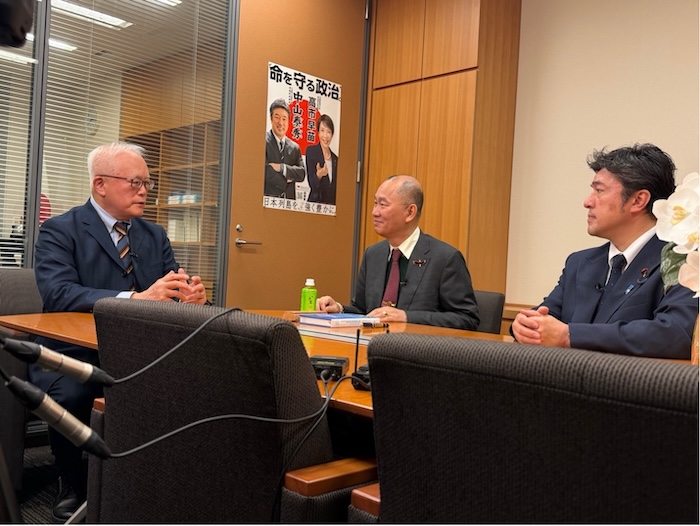
TOKYO, March 31, 2026 — Nguyen Anh Tuan, Co-Founder, Co-Chair, and CEO of the Boston Global Forum (BGF), delivered a distinguished keynote address at the headquarters of Japan’s Liberal Democratic Party (LDP) in Tokyo on March 31, 2026.
Organized by LDP leaders as a two-hour program, the event featured Nguyen Anh Tuan’s keynote address followed by a Q&A session. His remarks were introduced by Mr. Kenji Wakamiya, Chairman of the LDP Research Commission on Foreign Affairs, and Mr. Yasuhide Nakayama, Director of the Global South of the Liberal Democratic Party.
In his speech, “Japan as a Global Leader in AI Trust,” Nguyen Anh Tuan argued that in the age of artificial intelligence, nations will be judged not only by the power of the technologies they create, but by the trust they are able to build. He called on Japan to aim not only to be a leader in AI innovation, but to become a global leader in AI trust.
A central theme of the address was the historic legacy of Prime Minister Shinzo Abe, whom Nguyen Anh Tuan described as a statesman of vision who gave Japan confidence, direction, and a larger mission in the world. He also highlighted the leadership of Prime Minister Sanae Takaichi, presenting her as carrying that legacy forward in an era shaped by artificial intelligence, national resilience, and global transformation.
Nguyen Anh Tuan introduced key elements of the AIWS framework, including AIWS Trust Architecture, AIWS Trust Rating (ATR), AIWS Trust Index (ATX), and AIWS Trust Infrastructure, presenting them as practical pathways to move trust beyond aspiration and into standards, institutions, implementation, and long-term governance. He argued that Japan, together with trusted partners, is especially well positioned to help shape such an effort in the AI Age.
He also underscored the importance of the LDP Global South Cooperation Headquarters and Japan’s long-standing contributions through ODA and international cooperation, calling this accumulated trust and respect a major national asset. He emphasized that future cooperation can be strengthened through more reciprocal, sustainable, and innovation-driven partnerships, including with countries such as Vietnam.
He concluded that the future will belong not only to those who create more powerful AI, but to those who help humanity trust the age it is entering. (bostonglobalforum.org)
by Editor BGF | Apr 4, 2026 | News
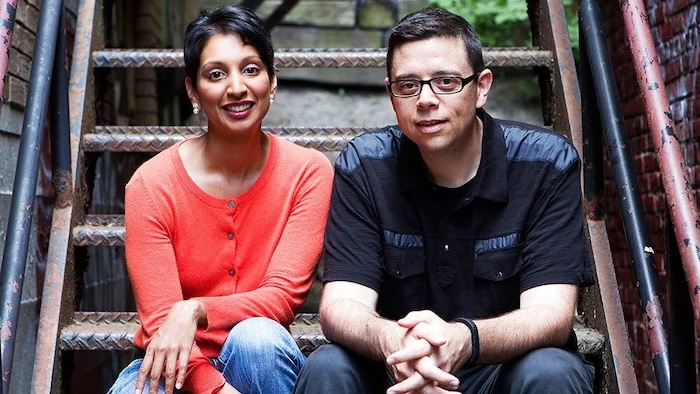
Boston, MA — The America at 250 Conference will feature a special luncheon dialogue, “America at 250: How Storytelling Influences Democracy in the AI Age,” from 12:30 PM to 2:00 PM at the Harvard Faculty Club on May 1, 2026.
Moderated by award-winning filmmaker Gita Pullapilly, the luncheon dialogue will include Jimmy Carter grandson and Carter Center Board Chair Jason Carter and Cobra Kai stunt choreographer Don Lee for a timely discussion on how storytelling, film, and cultural leadership can help sustain democratic values and strengthen public trust in a country facing election mistrust and an era shaped by artificial intelligence.
The luncheon discussion will also explore the emerging concept and criteria of Films for Humanity in the Age of AI within the vision of the AIWS Film Park. This includes reflection on what kinds of films and storytelling should be encouraged in the AI Age: works that affirm human dignity, strengthen empathy, promote truth and responsibility, inspire reconciliation, and contribute to the cultural foundations of democracy and freedom.
By bringing together diverse voices from film, civic leadership, and public life, this discussion will highlight a central message of the America at 250: A Beacon for the AI Age Conference: that America’s future in the AI Age will depend not only on technological innovation, but also on the strength of the accuracy of public knowledge, cultural influencers, and the principles behind democracy.
Event Details
12:30 PM – 2:00 PM
Luncheon Dialogue: Storytelling, Democracy, and America at 250
Hollywood and the Future of Freedom in the AI Age
Harvard Faculty Club
Moderator:
Gita Pullapilly
Panelists:
Jason Carter, Carter Center Board Chair and Jimmy Carter grandson
Don Lee, veteran entertainment industry professional and stunt choreographer
About the America at 250 Conference
The America at 250 Conference is a major gathering marking the 250th anniversary of the United States and examining America’s leadership role in the Age of Artificial Intelligence. Hosted by the Boston Global Forum, the conference brings together leaders, scholars, innovators, and cultural voices to explore democracy, trust, freedom, and humanity in the AI Age.
Media Contact
Boston Global Forum
bostonglobalforum.org
[email protected]