
by Editor BGF | Apr 19, 2026 | News
In the Age of Artificial Intelligence, humanity’s greatest challenge is not only to create ever more powerful technologies, but also to build a culture deep enough to guide those technologies in the service of human beings. From this understanding, the AI World Society (AIWS) has developed the AIWS Cultural Framework as a living architecture of values, symbols, and practices that binds the power of technology to the most enduring spiritual qualities of humankind. For AIWS, culture is not something decorative that merely accompanies technology; culture is a form of governance.
This cultural framework is built upon three core qualities: Warmth–Love, Creativity, and Nobility. These are the qualities AIWS seeks to cultivate in every leader, innovator, scholar, and citizen within its extended family. Warmth–Love enables people to encounter one another not as data or users, but as members of one shared human family. Creativity, in the spirit of AIWS, is not novelty for novelty’s sake, but noble creativity that expands human dignity. Nobility is the capacity to choose the higher path, even when the lower path would be easier, with a character that is honest, elevated, and kind.
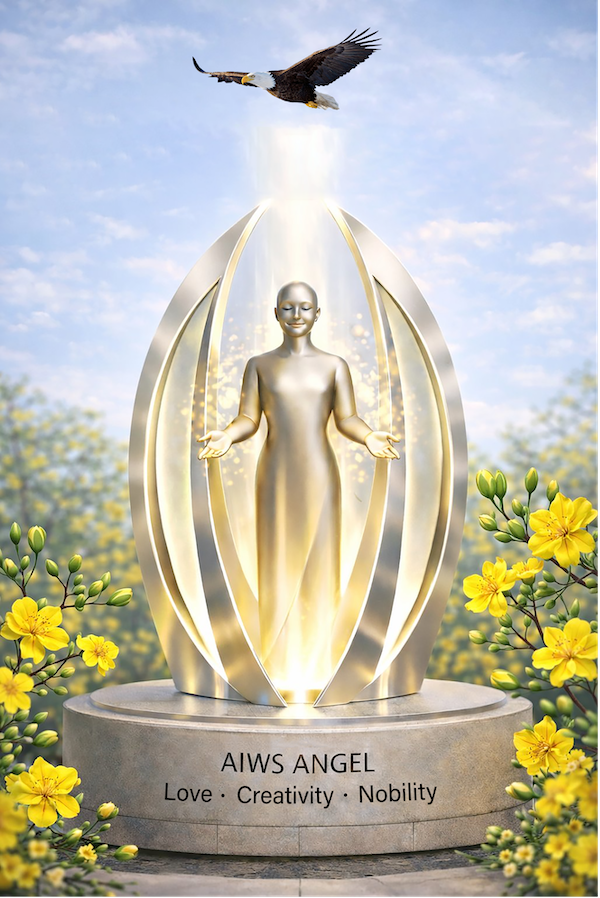
These three qualities are expressed through three symbols that together form a complete architecture of AIWS culture: Hồn Trà as the foundation, Mai Vàng as the heart, and the Bald Eagle as the spirit. Hồn Trà symbolizes stillness, contemplation, and wisdom; Mai Vàng symbolizes warmth, trust, joy, and renewal; and the Bald Eagle symbolizes creativity, a will that overcomes storms, and far vision at elevation. These three symbols do not stand apart; they complement one another as three inseparable dimensions of a complete AIWS character.
Among them, Hồn Trà serves as the cultural foundation. It is a contemplative ritual through the savoring of Cao Trà — crystals of concentrated tea essence from ancient tea trees in the high mountains of Vietnam — in deep stillness. Through this ritual, the AIWS member returns to an inner state in which clarity, love, and noble ideas may arise. Hồn Trà not only nurtures stillness and clarity, but also plants within the practitioner the qualities of optimism, joy, love, and the turning of thought toward what is noble.
Accompanying Hồn Trà is Mai Vàng, the symbol of a heart that is warm, loving, honest, trustworthy, and always capable of renewal. The AIWS Cultural Framework expresses this relationship in a beautiful formula: “Hồn Trà plants, Mai Vàng holds.” Hồn Trà plants good qualities in the moment of contemplation; Mai Vàng keeps those qualities present and alive in daily life, in work, in dialogue, and in action. If Hồn Trà is inner depth, then Mai Vàng is the radiance of a warm heart in the world.
The third symbol, the Bald Eagle, carries the spirit of AIWS as it enters the work of shaping the AI Age. It represents the spirit of creativity at elevation, of a courageous will that overcomes storms, and of far vision. The Bald Eagle reminds us that in the AI Age, leaders and builders of the future cannot merely react to disruption; they must rise above the daily flood of information, look ahead across decades, and transform crises and storms into lift — so that they may rise higher, go farther, and create from a nobler vantage point. The inclusion of the Bald Eagle in the AIWS Cultural Framework also carries deep symbolic meaning: it represents the meeting of the American democratic tradition and the contemplative depth and human warmth of Vietnamese cultural heritage.
What is especially distinctive about the AIWS Cultural Framework is that it does not stop at symbols or aesthetics; it moves into practice. This framework is expressed in conferences, honor ceremonies, visual identity, leadership selection, and the daily life of the AIWS family. A branch of Mai Vàng, an image of the Bald Eagle, or a box of Cao Trà in one’s workspace is not merely decoration, but a reminder that helps each member return to the core values of AIWS amid the rhythm of everyday life.
Ultimately, the AIWS Cultural Framework conveys a clear message: the future of AI cannot be shaped by intelligence alone; it must also be guided by wisdom and love. Hồn Trà offers stillness and depth; Mai Vàng sustains a warm and trustworthy heart; and the Bald Eagle lifts human beings through creativity, will, and far vision from a higher vantage point. Together, these three symbols form a distinctive cultural contribution of AIWS to humanity in the Age of Artificial Intelligence.
by Editor BGF | Apr 19, 2026 | Shinzo Abe Initiative for Peace and Security, News
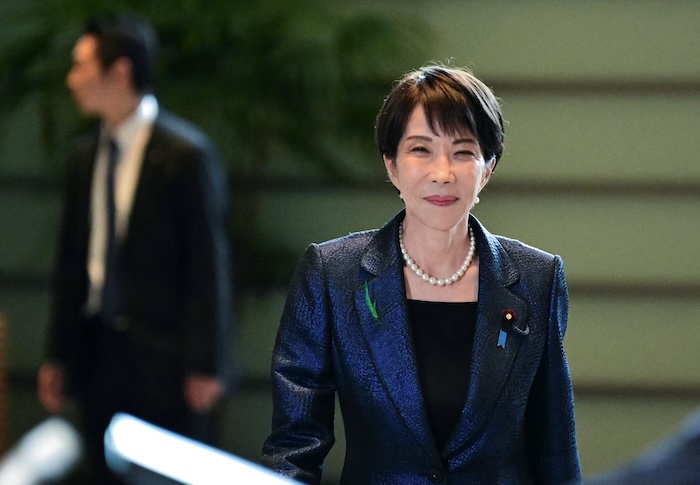
Sanae Takaichi, Prime Minister of Japan, is a prominent leader whose vision combines economic security, technological innovation, and regional cooperation in Asia. Most recently, she has advanced a new initiative aimed at strengthening Asia’s resilience in the face of energy shocks, while also announcing a $10 billion financial support package to help ASEAN countries and other Asian partners secure oil supplies, strengthen reserves, and reinforce the resilience of regional supply chains. This initiative reflects her broader approach: Japan should not only protect its own national interests, but also play a proactive role in strengthening “Asia’s power” through strategic cooperation, resilience, and regional stability.
https://www.reuters.com/business/energy/japan-plans-10-billion-framework-help-asia-secure-oil-2026-04-15/
by Editor BGF | Apr 19, 2026 | World Leader for Peace and Security, News, World Leaders in AIWS Award Updates
Nguyen Anh Tuan
Today, as America approaches the 250th anniversary of its founding, we gather not only to commemorate a great nation’s history, but to honor the extraordinary individuals whose work has helped shape its future.
With deep admiration, the Boston Global Forum and the AI World Society proudly honor the 50 America at 250: AI Pioneers.
These are not only brilliant scientists, inventors, and innovators. They are also visionary business leaders, policymakers, and public thinkers who have helped guide the development of technology in service of society, democracy, and humanity.
They are builders of a new age.
They helped build the foundations of the digital era — and from those foundations, they opened the path to the AI Age.
They advanced the Internet, the great network that transformed how humanity connects, learns, works, creates, and shares knowledge across borders and generations.
They advanced the defining fields of our time: machine learning, deep learning, probabilistic AI, privacy-preserving systems, robotics, human-centered AI, and trustworthy systems.
They opened new frontiers for AI in healthcare, education, science, economics, and public life.
And they helped ensure that the most powerful technologies of our time are guided not only by performance and scale, but by trust, fairness, accountability, transparency, privacy, and human dignity.
This is why their work carries such historic significance.
They did not merely make technology more powerful.
They helped make it more meaningful.
They did not merely accelerate innovation.
They helped define the principles by which innovation should serve society.
They did not merely change what machines can do.
They helped change what humanity can become.
Because of pioneers such as these, America has not only remained a center of scientific and technological strength.
It has also remained a center of creative leadership, democratic possibility, and responsibility to the world.
At this America at 250 moment, we honor them not only for what they have achieved, but for what they have made possible:
A stronger America.
A more innovative America.
A more trusted America.
And, we hope, a more responsible America in service to humanity.
In honoring these 50 AI Pioneers, we also affirm something larger:
That the future will not be shaped by intelligence alone.
It will be shaped by those who bring intelligence together with wisdom.
By those who unite discovery with responsibility.
By those who ensure that power serves human dignity.
That is why these honorees matter so much.
They are not only pioneers of technology.
They are pioneers of possibility.
They help illuminate the path on which America can continue to lead — not only with innovation, but with trust; not only with power, but with moral purpose.
And today, as we honor these remarkable pioneers, we also express a heartfelt hope: that in the next chapter of America’s journey, and in the next chapter of humanity’s journey, these 50 AI Pioneers will continue to make great contributions to the United States and to the world.
The Boston Global Forum and the AI World Society would be deeply honored to accompany them on that continuing journey — to help connect, convene, and bring together the collective strength, wisdom, and vision of these 50 extraordinary individuals for the road ahead.
On behalf of the Boston Global Forum and the AI World Society, I offer our deepest respect, our warmest congratulations, and our heartfelt gratitude to the 50 America at 250: AI Pioneers.
You helped build the digital foundations of our era.
You helped open the path from the Internet Age to the AI Age.
You helped define the standards by which the future should be built.
And you have helped illuminate a path forward for America — and for humanity.
Congratulations to the 50 America at 250: AI Pioneers.
by Editor BGF | Apr 19, 2026 | News, Shaping Futures
A new Economist leader, “America wakes up to AI’s dangerous power,” points to an important shift in American strategic thinking: after the “Mythos moment,” an overly laissez-faire approach to AI is no longer politically tenable or strategically wise. The article argues that the rapid advance of AI models has now become a matter of national security, public trust, and the future balance of power, not merely a story of technological innovation or market competition.
From the perspective of AIWS, this message is especially significant. AIWS has long emphasized that the future of AI cannot be guided by technological strength alone; it must be shaped by trust, responsibility, and governance frameworks that serve humanity and democracy. In that sense, The Economist article reflects a reality that AIWS has repeatedly highlighted: if America wants to continue leading the world in the AI Age, it must build not only more powerful systems, but also a more credible, more human-centered, and more responsible Trust Infrastructure for society and for humanity.
https://www.economist.com/leaders/2026/04/16/america-wakes-up-to-ais-dangerous-power

by Editor BGF | Apr 19, 2026 | Global Alliance for Digital Governance
A new CNAS Insight argues that the success of the U.S. American AI Exports Program will depend not only on exporting American AI technology, tools, and infrastructure worldwide, but also on addressing the growing global demand for AI sovereignty — the desire of nations to develop, deploy, and govern AI on their own terms. The authors, Ruby Scanlon and Vivek Chilukuri, warn that many countries are less interested in accepting Washington’s definition of AI sovereignty than in shaping their own, and that U.S. strategy must respond to this reality if it hopes to lead in global AI markets and standards.
The article proposes that a credible American response should rest on four commitments: security, resilience, openness, and partnership. In this view, the United States should offer privacy-enhancing and confidential-computing solutions for sensitive data, promote resilient rather than overly localized infrastructure, include carefully evaluated open-weight models for sovereignty-sensitive markets, and work with credible local partners rather than treating other nations as passive consumers of American AI. The broader message is clear: if America wants to shape the global AI order, it must offer not only technological strength, but also a sovereignty-aware model of cooperation.
This argument also resonates with the vision of AIWS. In the AIWS perspective, the future of AI cannot be built on technological dominance alone; it must be grounded in trust, responsibility, partnership, and respect for the legitimate aspirations of nations. A durable AI order will require not only powerful systems, but also frameworks that allow countries to participate with dignity, build their own capacity, and align AI development with their social values and national priorities. In that sense, the CNAS insight points toward a larger principle also central to AIWS: leadership in the AI Age will depend not only on exporting technology, but on building a trusted and cooperative architecture for humanity.
https://www.cnas.org/publications/commentary/cnas-insights-american-ai-exports-need-a-sovereignty-solution#
by Editor BGF | Apr 12, 2026 | News
The BGF–AIWS Family is working together every day to shape the Beacon Declaration and Process for the America at 250 Conference at Harvard Loeb House on May 1, 2026. The conference will be an important landmark, but of even deeper significance is the process of preparation—contributing ideas, building consensus, and shaping principles for the future of trust, responsibility, and cooperation in the AI Age.
Building the Beacon Declaration and Process is not simply about drafting a document for an event. It is a living process, unfolding every day through exchanges, reflection, proposals, and the shared efforts of members of the BGF–AIWS Family and those who join us in this journey. It is through this process that the spirit of AIWS Trust Infrastructure, democratic responsibility, and a humane future in the AI Age is cultivated and clarified.
The America at 250 Conference on May 1, 2026, at Harvard Loeb House will be a place to present, inspire, and spread that vision. But the true foundation is being built through daily, persistent contributions. The BGF–AIWS Family warmly invites you to join us in the journey of building and implementing the Beacon Declaration and Process—to help shape a beacon of trust, cooperation, and human-centered intelligence for America at 250 and for the world in the AI Age.
We warmly invite friends, partners, scholars, innovators, and citizens to send their contributions to the Beacon Declaration and Process for AIWS Trust Infrastructure to [email protected]
unspecified
by Editor BGF | Apr 12, 2026 | News
Hanoi, April, 2026
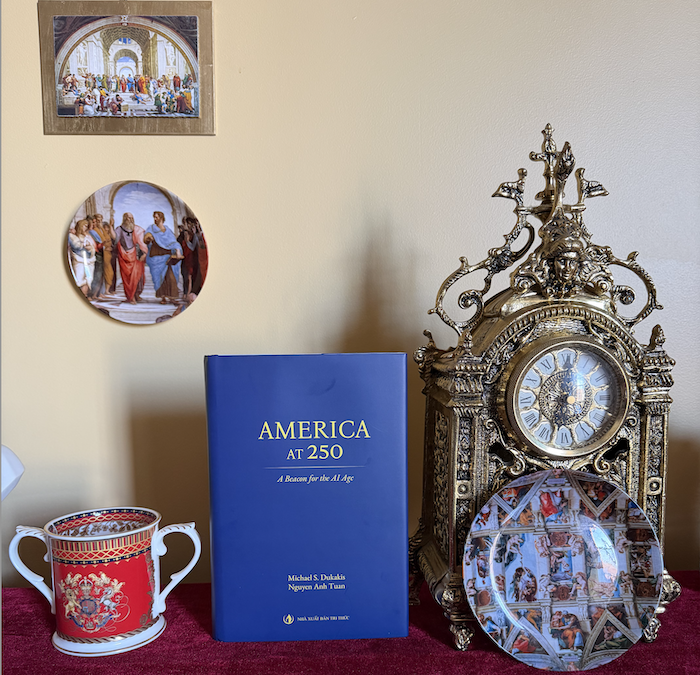
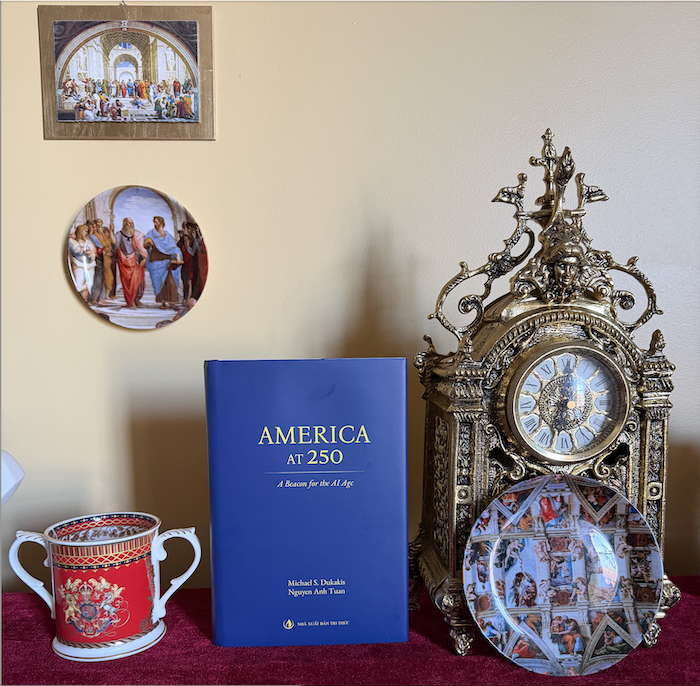
Tri Thuc Publishing officially announces the release of the book America at 250: A Beacon for the AI Age, co-authored by Governor Michael S. Dukakis and Nguyen Anh Tuan.
Published at a historic moment as the United States approaches its 250th anniversary and the world enters a profound new phase of the Age of Artificial Intelligence, the book offers more than reflection. It presents a vision, strategy, and practical solutions for how America can continue to lead the world toward a better future in the AI Age — and remain a true beacon for the AI Age.
One of the book’s most distinctive contributions is that it goes beyond general ethical concerns and proposes a more structural response to the challenges of the new era. It addresses the future through interrelated dimensions of political and social order, economic development, national defense, and international relations. At the center of its pioneering contribution are the concepts of AIWS Trust Infrastructure and AIWS Trust Order — proposed as foundational frameworks for building a trustworthy future for humanity in the AI Age.
The book reflects a rare collaboration between statesmanship and long-range technological vision. Governor Michael S. Dukakis, one of America’s distinguished public leaders, and Nguyen Anh Tuan, founder of AI World Society (AIWS) and co-founder of the Boston Global Forum (BGF), have created a work that speaks not only to America’s future, but to the future of democratic civilization in the age of AI.
On the occasion of the book’s release, Yasuhide Nakayama, Member of the National Diet of Japan and former State Minister of Japan, offered this reflection on Nguyen Anh Tuan:
“From the pioneer of Vietnam’s Internet in 1996, to the architect of AI World Society in 2017, to the co-architect of the AIWS Trusted Order for the America at 250 Conference in 2026, the journey of Nguyen Anh Tuan follows a remarkably consistent line: standing at the intersection of technology, governance, and human values — and doing so with unusual foresight, often seeing what others have not yet fully recognized.”
This observation captures the continuity of Nguyen Anh Tuan’s work across three decades: from pioneering Vietnam’s early Internet development, to advancing AI World Society, and now helping shape the foundations of a trusted order for the AI Age.
Tri Thuc Publishing believes that America at 250: A Beacon for the AI Age will be of value to leaders, policymakers, scholars, innovators, and readers interested in the future of America, democracy, and humanity in the age of artificial intelligence. It is not only a book about America at 250. It is a call to shape the next era with trust, responsibility, human dignity, and democratic vision.
Publication Information
Title: America at 250: A Beacon for the AI Age
Co-authors: Governor Michael S. Dukakis and Nguyen Anh Tuan
Publisher: Tri Thuc Publishing
Official Release Date: April 15, 2026
Media Contact
Tri Thuc Publishing
Tri Thuc Publishing – Nga Nguyen
[email protected]
by Editor BGF | Apr 12, 2026 | World Leader for Peace and Security, News, World Leaders in AIWS Award Updates
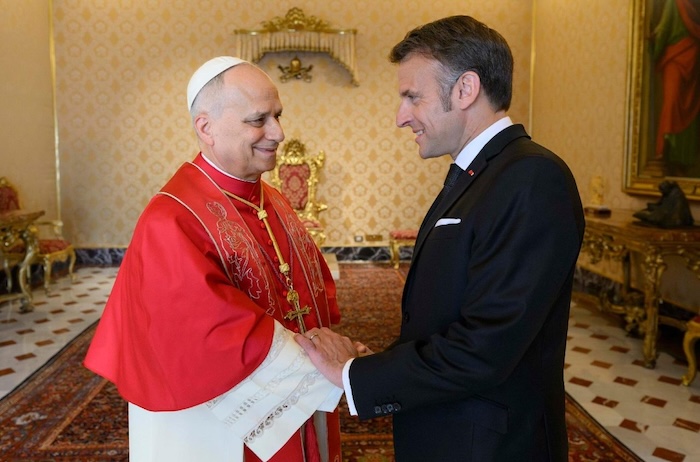
On April 10, President Emmanuel Macron, the 2024 World Leader for Peace and Security Award recipient, met Pope Leo XIV at the Vatican in their first personal audience. Vatican News reported that discussions centered on international conflicts and the hope that peace can be rebuilt through dialogue and negotiation.
This meeting carries special meaning for the Boston Global Forum. In honoring President Macron with the 2024 World Leader for Peace and Security Award, BGF recognized his role as a leader committed to peace, stability, and principled international engagement. His audience with Pope Leo XIV stands as a timely reminder that in a world of rising tensions, leadership for peace requires both political responsibility and moral courage.
https://www.vaticannews.va/en/pope/news/2026-04/pope-leo-xiv-meets-french-president-macron.html

by Editor BGF | Apr 12, 2026 | Shinzo Abe Initiative for Peace and Security, News
As part of the Shinzo Abe Initiative for Peace and Security, Nguyen Anh Tuan and Yasuhide Nakayama advanced work on the Shinzo Abe Film during discussions at the National Diet of Japan on March 28, joined by Professor Tomohiko Taniguchi, one of the closest interpreters of Abe’s vision and statesmanship. The meeting focused on preserving and presenting the deeper historical meaning of Shinzo Abe’s leadership for Japan and the world.
That effort continued on March 31, 2026, when Nguyen Anh Tuan delivered a distinguished keynote at LDP Headquarters in Tokyo in a two-hour program introduced by Kenji Wakamiya and Yasuhide Nakayama. In his speech, “Japan as a Global Leader in AI Trust,” Tuan linked Abe’s legacy to the challenges of the AI Age, arguing that Japan should lead not only in innovation, but in trust, responsibility, and democratic resilience. He presented the AIWS Trust Architecture, AIWS Trust Rating, AIWS Trust Index, and AIWS Trust Infrastructure as practical pathways for Japan today. Together, the Diet discussion on the film and the LDP keynote reflected a shared purpose: to honor Shinzo Abe’s legacy while contributing ideas and strategies for Japan’s leadership in a new era.
Please see full Tuan’s distinguished speech here: https://bostonglobalforum.org/news/japan-as-a-global-leader-in-ai-trust/