Assessment report and proposals from a BGF–AIWS perspective
Boston, April 22, 2026
1. Overall Assessment
SusHi Tech Tokyo 2026 stands out as a major strategic platform rather than a conventional startup event. Organized around the idea of “Sustainable High City Tech Tokyo,” it presents Tokyo not only as a market for innovation, but as a city seeking to shape the future of sustainable urban civilization through technology, startups, investment, and public leadership. Its official positioning as Asia’s largest innovation conference, together with its scale of 700 exhibiting startups, 10,000 business meetings, and 60,000 participants, gives it significant regional stature and global signaling power.
What makes SusHi Tech Tokyo especially distinctive is that it is city-centered, future-facing, and multi-layered at the same time. The official structure highlights four thematic domains—AI, Robotics, Resilience, and Entertainment—showing that Tokyo does not define innovation narrowly. It sees future cities as places where technological capability must be linked to social well-being, public systems, cultural vitality, and long-term sustainability. This gives SusHi Tech Tokyo a broader civilizational tone than many startup conferences that focus primarily on venture capital and product scaling.
2. Distinctive Values and Stature of SusHi Tech Tokyo 2026
The first distinctive value of SusHi Tech Tokyo 2026 is its integration of innovation with urban purpose. The official framing repeatedly returns to global urban challenges—environmental protection, disaster prevention, financial growth, and the future of city life. Tokyo is not presenting innovation merely as commercial opportunity; it is presenting innovation as a method for shaping a sustainable society. This gives the event public meaning and strategic seriousness.
The second distinctive value is Tokyo’s ability to combine scale with ecosystem design. The official program is not limited to sessions and exhibitions at Tokyo Big Sight. It extends into citywide official events and side experiences: Tokyo Innovation NIGHTs at Tokyo Innovation Base, invitation-only networking at Tennozu, mobility experiences at Miraikan, AI/Robotics/Resilience/Entertainment meetups, investor nights, startup matching programs, and youth-oriented initiatives such as TIB KIDS and WASABI. This ecosystem approach makes SusHi Tech Tokyo feel like a living innovation city rather than a single conference venue.
The third distinctive value is the way the event blends advanced technology with Tokyo’s identity and Japanese cultural energy. Official event descriptions deliberately combine innovation, EdoTokyo fusion, Japanese food and beverages, modern reinterpretations of traditional arts, and popcultural performance. This means SusHi Tech Tokyo is not only a technology platform. It is also a demonstration of Japan’s soft power: its ability to connect precision, craftsmanship, social order, aesthetic discipline, and future-oriented imagination.
The fourth distinctive value is strategic positioning. By convening startups, investors, corporates, public leaders, and city networks from around the world, SusHi Tech Tokyo offers Tokyo a platform to shape regional and international discourse about sustainable cities. It therefore has significance beyond event branding. It contributes to Tokyo’s long-term position as a node where policy, capital, technology, and urban experimentation can meet.
3. Why SusHi Tech Tokyo Matters for 2027
SusHi Tech Tokyo 2027 offers an important opening for Japan to move from being a respected technology nation to being a recognized leader in the next layer of AI-era civilization: trust, governance, and culture. The next phase of global competition in AI will not be defined only by who has better models, more capital, or more hardware. It will also be defined by who can design trust into systems, institutions, and public life. This is where BGF and AIWS can make a meaningful contribution.
From a BGF–AIWS perspective, Tokyo is well suited to host and help advance two complementary ideas in 2027. The first is AIWS Trust Infrastructure, leading toward AIWS Trust Order. The second is AIWS Lumina in Tokyo as one of the seven cities in the global cultural constellation. Together, these two contributions would allow Japan to lead not only in technology and innovation, but also in trust architecture and cultural leadership for the AI Age.
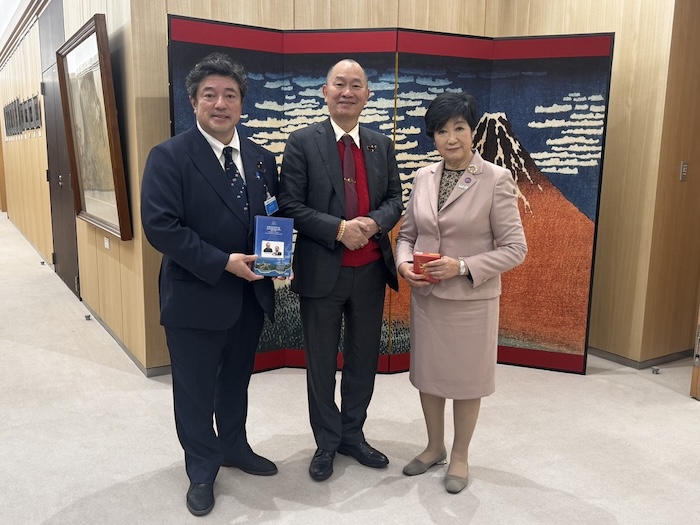
During the meeting with Governor Yuriko Koike at her office on March 31, Nguyen Anh Tuan, together with Yasuhide Nakayama, the Boston Global Forum’s Representative in Japan and Taiwan, presented these ideas and proposed that Tokyo adopt them as strategic initiatives for SusHi Tech Tokyo 2027, enabling Japan to play a pioneering role in advancing AIWS Trust Infrastructure, AIWS Trust Order, and AIWS Lumina in the AI Age.
4. Contribution 1: AIWS Trust Infrastructure and the Path to AIWS Trust Order
BGF–AIWS can contribute to SusHi Tech Tokyo 2027 by introducing a strategic dialogue and implementation pathway around AIWS Trust Infrastructure. This framework would emphasize that the future of AI requires not only capability, but trust-by-design: safety, transparency, accountability, privacy, human dignity, resilience, and ongoing public legitimacy. In practical terms, a Tokyo track could include a roundtable or summit segment on trusted AI systems, trustworthy urban platforms, and trust standards for AI deployment in city life.
From this foundation, SusHi Tech Tokyo 2027 could become a place where Japan helps articulate a larger concept: AIWS Trust Order. Trust Order means that AI-era society cannot remain governed only by technological acceleration or market logic. It needs trusted rules, trusted infrastructures, and trusted relationships among governments, enterprises, researchers, and citizens. Tokyo is especially suited to this role because Japan carries a reputation for discipline, quality, reliability, and long-term thinking. If SusHi Tech Tokyo embraces the trust dimension, Japan could become a visible pioneer of trusted innovation in Asia and beyond.
5. Contribution 2: AIWS Lumina in Tokyo
BGF–AIWS can also contribute to SusHi Tech Tokyo 2027 by proposing Tokyo as one of the seven host cities of AIWS Lumina: The Cultural Lights of the AI Age. Within the Lumina constellation, Tokyo would represent a light of harmony, aesthetics, restraint, and human-centered refinement. This aligns naturally with the Japanese traditions of Wa, Ma, and Wabi-sabi, and with Tokyo’s own position as a city where technological sophistication coexists with social order and cultural form.
A Tokyo Lumina event could be framed around the theme “Wa × AIWS: Harmony in the AI Age.” It would allow SusHi Tech Tokyo to expand from innovation and startup connectivity into a deeper question: how should civilization shape AI? Through this contribution, Tokyo would not only host innovation actors; it would help host a cultural architecture for the AI Age. That would be a major distinction. It would place Japan at the forefront of efforts to ensure that AI is not only powerful and useful, but also beautiful in spirit, human-centered, and worthy of trust.
6. Strategic Value for Japan
If these two contributions are advanced through SusHi Tech Tokyo 2027, Japan could occupy a unique leadership position. It could be seen as a country that helps connect three domains that are often treated separately: innovation, trust, and culture. Many countries can host startup conferences. Fewer can credibly convene dialogue on trusted AI infrastructure. Fewer still can link trusted innovation to cultural form, public meaning, and a civilizational ethos. Japan can do this.
This path would also activate Japan’s own strengths: its reputation for reliability; its tradition of craftsmanship and precision; its social emphasis on order, respect, and harmony; and its capacity to translate long civilizational inheritances into modern institutions. Through SusHi Tech Tokyo 2027, Japan could present to the world not only new technologies, but a deeper model of what future-oriented society should look like.
7. Conclusion
SusHi Tech Tokyo 2026 already demonstrated significant value and stature as a global innovation platform rooted in Tokyo’s city strategy and Japan’s distinctive strengths. Its scale, ecosystem design, and blend of technology with urban purpose make it one of the most important innovation conferences in Asia. Looking ahead, SusHi Tech Tokyo 2027 offers an exceptional opportunity for BGF–AIWS contribution.
By introducing AIWS Trust Infrastructure and the path toward AIWS Trust Order, and by coordinating with Tokyo to implement AIWS Lumina as one of the seven global cities, BGF– AIWS can help SusHi Tech Tokyo evolve from a major innovation conference into a more consequential platform for the AI Age. In that next stage, Japan would be able to demonstrate leadership not only in innovation, but in trust, culture, and the shaping of a better AI society for humanity.
Source Note
Prepared with reference to the official SusHi Tech Tokyo 2026 website and official events pages of the Tokyo Metropolitan Government-backed conference.
Key official references include event dates, scale, thematic domains, and official side-event descriptions.
Download The Sushi Tech 2027 – BGF Report are here: https://bostonglobalforum.org/wp-content/uploads/Sushi-Tech-2027-BGF-Report.pdf