by Admin | Aug 8, 2013 | Highlights
In an interview with Boston Global Forum (BGF), esteemed journalist, political analyst and author, Hedrick Smith, lends a political historian’s perspective to explain the reactions of American retailers to the tragic Rana Plaza collapse in Bangladesh, in April 2014. Smith’s book WHO STOLE THE AMERICAN DREAM describes the transition and evolution of the American economy over the latter half of the 20th century. Smith explains how industrial trends like switching from push manufacturing to pull manufacturing, deregulation and changing corporate attitudes have had a deleterious effect on worker safety standards in offshore manufacturing processes.

Credit- www.hedricksmith.com
BGF: In the evolution of the American economy, when did large American brand names start outsourcing their manufacturing processes overseas to other countries? And, was this a gradual shift or something that happened rapidly in a short span of time?
Mr. Smith: My understanding is that this shift really developed during the 1980s. Individual companies, like Motorola or General Electric and other American electronic firms, were among those who led the way to overseas production in the 1980s. At the time, radios and other electronic products and cars were being built in places like Japan. American manufacturers got interested in those countries, particularly in Japan, Taiwan and Korea. While Japanese, Taiwanese and Hong Kong exports were the first to hit the American market in scale in the 1970s, the real acceleration in American companies’ offshore exports to the U.S. happened much later – much of it under pressure from Wal-Mart. Wal-Mart was very interested in getting what they called the ‘lowest opening price point’ products made overseas so they could offer the cheapest goods available for American customers. Sam Walton, founder of Wal-Mart, went to Korea and returned fascinated with Asia and convinced that Asia could become a very important source of Wal-Mart’s imports and a real boost to Wal-Mart’s profits. From then on, Wal-Mart’s profit margins on goods from overseas were tremendous.
But the first major change that ultimately led to overseas production by U.S. companies was the shift in economic power here at home from big producers to big retailers. Wal-Mart led the way. It was an enormously powerful influence on American manufacturers, particularly of low-cost goods including goods like garments. Wal-Mart developed the bar code and other logistical systems that gave American Big Box retailers powerful market leverage that they had not previously enjoyed. This resulted in an economic power shift in American manufacturing. We went from ‘push manufacturing’ to ‘pull manufacturing’. ‘Push’ meaning that producers like Proctor and Gamble, other appliance manufacturers and electronics goods manufacturers determined what products they would produce, and they would push these products to the retail networks across the country. Retailers would simply sell the items they produced.
Under ‘pull manufacturing’, Wal-Mart and the other big-box retailers came to dominate the producers and the marketplace. They became highly organized and efficient by using tools like the bar code. At the cash register, retailers could far more rapidly, than the producers, see what products were being sold fastest and instantly place orders for more. That information shifted market power to the big box retailers. With that knowledge and its growing volume of sales, Wal-Mart was able to dictate the products it wanted produced to the producers. Not just what products, but what size, what color and what shape! They knew whether straight-legged jeans were selling or flared-legged; were button-blouses in fashion or not; whether large microwaves were popular or small toasters? These big-box retailers had very detailed information on the products they wanted to sell and so they told producers what to make. Then, led by Wal-Mart, which was seeking that low opening price point, they began to develop international supply lines, that is, overseas producers.
China was not the first target for overseas manufacturing. China came along after the Plaza Accord of 1985 in which there was an upward evaluation of the Japanese, Hong Kong, Taiwanese and Korean currencies to offset alarming flow of imports made from Asia to America. At the same time China devalued its currency. From that time onwards, because there was such a difference in the currency valuations between China and the rest of Asian exporters, China rapidly became the destination that American manufacturers went to. So after the Plaza Accord revalued currencies, the Chinese took market share away from the rest of the Asians. By the 1990s, Chinese supply chains took off. And their operations have become a model for other lower cost Asian producers like Vietnam and Bangladesh.
Talking about Wal-Mart’s role in this trend, in Chapter 15 of Who Stole the American Dream?, I described a meeting of Wal-Mart executives with various American producers. I was told that Wal-Mart pushed them hard to move their manufacturing, especially of low-cost consumer goods, overseas and particularly to China. This did not involve Bangladesh at the start, but there was a sequence here. Japan was the first destination, followed by Hong Kong, Taiwan and Korea. After Korea, the American manufacturers went to mainland China, which has maintained a strong hold for a long time. From 2000 onward, China was supplying 80 percent of Wal-Mart’s overseas imports. From China, the businesses moved to Bangladesh and Vietnam and other lower cost countries.
What you’re watching in Bangladesh, today, is really the outcome or the latest phase in this movement to low-cost production.
The second factor that in my mind is important to understanding the American response to the terrible factory conditions in Bangladesh, even though it doesn’t seem related, is the beginning of a push for de-regulation of American industries that began in 1978 under Jimmy Carter. It began with trucking and telecommunications and not with garment manufacturers but this deregulation began a long-term trend that reversed the policies of Richard Nixon, the Republican President from 1969-74. Nixon and his administration probably put in more new regulatory agencies and more new regulations on business than any other president since World War II, certainly more than the Democrats like Kennedy and Johnson. And there was a strong business reaction against Nixon’s regulatory regime. This reaction reached its peak in the mid 1990s, when Newt Gingrich was Speaker of the House and Tom Delay, a Congressman from Texas, was the majority whip. Delay was known as “Tommy Dereg'” because of his aggressive push for deregulation. Deregulation had started under Carter but it really blossomed under Gingrich and the Republicans. You don’t get much re-regulation until the financial collapse of 2008.
But, why is that important to Bangladesh?
It’s important because if you look at the American manufacturers and their response to the collapse of the factory and the fire in the other factory in Bangladesh, they resisted any form of regulation that would make them responsible or accountable for the safety of those buildings. They are responding to it very differently from the Europeans. By 2012 and 2013, the American companies had become accustomed to de-regulation. So they were opposed to any regulatory response to the Bangladesh disasters. The European retail firms have responded differently. They are used to more regulation in their economies, so it was more natural for the European firms and their retail customers to step in and accept both some financial responsibility and some legal and moral responsibility. On the contrary, American manufacturers led by Wal-Mart, Target and some of the others, are staunchly resisting any effort to codify rules of behavior, financial responsibility and legal responsibility for the death, damage and destruction of workers and factories in Bangladesh.
To better understand what’s happening in Bangladesh, it’s important to study these two trends in America: ‘push’ manufacturing to ‘pull’ manufacturing where retailers pushed production overseas, and the deregulation trend that accelerates in the mid 1990s. Understanding those trends helps us understand how U.S. companies behave today, what their attitudes are, what their expectations are and what their corporate culture is. And their corporate culture has a lot to do with their financial and legal response to the disaster in Bangladesh. Historical roots are very important to corporate habits of mind and actions today.
BGF: You raised the point about ‘responsibility’, why do you think there was such a sharp contrast between the reactions of American brands and their European counterparts?
Mr. Smith: That leads to a larger question about the ‘social compact’ and about corporate ethic. In the last 30-35 years, we in America have experienced a breaking of the old social compact and the Europeans have not had that. Earlier on, in America, we had labor agreements and labor contracts that determined pay and working conditions. But over and above that, there was a sense among American business leaders and the government that corporations had some responsibility to society. Charlie Wilson, head of General Motors, once said “what’s good for America is good for GM and vice versa.” But now American multinational corporations make a point of stating that they don’t think of themselves any more as American corporations. Typically, they call themselves “global” and they no longer say what Charlie Wilson said, that what’s good for our country is good for the company, too. In Europe, there’s still that sense of a social compact that corporations have an obligation to society as a whole. They have an obligation to their workers, they have an obligation to their customers and they are economic and social citizens, not just corporations.
In Chapter 16 of my book, I describe the change in corporate culture in the US when American corporate leaders came to reflect the new attitude that they are no longer American corporations but global corporations. “We just happen to have our home office in America,” they say. This change starts to happen significantly in the 1990s but it really accelerates in the 2000s after the US – Chinese trade agreement following which there’s a great rush by large American corporations to set up shop in China.
How does that relate to your question? It helps explain the different European and American responses to the crisis in Bangladesh. Well, if you as a business don’t feel rooted in a country, you don’t feel any particular obligation to your customers in that country or to your workers in that country. So as American firms globalize their operations, they look at the problems of their Bangladesh suppliers strictly on a profit-and-loss basis. They’re response is-“What does it cost us to get out of trouble in Bangladesh? We don’t want to take on any permanent responsibility there.” But European companies are looking at Bangladesh and saying, “How do we maintain credibility with our domestic customers? And how do we remain a good German or French or Dutch or Danish corporate citizen in our country? We would be regarded as a bad citizen if we buy garments and make a profit from a country where there are scandalous working conditions.” The Europeans have a responsible corporate ethic at work.
The corporate ethic at work in America today is the ethic of ‘shareholder capitalism’. Our goal is to maximize the return to our shareholders, our owners. Our focus is on the stock market price of our company shares. That also matters to European firms, but they are operating on a broader stakeholder basis. They are talking about ‘stakeholder capitalism’. The Europeans believe that their stakeholders include owners, shareholders, workers, customers, and the communities they operate within. They want to maintain good relations with all their stakeholders. So when they look at the terrible working conditions in Bangladesh, they’re looking at how to protect those relationships between their corporations and the home society where they sell their products.
The American CEOs are thinking what’s profit and loss? They’re thinking, “If I’m going to take a loss here because American customers are upset for a little while about the collapse of a factory in Bangladesh, what do I have to fork up now? What do I have to do to make myself look good for the moment because these people are going to forget about this in another six months.” It’s a crass profit and loss calculation, very different from the Europeans. I believe that’s why they’re behaving differently. American businessmen used to believe in a pretty similar corporate ethic to the Europeans. And some do now too, I think Costco is quite different from Wal-Mart. I think Costco is much more concerned about its relationships with its customers and employees. In general, they behave like a good corporate citizen, but for other companies, the Wal-Mart model is more prevalent. I would say that’s the third great change.
So I see three long-term trends affecting the corporate responses to what’s going on in Bangladesh today: the change in the corporate mindset and social contract at American companies; the shift in economic power from ‘push’ production to ‘pull’ production; and the growth in corporate expectations of deregulation and their freedom from legal and financially accountability so that they can make maximum profit at minimum risk and minimum cost.
BGF: It took a factory collapse that killed 1100 people to start a conversation about worker safety. What could bring about a change in American corporate attitude akin to the kind that Europe is reflecting now? What is that catalyst for change, if there is a possibility for one?
Mr. Smith: I have to admit that, as far as American businesses are concerned, I’m skeptical. In Europe, social pressures, laws and regulations, and a pact among the major European retailers are going to change their conduct. European retailers have committed themselves to take action, make investments to improve working conditions in Bangladesh and monitor conditions there. I am skeptical that the American retailers are going to change fundamentally unless there is continued public pressure and public unease about buying goods from companies in which there is blood on the hands of the Bangladesh producers. They have been making a profit by failing to protect their workers and blood was spilled. There was an immediate reaction of horror in North America as well as in Europe but public concern has subsided substantially in America now. I think unless there is public pressure or legislative action, most American retail giants will carry on pretty much as they have in the past, without taking direct corporate responsibility to improve the situation. The $100 million pledged by American brands, is a loan fund, not a direct investment by the American firms in safety improvement. They’re offering to lend the money to the Bangladesh producers, but it is up to the Bangladesh producers to spend the money and pay back the loans. The Bangladesh producers have already established themselves as unconscionable on these issues of worker safety. Counting on the Bangladesh manufacturers to improve the situation is like waiting for the tooth fairy.
The American firms have said they will demand that Bangladesh producers comply with certain standards but their standards are vague, so it will be pretty hard for the rest of us to know whether the Bangladesh garment manufacturers will have done enough to improve the situation. And who’s going to monitor progress and on what basis? Theoretically that kind of corporate monitoring has been going on all along, but when the factory collapsed, American firms were quick to deny that they knew about those bad conditions. I would like to believe that from now on that there is hope for improvement, but this is not a new situation. It’s been going on a long time and not just in Bangladesh. There are bad factory conditions all over China. They have not had one single disaster as bad as in Bangladesh. So there’s no single incident to highlight Chinese working conditions. And theoretically, U.S. firms monitor working conditions there, periodic revelations show that not very much has been done to significantly improve working conditions in China, not by firm such as Wal-Mart, which is getting a huge percentage of its products from China. So on that basis, I don’t see these American retailers taking an aggressive initiative in Bangladesh without there being an intense amount of public pressure or some new disasters.
And we would all hate to see that it required more disasters to generate sustained pressure for improvements. That would be terrible.
by Admin | Aug 5, 2013 | Highlights
In all its reports about the Bangladesh factory collapse, the western media seems to have overlooked an important question- Was Rana Plaza an example of capitalism gone wrong? David Rowlands from Australia’s Green Left Weekly says that the disaster, that rocked the developed world, stems from a deep deficiencies in what he defines as the “neoliberal capitalist model.”
Credit- Green Left Weekly
Bangladesh: What has changed after Rana Plaza?
In the aftermath of the April 24 Rana Plaza collapse, the plight of Bangladeshi garment workers occupied global media attention in a way it never had before.
The inconvenient thing about Rana Plaza, as far as the fashion brands that rely on outsourced sweatshop labour were concerned, was that so many workers — more than 1100 — died in one spectacular incident.
The 1800 workers killed in separate incidents since 2005 had been easy to ignore, but Rana Plaza was different. It was a big, uncontrollable story that caused the mainstream media to raise questions about the nature of the relationship between retailers and their labour force in Bangladesh.
For a brief moment, the wide conceptual gulf between the consumer goods on our shelves and the exploited foreign workforce that makes them was bridged. With research indicating that the consumer base in Western nations was concerned about the situation in Bangladesh, there was a general feeling that “something” should be done.
Three months on from Rana Plaza, what has changed?
Rhetorically, some progress appears to have been made. For instance, scores of global brands, including several Australian ones, have now signed on to the Bangladeshi Fire and Building Safety Accord, a step they had previously resisted.
It was public pressure, generated in part by campaigning NGOs such as Oxfam, that shamed the retailers into signing up.
Oxfam said: “The Accord, which has been signed by more than 80 global retailers, including Target, Kmart, Forever New and Cotton On, gives workers the right to refuse dangerous work, and mandates independent building inspections, workers’ health and safety training, and repairs and renovations to unsafe factories.”
This development has been cautiously welcomed by Bangladeshi labour organisations, but the sign-up has been far from universal and it remains to be seen how effective it will actually prove in reducing the industrial attrition that has been accepted for so long in the Bangladeshi garment export free-for-all.
Several large Australian companies have flatly refused to take part. Oxfam reports that, as of July 24, the hold-outs included, “Woolworths (Big W), the Just Group (Just Jeans, Jay Jays), Best and Less, Rivers, and Pacific Brands (Bonds, Berlei).”
Safety Accords make for good corporate public relations exercises, but in their current form they do not challenge the deep structural mechanisms of exploitation that have underpinned the global capitalist economy since the age of conquest began five centuries ago.
Like the 5000 or so other factories where 3.5 million Bangladeshi garment workers, mostly rural women, earn less than $40 a month working 15-hour days for six days a week, the factory at the shoddily built Rana Plaza represented a significant victory for the “market forces” that have driven the post-Cold War globalisation project.
Since its inception, the globalisation campaign has been involved in a continuous “race to the bottom” in terms of wages and conditions. This race has moved from continent to continent, leaving devastated societies in its wake.
One of the first low-wage frontiers was Mexico, which was handed over to multinational corporations courtesy of the 1994 North American Free Trade Agreement (NAFTA). For a few years, boom conditions prevailed on the Mexico-US border zone and the world became familiar with the term “maquiladoras”, glorified sweatshops filled with poorly paid female workers.
And then, almost as suddenly as it had begun, the NAFTA boom was over. The low wages paid in Mexico were not low enough to satisfy the profit-hungry corporations, who found an even more cut-price workforce in Asia as China increasingly integrated itself into the world economy.
In recent years, rising wages and higher production costs in China have prompted another wave of capital flight to places like Bangladesh and Pakistan. In Bangladesh, one of the poorest and most flood-prone countries in Asia, the corporations found conditions that were almost diabolically ripe for exploitation.
Bangladesh has a total land area considerably less than the Australian state of Victoria and a population of 150 million, almost eight times larger than that of Australia.
During the 1980s, Bangladesh was encouraged by institutions like the World Bank to begin using its “comparative advantage” to carve out a niche for itself in global manufacturing.
The comparative advantage was, of course, its desperately poor and highly concentrated population, which would be willing to work longer hours for pay rates lower than almost anywhere in the world.
Bangladesh was one of many developing nations to undertake “structural adjustment programs” during this period. These programs were designed to soften up the already vulnerable Bangladeshi economy, like a heavy artillery barrage before troops move in to occupy.
Under the close direction of the World Bank, Bangladesh removed almost all protection for domestic industries and embarked on a scorched-earth campaign of denationalisation and privatisation. Restrictions on direct foreign investment were dramatically slashed, as were tax rates for foreign companies operating in the countries.
Tariffs on agricultural imports were cut, resulting in agribusiness “dumping” and the loss of agricultural livelihoods for millions of Bangladeshis. Once the “anti-export bias” in the economy was removed, Bangladesh emerged as an “open”, “liberalised” economy, meaning that it was ready for plunder — like Mexico before it.
Research by Bangladeshi academic Mohammed Nuruzzaman has found: “Instead of distributing benefits among different societal groups [the neoliberal reforms] have brought an economic windfall mainly for the business and industrial class in Bangladesh.
“There is now a small group of 40 to 50 families who effectively control the total industrial and financial assets of this poor nation. The lack of policies of distributional justice has resulted in widening disparities in income and wealth between the low and high strata of the society and deterioration in the overall poverty situation of the country.”
As in its dealings with other developing nations, Washington has sought by a variety of means to keep the general Bangladeshi population under strict levels of control.
During the neoliberal era, it has been a key objective of US foreign policy to bolster client regimes that implement policies designed to enrich foreign corporations at the expense of host societies.
Billions of dollars of “aid” has been funnelled to the Bangladeshi state since 1972, in return for compliance with Washington-approved development policies.
The US military has forged close links with the Bangladesh Armed Forces, ostensibly to remediate natural disasters and counter “terrorism”, but actually to suppress internal dissent as the society polarises between a tiny wealthy elite and a vast underclass.
Western-backed death squads and neoliberalism have always gone hand in hand. In Bangladesh, the extrajudicial torture and killing of labour activists and other dissenters is performed by the Rapid Action Battalion [RAB], a specialist military outfit established in 2004 which openly engages in so-called “crossfire killings”.
The RAB has claimed over a thousand victims in recent years, probably including a prominent labour organiser, Aminul Islam, who was disappeared in April last year.
At the time of his death, Islam was involved in negotiations on behalf of workers in a dispute with factories making products for Tommy Hilfiger and American Eagle.
In 2010, secret US diplomatic cables released by WikiLeaks showed that the RAB was receiving extensive training from the British government in “rules of engagement” and “investigative interviewing techniques”. Another leaked cable reveals that the US ambassador considered the RAB the “enforcement organisation best positioned to one day become a Bangladeshi version of the US Federal Bureau of Investigation.”
The repression of the Bangladeshi workforce, a task carried out with the active assistance of Western governments, has led to a climate of impunity for garment manufacturers — with foreseeable consequences.
Only a month before the Rana Plaza collapse, the report “Fatal Fashion” by the Dutch-based Centre for Research on Multinational Corporations said: “Bangladesh has the lowest hourly wage in the world at US$0.32 cents per hour …
“As a consequence, the volume of orders … has exploded, but the production capacity of factory buildings has not been adequately adapted to these changing circumstances.
“In combination with failing or absent government inspections and inadequate buyer policies, this creates a ticking time bomb and the certainty that many more calamities will occur unless considerable investments in building and fire safety in … Bangladesh are made.”
Oxfam and other NGOs have rightly called on the recalcitrant firms in Australia and elsewhere to sign on to the Fire and Building Safety Accord.
However, even if all retailers were to sign on tomorrow, their past conduct in Bangladesh raises serious doubts as to whether their commitment to meaningful safety standards would last after the ink had dried.
It is the relentless squeezing of Bangladeshi suppliers, the endless and shameless haggling by Western companies for lower and lower production costs, that creates the criminally negligent safety standard in Bangladesh.
And as for workers’ dignity, forget about it.
By design, wages in Bangladesh are not living wages, and when the corporations talk piously about promising to pay Bangladeshi workers the “minimum wage” or even slightly above it they know full well that it is impossible to live decently on it.
Kmart Australia managing director Guy Russo said: “Kmart’s strict requirement for supplier factories is that they must pay at least the minimum rate to all workers or we will not do business with them.
“Lifting people out of poverty through economic development is vital.”
This is pure spin, designed only to get Kmart through the next media cycle. After decades of neoliberal “economic development”, the average Bangladeshi yearly income remains under $650 (compared to the global average of $8000).
More than a third of the Bangladeshi population lives below the poverty line. Most of the rest hover just above it in perpetual insecurity.
A relevant question that might be addressed to Kmart and other Australian exploiters is whether they will formally commit to paying their Bangladeshi workers a living wage.
Reform measures will not in themselves lead to a meaningful reconfiguration of the power relationship between foreign capital and Bangladeshi labour — and it is this grossly unequal power relationship, the deliberate outcome of decades of neoliberal policies implemented by Western governments, global financial institutions and their Bangladeshi elite collaborators, that actually led to the “ticking time bomb” of Rana Plaza in the first place.
This disaster was the outcome of capitalist globalisation logic, a point that the vast bulk of media coverage of the event has simply shied away from.
If we really want to improve conditions for garment workers, the neoliberal capitalist model must be challenged from within the Western societies that have imposed it on the rest of the world.
by Admin | Aug 5, 2013 | Highlights
President and CEO of Fair Trade USA, Paul Rice, argues that increasing threats to worker safety are because businesses are forgetting their social responsibility. “Putting people back into business,” might be as (if not more) necessary as reforming legislation and mobilizing consumer support. Rice identifies three key points that business leaders should bear in mind in order to ensure sustainable business practices.
Credit-www.fastcoexist.com
Why Social Sustainability Should Be Part Of Every Business?
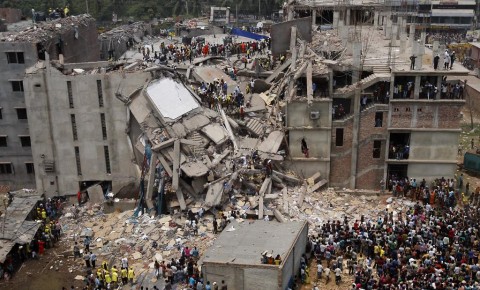
I can’t think of anything that illustrates the human cost of doing business more than the tragedy this past April in Bangladesh. More than 1,100 men, women, and children died when the Rana Plaza building, which housed a number of garment factories, collapsed. Most were garment workers who were ordered by supervisors to report to work, even after inspectors deemed the building unsafe.
Millions of people around the world work in dangerous and unhealthy conditions, earning a nominal income to deliver the products we consume. While the factory collapse in Bangladesh is a terrible tragedy, it’s another wake-up call that business leaders need. We can no longer ignore the human side of our global supply chains. Now is the time for all of us to recognize and embrace social sustainability–much in the same way we’ve focused on environmental sustainability for the past 20 years–as a mission-critical way of doing business. By social sustainability, I mean investing in the livelihoods of farm and factory laborers, ending worker exploitation, and ensuring that there is ethical sourcing behind the things we buy.
Some of you might be thinking that social sustainability is a phrase made up of feel-good buzz words. But social sustainability is good business.
Here are three key points that every business leader should keep top-of-mind:
SOCIAL SUSTAINABILITY MITIGATES RISK
Simply put, ignoring social sustainability is a liability–to both your brand and product quality–that businesses can no longer afford.
Case in point: apparel companies, especially those that had previously outsourced their manufacturing to Bangladesh, began scrambling for PR cover within days of the Rana Plaza collapse. Earlier factory tragedies involving global corporations resurfaced as well, demonstrating the prominence of these issues in the eyes of the media and consumers.
Similarly, businesses risk product quality by ignoring the social side of sustainability. In the last month alone, the FDA issued recalls or safety alerts regarding food products tainted by salmonella, listeria and hepatitis A–contaminations that typically start in the fields where farm workers could be more vigilant if they were trained and empowered to do so. Not only do these outbreaks create a serious threat to public health, they can also cost food manufacturers millions of dollars to remedy each incidence of food-borne illness.
Investing in social sustainability allows companies to flip these types of liabilities into assets. When you provide safer working conditions, living wages, and job security, you create a more secure supply chain. When you give farm workers a reason to care about food safety and pest contamination by giving them special training and higher pay, you go a long way in ensuring the integrity of your product.
CONSUMERS WANT SOCIALLY SUSTAINABLE PRODUCTS
We’re seeing the rise of the conscious consumer–people who are informed and engaged, and who care about the environmental and social impact of the products they buy.
Businesses are responding. West Elm, for example, is partnering with Craftmark, an organization that is part of the All India Artisans and Craftworkers Welfare Association, to bring locally sourced and handmade products to consumer markets around the world. Many rug importers and exporters are looking for products free of child labor, and they work with organizations like GoodWeave for quality control. And with some companies, like prAna, customers show support by looking for the Fair Trade Certified label on their clothing offerings.
Does all this transparency pay off? Absolutely. Conscious consumers are willing to spend a little bit more to know that the items they purchase are sweatshop-free, help the lives of the workers who made them, and build stronger communities.
SOCIAL SUSTAINABILITY HAS NEVER BEEN EASIER
The good news is that social sustainability has never been easier to practice. There is no lack of information, and no shortage of partners who can help you develop, implement and audit a business model that gets it right:
The Fair Labor Association conducted an in-depth investigation of factories in China operated by Foxconn, Apple’s biggest supplier. Both Apple and Foxconn have agreed to follow FLA guidelines to reduce working hours, protect pay, and improve working conditions.
United Farm Workers, Oxfam America, and Costco, in collaboration with many other organizations, have lent considerable muscle to develop and support the Equitable Food Initiative. One of the initial projects had California strawberry growers commit to training their workers and paying them higher wages as an incentive to practice a higher standard of food safety.
Green Mountain Coffee Roasters recently completed a two-year partnership with Fair Trade USA and USAID to educate small-scale coffee farmers in Brazil about environmental conservation and effective natural resource management.
By putting people back into business, we’re choosing a world where farmers and workers are able to fight poverty through better trading practices, work in safe conditions, and have access to adequate schooling, health care, and housing. When this happens on a large scale, social sustainability will no longer just be “good business,” it’ll be business as usual.
by Admin | Aug 5, 2013 | Highlights
The Rana plaza collapse in Bangladesh has raised a critical call for improvement of working conditions in developing countries. Inspired by this incident, Boston Global Forum directors decided to choose its mission of the year 2013 as “Minimal standards for Worker safety”. The issue has gathered several concerns from political leaders and renowned professors at Harvard and MIT.
Mr Vu Dang Vinh, CEO of Vietnam Report also has shown his concern and expressed support for the issue.
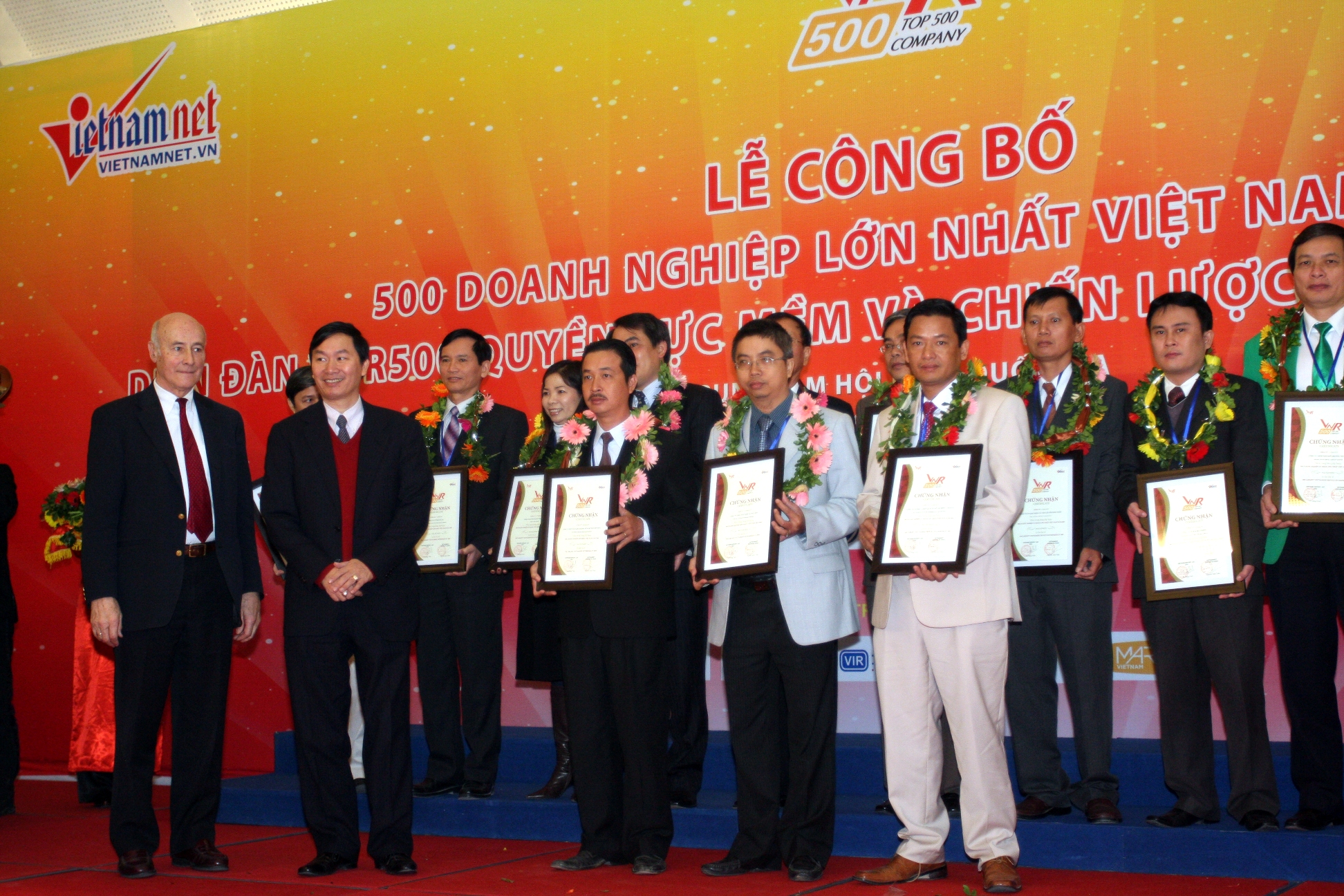
 Photo: Professor Joseph Nye presented awards to Top Vietnam largest companies in VNR500 in 2010.
“Boston Global Forum has raised an important issue of worker safety which is still an absence in many international conversation. Professor John A. Quelch has proposed very interesting questions for discussion of “Minimal Standards for Worker Safety” with very unique perspective.
Vietnam Report, Vietnam Economic Forum (VEF) and VNR500 (Vietnam Top 500 largest company ranking) highly appreciate that Boston Global Forum has raised this issue as it core mission of 2013.
The proposal of “Minimal standards for worker safety” issue is indispensable for the year of 2013. Boston Global Forum should be the one who forms these safety standards and makes it become reality in every organizations, and every countries. These standards not only will bring good things to the workers, but also create a fair competition between countries and between organizations.
We believe that by gathering opinions and suggestions of experts in area of worker safety, political leaders, and distinguished professors, Boston Global Forum will be able to form the best standards for the problem, which will be the guidance for all countries and organizations.
The U.S. government, the United Nations should lead and set up requirements to deploy the standards outlined by Boston Global Forum. All big brands of the U.S should be the pioneer in applying the standards. Based on these BFG’s standards, US government should promulgate and enforce standards for textiles industry as the same as it did to agricultural products and foodstuffs (FDA). If these commodities do not pass standards, they will not be imported into the US market.
Vietnam Report will raise this issue in its upcoming Vietnam CEO Summit 2013 conference on August 23 in Ho Chi Minh City and will mobilize all organizations, especially Vietnam textile companies to support and apply these standards.”
About Vietnam Report
Vietnam Report Joint Stock Company is the pioneer and leader in areas of report, ranking for business organizations, products and services in Viet Nam. It business focused on providing consultant services, and data for marketing, investment and market research in Viet Nam. Its renowned products and services include VNR500 (Vietnam’s Top 500 largest companies), FAST500 (Vietnam’s Top fastest growth companies), V1000 (Vietnam’s Top 1000 income tax-paid companies).
by Admin | Aug 5, 2013 | News
With all eyes on Bangladesh, it’s worthwhile to take a look at safety standards in garment factories in other countries. An International Labor Organization report discloses a disappointing decline in worker safety in Cambodia.
Credit- qz.com
For international retailers who have committed more than $250 million to improve factory workers’ safety in Bangladesh, the conditions in Cambodia should give them pause.
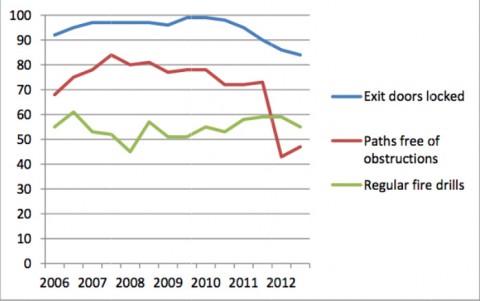
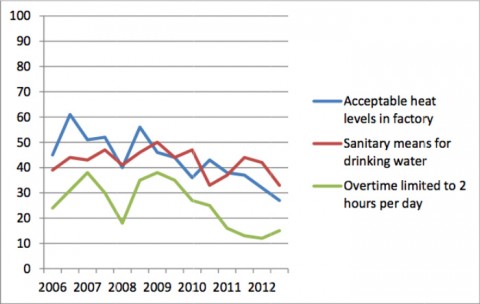
A bi-annual report (pdf) from the International Labor Organization-sponsored Better Factories program reveals a disturbing decline in working conditions in Cambodia’s garment factories. In the November 2012-April 2013 period, Better Factories found that the compliance to fire safety and worker health regulations were lower than what they were seven years ago.
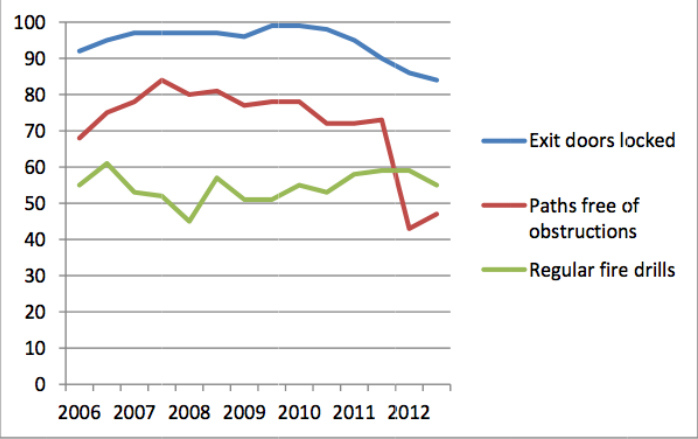
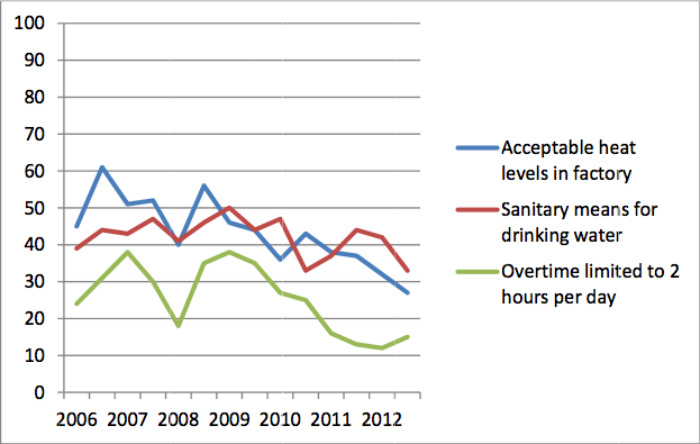
Of the 155 factories assessed, 53% had obstructed access paths, compared with a little more than 30% in 2006, nearly 45% failed to conduct regular fire drills, and 15% kept emergency exit doors locked during working hours.
Credit-qz.com
The report also highlights serious violations including excessive heat levels, shortage of safety masks, lack of proper equipment for handling chemicals and inadequate access to clean drinking water.
Cambodia is among the Southeast Asian countries that have benefitted from the double-digit wage increases and shortage of factory labor in China (paywall). The number of apparel export factories in Cambodia has surged from 185 in 2001 to 412 in April 2013 (pdf). Last year, the garment industry generated over $4.6 billon in exports, accounting for 84% of Cambodia’s total exports. The garment factories employ around 2.5% of Cambodia’s 15 million citizens and remittance payments from factory workers to families in rural regions sustain about 20% of the population, according to Japan External Trade Organization (pdf).
But the industry has been marred by mishaps and labor unrest in recent months. In May, accidents at two factories, including one that left two people dead when part of a shoemaking factory collapsed, highlighted unsafe conditions. Local media pounced on instances of workers fainting because of poor air circulation, and factory owners threatening to fire employees who refused to work overtime. Workers complained that the prevalence of short-term contracts lasting three to six months made it easier for employers to fire workers who joined unions (paywall) or demanded benefits like maternity leave.
A series of strikes over pay and conditions forced the factory owners to agree to a20% wage hike effective from May. Thanks to pressure by the Cambodian government, employers raised the monthly minimum wage from $61 to $75 and boosted employee healthcare stipends by $5 per month. Unions argue that, adjusted for inflation, those wages are on par with pay levels in the year 2000.