by Admin | Aug 20, 2013 | Highlights
This story from fashionunited.co.uk, reflects the negative criticism the American Alliance for Bangladesh Worker Safety is receiving as it begins to implement the plan to meet its September deadline.
Credit-http://www.bangladeshworkersafety.org
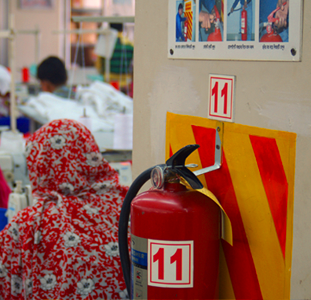
Major US retailers including Gap and Walmart are expected to begin implementing the Bangladesh safety-plan, to meet the September 10 deadline. In the wake of the Bangladesh factory that collapsed last April, a group of 20 retailers will appoint an executive director and management firm to oversee the 45 million dollar funding in place to improve worker safety.
The retailers, which also include Macy’s and Target, struck a five-year deal to train workers and inspect factories. It will, however rely on factory owners in Bangladesh to pay for their own safety renovations despite the retailing committing to providing 100 million dollars in low-cost loans toward the effort. Participation in the lending program is voluntary and varies by retailer, according to the Wall Street Journal.
The agreement continues to attract scrutiny from labour activists and worker groups who say the safety plan falls short of a separate, legally binding agreement that commits Hennes & Mauritz, Tommy Hilfiger parent PVH Corp and 70 other, mostly European companies to directly pay for the costs of repairing and renovating some 5,000 Bangladesh garment factories.
Critics also complain of the absence of labor organizations from the North American alliance’s board of directors and say that nothing will change as long as the retailers continue to control the inspection process by choosing and paying the auditors, as well as electing a board that is supposed to conduct oversight and ensure the companies follow through with their safety plan.
“They are essentially asking the companies and factory owners to regulate themselves,” said Scott Nova, executive director at the Worker Rights Consortium, who helped craft the European-led accord. “They want people to see this as an alternative plan, but it’s no different than what companies have been doing without success for decades.”
The North American retail alliance’s eight-member board includes four company representatives from Target, Wal-Mart, Gap and VF Corp. as well as former US Ambassador to Bangladesh Jim Moriarty and fire-safety consultant Randy Tucker, both of whom were employed by the companies on previous safety programs.
by Admin | Aug 8, 2013 | Highlights
Fast Retailing Joins Inditex, H&M’s Bangladesh Safety Accord
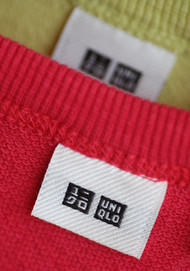
A tag with Fast Retailing Co.’s Uniqlo logo is displayed on a sweater at the company’s store in the Ginza district of Tokyo. Credit- Bloomberg
Fast Retailing Co. (9983), Asia’s largest clothing retailer, joined Inditex SA (ITX) and Hennes & Mauritz AB (HMB) in signing an accord to improve factory safety in Bangladesh after an April garment complex collapse killed more than 1,000 people.
Fast Retailing has independently reviewed fire and building conditions at plants run by its partners in Bangladesh and detailed results are expected by November, it said in today’s statement.
Inditex and H&M, Europe’s two largest clothing retailers, signed the safety pact initiated by international organizations IndustriAll Global Union and UNI Global Union, after an eight-story garment complex collapsed in April in Bangladesh’s worst industrial disaster. The accord includes plans to survey all factories on related risks within the next two years and implement reforms to improve conditions, Fast Retailing said.
Seventeen North American retailers, including Gap Inc. and Wal-Mart Stores Inc., announced a separate five-year plan earlier in July to improve factory safety in the country.
About 70 percent of the Japanese retailer’s production comes from China with the rest coming from Southeast and South Asian countries, including Bangladesh, Keiji Furukawa, the company’s spokesman, said today. The company plans to reduce the percentage of clothes it produces in China to about two-thirds as it seeks to diversify risks and improve efficiency, he said. None of the company’s suppliers or workers were involved in the April building collapse, Furukawa said.
by Admin | Aug 15, 2013 | Highlights
Story sourced from Bloomberg News.
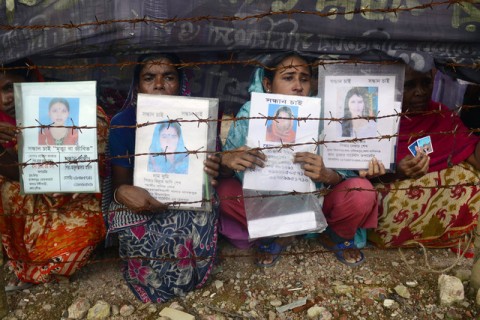
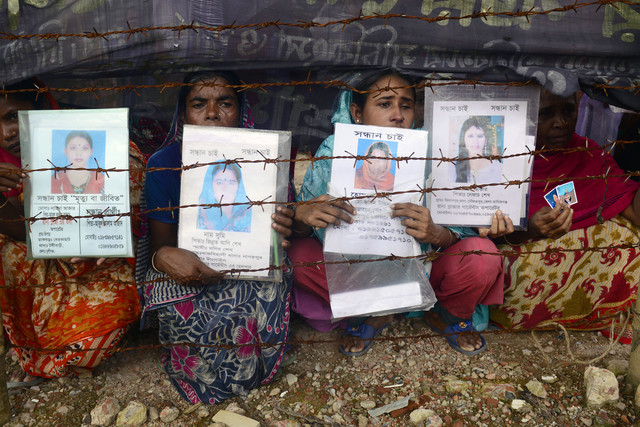
Mourners hold up portraits of their missing relatives at the disaster scene during the one hundredth-day anniversary of the Rana Plaza garment building collapse in Savar, on the outskirts of Dhaka, on August 2, 2013. Credit- Munir uz Zaman/AFP via Getty Images
A meeting to determine compensation for victims of two factory disasters in Bangladesh was postponed until September after a union official fell ill, workers threatened to strike in Dhaka and European brands balked at attending over the summer.
“We thought it was a better solution to do this in Europe in September,” IndustriALL General Secretary Jyrki Raina, who is organizing the meeting, said by phone. “The problem is Rana Plaza workers and families aren’t receiving money, so it’s not as it should be.” The initial meeting to aid victims of the Rana Plaza collapse and Tazreen factory fire was planned for Aug. 11 and 12 in Dhaka.
The union and the Clean Clothes campaign want retailers including Benetton Group SA, Mango and Wal-Mart Stores Inc. (WMT) to agree to a lump sum payment for pain and suffering as well as lost earnings for the victims and dependents of those involved in the disasters. IndustriALL estimates the long-term compensation cost will be $71 million for the Rana Plaza collapse, where 1,131 people were killed in the nation’s worst industrial accident, and $5.7 million for the Tazreen garment factory fire, which killed 112.
Clothing bound for Wal-Mart was found in the charred ruins of Tazreen, and documents provided by the Worker Rights Consortium, a Washington-based labor-rights monitoring group, show that merchandise bound for Wal-Mart was produced at Ether Tex Ltd.’s factory in Rana Plaza. Still, Kevin Gardner, a Wal-Mart spokesman, said the company’s own investigation showed “no evidence of authorized or unauthorized production at the time of the tragedy” at Rana Plaza.
Primark Agreement
Wal-Mart has declined to compensate victims of the factory fire and did not join a fire and building safety pact supported by labor groups and signed by more than 80 companies this year, according to a July statement from IndustriALL.
Associated British Food Plc’s Primark chain, which used a supplier in Rana Plaza, has agreed to pay compensation to survivors and dependents. It’s the only retailer to do so for Rana Plaza, in accordance with existing frameworks established after the Spectrum factory fire in 2005, according to the Clean Clothes campaign, which is working with IndustriALL on the meeting.
Some European brands including C&A Group, Tengelmann Group’s Kik and El Corte Ingles SA agreed to pay compensation for the Tazreen fire in April, though that process stalled due to the Rana Plaza collapse, Raina said.
Representatives for the brands sourcing that received goods from those two factories, who had been invited to attend the IndustriALL meeting, will receive an invitation for the re-scheduled September event, including Walt Disney Co. (DIS) and Li & Fung Ltd. (494)
To contact the reporter on this story: Sarah Shannon in London at [email protected]
by Admin | Aug 8, 2013 | News
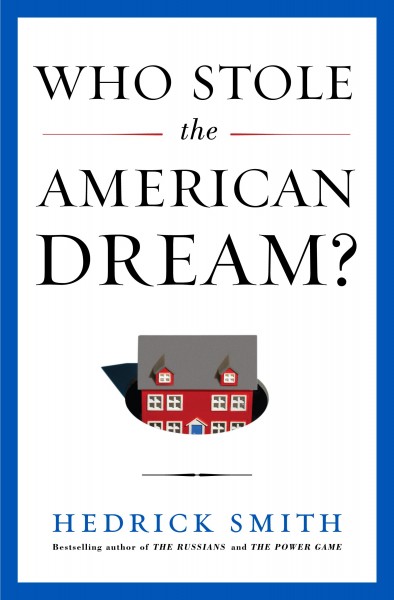
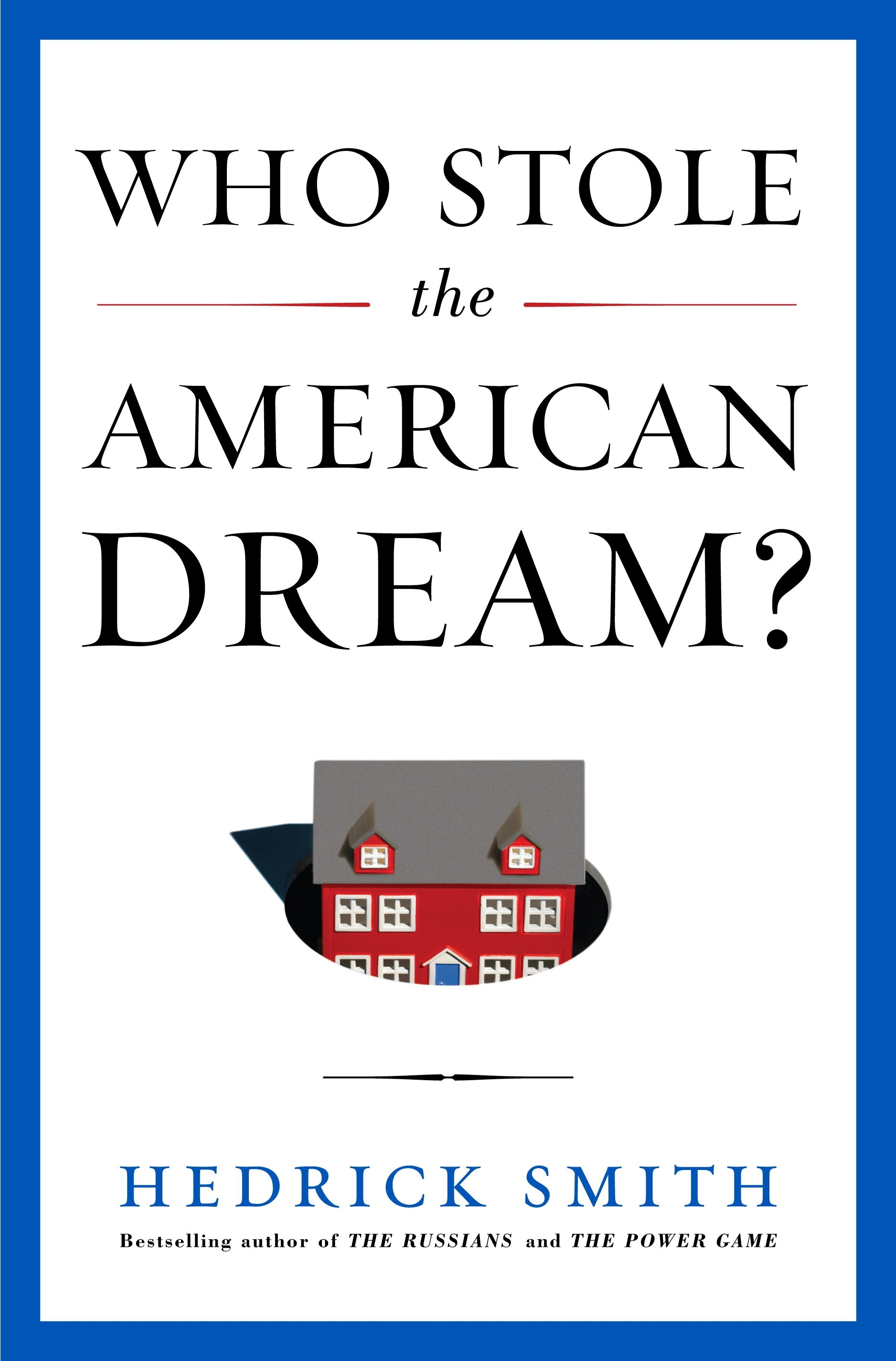
Pulitzer Prize-winning former reporter and editor for The New York Times, Emmy Award-winning producer for PBS’ show Frontline and author of five best-selling books, Hedrick Smith, explains what happened to America’s economy after WWII in his book Who Stole the American Dream? One of the greatest journalists of our time, Hedrick Smith, analyzes the decline of the American middle class and the crumbling of the country’s economy in the last four decades, in this book. Below is a review on Smith’s book published in the Huffington Post.
Defying Gravity: The History of 40 Years of Wealth Falling Up
Dan Froomkin, Senior Washington Correspondent, Huffington Post
Who stole the American Dream? The short answer to the question in the title of Hedrick Smith’s new book is: The U.S. Chamber of Commerce and Wal-Mart.
But the longer answer is one heck of a story, told by one of the great journalists of our time.
In his sweeping, authoritative examination of the last four decades of the American economic experience, Smith describes the long, relentless decline of the middle class — a decline that was not by accident, but by design.
He dates it back to a private memo — in effect, a political call to arms — issued to the nation’s business leaders in 1971 by Lewis F. Powell, Jr., a corporate attorney soon to become a Supreme Court justice. From that point forward, Smith writes, corporate America threw off any sense of restraint or social obligation and instead unstintingly leveraged its money and political power to pursue its own interests.
The result was nothing less than a shift in gravity. Starting in the early 1970s, every major economic trend — increased productivity, globalization, tax law overhauls, and the phasing out of pensions in favor of 401(k)s — produced the same result: The benefits fell upward.
Smith, a 1970 Nieman Fellow, is at his very best as he examines, one by one, the key economic shifts of the last 40 years and shows that in each case the money flowed to the very richest Americans, particularly those on Wall Street, while impoverishing the middle class.
Nowhere was that more blatantly the case than in the housing sector. We are all well aware of how the bursting of the housing bubble has left many middle-class Americans without the nest egg they were counting on for their retirement. But Smith describes how the banks had been sucking the home equity out of the middle class for years before that.
“Instead of enabling ordinary Americans to achieve The Dream, they fashioned stratagems that stole the dream,” Smith writes, describing what he calls the “New Mortgage Game.” The sales pitch “was that homeowners should think of their houses not as nests … but as ATM machines,” Smith writes. The goal was “perpetual hock” — and correspondingly high fees.
The banks “seduced millions of middle-class families into draining the precious equity that they had painstakingly built up in their homes” and the result was “a monumental transfer of the absolute core of middle-class wealth from homeowners to banks. Trillions of dollars in accumulated middle-class wealth were shifted from average Americans to the big banks, their CEOs, and their main stockholders.”
Again and again, Smith exposes the same relentless pull. He examines the merciless toll on the American worker of globalization, fueled in no small part by the relentless outsourcing championed by Wal-Mart, which one of Smith’s sources describes as being essentially engaged in a joint venture with China.
Who benefits? Well, the Walton family, for one, which as Smith points out currently enjoys as much wealth as the bottom 40 percent of the U.S. population, or 120 million people.
The familiar story of the decline of guaranteed pensions and the rise of retirement accounts nevertheless carries a new emotional wallop in Smith’s telling. Get ready for waves of retirees who run out of money long before they die not just because they didn’t put enough money into their 401(k)s but because of the huge bite taken by mutual fund managers, whose fees and transaction costs average 2 percent a year.
At 5 percent a year, $1 over 40 years becomes $7.04 — but at 3 percent, it only comes to $3.26. Smith quotes Jack Bogle, founder and CEO of the Vanguard Group, explaining that “you the investor put up 100 percent of the capital. You take 100 percent of the risk. And you capture about 46 percent of the return. Wall Street puts up none of the capital, takes none of the risk, and takes out 54 percent of the return.”
There’s so much more in the book: How bankruptcy laws have served as a means of transferring money from the middle class to the banks. How poor credit-card users have come to subsidize rich credit-card users. How stock options are “the primary vehicle for the corporate super-rich.”
And there is the complete lock that the super-rich — most ably represented by the Chamber of Commerce, the Business Roundtable, and the like — seem to have on tax policy. In 2010, for instance, a majority of the public supported ending the Bush tax breaks for the top 2 percent of Americans. The argument that tax cuts were necessary to free up job-creating capital was not credible, given that corporate America was sitting on well over a trillion dollars in idle capital it just didn’t want to spend. But when corporate CEOs issued a demand that all the tax cuts be extended, Senate Republicans took their side, and no one could stop them.
Smith’s extraordinary clarity in describing this sometimes obscured narrative arc evidently emerges from his sense of journalistic outrage. He sees a country splitting into two, divided by a vast wealth gap. He sees the social fabric of the nation tearing. He wants to make it better.
But the hopeful chapters at the end of books like this are always jarring, and none more so than here. After showing so effectively how the rich have everything rigged in their favor, Smith nevertheless calls for average Americans to rise up and make themselves heard.
“Changing America’s direction will not be easy,” he writes. “It will happen only if there is a populist surge demanding it, a peaceful political revolution at the grass roots, like the mass movements of the 1960s and 1970s.” He puts forth a succinct and attractive 10-point plan to fix the country that closely mirrors the typical progressive wish list. He calls on American business leaders to change their mindset and share.
He cites the Occupy movement as a positive indicator, but the fact remains that Occupy never rose to the level of mass movement, and didn’t really return after winter.
Mass movements do happen, of course. Smith actually covered the ones in the ’60s and ’70s — along with just about every other major story of the last half-century.
But to turn things around — again, now — would seem to require leverage and power that the middle class, by Smith’s own accounting, no longer possesses. Forty years ago, corporate America managed to get the money and power to flow from the bottom to the top. Now it’s collected there, and congealed, and it’s hard to see how to get it to flow back.
Click here to visit Smith’s website and order a copy of Who Stole the American Dream?
Click here to read an exclusive interview with Hedrick Smith on the political and historical decisions that have shaped private businesses in America and to understand why American brand names reacted in a less than satisfactory manner to the collapse in Bangladesh.
by Admin | Aug 6, 2013 | Highlights
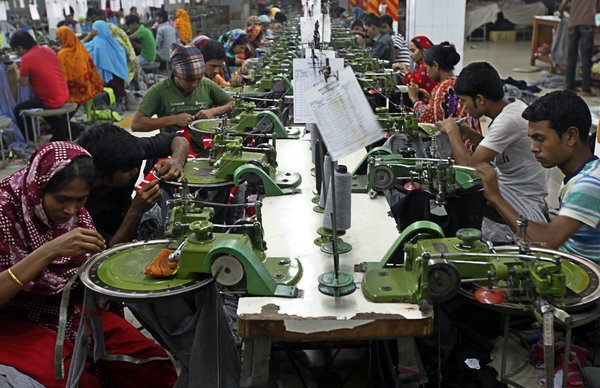
Garment worker woes, in Bangladesh, are not a recent development. In this report from the International Labor Rights Forum in 2010, the suffering and repression of factory labor in Bangladesh is made apparent. Their meager monthly wage of $43 not only far behind their demand for $72, but was also nutritionally less than prisoners in the country! Trade union leaders and human rights groups that challenged their unfair situation were subjugated. The recipe was ripe for disaster and it hit three years later.
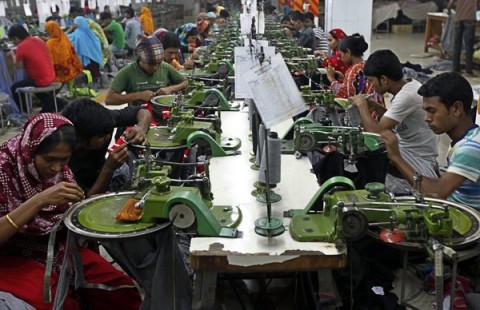
November 1, 2010 – A report by the International Labor Rights Forum (ILRF) released today reveals a severe government crackdown on labor rights activists in Bangladesh in the last few months as the country’s garment workers demanded higher wages. Bangladeshi garment workers are the worst paid workers in the world. Worker protest against low wages and poor working conditions peaked in early August this year following the government’s announcement of a new $43 monthly minimum wage, well short of workers’ needs and expectations. The new wage is scheduled to take effect today.
“We were forced to take to the streets as the owners exploited us right under the government’s nose,” said a garment worker quoted in The Daily Star, a Bangladeshi newspaper, after the government announcement of the new minimum wage.
According to the ILRF report, Enemies of the Nation or Human Rights Defenders? Fighting Poverty Wages in Bangladesh, the new $43 dollar minimum wage is still a “malnutrition wage.” Even Bangladeshi prisoners are better off than garment workers in nutritional terms, the report claims. It estimates a garment worker needs almost four times the new minimum wage just to feed her average-sized family.
The ILRF report criticizes the Bangladeshi government for scapegoating labor activists for inciting worker unrest and branding them “enemies of the nation” instead of dealing with workers’ genuine grievances. Focusing on the experiences of the leaders of the Bangladesh Center for Worker Solidarity, one of the most prominent labor rights groups in Bangladesh, the report relates a harrowing story of persecution as Bangladeshi police and security forces, including the notorious Rapid Action Battalion, raided staff members’ homes and attempted by subterfuge to discover the hideouts of the organization’s leaders. When captured, two of the labor leaders were tortured in custody to extract a confession that the organization had fomented worker riots.
Human rights groups, labor rights groups, and industry groups have denounced the Bangladeshi crackdown on labor rights activists. Human Rights Watch condemned the “serious harassment of trade union leaders and other labor rights activists and workers in the ready-made garment (RMG) industry who have been pressing for the right of workers to organize in unions and seeking increases in Bangladesh’s minimum wage regulations” in a letter to Prime Minister Sheikh Hasina on August 10, 2010.
The ILRF report calls on both companies and the Bangladeshi government to take action to protect civil liberties for the Bangladesh Center for Worker Solidarity and other labor rights defenders and increase the minimum wage for garment workers to at least $72 per month, the workers’ demand.
“We hope that this report will help bring justice for the leaders and staff of Bangladesh Center for Worker Solidarity and, in so doing, advance the cause of Bangladeshi garment workers who seek only the basic dignity of decent work and good wages,” said Bjorn Claeson, author of the report and director of the SweatFree Communities program at ILRF.
Enemies of the Nation or Human Rights Defenders? Fighting Poverty Wages in Bangladesh is available at www.sweatfree.org/bcws.
***
The International Labor Rights Forum (ILRF) is an advocacy organization based in Washington, DC, dedicated to achieving just and humane treatment for workers worldwide. ILRF serves a unique role among human rights organizations as advocates for and with working poor around the world. We believe that all workers have the right to a safe working environment where they are treated with dignity and respect, and where they can organize freely to defend and promote their rights and interests.
A program of the International Labor Rights Forum, SweatFree Communities, coordinates a national network of grassroots campaigns that promotes humane working conditions in apparel and other labor-intensive global industries. SweatFree campaigns build broad community support for sweatshop-free government purchasing and help build a market for decent working conditions.