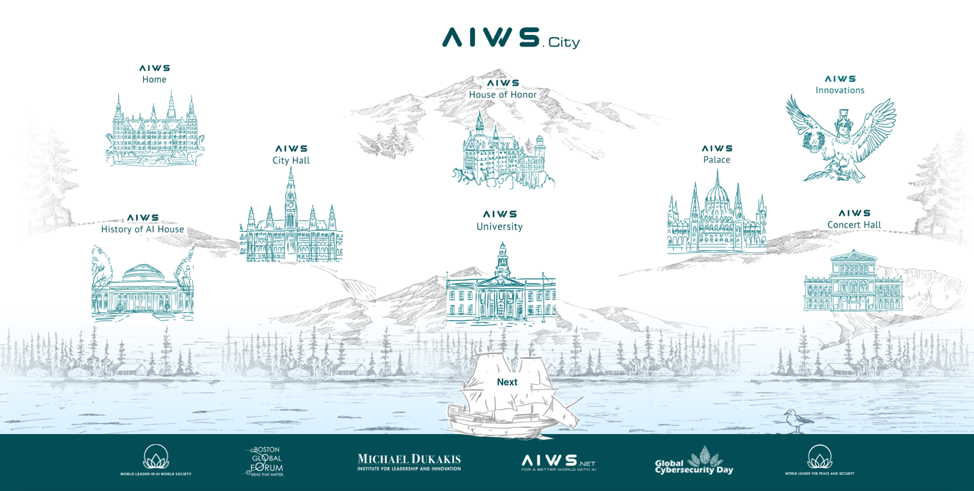
AIWS Leadership Master Program belong to AIWS University (AIWS City), will practice their leadership by practicing at Global Alliance for Digital Governance. They will be assigned to solve issues:
Misinformation, Disinformation, and Global Enlightenment Education
The Value System and Innovation Ecosystem of AI World Society (AIWS)
Building trust between leaders of nations
The Fundamentals for new international cooperation on the basis of standards of the Social Contract for the AI Age
Building Global Law and Accord on AI and Digital technologies
Ensuring responsible and democratic exercise of state power in the AI and digital age
Building on opportunities in technology and Big Tech companies while addressing their challenges, threats, and dangers.
They continue with support, leading of presidents, prime ministers, leading thinkers, innovators:
Connect and organize discussions between leaders of companies
Organize discussions between leaders of governments
Connect and organize discussions with professors of Law Schools
Monitor governments in standards of Social Contract for the AI Age
Connect companies and organizations to invite them join the Exchange AIWS Values
Using Blockchain to create crypto-currency of AIWS Values.
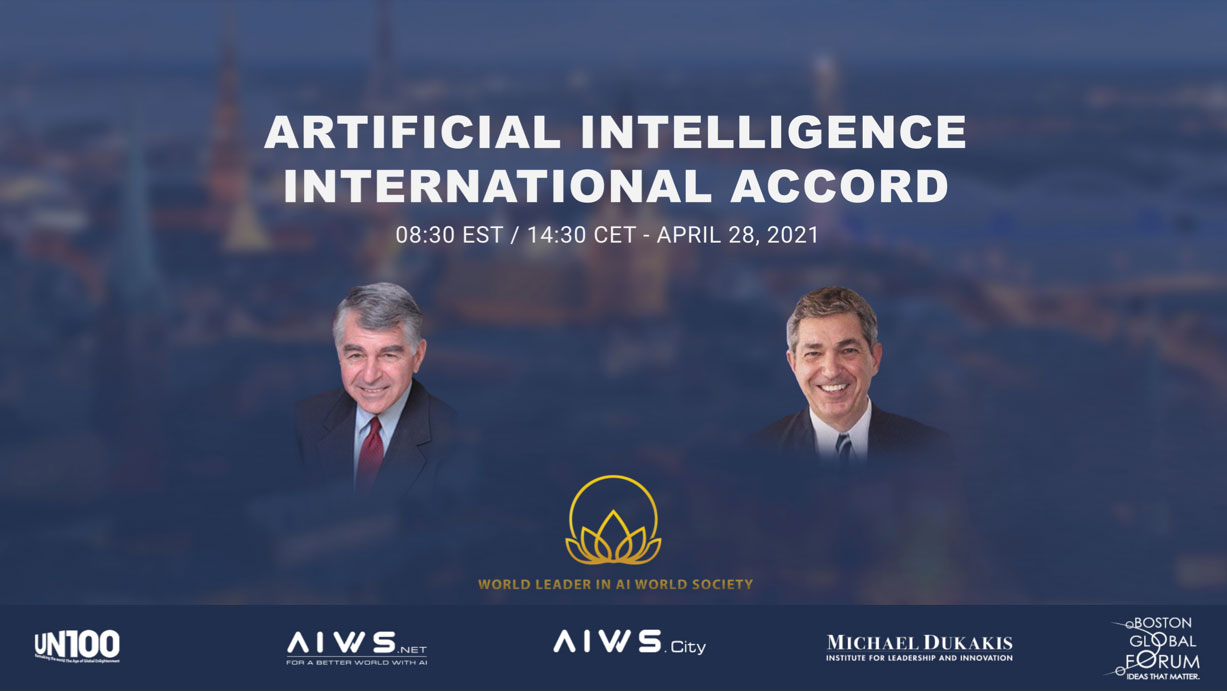
World Leader in AIWS Award and AI International Accord Roundtable
8:30 am – 10:30 am, EST, April 28, 2021
Ceremony to honor Ambassador Stavros Lambrinidisas 2021 World Leader in AIWS
Remarks of Governor Michael Dukakis to honor Ambassador Stavros Lambrinidis
Acceptance and Keynote Speech of Ambassador Stavros Lambrinidis
Congratulations of Greek Consul General in Boston, Stratos Efthymiou
2021 World Leader in AIWS award: Ambassador of the European Union to the United States Stavros Lambrinidis
World Leader in AIWS Award winners:
Secretary General of OECD Angel Gurria, 2018
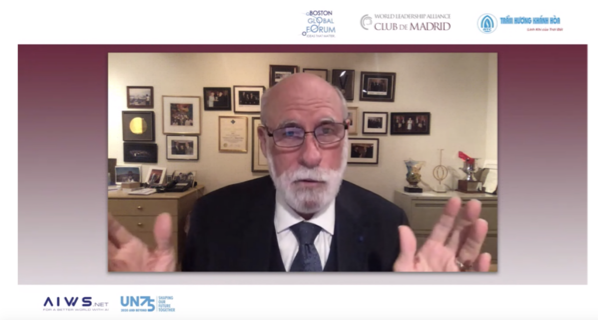
Father of Internet Vint Cerf, 2019,
Father of Causal Inference Methodology, Chancellor Professor Judea Pearl, UCLA, 2020
Ambassador Stavros Lambrinidis, 2021
The United Nations Centennial Roundtable “AI International Accord”
The framework for AI International Accord (AIIA)
Chair/Moderator: Governor Michael Dukakis, Co-founder and Chairman of Boston Global Forum
Speakers/Panelists:
Ambassador Stavros Lambrinidis, EU
Professor Nazli Choucri, MIT
Director for Partnerships and Outreach, UNESCO, Magnus Magnusson
Ambassador P.S Raghavan, India
EU Commission Principal Advisor, Paul Nemitz
Discussants:
Professor Alex Sandy Pentland, MIT
Professor David Silbersweig, Harvard
Mr. Robert Whitfield, Chair, One World Trust
Mr. Allan M. Cytryn, Principal of Risk Masters International
Mr. Marc Rotenberg, Former President of EPIC
Ms. Merve Hickok, Founder of AI Ethicist
Dr. Lorraine Kisselburgh, Chair, ACM Technology Policy Council
Ms. Megan Wan, University of Massachusetts Amherst
Professor Kirill Krinkin, Saint Petersburg Electrotechnical University, Russia
Roundtable of Artificial Intelligence International Accord
April 28, 2021
The framework for AI International Accord (AIIA) is a follow-up of the Social Contract for the AIAge. The framework is designed to build the AI World Society (AIWS) and to meet the goals of the United Nations Centennial Initiative — as articulated by the United Nations Academic Impact and the Boston Global Forum.
The AIIA framework serves as a guide to international relations in the AI and Digital Age. It is based on AIWS values, and smarter, quicker, and more effective action.
The AI International Accord Roundtable will address:
Fundamentals of the framework for AI International Accord,
Processs to build AIIA,
Mechanisms to implement AIIA, and.
Supports of governments, international organizations, and companies and firms to acknowledge, buttress, and enable this international accord.
Agenda
Governor Michael Dukakis
Introduction & Moderator
Ambassador Stavros Lambrinidis
“View of EU leaders on international accord for AI, and the special EU-US AI Agreement”
(Acceptance and Keynote Speech at the Ceremony to honor Ambassador Stavros Lambrinidis as 2021 World Leader in AIWS)
Professor Nazli Choucri,
“Introduction to the Framework for AI International Accord”
Mr. Magnus Magnusson
“Bring Goodness and AI Ethics to AI International Accord, and view from UNESCO”
Ambassador P.S Raghavan
“How to mobilize the consensus support of democratic governments of AI International Accord”
Paul Nemitz
“Mechanism to implement and enforce AI International Accord”
Discussion, led by Governor Dukakis
Concluding remarks, statement of appreciation, and next steps
Nguyen Anh Tuan, CEO, the Boston Global Forum
Delegation of the European Union to the United States
The EU is represented in the United States by the Washington, DC Delegation of the European Union, which works in close coordination with the embassies and consulates of the EU member states.
Ambassador of the European Union to the United States Stavros Lambrinidis
Stavros Lambrinidis is the Ambassador of the European Union to the United States, as of March 1, 2019.
From 2012 to February 2019, he served as the European Union Special Representative for Human Rights.
In 2011, he was Foreign Affairs Minister of Greece.
Between 2004 and 2011, he was twice elected Member of the European Parliament (MEP) with the Greek Social Democratic Party (PASOK). He served as Vice-President of the European Parliament (2009-11), Vice-President of the Civil Liberties, Justice and Home Affairs Committee (2004-09), and Head of the PASOK Delegation (2005-11).
Between 2000 and 2004, he was Director-General of the International Olympic Truce Centre, an International Olympic Committee organization.
He served as Ambassador ad personam of the Hellenic Republic (1999-2004); Secretary-General of the Greek Foreign Ministry, responsible for Expatriate Greeks (1996-99); and Chief of Staff to the Greek Foreign Minister (1996).
Between 1988 and 1993 he worked as an Attorney at Wilmer, Cutler & Pickering in Washington, D.C., specializing in international trade, transactions, and arbitration.
Mr. Lambrinidis was born in Athens, Greece in 1962. He studied Economics and Political Science at Amherst College (Bachelor of Arts degree, 1984) and Law at Yale Law School (Juris Doctor degree, 1988), where he was also Managing Editor of The Yale Journal of International Law. He is a 1980 graduate of the Athens College High School in Greece. He is married and has a daughter.
Chair:
Governor Michael Dukakis, Co-Founder and Chairman of The Boston Global Forum
Chairman of The Michael Dukakis Institute for Leadership and Innovation
Co-Founder and Chairman of The Boston Global Forum
Co-founder of AIWS.net and the AIWS City
Co-Author of Social Contract for the AI Age
The three-term Governor of Massachusetts and the 1988 Democratic nominee for President of the United States, Distinguished Professor of Northeastern University and UCLA
Michael Stanley Dukakis culminates a half-century career dedicated to public service, political leadership, fostering the careers of young leaders, and scholarly achievement.
Together with Nguyen Anh Tuan, this former Massachusetts governor, has established The Boston Global Forum as a globally recognized think tank noted for developing peaceful solutions to some of the world’s most contentious issues.
Speakers / Panelists:
Professor Nazli Choucri, MIT, AIWS City’s Board of Leaders
Nazli Choucri is a Boston Global Forum board member and Professor of Political Science at the Massachusetts Institute of Technology (MIT). Her work is in the area of international relations, most notably on sources and consequences of international conflict and violence. Professor Choucri is the architect and Director of the Global System for Sustainable Development (GSSD), a multi-lingual web-based knowledge networking system focusing on the multi-dimensionality of sustainability. As Principal Investigator of an MIT-Harvard multi-year project on Explorations in Cyber International Relations, she directed a multi-disciplinary and multi-method research initiative. She is Editor of the MIT Press Series on Global Environmental Accord and, formerly, General Editor of the International Political Science Review. She also previously served as the Associate Director of MIT’s Technology and Development Program.
The author of eleven books and over 120 articles, Dr. Choucri is a member of the European Academy of Sciences. She has been involved in research or advisory work for national and international agencies, and for a number of countries, notably Algeria, Canada, Colombia, Egypt, France, Germany, Greece, Honduras, Japan, Kuwait, Mexico, Pakistan, Qatar, Sudan, Switzerland, Syria, Tunisia, Turkey, United Arab Emirates and Yemen. She served two terms as President of the Scientific Advisory Committee of UNESCO’s Management of Social Transformation (MOST) Program.
Stratos Efthymiou, Consul General of Greece in Boston
Stratos Efthymiou is a career diplomat working for the Hellenic Ministry of Foreign Affairs.
From early 2016 to September 2017 Stratos Efthymiou was the Spokesperson of Ministry of Foreign Affairs and Director of its Information & Public Diplomacy Department. As Spokesperson he was part of the Greek negotiating team in the UN Conferences on the Cyprus issue in Geneva and in Crans Montana. He was also responsible for the public diplomacy and the social media of the Greek Foreign Ministry and for the communication aspects of international events such as the Ancient Civilization’s Forum and the two Rhodes Conferences for Security and Stability in the Eastern Mediterranean.
Consul General Efthymiou also served for 3 years as Deputy Director of the Information and Public Diplomacy Department dealing with the Ministry’s website and social media and was actively engaged in the communication policy of the 2014 Greek Presidency of the EU Council of Ministers.
Since joining the Ministry of Foreign Affairs in 2004, Mr Efthymiou has served at the Embassy of Greece in Moscow (2011–2013) and at the Embassy of Greece in Ankara (2009 – 2011), where he was previously appointed Head of the Embassy’s Consular Office (2007-2009).
He holds a Masters degree (DEA) in International Relations and a Diploma in Political Sciences from the Institute of Political Studies of Paris (Sciences-Po). He also holds a BA degree in International Relations and European Studies from Athens’ Panteion University of Social and Political Sciences. He is a graduate of the Greek-French School of Athens.
Prior to joining the Ministry of Foreign Affairs and during his studies in Paris (1998-2001), Mr. Efthymiou worked as a freelance journalist, publishing articles in the Greek daily Kathimerini.
He speaks English, French, Spanish, Russian and German, and has obtained the highest Turkish-language qualification degree from the University of Ankara.
He is married with a daughter and a son.
As of September 2017, he is the Consul General of Greece in Boston.
Ambassador Stavros Lambrinidis
See at World Leader in AIWS Award above
Magnus Magnusson, Director for Partnerships and Outreach, UNESCO
Magnus Magnusson joined UNESCO 1 September 2017 as Director for Partnerships and Outreach in the Human and Social Science Sector.
Prior to joining UNESCO, Magnus held positions as Vice President for Emerging Markets and Sustainability at Eco Capacity Exchange, Head of Government Relations, Northern Europe at the Bill & Melinda Gates Foundation, Head of Business Development and External Relations at the United Nations Capital Development Fund (UNCDF) and Regional Manager at the Nordic Development Fund (NDF) with responsibility for a USD 150 million infrastructure portfolio in Tanzania, Kenya, Rwanda, Ghana and Ethiopia.
He started his career at the Ministry for Foreign Affairs with desk responsibility for the World Bank, regional development banks, IFAD and micro finance. Thereafter he joined the Nordic Council of Ministers as Senior Advisor for the finance, transport and development cooperation sectors.
He also acted as secretary to the Board of Governors of the Nordic Investment Bank, Nordic Development Fund and representative in the Board of the Nordic Project Fund. Hereafter Magnus joined the United Nations Environment Programme/GRID Arendal as Head of the Stockholm Office.
A Swedish citizen, Mr. Magnusson has an academic background in social sciences, business administration and economics and environmental studies from Uppsala University, Swedish Royal Institute of Technology, Stockholm School of Economics and University of California, Berkeley. He wrote his thesis on microfinance in rural Laos.
He is a board member of the Stockholm Philanthropy Symposium Foundation and advisory board member of Hand in Hand USA. Global Vaccines Project and ECO Capacity Exchange. He is a frequent panelist and speaker including in the areas of innovative finance and impact investing.
Paul Nemitz, Principal Advisor of European Commission
Paul F. Nemitz is Principal Advisor in the Directorate-General for Justice and Consumers of the European Commission. Before, he was the Director responsible for Fundamental rights and Union citizenship, the lead Director for the reform of the EU data protection legislation, the “Snowden” follow up, the negotiations of the EU – US Privacy Shield and the EU Code of Conduct against Hate speech on the internet.
Before joining DG Justice, he held posts in the Legal Service of the Commission, the Cabinet of Commissioner Nielson, and in the Directorates General for Trade, Transport and Maritime Affairs. He has a broad experience as agent of the Commission in litigation before the European Courts and he has published extensively on EU law.
Selected publications and interventions:
Human Principle – Power, Freedom and Democracy in the Age of Artificial Intelligence, with co-author Matthias Pfeffer, 2020; the more than 1000 endnotes of the book are freely available on the dedicated website for the book PrinzipMensch.eu
Strengthening Democracy in Europe and its Resilience against Autocracy: Daring more democracy and a European Democracy Charter, with Frithjof Ehm, Research Papers in Law 1/2019, College of Europe; to be published in S. Garben, I. Govaere and P. Nemitz (Eds.), Critical Reflections on Constitutional Democracy in the European Union and its Member States (Oxford, Hart Publishing, 2019), https: //www.coleurope. eu / study / european-legal-studies / research-activities / research-papers-law
Ambassador P.S. Raghavan, Former Chairman of the National Security Advisory Board, India
Ambassador Raghavan is Chairman of the National Security Advisory Board, which advises India’s National Security Council on strategic and security issues.
As a career diplomat, he has served as India’s Ambassador to Russia, Czech Republic and Ireland. He had other diplomatic assignments in USSR, Poland, UK, Vietnam and South Africa.
He was an advisor to the Prime Minister of India (2000-2004) on foreign affairs, defense, national security, nuclear energy and space.
He founded, and was the first head of, the Development Partnership Administration, which coordinates India’s economic partnership programmes abroad, with an annual budget of over US$ 1.5 billion.
He was Chief Coordinator of the BRICS Summit in New Delhi (2012). From 2012 to January 2014, he was Special Envoy of Government of India to Sudan and South Sudan.
The United Nations Centennial Initiative:
The United Nations Centennial was launched in 2019 by the United Nations Academic Impact in partnership with The Boston Global Forum.
The UN Centennial programs host roundtable discussions, conferences, new concepts, solutions, think pieces, and reflections as we look ahead to the global landscape in 2045—the United Nations Centennial year.
This initiative will examine issues impacting technology, including artificial intelligence, cybersecurity, diplomacy, warfare, and other pressing concerns. Our goal is to look to the future and the role the United Nations will continue to play in making our world more peaceful, democratic, prosperous and universally secure.
The Boston Global Forum contributes AI World Society initiative to the United Nations Centennial.
The mission of UN Centennial Initiative and AI World Society: Remaking the world – The Age of Global Enlightenment.
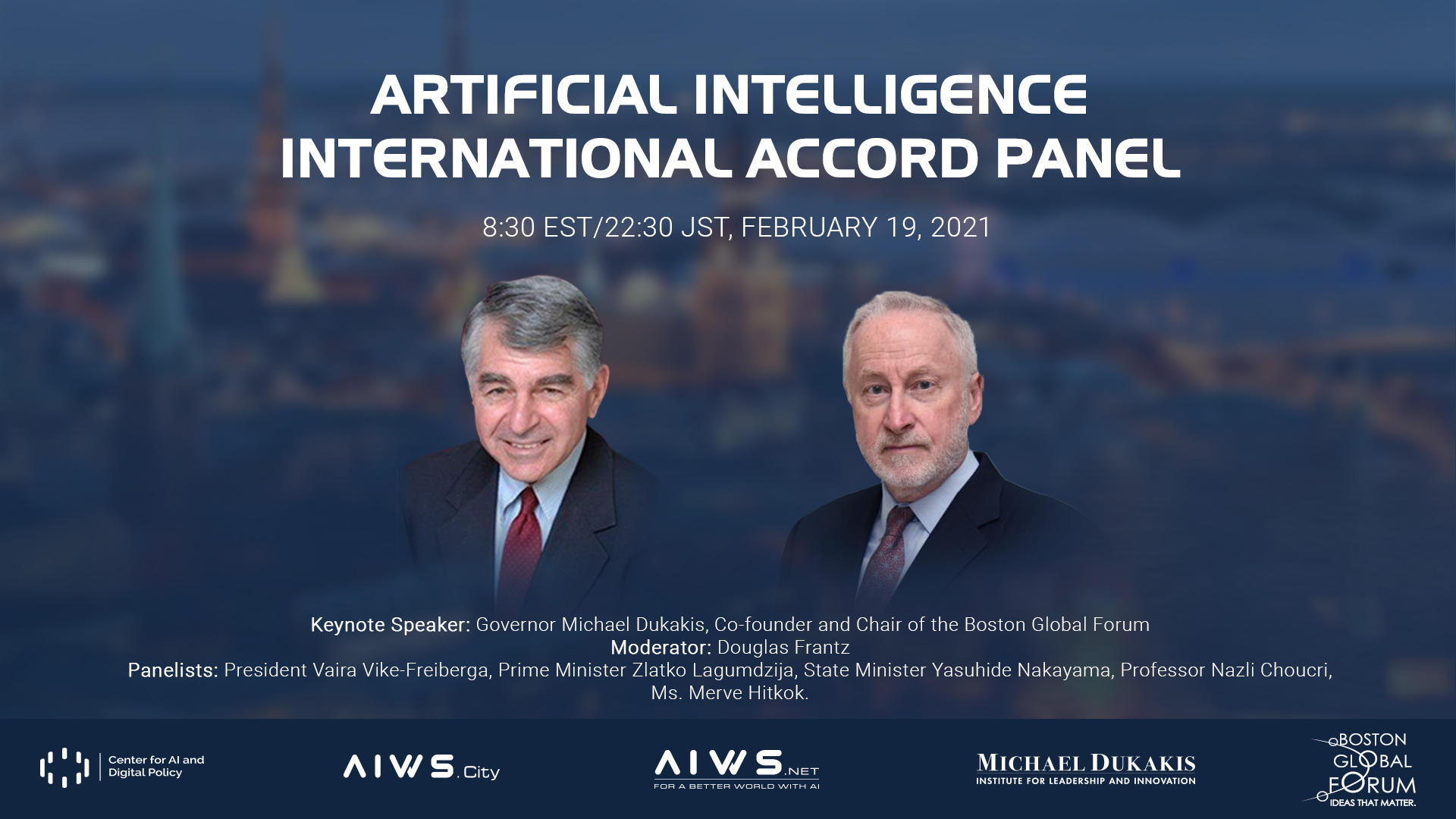
The moderator Douglas Frantz will introduce each panelist and make a short statement about the purpose of the panel and the project.
Then panelists will talk: average 7 minutes for each panelist talk.
Governor Michael Dukakis
Professor Nazli Choucri
State Minister Yasuhide Nakayama
President Vaira Vike-Freiberga
Prime Minister Zlatko Lagumdzija
Ms. Merve Hitkok
Then the moderator will discuss with panelists.
Finally, moderator will sum up views of panelists at the end of the session.
Time: 8:30 am – 10:30 am, EST, Feb 19, 2021.
Guidance on content:
Among the issues addressed by the Panel are the following:
Reviewing legal frameworks for AI and identifying essential elements for an international AI legal framework.
Defining methods to present abuses by governments and businesses in uses of AI, Data, Digital Technology, Cyberspace, (including attacking companies, organizations, and individuals on the Internet)
Articulating norms to manage robotics and cybersecurity, protecting Social Contract for the AI Age, democratic values, transparency, and accountability while ensuring equal opportunities across diverse socio-economic landscapes.
Supporting the provisions of the Budapest Convention on Cybercrime as well as the EU General Directives and/or incorporating basic principles thereof
Sanctioning entities –including governments, businesses, and not-for profit actors — who violate the AI International Accord and/or Social Contract for the AI Age).
Purpose and Scope of the AI International Accord Initiative
– Create an initial framework for the AI International Accord
– Establish a World Alliance for Digital Governance focused on supporting to support the AI International Accord and the Social Contract for the AI Age.
– Design a Monitoring System to observe all abuses in applications of AI by private and public entities, and to identify notable violations of an emergent AI International Accord and of the Social Contract for the AI Age.
– Provide an initial “proof of concept” – in terms of implementation and operations in practice – focused on AIWS City
– Explore potentials for reviewing and regulating potential deviances or damage created by algorithm development and implementation.
1. Process toward AI International Accord Initiative (Proposed)
The following process is currently envisaged:
(1) Creation of Draft-Framework prepared by the AIIA Team
(2) Discussion and Review by
· AIIA Panels organized by Boston Global Forum and Michael Dukakis Institute
· Quad Roundtables organized by Boston Global Forum and Riga Conference 2021
(3) Communication of progress with governments and international organizations
(4) Creation of “alliances-for-system-test” to focus on challenges of implementation
(5) Implementation of on-site operation and assessments at AIWS City
(6) Assessment of results to this point
2. Review, Revisions, and Refinements
Identify the operational steps to be undertaken in, and addressed, at several levels and in different contexts:
Local
National
Regional
International
The results will reflect the inputs, reactions, and considerations at each level.
3. Endorsement and Support
We shall explore (and seek to obtain) the support of the following entities
– First Quad group and EU
– Second OECD countries
– Third United Nations
– Fourth Russia and China
4. Host and Partners:
Host: Boston Global Forum and Michael Dukakis Institute
Active Partners:
World Leadership Alliance-Club de Madrid
Riga Conference 2021
United Nations Academic Impact
Potential Partners:
European Commission
US, Japan, Australia, India, Sweden, Latvia
5. Timeline of Key Events:
Quad Roundtable April, 2021
AI International Accord
Riga Conference 2021
Session on AIIA
World Leadership Alliance – Club de Madrid, September 2021
World Leaders and AIIA
AIWS City as the place for initial implementation of AIIA
Boston Global Forum December 12, 2021
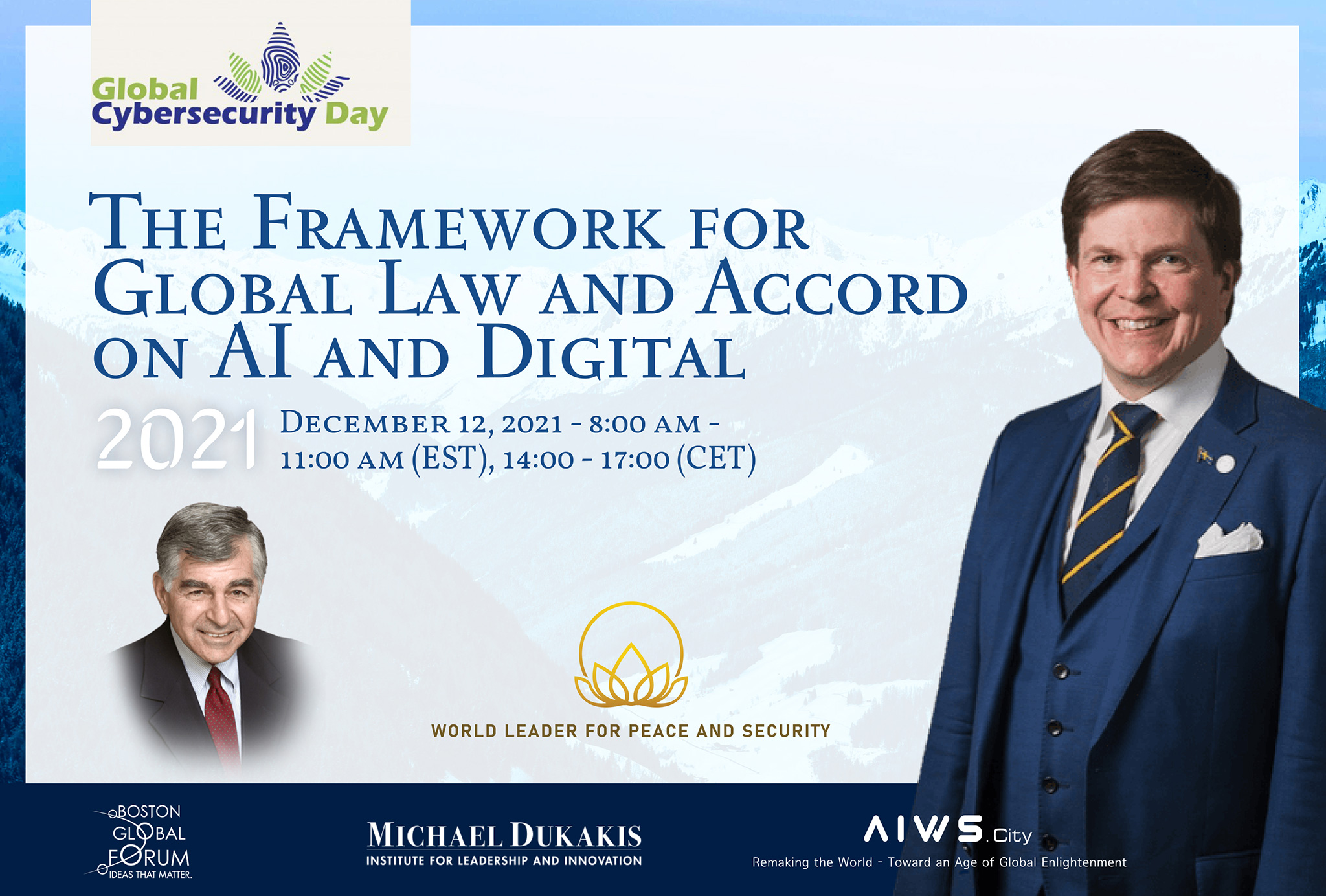
Announce the AIIA Accord and present World Leader for Peace and Security 2021 who made significant contributions to AIIA
6. Leadership:
– The Panel is convened under the leadership of Governor Michael Dukakis, and President Vaira Vike-Freiberga.
In a time of great challenge, we look to technology and its judicious use and an upwelling of human compassion. In the face of the COVID-19 pandemic with its devastating health and economic consequences, our ability to work together is among the most vital strengths of our species. The invention of machine learning and other forms of artificial intelligence is already playing a key role in improving our well-being. These technologies that augment our human capacity have delivered vaccines in record times. In the midst of such troubled times, we can celebrate the tools we use, including the Internet, to collaborate on a global scale never before possible. May this New Year bring essential improvement in the well-being of the Vietnamese people wherever they may be.
Professor Judea Pearl has been named World Leader of 2020 by the Artificial Intelligence World Society for his watershed work on quantifying cause-and-effect relationships in statistical analysis. This is a significant leap forward because statisticians heretofore focused on correlations, and remained mute on causality as being within their analytical realm.
In presenting the award to Prof. Pearl, Gov. Michael J. Dukakis, Chairman of the Michael Dukakis institute, stated, “I am inspired by your watershed work in establishing cause-and-effect relationships as a statistical and mathematical concept; most especially as we strive to more completely understand the rapidly evolving impact of Artificial Intelligence and Machine Learning on society.”
He went on to say, “Your latest book, “The Book of Why: The New Science of Cause and Effect,” provides us with the new tools needed to navigate the uncharted waters of causality for students of statistics, economics, social sciences, mathematics and most urgently today, epidemiology.” The Michael Dukakis institute, under the umbrella of its Artificial Intelligence World Society Innovation Network (AIWS-IN) AIWS.net, is calling for artificial intelligence to be developed and deployed in ways that benefit all mankind. Professor Pearl will serve as Mentor to AIWS Innovation Network programs in support of these goals.
He added, “With your remarkable achievements in mind, I am thrilled to have you accept this important honor as the: World Leader in the Artificial Intelligence World Society for 2020. To be sure, the AIWS.net is eager to explore and apply your Causal Models to the decision-making process by national governments as well as individual citizens.”
In accepting the award, Prof. Pearl said, “I believe we are kindred spirits in our pursuit of a world where we all share in the concern for our fellow citizens. I also believe the Boston Global Forum; the Michael Dukakis Institute for Leadership and Innovation and the AIWS-IN are playing a vital role in helping to inspire leading thinkers and scholars from around the world.”
The AIWS-IN focusses on the ethical, moral, concepts, models, and legal underpinnings of Artificial Intelligence developments at the cusp of the AI Age and plays a pivotal role in bringing together
distinguishes thinkers on the subject. Cofounder of the Michael Dukakis Institute, and AIWS-IN creator Mr. Tuan Nguyen said, “As we enter the age of Artificial Intelligence and Machine Learning we must ask: will machines that think humans, perhaps with human emotions, create a better life for us, or will AI take us to a dystopian world of economic upheaval and social unrest. Given the promise and peril of AI, we are seeking a broad base of ideas for a Social Contract for AI Age that will foster, safety, security and sustainability in the AI Age, something Professor Pearl can help us achieve.”
Founded in 2012, The Boston Global Forum (BGF) is a not-for-profit think tank based in Boston, Massachusetts. Our mission is to bring together, in an open and accessible public forum, an eclectic and engaging spectrum of esteemed academic leaders, real-world experts, thought leaders, media experts and promising young leaders, who are dedicated to seeking peaceful solutions to the most contentious issues of our times.
As an offshoot of The Boston Global Forum, The Michael Dukakis Institute for Leadership and Innovation (MDI) was born in 2015 with the mission of generating ideas, creating solutions, and deploying initiatives to solve global issues, especially focused on Cybersecurity and Artificial Intelligence.
Further details are available by contacting Mr. Tuan Anh Nguyen, Cofounder and Chief Executive Officer of the Boston Global Forum, and Director of the Michael Dukakis Institute for Leadership and Innovation.
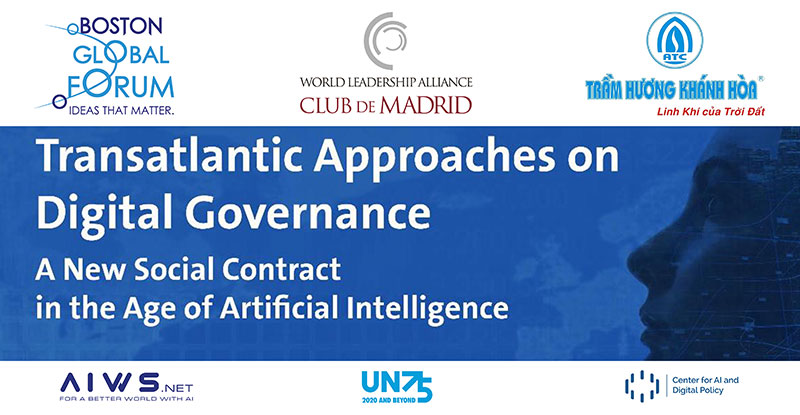
Thank you to the World Leadership Alliance-Club de Madrid and Boston Global Forum for inviting me to deliver some introductory remarks to this timely and important event on the theme – Transatlantic Approaches on Digital Governance: A New Social Contract in the Age of Artificial Intelligence
I’m speaking to you from my home city of Melbourne, where more than 5 million people are living under a strict lockdown as we grapple with an outbreak of the COVID-19 infection.
At the moment we have a 9pm to 5am curfew.
We cannot go outdoors for more than one hour a day to exercise, one trip to do essential shopping, nor can we travel more than 5 kilometers from our homes.
Nearly all businesses and community facilities are closed.
I know many of you have had similar experiences in your home cities over the course of this extraordinary year.
The impact of this global pandemic has been felt by all of us, and all of our lives have been changed by it.
We have learned some very important lessons this year.
We have learned that community still matters.
We have learned that solidarity still matters.
We have learned, or been reminded, that individual freedom has to be balanced against the common good.
We have learned that government still matters, and that competent government matters a great deal.
We have learned that transparency is better than concealment.
We have learned to value our health-care workers, and that cutting spending on public health is a false economy.
Most of all, we have learned that facts matter; that truth matters; that accurate and timely information matters.
More concretely, we have learned that science matters.
Science holds the key to understanding the multiple challenges posed by COVID-19, to responding effectively to those challenges – and ultimately – to defeating COVID-19 and saving the lives of millions of people.
That’s why it’s so timely that you are meeting – thanks to the wonders of contact-free global conversation – to discuss the role of science and technology in responding to the challenges of our century, of which the COVID-19 pandemic will not be the last.
We have had transnational and even global pandemics before.
We had plague, smallpox and cholera.
A hundred years ago we had the so-called Spanish Flu.
Nearly forty years ago we saw the advent of HIV/AIDS.
But while this is not the first global pandemic, it is the first pandemic in a globalised world.
It is the first pandemic in the era of the smartphone, of social media, of instantaneous global information and disinformation.
When Mark Twain wrote that “a lie can travel around the world and back again while the truth is lacing up its boots” he could not have known how true that would be in the year 2020.
Perhaps the most important challenge we face is how to prevent the wonderful technologies we now possess being misused; being put at the service of lies and propaganda and the promotion of hate-filled conspiracy theories.
The pandemic will elicit an examination of the social contract – what is the volonté générale, or the mens una, or have the inputs for utilitarian outcomes shifted?
We may need to examine whether the freedoms and rights that the citizenry of a western liberal democracy has traditionally enjoyed and that have been given up by the citizenry during the last few months will be altered, and whether there will be a ceding of those rights and freedoms to governments, given the course of this pandemic and the fact that no society can guarantee that we can be free of another wave, or indeed, another pandemic.
And in this century we may also face an examination of innate human morality and the foundation that that provides in a society, balanced against an artificial intelligence.
But the post-COVID world will not be the pre-COVID world.
We can never go back to life as it was in 2019, as individuals, as communities or as nations.
The challenge facing all of us, as leaders, as legislators, as policy-makers, as shapers of public opinion, is to see that all these lessons are learned, that truth prevails over propaganda and science over mythology.
Science has given us the technology we need to defeat not only COVID-19, but all of the multiple challenges we face.
What we need now is the political will to use it effectively.
Thank you, and all the best for your discussion over the next two days.
Democratic former Heads of State and Government, Members of Club de Madrid, current Government representatives, experts and renowned scholars will analyse global challenges and offer actionable policy solutions at a transatlantic and multi-stakeholder Policy Lab on the Social Contract for the AIAge, a new social contract on digital technologies and artificial intelligence
Madrid, 10 September 2020. In the midst of the current COVID-19 global health emergency, has impacted all spheres of life, humanity has turned to digital technologies and artificial intelligence to face impending challenges. From remote working to financial services and medical equipment, the extent to which we now depend on technology is increasing at a staggering rate. Hospitals are using robots to disinfect rooms, governments have become reliant on complex databases to curb the virus’ spread, and programmers have designed phone apps from which we can remotely control outbreaks. Under the present circumstances, technology seems to be an ally rather than a foe. Still, increasing concern from governments, academics and civil society that this technological transformation may be outpacing policy, must not be overlooked.
To debate these challenges, this forthcoming Policy Lab will convene over 10 former democratic Heads of State and Government (all Members of Club de Madrid) Manuel Muñiz, Secretary of State for Global Spain, Ministry of Foreign Affairs, European Union and Cooperation of Spain, as well as world class experts like computer scientist and father of the Internet, Vint Cerf, chess grandmaster Garry Kasparov, MIT Professor Alex ‘Sandy’ Pentland, Governor Michael Dukakis, Democratic Party nominee for President of the United States (1988), professors of Harvard, MIT, and top universities. Together, participants will lend their experience-based critical judgement to pioneering discussions which seek, among other priorities, to identify ways of engaging different sectors of society in grounding policymaking while protecting the democratic mandate.
Safeguarding citizen rights has become imperative since technology grants substantial power to those who control it. For instance, the technology being used to track citizen movements could potentially pose a violation of privacy rights if misused or left at the hands of non-democratic governments. New communication channels have also been contributing to the rapid spread of fake news about COVID-19, which has generated disinformation and increased confusion.
All in all, the rapid rollout of digital technologies and AI beyond the control of states poses a global challenge never seen before, which is why we should not set global, regional and national standards of digital governance without the participation of all societal actors. In this sense, debates from this Policy Lab on “TheSocial Contract for the AI Age”, the first social contract in the digital, Internet and AI era, a platform for connection among governments, stakeholders, and private and public institutions, and for balancing centers of power, initiated by the Boston Global Forum, will pay particular attention to insights presented by government representatives, academic institutions, think tanks, tech companies and civil society.
By comparing American and European approaches in the creation of a new social contract on digitalisation, with the foresight of former democratic presidents and prime ministers, this discussion will generate a space to encourage and strengthen transatlantic cooperation around digital governance, in the framework of much needed multilateral reforms and urgent global responses to global challenges like the COVID-19 crisis. The dialogue will also serve as a platform to establish a Transatlantic Alliance for Digital Governance and the AIWS City, an all-digital virtual city based on the standards and norms of “the Social Contract for the AI Age”, “People Centered Economy”, “Trustworthy Economy” and “Intellectual Society”. Lastly, the policy discussion aims to discuss the creation of an initiative to monitor governments as well as companies in using AI and to generate an AI Ethics Index at all levels.
REGISTRATION AND FURTHER INFORMATION
Join us in this Policy Lab “Transatlantic Approaches to Digital Governance: A New Social Contract in the Age of Artificial Intelligence” to be held between 16-18 September.
World Leadership Alliance-Club de Madrid (WLA-CdM) is the largest assembly of political leaders working to strengthen democratic values, good governance and the well-being of citizens across the globe. As a non-profit, non-partisan, international organization, its network is composed of more than 100 democratic former Presidents and Prime Ministers from over 70 countries, together with a global body of advisors and expert practitioners, who offer their voice and agency on a pro bono basis, to today’s political, civil society leaders and policymakers. WLA-CdM responds to a growing demand for trusted advice in addressing the challenges involved in achieving ‘democracy that delivers’, building bridges, bringing down silos and promoting dialogue for the design of better policies for all. This alliance, providing the experience, access and convening power of its Members, represents an independent effort towards sustainable development, inclusion and peace, not bound by the interest or pressures of institutions and governments.
In 2019 the WLA-CdM launched a ‘Call to Action’ to promote a democratic approach to Digital Transformation and the Future of Democracy, developed during its 2019 Annual Policy Dialogue, whereby it invites world leaders to take proactive action to frame the development of digital technologies in an inclusive, fair and rights-based legal, political and social framework.
The Boston Global Forum (BGF) is a not-for-profit think tank based in Boston, Massachusetts. Its mission is to bring together, in an open and accessible public forum, an eclectic and engaging spectrum of esteemed academic leaders, real-world experts, thought leaders, media experts and promising young leaders, who are dedicated to seeking peaceful solutions to the most contentious issues of our times. An offshoot of The Boston Global Forum, The Michael Dukakis Institute for Leadership and Innovation (MDI) was born in 2015. Its mission is to generate ideas, create solutions, and deploy initiatives to solve global issues, especially initiatives in Cybersecurity and AI World Society Innovation Network (AIWS-IN)
The Artificial Intelligence World Society (AIWS) is a set of values, ideas, concepts and protocols for standards and norms whose goal is to advance the peaceful development of AI to improve the quality of life for all humanity. It was conceived by the Michael Dukakis Institute for Leadership and Innovation (MDI) and established on November 22, 2017. Read more here.
CONTACT
Further details of WLA-CdM are available by contacting Agustina Briano, Outreach and Development Coordinator of WLA-CdM: [email protected]
Further details of BGF and AIWS are available by contacting Tuan Anh Nguyen, Co-founder and Chief Executive Officer of The Boston Global Forum, and Director of The Michael Dukakis Institute for Leadership and Innovation: [email protected]
For press credentials please contact Dick Pirozzolo: [email protected] / +16179594613
For press inquiries and/or interview requests of WLA-CdM Members, please reach Alejandro Hita, Communications Manager of WLA-CdM: [email protected] / +34607694354
President Vaira Vīķe-Freiberga, Latvia and World Leadership Alliance-Club de Madrid
Additional Signatories
Vint Cerf, Father of Internet, Google, Nazli Choucri, MIT,
Prime Minister Zlatko Lagumdzija, Bosnia and Herzegovina,
Tuan Anh Nguyen, Boston Global Forum, Thomas Patterson, Harvard University,
Alex Pentland, MIT, Marc Rotenberg, CAIDP, David Silbersweig, Harvard University
I. A New Social Contract in the Age of Artificial Intelligence
The term “artificial intelligence” refers to the development of computer systems able to perform tasks that normally require human intelligence, such as visual perception, speech recognition, decision-making, language translation, and self-driving cars. Advances in AI have already altered conventional ways of seeing the world around us. This is creating new realities for everyone – as well as new possibilities.
These advances in AI are powerful in many ways. They have created a new global ecology and yet remain opaque and need to be better understood. Advances in AI raise policy issues that must be assessed. We must now focus through dialogue, tolerance, learning and understanding on key principles and practices for an agreement among members of society for shared social benefit that we call the Social Contract for the AI Age.
The expansion of Artificial Intelligence is widely recognized and could change our lives in ways yet unimagined. At the same time, without guidelines or directives, the undisciplined use of AI poses risks to the wellbeing of individuals and creates possibilities for economic, political, social, and criminal exploitation.
The international community recognizes the challenges and opportunities, as well as the problems and perils, of AI. Many countries have announced national strategies to promote the proper use and development of AI. These strategies set out common goals such as:
Scientific research, funding and culture,
Sustainable development, and inclusive growth
Skills, education, and talent development
Public and private sector adoption,
Fairness, transparency, and accountability
Ethics, values and inclusion,
Reliability, security and privacy,
Science-policy links,
Standards, human control and regulations
Data and digital infrastructure.
AI is also the focus of foreign policy and international cooperation. There is a shared view that no country will be able to compete or meet the needs of its citizens without increasing its AI capacity. As well, many countries are now engaged in technology leapfrogging. It is no longer expected, nor necessary, to replicate the stages of economic development of the West—one phase at a time.
In a world as diverse as the one today, there are few mechanisms for responding to such possibilities on a global scale. Social Contract for the AI Age is designed to establish a common understanding for policy and practices, anchored in general principles to help maximise the “good” and minimise the “bad” associated with AI. Derived from the 18th century concept of a social contract—an agreement among the members of society to cooperate for social benefits—Social Contract for the AI Age is focuses on the conditions of the 21st century. It is a response to artificial intelligence, big data, the Internet of Things, and high-speed computation.
Foundations
Just as earlier social contracts helped shape societies for a common purpose, the Social Contract for the AI Age has a transformative vision, one that transcends the technological features of artificial intelligence and seeks to provide foundations for a new society. Consider, for example, how the Covid-19 pandemic urgently requires a new society with new structure and order, approach — new ways to share data and coordinate action, accelerated social reliance on digital service across businesses, education, and government services. The Social Contract for the AI Age would create standards for a new international system. It focuses on the conduct of each nation, relations with international business and not for profit entities, and the cooperation of nations. Just as TCP / IP is the platform for communication among internet users, the Social Contract for AI Age is a platform for connection among governments, stakeholders, and private and public institutions.
Objectives
The Social Contract for the AI Age seeks to build a multi-stakeholder, inclusive society in all aspects of life across politics, government, economics, business, and industry. The Social Contract for the AI Age values creation, innovation, philanthropy, and mutual respect. It seeks the right of freedom on, and access to, the Internet worldwide. The Social Contract for the AI Age seeks to make the world a locus of responsible interaction—a place where every person’s contribution is recognized and everyone has a right to knowledge and access to information, where no one is above the law, where money cannot be used to subvert political process, and where integrity, knowledge, creativity, honesty, and tolerance shape decisions and guide policy.
In short, the Social Contract for the AI Age seeks to build a world where all are recognized and valued, and all forms of governance adhere to a set of values and are accountable and transparent. It is a world where global challenges are met by collective action and responsibility.
II. Principles
Extensive and appropriate AI application to politics, governments, society, and businesses can create a Smart Democracy. The Social Contract for the AI Age creates a platform for a Smart Democracy society, and a new global supply chain, named Supply Chain 2020. As a framework for society in the AI age, the Social Contract 2020 is based on balancing power among governments, businesses, civil society, individuals, and AI assistants. The Social Contract for the AI Age is a commitment to protect property, common values, and collective norms.
(1) AI must respect fundamental human rights such as human dignity, rule of law, and privacy protection.
(2) AI systems must be considered from a multi-stakeholder perspective — for the individual and for society as a whole
(3) The Social Contract for the AI Age is a basis to achieve sustainable and inclusive development for a global community that is fair, equitable, and prosperous. It is designed to apply the concept of a people-centered economy and to create a trustworthy AI, data, and Internet ecosystem for work and life.
(4) The Social Contract for the AI Age should be transparent and accountable, and follow standards based on policies driven by trustworthy data. The UN Sustainable Development Goals data metrics and the World Economic Forum Environmental, Social, and Governance (ESG) metrics, should provide citizens and organizations with reliable data that enables well-informed policy choices.
(5) Communities must have control over their data. Data is the basis of self-determination and provides the ability to measure the impact of actions and policy in the AI realm.
(6) Data literacy at all levels of society, together with open, trustworthy information, is the basis for an intelligent, thoughtful society.
III. Commitments of Stakeholders/ Power Centers
(1) Individuals, Citizens, Groups:
Everyone is entitled to basic rights and dignity that are enhanced/promoted by AI.
Data Rights and Responsibilities:
Each individual has the right to privacy and is entitled to access and control over their own data. Individuals have a right to manage their data, individually or collectively, and the right to withhold their data from businesses.
Each individual and each community must have access to a trustworthy AI, data, and Internet ecosystem to create an inclusive, fair, people-centered economy, and society.
Internet Rights:
Each individual has the right to access the Internet and any website or news system without restriction.
Freedom of expression on the Internet is guaranteed.
Secure digital identity allows the individual to know about, and control access to their data.
Education and Political Participation:
Each individual has the right to education through best available venues.
Each individual must have access to education/knowledge/training about the use and impact of AI.
Each individual has the right to unimpeded political participation.
Everyone must have access to due process and fair trial, as well as remediation for injustice.
Responsibility:
Individuals is prohibited from exercising socially disruptive behaviors, such as hacking, disseminating disinformation or online hate.
Individuals must contribute to the common good through appropriate taxes and provision of critical personal information (with appropriate data protection) as, for example, in the collection of census data and voting for public officials
(2) Governments. Governments have a leading role in the Social Contract for the AI Age.
All government should behave responsibly in the management of AI for governance and for interactions with individuals and such behavior must be easily auditable.
All governments implement AI governance policies that respect honesty, transparency, fairness, and accountability. These standards and norms apply in every area of governance and are the basis for collaboration with international communities.
All governments create incentives for citizens to use AI in ways that benefit society (for example each person does good work for society that will be recognized as value, and this value can be exchanged with other values such as financial value, products, services, etc.).
All governments construct a secure, stable, and trustworthy AI, data, and Internet ecosystem for work and life to support the people-centered economy.
All governments ensure that communities are able take control of their data and use AI with their data so that they can manage their community to suit their needs and to create prosperity for themselves and their family.
All governments establish norms, rules and pass laws to ensure AI benefits society.
All governments create secure safety net for citizens in a trustworthy AI, data, and Internet ecosystem for work and life.
All governments protect intellectual property rights without undermining free access to the information commons.
Collaborations between governments:
Norms, values and standards of the Social Contract for theAI Age are designed as connections among governments. To maintain the Social Contract for the AI Age, it is essential for countries to establish a Democratic Alliance for Digital Governance. All governments should work to promote the Democratic Alliance for Digital Governance.
United Nations and International Organizations:
The United Nations should extend international human rights standards for AI, and create a UN Convention on AI and establish a specialized UN Agency on AI
(3)Business Entities. Business operations and related rights come with accountability and responsibility – nationally and internationally. Business must:
Enable independent audits for transparency, fairness, accountability, and cybersecurity.
Adopt common AI values, standards, norms, and data ownership rules with penalties for noncompliance.
Companies will be incentivized to do business only with companies and countries that uphold the Social Contract for the AI Age and endorse Supply Chain 2020.
Collaborate with governments and civil society to help create a people-centered AI, data, and Internet ecosystem, to create trustworthy and relevant data, and to use AI to share wealth with individuals and communities.
(4) Civil Society Organizations & Community. Rights and responsibilities of civil society organizations include:
Monitor governments and firms with respect to common values.
Promote common values, norms, standards, and laws.
Support AI users and assist them to serve the broad interests of society.
Collaborate with governments, business entities, and others to create a people-centered AI, data, and Internet ecosystem for work and life, enabling all people can create meaningful data, value, and create value-based wealth for their community.
Enable data cooperatives—the voluntary collaborative pooling by individuals of their personal data for the benefit of the group or community.
Participate in the making of AI rules and norms.
Enhance civil society become an intelligent, thoughtful civil society based on knowledge, smart data, critical thinking and social responsibility; and through the achievement of data literacy, to become a trusted open-data system, with validated, predictive AI tools that communities to plan their future.
(5) AI Assistants. AI assistants provide an interface to facilitate compliance with established standards.
Support AI users and assist them to serve the broad interests of society.
Engage with other power centers for mutual support and supervision.
Community control: AI assistants should be governed by communities of users.
IV. Implementation. The Social Contract for the AI Age will be implemented as follows:
The promulgation of a Code of Ethics for AI Developers and AI Users.
The creation of a system to monitor and evaluate governments, companies, and individuals (based on their contribution to maintaining norms, standards, common values, and international laws for honesty, transparency, accountability, and responsibility).
The recognition of the Social Contract for the AI Age by the United Nations, governments, companies, civil society and the international AI community.
The establishment of a United Nations Convention on Artificial Intelligence to obligate governments and others to comply with international rules and norms to protect rights in AI age.
The development of the Democratic Alliance for Digital Governance as the global authority to enforce the Social Contract for the AI Age.
The creation of the “AIWS City”—an all-digital virtual city based on the standards and norms of “the Social Contract for the AI Age”, “People Centered Economy”, “Trustworthy Economy”, “AI-Government”, and “Intellectual Society-Thoughtful Civil Society”.