by Admin | Jun 30, 2019 | AI-Government, News
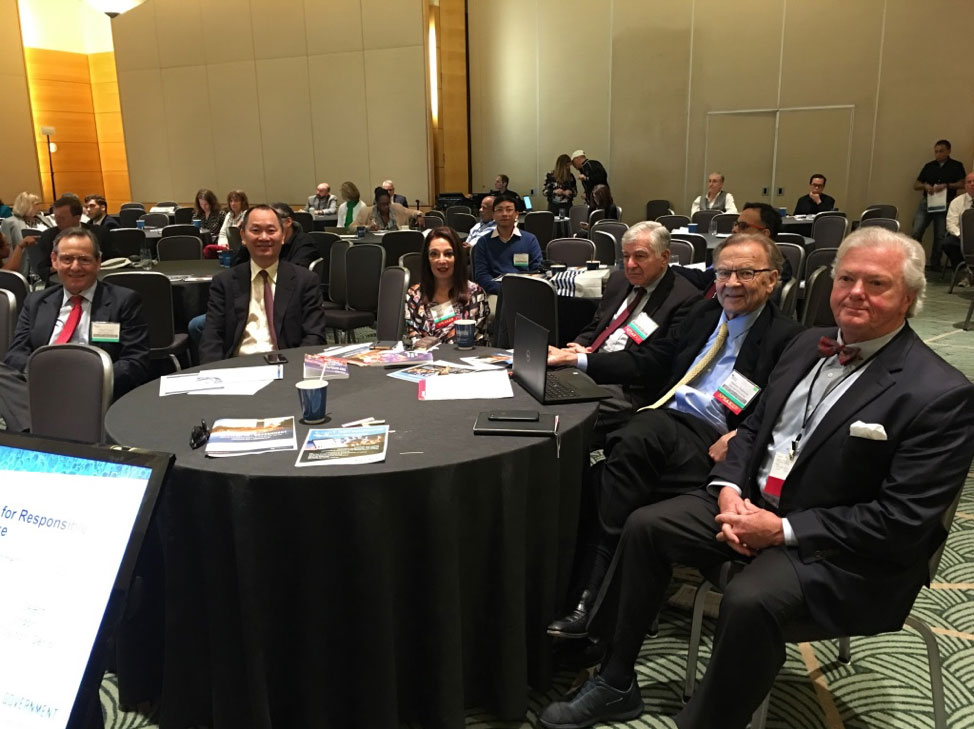
Delegation of the Boston Global Forum, including Governor Michael Dukakis, Mr. Nguyen Anh Tuan, Professor Thomas Patterson, Professor Nazli Choucri, Professor Thomas Creely, and Mr. Allan Citryn, attended AI World Government Conference and Expo in Washington DC. The BGF is a part of the strategic alliance of this event. BGF hosted the Summit of AI World Government with the topic “AI Governance, Big Data, and Ethics”. After Governor Michael Dukakis give opening remarks, Prof. Thomas Patterson presented the AI World Society-G7 Summit Initiative. He focused on the AI-Government model and AI-Citizen, in which AI-Citizen as new concepts. AI-Government affects the public through improvement of public services, such as health care and education. This impact, however, deals only with individuals as subjects – recipients of government action. AI also has the capacity to empower individuals and make them more responsible for their actions. In this sense, AI is a mechanism for enhancing individuals as citizens rather than merely as subjects.
As we envision the AI World Society (AIWS), it is a society where innovation, creativity and dedication are promoted and given material support, and in which individuals who contribute to society through innovation, creativity and dedication are heard, recognized and rewarded.
We also envision it as a society that increases citizens’ opportunities to influence governmental decisions and to hold government accountable for its actions. Citizen participation is not a substitute for representative institutions, but the AIWS model expands the range of decisions in which citizens are directly and materially involved. AI in this context should support the self- organization of citizens in structures of civil society and those for political action, thus contributing to a more vibrant and open society and a living democracy.
AI-Citizen would seek to nurture innovation, creativity and dedication and the ability to organize for a common purpose; develop a mechanism for rewarding innovation, creativity and dedication, getting organized for public interest purposes; develop ways for individuals to participate more fully and actively in government decisions, parliamentary and other democratic activity and civil society; and provide ways for individuals to hold government and other actors accountable for decisions affecting them and society generally.
Prof. Patterson introduced the Social Value Reward (or Social Value Recognition) SVR. This system is in contrast with Social Credit System of China. Social Value Reward is for citizens and by citizens. Mr. Nguyen Anh Tuan, CEO of BGF, emphasized that the Social Credit System of China government is anti-democratic, and the world need a democratic system to replace the Social Credit System of China.
Social Value Reward (SVR) System would provide a way for citizens to track their contributions to society, as well as a way for society to acknowledge those contributions. It would allocate reward based on citizens’ adherence to norms such as their dedication and their innovative, creative contributions. It stands in sharp contrast to China’s “social credit” system, which is a mechanism of state control. Based on a blockchain system, SVR would not have government input or be accessible by government. Reward would be allocated by civic-minded non-governmental organizations. The system is used to recognize and honor citizens for their contributions to society. Punitive action is prohibited. SVR would also permit citizens to evaluate the leaders of governmental institutions, governments, non-government organizations, and firms for their contributions to society. SVR would accord with The European Union’s General Data Protection Regulation (GDPR) and The Ethics Guidelines for Trustworthy Artificial Intelligence (AI) issued by the European Commission’s High-Level Expert Group on Artificial Intelligence.
Professor Patterson informs that BGF are discussing about The New Social Contract for AI, Data, Internet society.

BGF delegation attended AI World Government.

Governor Michael Dukakis gives opening remarks at the Summit of AI World Government.

by Admin | Jun 30, 2019 | News, World Leaders in AIWS Award Updates
The prime minister Abe called for the reform of the World Trade Organization, which has been criticized for not functioning properly. He also stressed to leaders the necessity of compiling a new global taxation rule aimed at imposing greater taxes on large information technology companies by next year.
The G20 summit officially started on Friday at noon with a special leaders event on the digital economy. On the first day of the summit, leaders mainly discussed the global economy, trade and investment, and dinner was to be hosted by Abe. On Saturday, the second day of the summit meeting, issues such as climate change, the environment and energy will be discussed.
http://the-japan-news.com/news/article/0005840718

The Boston Global Forum honored Prime Minister Shinzo Abe with the World Leader for Peace and Cybersecurity Award on Global Cybersecurity Day December 12, 2015 at Harvard University Faculty Club.
Prime Minister Abe sent an acceptance speech through video and Japanese Consul General in Boston, representative of Prime Minister Abe, received the Award at Global Cybersecurity Day.

by Admin | Jun 30, 2019 | AI-Government, News
Automation is to achieve efficiency. What if AI sees humanity itself as the thing to be optimized? The New York Times this week wrote about the possibility of robots replacing your bosses.
It is happening indeed, kind of. Amazon’s complex algorithms are already used to track worker productivity in its fulfillment centers and can automatically generate the paperwork to fire workers who don’t meet their targets. IBM’s AI Platform, the Watson, its A.I. platform can predict future performance of employees with almost 100% accuracy. Cogito is an AI supervisor for call centers and other workplaces; it gives workers feedback in real time.
But the use of AI program to manage workers remains controversial. “It is surreal to think that any company could fire their own workers without any human involvement,” Marc Perrone, the president of United Food and Commercial Workers International Union. How do you resolve conflict between the workers and the platforms serving as the supervisor?
Defenders of workplace AI argue that these systems are meant to make workers better. For example, there may be situations in which human bias skews decision-making, such as hiring and this is where AI can help.
Nevertheless, one should by all means avoid the temptation to abuse AI for the purpose of big-brother watching the workers. The full article of the New York Times is here.

by Admin | Jun 30, 2019 | AI-Government, News
The field of artificial intelligence (AI) is exploding with projects such as IBM Watson, DeepMind’s AlphaZero, and voice recognition used in virtual assistants including Amazon’s Alexa, Apple’s Siri, and Google’s Home Assistant. Because of the increasing impact of AI on people’s lives, concern is growing about how to take a sound ethical approach to future developments. Building ethical artificial intelligence requires both a moral approach to building AI systems and a plan for making AI systems themselves ethical. For example, developers of self-driving cars should be considering their social consequences including ensuring that the cars themselves are capable of making ethical decisions.
“Decisions about AI should be based on human needs rather than on greed.” This philosophy is also aligned with Artificial Intelligence World Society (AIWS) for the purpose of promoting ethical norms and practices in the development and use of AI. According to AIWS ethics report, AI can be an important tool to serve and strengthen democracy, human rights, and the rule of law.
by Admin | Jun 30, 2019 | AI-Government
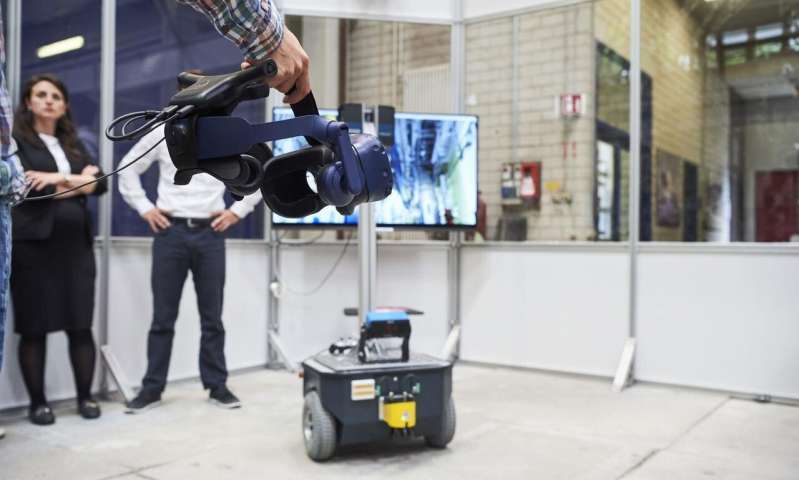
Whether it’s at rescue and firefighting operations or deep-sea inspections, mobile robots finding their way around unknown situations with the help of artificial intelligence (AI) can effectively support people in carrying out activities in hazardous environments. The potential as well as the concrete benefits of AI in this field are illustrated in a current report from Plattform Lernende Systeme, Germany’s Platform for Artificial Intelligence, using two application scenarios.
In future, mobile self-learning robots can relieve people from dangerous or harmful activities. At the same time they can make operations in difficult-to-access terrain more economic or possible in the first place. The use of artificial intelligence comes with enormous opportunities for our society. Especially in disaster prevention, the decommissioning of nuclear power plants and in the maritime field there are a number of options for effectively supporting professionals with the help of artificial intelligence.
According to Michael Dukakis Institute for Leadership and Innovation (MDI), AI can be a force for helping people achieve well-being and happiness, unleash their potential, obtain greater freedom, relieve them of resource constraints and arbitrary/ inflexible rules and processes, and solve important issues, such as SDGs.
