Framework for Peace and Security in the 21st century

Framework for Peace and Security in the 21st century

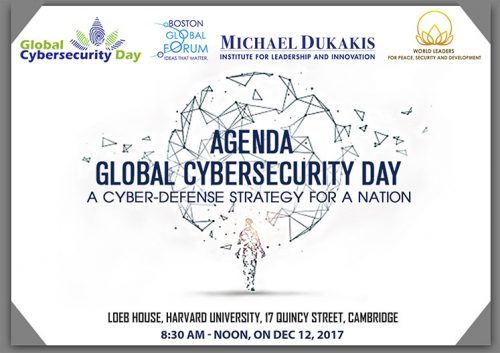
SPEAKERS AND DISCUSSANTS

  • Governor Michael Dukakis, Co-founder and Chairman of the Boston Global Forum, Co-Chair
  • Stratos Efthymiou, Consul General of Greece in Boston, Co-Chair
  • Prof. Stephen Walt, Harvard Kennedy School
  • Prof. Nazli Choucri, MIT
  • Prof. Thomas Patterson, Harvard Kennedy School
  • Prof. David Silbersweig, Harvard Medical School
  • Prof. Thomas Creely, Naval War College
  • Barry Nolan, Adviser of US Congress
  • Nguyen Anh Tuan, Co-founder and CEO of the Boston Global Forum
  • Prof. Constantine Arvanitopoulos, the Karamanlis Chair at the Fletcher School of Law and Diplomacy, Professor of International Relation, Tufts University
  • Prof. Christo Wilson, Northeastern University, Harvard Law School Fellow, Michael Dukakis Leadership Fellow
  • Nguyen Phan Nguyet Minh, AI World Society Young Leader

You can download detail Agenda here 

Archive house and statue of Vint Cerf in Nha Trang

Archive house and statue of Vint Cerf in Nha Trang

Dr. Vint Cerf, one of “the Father of the Internet” and World Leader in AI World Society Award, will be honored in Nha Trang, Vietnam in 2020.

VietNet Information Highway, the first Internet of Vietnam applied by TCP/IP protocol , was born in  Nha Trang city in December 1995, and officially provided internet service in January 1996, two years before Vietnam government officially allowed on Internet connectivity. Internet has supported to a remarkable change in Vietnam. It has connected Vietnam together with developed countries (United States and Western countries), as an important factor to make open and strong Vietnam.

To respect and honor the Father of Internet, Nha Trang city will create Vint Cerf Archive room and statue. When Dr. Vint Cerf visit Nha Trang in 2020, the city will organize a special ceremony to welcome and honor Dr. Vint Cerf, as well as officially launch the Vint Cerf Archive Room and Statue. Besides, Dr. Vint Cerf will give a special speech at the ceremony.

Dr. Vint Cerf also joins to the team to build the Social Contract 2020.

10 Ways Machine Learning Is Revolutionizing Manufacturing In 2019

10 Ways Machine Learning Is Revolutionizing Manufacturing In 2019

The leading growth strategy for manufacturers in 2019 is improving shop floor productivity by investing in machine learning platforms that deliver the insights needed to improve product quality and production yields.

Artificial Intelligence (AI) has the potential to create $1.4T to $2.6T of value in marketing and sales across the world’s businesses, and $1.2T to $2 in supply-chain management and manufacturing. 50% of companies that embrace AI over the next five to seven years have the potential to double their cash flow with manufacturing leading all industries due to its heavy reliance on data according to McKinsey.

Using machine learning to streamline every phase of production, starting with inbound supplier quality through manufacturing scheduling to fulfillment is now a priority in manufacturing. According to a recent survey by Deloitte, machine learning is reducing unplanned machinery downtime between 15 – 30%, increasing production throughput by 20%, reducing maintenance costs 30% and delivering up to a 35% increase in quality.

According to Michael Dukakis Institute for Leadership and Innovation (MDI), AI can be an important tool for government and society, especially in manufacturing industry, to relieve people of resource constraints and arbitrary/inflexible rules and processes, as well as solve important issues, such as SDGs.

AIWS House in Dalat University will be officially operated in 2020

AIWS House in Dalat University will be officially operated in 2020

On August 16 2019, President Le Minh Chien and leaders of Dalat University welcome and have a great meeting with Mr. Nguyen Anh Tuan, co-founder of AI World Society Initiative. They have discussed and confirmed on design as well as timeline for AI World Society (AIWS) House at Dalat University at the old library of the University. The AI World Society house will have 3 main components including Archive of AI in the world, Seminar and Conference Room, and Research Room. They will also build AI World Society Square connect with AI World Society House. AIWS House will host special research and education program in AI technology supported by Michael Dukakis Institute (MDI) for Leadership and Innovation. The AIWS House will have online version to encourage and engage global communities for AI applications on Art, Cultures, and Society.

The AIWS House will officially operate from 2020, and will host AI World Society Festival in Art and Culture for peace and happiness in December 2020.

Dalat University or the University of Dalat is a university in the city of DalatVietnam. The original Dalat University was established in 1957 — after support of and requests by Archbishop Pierre Martin Ngô Đình Thục — by the Council of Vietnamese Catholic Bishops as a centre for education.  Today, it is a multidisciplinary university that offers undergraduate and graduate education for the Central Highlands region

How to enforce policy/regulation. “Trust but verify”

How to enforce policy/regulation. “Trust but verify”

Shaping the future of AI will require new regulation of technology. Some possible directions include restrictions on the collection and use of data, requiring the use of machine learning tools and frameworks that are fair by design, and mandating processes that promote accountability by allowing people to contest algorithmic decisions.

However, the natural question that arises is: how will these new policies and regulations be enforced? Without a means for assessing whether systems are in compliance, regulators are powerless to hold the designers and operators of those systems accountable.

Algorithm auditing is one potential answer to this question. Using algorithm auditing techniques, it is possible to scientifically evaluate whether a black-box system exhibits a range of negative behaviors, such as discrimination against protected classes or predatory pricing. Algorithm auditing enables academics, members of civil society, investigative journalists, and regulators to assess whether algorithmic systems are obeying policy proscriptions and best-practices.

Algorithm auditing methods have two desirable properties. First, systems can be audited without requiring access to proprietary source code and datasets. This avoids obvious concerns about revealing trade secrets or sensitive datasets to third-parties. Second, audits can be conducted in secret, making them suitable for voluntary and involuntary compliance testing.


As part of the Social Contract 2020 we should carefully consider the compliance and enforcement role that algorithm audits can play. One option is to mandate independent algorithm audits of all consequential AI systems, similar to how we currently mandate financial audits (and should mandate cybersecurity audits). A second option is not to mandate algorithm audits, but to instead legalize and legitimize their practice. This would at least permit consequential AI systems to be audited, rather than allowing system owners to shroud their technology in a haze of legal use restrictions.

Christo Wilson

Associate Professor
Khoury College of Computer Sciences
Northeastern University

Member of the Social Contract 2020 Team

Michael Dukakis Leadership Fellow