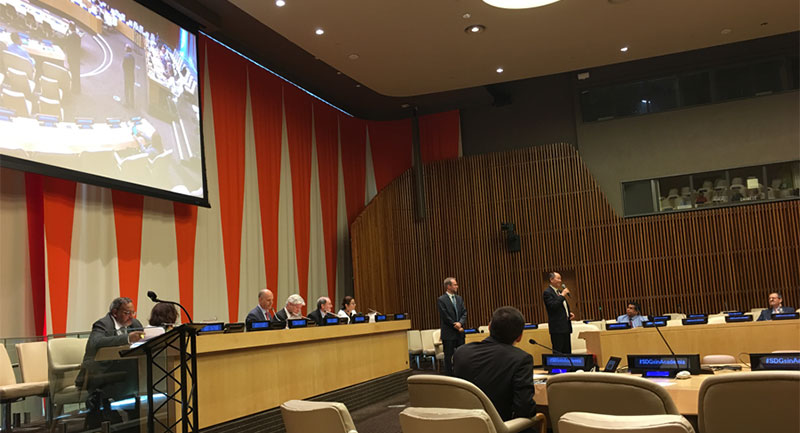
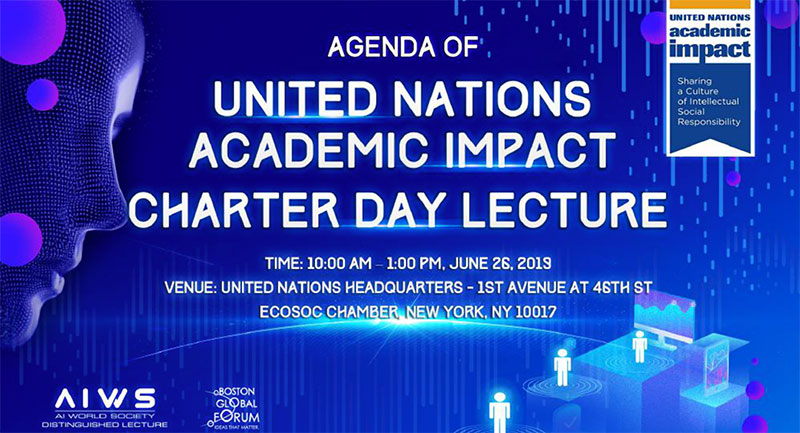
On June 26, 2019, the 74th anniversary of the United Nations Charter Day, Boston Global Forum (BGF) was pleased to collaborate with United Nations Academic Impact to co-organize the AI World Society Distinguished Lecture delivered by Dr. David A. Bray in the ECOSOC Chamber, United Nations Headquarters. On this special day, the AI World Society Distinguished Lecture is named as the United Nations Charter Day Lecture.
Mr. Nguyen Anh Tuan, CEO of the Boston Global Forum, presented the AI World Society Distinguished Lecture Plaque to Dr. David Bray, after the Lecture.
Dr. Bray is the Executive Director of the People-Centered Internet Coalition and a Senior Fellow of the Institute for Human-Machine Cognition, one of 24 American under 40 year- old that changed the world, Member of the AIWS Standards and Practice Committee.. He was a co-chair of the Summit on AI Governance, Big Data and Ethics, a special program of the AI World Government Conference two days earlier in Washington DC, of which the BGF was a part of the Strategic Alliance.
Dr. Bray’s talk consists of three main parts. In the first part, he raised several current issues which technology can help address, and suggested that the UN be an ideal place to start the conversation about them. An issue is that globalization has not benefited everyone and when it comes to the revolution involving AI automation, certain groups of people are not convinced enough to sign up. Another issue is that the technology also can incentivize wrong behaviors. The third issue is due to the fact that a significant number of people still do not have the same empathy toward their fellow human beings.
In the second part, Dr. Bray talked about ongoing tensions in both open and closed societies under ripple effects of technology. He mentioned global libertarianism, progressive localism, national protectionism, global neoliberalism, and national developmentalism as competing ideologies in open societies. In closed societies, tensions are due to taller “walled gardens”, increased censorship, and longing for a new world order.
In the third part, he proposed that technology can have impact on the following key questions: will tech continue to erode social cohesion? can we “act locally” and AIs “think globally” safely? will cognitive cold wars misuse the internet? will globalization’s “low tide” decimate rural areas”? and can tech balance national and ecological interests?
He concluded the talk with some actions the UN should consider. Firstly, we should demonstrate how people can have greater decision-rights regarding personal data. Second, we should use AI to make public health and health care in general more affordable. Last but not least, we should demonstrate how technology can positively reframe how we work as individuals and communities.
Dr. Bray’s talk was presented before a UN panel on Academic Impact. It offers a proposal on global developments not foreseen when the UN Charter was drafted but which, wisely used, could contribute to the realization of its purposes and principles.
If you would like to join the discussion online you can watch the event live at webtv.un.org.
Our speaker will be Dr. David A. Bray, whose talk Artificial Intelligence, the Internet and the Future of Data: Where Will We Be in 2045? , will examine the impact of technology on the mission of the UN 100 years after its creation.
Dr. Bray has served as Executive Director for the People-Centered Internet Coalition focused on providing support and expertise for community-based projects that measurably improve people’s lives using the internet. Business Insider named him one of the top “24 Americans Who Are Changing the World under 40″ and he was named a Young Global Leader by the World Economic Forum for 2016-2021, a Marshall Memorial Fellow and a Senior Fellow with the Institute for Human-Machine Cognition.
Dr. Bray’s talk will be followed by reflections of discussants and a larger conversation with the audience. The invited discussants include:
Fabrizio Hochschild, United Nations Under Secretary-General and Special Adviser on the Preparations for the Commemoration of the Seventy-Fifth Anniversary of the United Nations
David Silbersweig, Stanley Cobb Professor of Psychiatry at Harvard Medical School
Mariko Gakiya, Director, Global Leadership for Health, Peace and Human Security, Boston Global Forum
Nam Pham, Department of Business Development and International Trade , State of Massachusetts
Atefeh Riazi, UN Assistant Secretary-General, Chief Information Technology Officer , United Nations Office of Information and Communications Technology
OK. Hello. My name’s Alex Perry Well I’m a professor at M.I.T.. And I run a group. Called connection science which actually develops techniques and. Open source software. For helping countries. And. Companies. Deal with A.I. in a way that is both effective. And efficient. But also ethical. And. The key idea is. That in this new world we’re entering as you have been everywhere. Most of the day was in private hands in the hands of. Companies. By yet you need that data to be able. For it. To be able to run government to be able to be efficient about social systems. Civic systems. How are you going to do that in a way that’s trustworthy unbiased fair. And that the people understand. What’s happening. And. So. I’ve developed a method that I call. Open algorithms. That allows you to take data from private entities like companies. And combine it. In a safe way. To produce. Data. About. Entire countries or other large structures large. International companies etc.. In a way that’s safe. Auditable. And. Understandable. So. The drivers of this are things like. Security. If you put all the data in one spot it’s sure to get stolen. An enormous risk. It’s. Inertia. Different people own the data. And. With privacy concerns. Individuals. Own the data in a certain sense. They should be able to know what’s happening. They should have control over data. About and. How do you put this together. The big. Idea is that instead of putting data on one place you keep data where it’s originally collected. This is you. Federated data. Rather than concentrated. So the people that have. Ownership. Rights over data. Continue to hold on to the data. But they agree. To. Algorithmically answer questions. So. The computer that data is on is also willing to answer questions. For the public good. Or for. The Joint Group. Those questions are called. Algorithms. And. In our system we call these open algorithms because. They’re things that are. Legally agreed to beforehand. So instead of going to someone to say can you give me your data and you say. Well here’s an algorithm I’ll show it to you. Can you run this on their data and give me the answer. Legally and organizationally that’s a much easier thing to do. And in fact. Small countries like Estonia have been doing it for a long time. And big companies. Like. AT&T. Do it as a matter of self-protection. To make sure that they’re not breaking the law. Well it sounds complicated to the human. Ear. I’m a computer point of view. Reading the data where it’s collected and answering questions. Is. In many cases more efficient than moving the data to one place and answering the questions there. The difference is is that it’s a lot safer to leave the data wherever it’s collected. Military people figured this out a long time ago it started building a castle with nodes. Which. In today’s computer Oracle firewalls and they work to defense and debt. That’s what we do with. Data. When you do that all of a sudden you can keep track of what questions are being asked and what data. And what people who collected the data and the people who already. Have the ability to monitor if the. Questions are ones that they agree to. And. So you can record what’s happening in the system is orderly. So if you have a question about bias or fairness. You can go. And. Answer that question because now you have a record. Of what was done with the data. And who did it. So for instance. In the country of Columbia we were able to look at. Know. Poverty programs. And discover that there were almost a million people. Who were getting benefits that shouldn’t. And a million people that weren’t getting benefits. Sure. And that comes with the ability to. Audit. All. The decisions. Which are going to human ears sounds complicated but actually. Computer point of view. It’s just a dashboard that keeps track of what’s happened. So. That’s the sort of big view is that instead of having. One centralized control one centralized repository. You have a federation. Of different. Players. And their interests that agree to answer certain questions for certain functions. And you ordered them. So. As I said there are some countries like Estonia that are doing more. Recently. Europe. Agreed. Eurostat the official data. Organizations of all. EU countries. Adopted this sort of framework. And there are several other countries that we’re working with. Israel and Australia. Others. That are also. Putting pilots in this to be able to explore. How they can get better insights about their country. And had better policies. By using this public and private data together. In an. Open. Honorable way. So. That’s the key thing. We’re. Deploying these things in different place parts of the world. We’d be happy to help you if you’re interested. People are typically interested in things like. Social programs being more efficient being able to have greater income from tourists or from. Innovation. Or new sorts of civic systems better transportation and public health. And we help build those. Things for people. We don’t know turnkey. Solutions what we do. Is we build. Prototypes. That are then. Specialized to be operational for your particular situation. And if you want to know more about this I refer you to for instance. The keynote again for the EU presidency. Or. Other sorts of talks like that that. Will be making available. To you. And we have a book called trust data. Which describes the techniques that includes the. Piece that the Obama White House asked us to do for them. The piece that the UN secretary general has. A piece for The World Economic Forum. Describing both the policy the legal and the technical aspects. Interestingly the Chinese central government just translated this into China on. Chinese and published it through the. Chinese. Central and economic press. So you might be interested in. The. Problem. So that’s the top level story here. I hope you’re interested we’d be happy to talk to you and. And work with you. Thank you