by Editor | Aug 25, 2019 | News
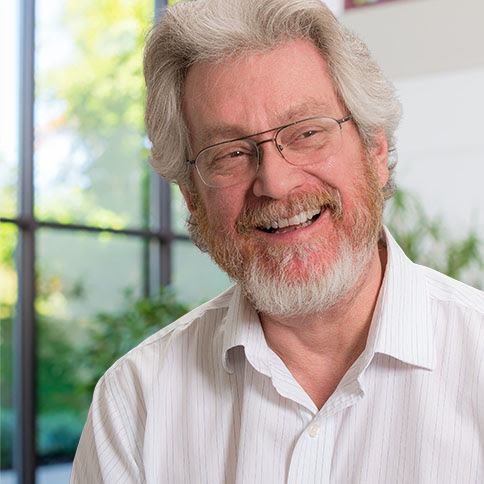
Professor Alex Sandy Pentland, Director of Connection Science, MIT, and Member of Boston Global Forum’s Board of Thinkers, will speak about the Social Contract 2020 at the World Leadership Alliance-Club de Madrid Conference on October 21, 2019 in Madrid, Spain. He said:
“Social Contract 2020: Data has joined labor and capital as the raw material of prosperity, and so data must also become an integral part of the social contract; to this end I propose a strategy for incorporating both data ownership rights and data governance into our civic systems.”
At the conference, one of topics is “Data Economies and the Future of the Social Contract”. The World Leadership Alliance–Club de Madrid, the largest forum of democratic former Head of States, expects to bring two to three initiatives for concrete action to be taken forward as projects. The Social Contract 2020 will be one of three initiatives of the conference.
The Policy Dialogue on AI and democracy seeks to move the conversation on AI beyond tech and into the democratic governance arena. By bringing together experienced politicians, tech companies, academic researchers, and civil society representatives, it seeks to promote ‘multi-stakeholderism’ in the articulation of informed policy proposals that can effectively turn the design, development and deployment of AI into a driver for democratic innovation and renewal at a time when wide-spread dissatisfaction with the present system and uncertainty about the future are seriously affecting public trust.

by Editor | Aug 25, 2019 | News
Governor Michael Dukakis, co-founder and chairman of the Boston Global Forum, co-founder of the Social Contract 2020, will moderate the AI World Society Conference, with the theme “A Proposed Social Contract 2020, Regarding Rules and International Laws for AI and Internet.”
Professor Alex ‘Sandy’ Pentland, who directs the MIT Connection Science and Human Dynamics labs, co-founder of the Social Contract 2020, noted as one of the “7 most powerful data scientists in the world” alongside the founders of Google and the Chief Technical Officer of the United States, will be the keynote speaker. He will present the concepts of the Social Contract 2020. Dr. Paul Nemitz, Principal Adviser, Directorate General for Justice and Consumers, the European Commission, a member of AI World Society Standards and Practice Committee, will present the Rules and International Laws of AI World Society. Professor Christo Wilson, Harvard Law School Fellow, and Michael Dukakis Leadership Fellow, will present Solutions for AI Transparency.
Other leading global thinkers and leaders will join and discuss at the conference, which will be take place at Harvard University Faculty Club on September 23, 2019.
The extent to which governments and corporations succeed in amassing and using relevant data –the means of production of AI– is set to alter the global economy and the balance of power between states, markets and civil society. The rise of AI is reshaping the geopolitical and societal orders in ways researchers are only beginning to examine.
The use of AI may pose a challenge to democracy, but, if handled correctly, it can also bring more and better democracy. Democratic governments simply cannot afford to lag behind; they must govern the digital game before it governs us all. “The digital is political” and therefore requires a political response: How can we anticipate the fast-changing world of AI and reap the benefits while countering the risks it poses to democracies?
Discussions and matters from this conference will be introduced at the World Leadership Alliance-Club de Madrid Conference in Madrid, October 2019.
by Editor | Aug 11, 2019 | News
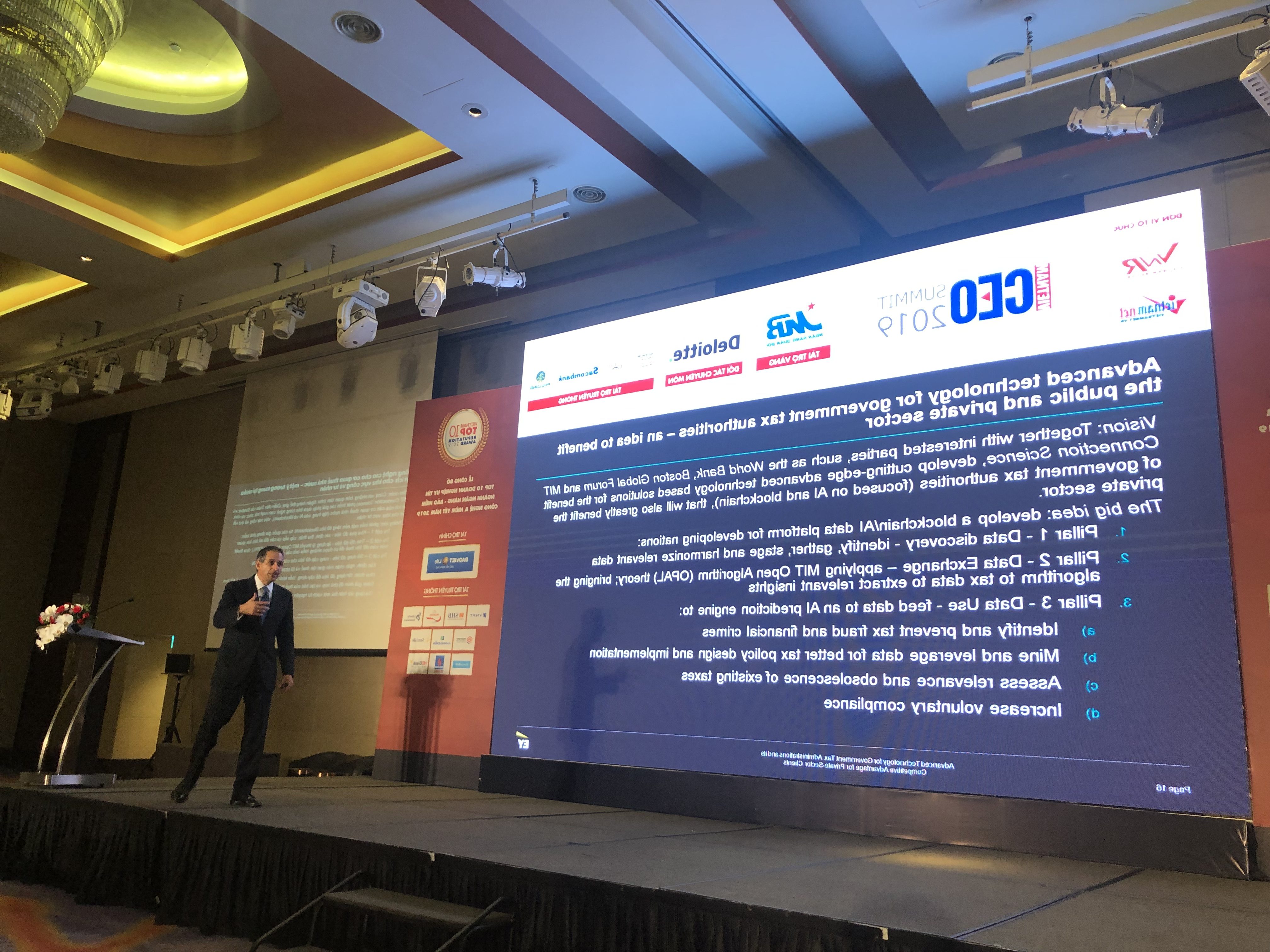
Speaking at the Vietnam CEO Summit 2019, titled “Leading Strategy in Digital Transformation and Opportunities for Vietnamese Businesses”, Mr. Jeffrey Saviano, EY Global Tax Innovation Leader and MIT Connection Science Fellow said that Artificial Intelligence (AI) and Blockchain are very important to build a global tax system.
Value-added from Blockchain-based business operation will increase to about USD 176 billion by 2025 and will then skyrocket to USD 3.1 trillion by 2030. However, only 4% of CIOs are actively using AI within their own organization currently. Meanwhile 42% of CIOs are deploying AI development projects.
Mr. Saviano also quoted the report from McKinsey & Company and Gartner, which state that the technology giant such as Baidu and Google have paid USD 20 billion to 30 billion for AI in 2016. By 2021, 40% of new business applications will be equipped with AI technologies. From now to 2030, AI will generate 13 trillion USD of GDP growth (equivalent to 1.2% per year).
US-based companies have made 66% of all investments in AI in 2016. China ranks second with 17%, but is growing very fast. Global business value derived from AI is expected to reach USD 1.2 trillion in 2018 and USD 3.9 trillion in 2022. Cash flow can be reduced by 20% compared to the current if AI technologies are not applied.
Also according to Mr. Saviano, in this year, they built a model of Global Tax System, a kernel of the AI-Government. This will be a pioneering initiative in applying advanced technologies to the most pressing tax issues in the world. Tax digitization trend and shifting focus from tax returns to tax payment by data will become clear. This tax digitization procedure model will extract data directly from source systems and send such data directly to the government. Moreover, the cycle time of this model can be shortened from 3 years to 90 days.
With AI and Blockchain applications, businesses will be able not to declare tax as the usual process. Instead, businesses will take their own data to calculate tax with assistance of AI and then submit directly to the government; the tax authorities only consider whether the enterprise paying such taxes is appropriate. When tax administration will be digitalized at a deeper level, the government must also make it possible to facilitate their own institutions.
Advanced technology capabilities for tax in the coming time will include Document Intelligence (DI), Structured Machine Learning (ML), and Blockchain for supply chain. With AI solutions, time on task has been reduced by 50-70%, accuracy is greatly improved, tax professionals’ satisfaction is much higher and key tax data can be extracted in hours rather than days.
Tax policies and tax management are important to every government. Tax solutions with advanced technologies and the explosion of Blockchain technology with specific applications into business operations have attracted the attention of businesses at the CEO Summit. Most businesses are wondering about which scope to apply Blockchain, how to create value, where to start, and how to do it.
Together with interested parties, such as the World Bank, Boston Global Forum & Michael Dukakis Institute for Leadership and Innovation and MIT Connection Science develop cutting-edge advanced technology based solutions for the benefit of government tax authorities (focused on AI and Blockchain) that will also greatly benefit the private sector. It will open a potential application trend for many areas such as banking and finance, retail, transporting goods, manufacturing, telecommunications, etc. With prioritised policies focusing on developing IT to a key sector, Vietnam is expected to be where Blockchain technology has many good conditions for development. This is also considered as an opportunity for start-up businesses and individuals to apply this new to be able to reach out to the region and the world.
by Editor | Aug 11, 2019 | News
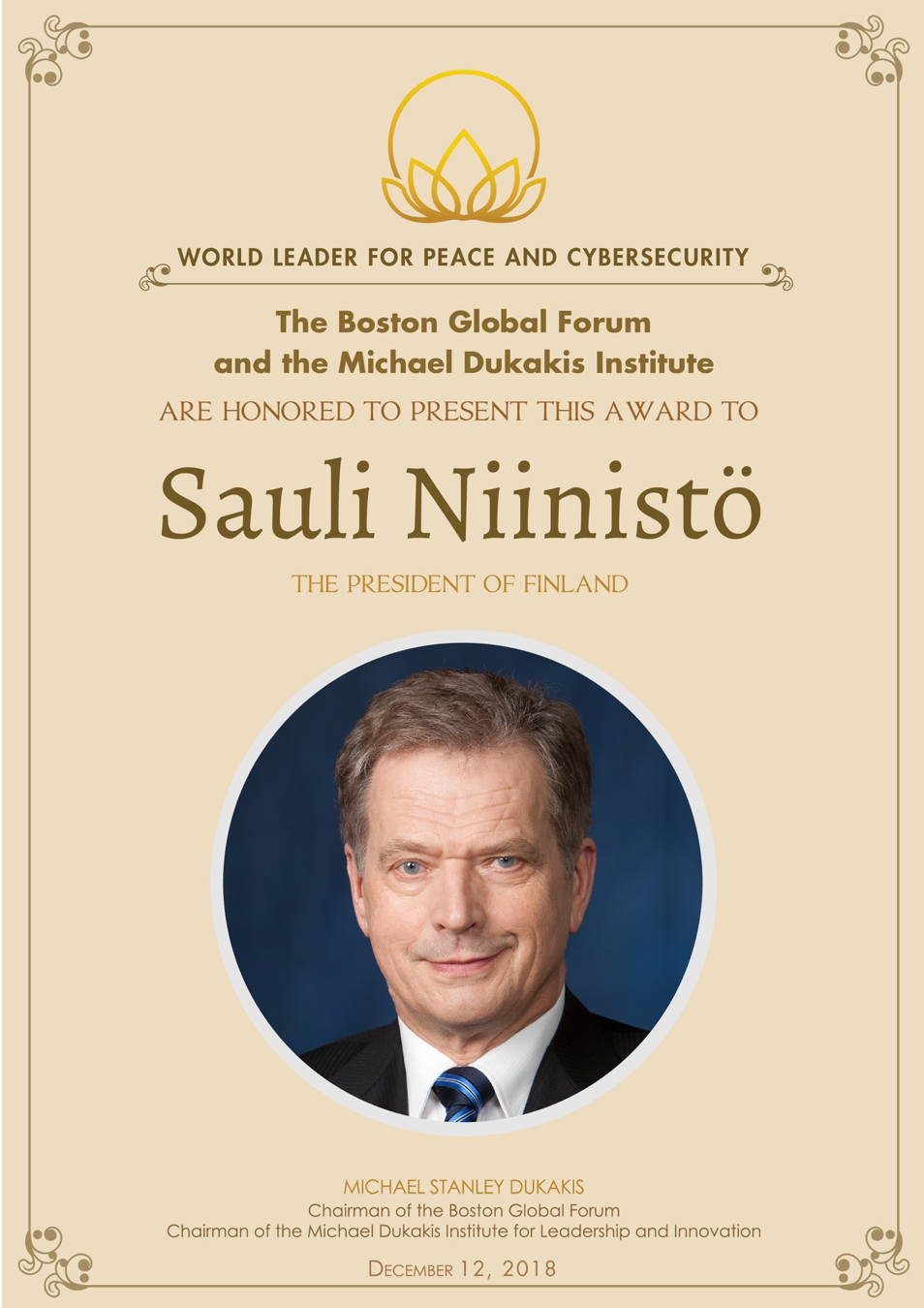
President of the Republic of Finland Sauli Niinistö, who was honored with the World Leader for Peace and Cybersecurity Award presented by the Boston Global Forum on Global Cybersecurity Day December 12, 2018 at Loeb House, Harvard University, and Federal President of Germany Frank-Walter Steinmeier opened the 2019 Kultaranta Talks by discussing the change and future of Europe. In his opening remarks, President Niinistö challenged the audience to think what Europe has in common.
Organised for the seventh time now, the Kultaranta Talks have an interesting timing, said both Presidents in the opening discussion on 16 June. Finland has a new government, and Europeans have new representatives in Brussels. Moreover, Finland is getting ready for the EU Presidency. “This is a good moment to reflect on Europe’s challenges and the major tasks facing our continent and our Union,” President Steinmeier said.
The Presidents agreed that the EU will have many challenges to rise to. “The world’s political and economic centre of gravity is moving away from Europe. Europe has to reassess some of its own fundamental assumptions and to rethink its relations with the world’s major powers,” President Steinmeier said.
“The vision for the future is not very clear. It would be a surprise if we didn’t get any surprises in near future. Those are very difficult to predict, and that’s a demanding task for the European Union. The most central question is, whether we still have something in common. We should remind ourselves why we are together,” President Niinistö said.
Facing financial influence
In his speech, President Steinmeier mentioned superpowers and China, saying that while China is becoming closer to Europe, it is getting politically more distant. “How do we want this relationship to develop within the dynamics between the US, China, Russia, and Europe? Are we able to maintain our cohesion as the European Union?”
President Niinistö continued the thought by also analysing the financial influence of China from the point of view of the rules-based international system. He said that countries can be seduced by economic elements to forget the rules-based order. “Maintaining the cohesion will not be an easy task for the EU.”
From disintegration to cohesion
In their discussion, the Presidents also mentioned Brexit and the dividing lines it has created in Europe. President Steinmeier believed that the Europeans would be ready to learn the lesson from the Brexit. “If not the Europeans, who else would fight for the European cohesion?”
President Niinistö said that he is happy to see that the discussion on security and defence issues in the EU has started. “What kind of a union is a union which is based on outside help?”
While the Presidents discussed the challenges of European cooperation at length, they both agreed that there is no reason to be overly pessimistic. “It is our duty as presidents to be optimistic,” President Steinmeier said. President Niinistö agreed: “More and more political leaders are going back to the roots and understand that we do have a lot in common. And what we have in common, is becoming increasingly more important. When we recognise the common nominators, it will be easier to settle arguments.”
The original article can be found here.

by Editor | Aug 11, 2019 | News
Artificial Intelligence (AI) will bring many wonders. It may also destabilize everything from nuclear détente to human friendships. We need to think much harder about how to adapt.
Humanity is at the edge of a revolution driven by artificial intelligence. It has the potential to be one of the most significant and far-reaching revolutions in history, yet it has developed out of disparate efforts to solve specific practical problems rather than a comprehensive plan. Ironically, the ultimate effect of this case-by-case problem solving may be the transformation of human reasoning and decision making.
This revolution is unstoppable. Attempts to halt it would cede the future to that element of humanity more courageous in facing the implications of its own inventiveness. Instead, we should accept that AI is bound to become increasingly sophisticated and ubiquitous, and ask ourselves: How will its evolution affect human perception, cognition, and interaction? What will be its impact on our culture and, in the end, our history?
The full article can be found here.
To recognize the AI impact to humanity, the Michael Dukakis Institute for Leadership and Innovation (MDI) established the Artificial Intelligence World Society (AIWS) for the purpose of promoting ethical norms and practices in the development and use of AI. AI can be an important tool to serve and strengthen democracy, human rights, and the rule of law for solving important issues, such as SDGs.