The China question: Beijing supports banning the use of these weapons, but not their development or production. The U.S. and NATO have argued that they need to keep autonomous lethal weapons in their arsenals as deterrence and defense against “malign” actors — all very reminiscent of the Cold War and nuclear politics.
Van Weel, the assistant secretary-general, said: “China has a seamless flow of these new technologies from the private sector into the defense realm. I’m … not sure that they’re having the same debates on principles of responsible use or they’re definitely not applying our democratic values to these technologies.”
Coyle doesn’t trust Beijing either, calling it an “insincere partner in many of their multilateral agreements.”
The article was original published at Politico EU.
The Boston Global Forum and World Leadership Alliance-Club de Madrid are collaborating in building the Framework for AI International Accord (AIIA) and AIIA Policy Lab, which will be organized on June 22-24, 2021.
On May 6, 2021, Mr. Anders Hjorth Agerskov, Lead Public Sector Specialist at the World Bank Group, presented “Future of Taxation” at the United Nations Centennial Roundtable:
Tax administrations will become “invisible” – as data is captured seamlessly in real time
Data transfer from accounting systems will be automated through an Application Programming Interface and tax information will increasingly be embedded in blockchain enabled smart contracts, requiring no or minimal human intervention.
AI driven robotic decision-making will increase – but risks need to be managed!
Decisions within the tax administration are being automated. Such efforts will initially be based on Robotic Process Automation and later on more advanced algorithmic decision-making made possible by robust and federated Artificial Intelligence solutions and expert systems incorporating tax and case law.
Data and digital solutions will allow for a new generation of taxpayer services and experiences These may include prefilled tax returns, taxpayers’ access to their own filing information, taxpayers’ sharing of data with banks to expedite credit approvals, and privacy preserving queries on the tax file by researchers and local communities. The touchpoints will be personalized rather than developed solely from the perspective of the tax administration’s internal procedures. The focus will be on promoting user adoption and building trust.
Tax administrations’ mandate will expand – they could become governments’ data warehouse That means providing economic data for monitoring the economy; verifying compliance under social, (COVID-19 related) stimulus, and other programs; supporting the modelling of economic policy across agencies; and promoting transparency.
Ecosystem and stakeholder management will come to the fore
This is due to the increasing importance of collaboration with tech firms and tax advisers to build interfaces to the taxation system and through a shift in the deployment of resources from operations to systems design and maintenance.
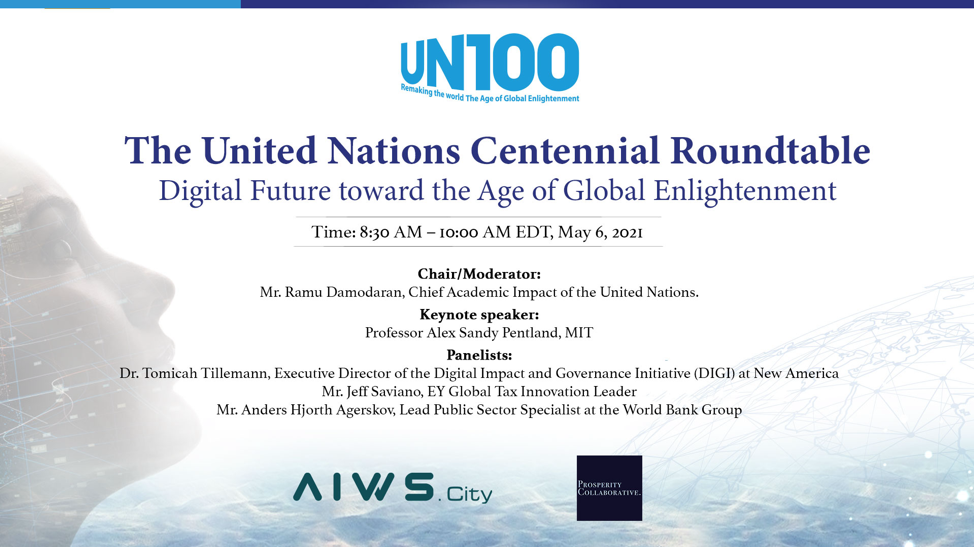
The United Nations Centennial Roundtable was hosted by AIWS Innovations at AIWS City on May 8, 2021.
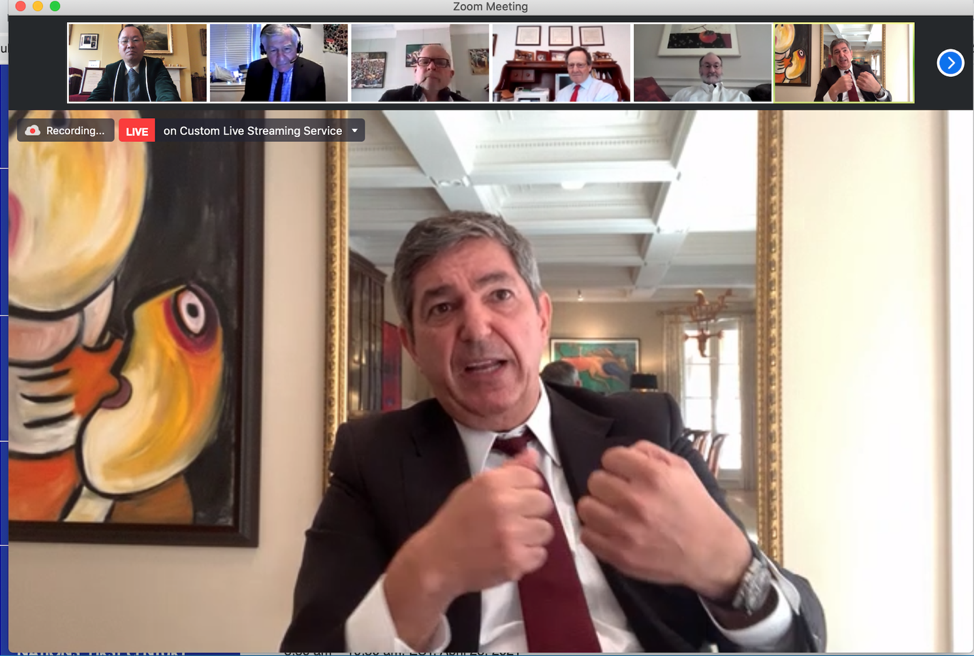
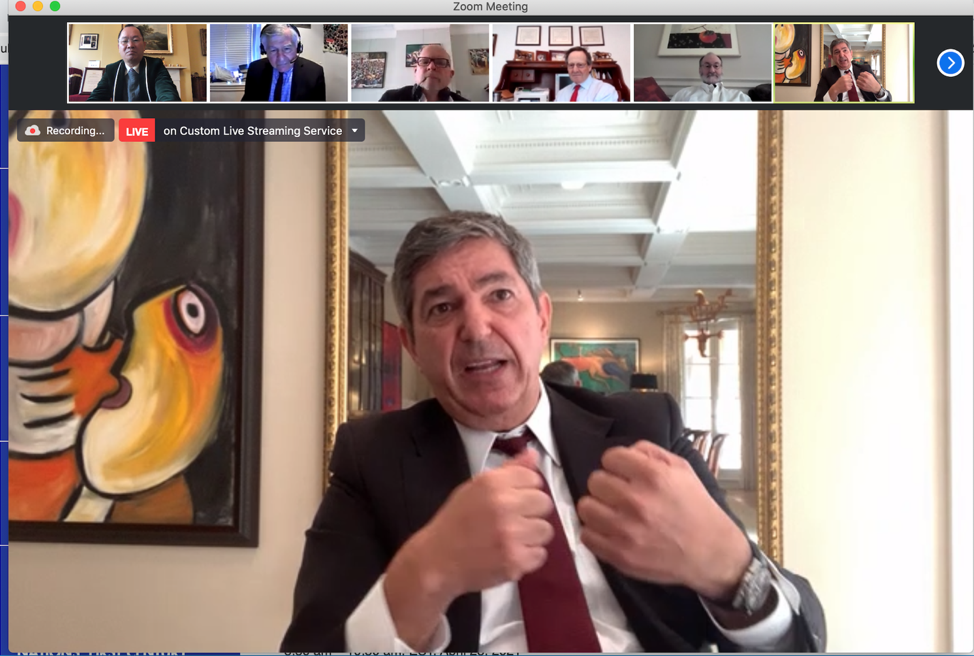
We introduce part of the acceptance speech by the European Union Ambassador to the US Lambrinidis for the World Leader in AI World Society Award on April 28:
In Europe, we believe that there is a clear interrelation between Innovation and Fundamental Rights – that one can promote the other.
We value, champion, and thrive from innovation. Last year, as the deadly COVID-19 pandemic spread rapidly across the globe, AI demonstrated its potential to aid humanity by helping to predict the geographical spread of the disease, diagnose the infection through computed tomography scans, and develop the first vaccines and drugs against the virus.
European companies and innovators have been at the forefront in every aspect of that effort. The winner of last year’s Future Unicorn Award, presented annually by the European Union to start-ups with the greatest potential, was awarded to a Danish company, Corti, which uses AI and voice recognition to help doctors predict heart attacks.
Clearly, the possibilities and opportunities for AI are immense – from turning on wind turbines to produce the clean energy for our green transition, to detecting cyber-attacks faster than any human being, or cancer in mammograms earlier and more reliably than trained doctors. We hope that AI will even help us to detect the next infectious outbreak, before it becomes a deadly pandemic.
We want AI to do all of these great things.
At the same time, just as in every technological evolution that has come before it, we must prepare for the unexpected. With the increasing adoption of AI, our rights to privacy, dignity, freedom, equality, and justice are all at stake. These are fundamental to our lives as Europeans, and enshrined in the European Charter of Fundamental Rights.
If it is our aspiration to create machines that are able to do more and more of our thinking, selections and decision-making, we must also take care to ensure they do not make the same mistakes that we humans have been prone to make. Let me offer two examples to illustrate the point:
First – the use of facial, voice, and movement recognition systems in public places can help make our lives more secure. However, it can also allow governments to engage in mass surveillance, intimidation, and repression, as China has shown, in the most cynical and calculated way, in Xingiang.
Second – the use of AI in recruitment decisions can be helpful. However, if a computer compares resumes of senior managers and concludes that being male is a good predictor of success, the data simply reflects bias – a bias within our society, which historically has favored men for leadership positions. We do not want AI to reinforce existing biases by copying and infinitely replicating them.
These are just two examples that illustrate why we must not become bystanders to the development and deployment of AI. If we, the major world democracies, do not move to establish a regulatory framework, if we do not move fast, smart and strategically to build alliances and set standards for human-centric, trustworthy, and human rights-respecting AI with countries big and small from all over the world, I dread to think who might.
At the AI International Accord Roundtable April 28, 2021, Mr. Magnus Magnusson, Director for Partnerships and Outreach, UNESCO, presented “Bring Goodness and AI Ethics to AI International Accord, and view from UNESCO”. He raised “Diversity must be integrated in every single step of the AI lifecycle; from creation of algorithms to the collection of data, down to the numerous applications of AI in every aspect in today’s society: healthcare, education, transportation and so forth. This is the only way to ensure all voices will contribute to the development towards policies and frameworks for AI”.
The plethora of government tax, fiscal, and trade digital transformation initiatives are each occurring within a single country domain. A preliminary analysis of this growing digital transformation demand reveals multi-country interest in key tax, fiscal, and trade technology initiatives, including digital identification, multi-party data sharing, e-invoicing, distributed systems (e.g., blockchain) applied to global trade, and artificial intelligence / data systems to improve governmental decision-making. Absent intervention, these initiatives will continue as single-country initiatives, duplicative technology solutions will be developed, and intergovernmental technology interoperability will be sub-optimized.
Our idea is for The Prosperity Collaborative to lead an effort to convert certain aspects of this global digital demand to DPGs immediately available to multiple jurisdictions, playing a key leadership role in advancing DPGs for tax, fiscal, and trade systems within governments, as a practical solution for the Concept of AI-Government, conceived by Boston Global Forum and Michael Dukakis Institute. Our Collaborative builds and leads a multi-stakeholder consortium focused on developing and advancing DPGs in this important space. We could call this new organization the Digital Tax and Trade Consortium (DTTC). This new multi-stakeholder DTTC would be comprised of multilaterals, anchored by The World Bank, and ideally including the UN, OECD, ADB, etc.; fintech providers, World Economic Forum, technologists (principally, Microsoft), philanthropists, and leading policymakers.
Chair/Moderator: Mr. Ramu Damodaran, Chief Academic Impact of the United Nations. Keynote speaker: Professor Alex Sandy Pentland, MIT
Panelists:
Dr. Tomicah Tillemann, Executive Director of the Digital Impact and Governance Initiative (DIGI) at New America
Mr. Jeff Saviano, EY Global Tax Innovation Leader
Mr. Anders Hjorth Agerskov, Lead Public Sector Specialist at the World Bank Group