
by Editor BGF | Mar 16, 2026 | World Leader for Peace and Security, News, World Leaders in AIWS Award Updates
On March 11, 2026, Japanese Prime Minister Sanae Takaichi, recipient of the 2023 World Leader in AIWS Award from the Boston Global Forum, joined a G7 Leaders’ Online Meeting held under the chairmanship of France, this year’s G7 Presidency, to discuss the escalating situation in the Middle East and its impact on the global economy, financial markets, and energy security. Japan’s Ministry of Foreign Affairs said the meeting took place on the night of March 11 (JST) and lasted about one hour.
According to Japan’s Foreign Ministry, G7 leaders discussed the effects of the crisis on the world economy, financial and energy markets, as well as safe maritime transportation, including in the Strait of Hormuz, and cooperation in protecting their nationals in the region. Prime Minister Takaichi stressed that Iran must never be allowed to develop nuclear weapons, condemned attacks on civilian and energy-related facilities in Gulf countries, and urged Iran to stop actions threatening navigation safety.
Prime Minister Takaichi also warned that growing disruption in the Strait of Hormuz could drive up energy prices and have wider global economic consequences. She welcomed the decision by IEA member countries to implement a collective crude oil release and noted that Japan had announced its own release the same day. The meeting concluded with G7 leaders agreeing to continue close cooperation. (Ministry of Foreign Affairs Japan)
by Editor BGF | Mar 16, 2026 | News, Shaping Futures
In the Age of Artificial Intelligence, the future will not be shaped only by the power of technology, but by the degree to which people, institutions, and nations can trust it.
That is why AIWS Trust Architecture matters. It offers a new way of thinking about AI governance: not as a narrow issue of regulation or ethics alone, but as a full architecture of standards, infrastructure, measurement, and trusted cooperation.
AIWS Trust Architecture can shape the future in several important ways.
First, it can help build trustworthy AI systems. By advancing AIWS Trust Standards, it creates practical expectations for safety, transparency, accountability, resilience, and human dignity. This means AI can be governed not only by ambition, but by responsibility.
Second, it can help build trusted institutions. Through AIWS Trust Infrastructure, trust becomes something operational — supported by monitoring, redress, emergency response, civic safeguards, and continuous learning. In this way, AIWS helps institutions become more credible, more resilient, and more worthy of public confidence.
Third, it can help shape trusted public life. In an era of deepfakes, synthetic media, and information disorder, AIWS Trust Architecture recognizes that democracy cannot survive without trust in information. Its emphasis on trusted civic information, provenance, and deepfake defense makes it highly relevant to the future of democratic resilience.
Fourth, it can help shape trusted international cooperation. Through the idea of the AIWS Trusted Order, the framework points toward a world in which trust is not only domestic, but also international — linking systems, institutions, and partners through shared standards and mutual confidence.
Finally, AIWS Trust Architecture can shape the future because it understands that trust is not only technical. It is also human, cultural, educational, and civilizational. A trustworthy future depends not only on stronger systems, but on stronger memory, stronger knowledge, stronger institutions, and stronger moral imagination.
In that sense, AIWS Trust Architecture is more than a governance framework. It is an effort to help shape the trust architecture of the future.
In the AI Age, those who shape trust will help shape the world.
Please download the AIWS Trust Architecture White Paper here
by Editor BGF | Mar 16, 2026 | News
The AIWS Trust Architecture White Paper is released today. This is not the destination. It is the first step of a journey that will determine whether the AI Age is governed — or merely endured.
History is not made in a single moment. It is made when a single moment sets in motion something that cannot be stopped.
Today, March 15, 2026, the Boston Global Forum and AI World Society release the AIWS Trust Architecture White Paper — the first governance framework to integrate standards, measurement, enforcement, and trusted international cooperation for artificial intelligence into a single coherent architecture. It is the most comprehensive answer yet given to the question that the AI Age demands an answer to: how do we make AI trustworthy, not just powerful?
In the AI Age, trust cannot remain a slogan. It must become standards, infrastructure, measurement, and order.
The White Paper is not the history. The history will be written by what happens next.
It will be written when the first ATR pilot runs in Hanoi in 2026 and independent reviewers confirm that trust can be measured reliably across organizations that did not ask to be measured. It will be written when Japan and Vietnam stand together at APEC 2027 in Phú Quốc and present the first nationally validated AI trust indices to 21 Pacific economies. It will be written when the AIWS Trusted Order has its founding partners, when the first Trust Passport crosses a border, when the first government cites AIWS Information Trust Standards in national legislation, when the first academic paper asks whether a country’s ATX-N score predicts the quality of its democratic institutions.
None of that has happened yet. All of it is possible.
The AI Age will be remembered for what it built. The governance of that age — who shaped it, who was included in it, whether it was worthy of democratic societies — that story is still being written. It begins today, in a White Paper released forty-seven days before its formal presentation at Harvard Loeb House on May 1, 2026, America’s 250th anniversary.
The journey to make history has begun.
Please download the AIWS Trust Architecture White Paper here

by Editor BGF | Mar 16, 2026 | Global Alliance for Digital Governance
AIWS Trust Architecture is pioneering not because it introduces trust as a new concern, but because it integrates into one architecture functions that most leading frameworks address only partially or separately. Its distinctiveness lies in turning trust into a governable chain that connects standards, infrastructure, measurement, civic resilience, human dignity, cultural continuity, and trusted international cooperation.
Key pioneering features include:
- Among the first frameworks to link system-level AI trust scores (ATR), national cooperation metrics (ATX-N), and international standing through the AIWS Trusted Order in a single governance chain
- Distinctive in requiring hallucination rate as a mandatory, independently verified trust metric
- Pioneering in defining Human-in-Command, including categories of decisions that AI should never make regardless of capability
- Among the first frameworks to treat civic information trust — including deepfake defense, provenance, and trusted public communication — as an independently weighted pillar of governance
- Among the first AI governance frameworks to propose an AIWS Trust Emergency Protocol for rapid democratic response to information attacks and trust failures
- Distinctive in providing a structured pathway for emerging economies to enter a trusted AI order
- Distinctive in introducing an AIWS Trust Passport as a portable trust credential for systems, institutions, and trusted cooperation
- Distinctive in establishing an AIWS Trust Ledger as a traceable institutional memory of certification, incidents, corrections, and renewal
- Pioneering in advancing an AIWS Civic Trust Safeguard Layer to protect trusted civic information, democratic legitimacy, and the epistemic commons
- Pioneering in creating an AIWS Historical Memory, Education, and Knowledge Trust Layer to safeguard educational integrity, historical continuity, and responsible knowledge stewardship
- Distinctive in proposing an AIWS Trust Dividend and Incentive Layer so that trust improvement becomes a rewarded capability rather than only a compliance burden
- Pioneering in adding an AIWS Culture and Humanity Layer that recognizes trust in the AI Age as not only technical and institutional, but also cultural, moral, and civilizational
Taken together, these features make AIWS Trust Architecture more than a framework of principles. They position it as a practical architecture for making trust in AI measurable, actionable, publicly visible, culturally grounded, and internationally scalable.
“What makes AIWS Trust Architecture pioneering is that it treats trust not only as a principle, but as a full architecture of standards, infrastructure, measurement, civic protection, historical memory, cultural humanity, and trusted order.” Said Nguyen Anh Tuan, Co-Chair and CEO of BGF, at the launch of the AIWS Trust Architecture White Paper.
Please download the AIWS Trust Architecture White Paper here
by Editor BGF | Mar 15, 2026 | Papers & Reports
The AI Age is transforming not only technology, but the foundations of governance, legitimacy, and social trust. Artificial intelligence is increasingly embedded in healthcare, education, finance, government, civic information, public communication, and national security. As AI becomes infrastructure for all infrastructure, the central challenge of governance is no longer simply how to accelerate innovation, but how to make AI trustworthy, accountable, beneficial, and worthy of public confidence.
This white paper proposes a democratic trust architecture for the AI Age built on three connected layers:
• AIWS Trust Standards
• AIWS Trust Infrastructure
• AIWS Trusted Order
Access the full white paper or read the introduction:
Full White Paper: [Download here]
Introduction: [Read here]
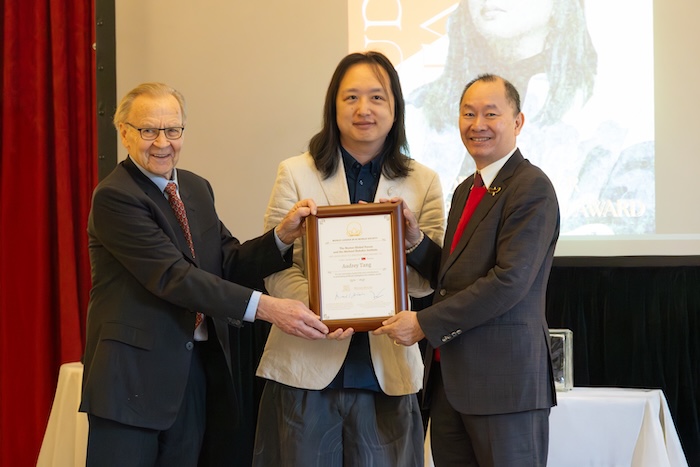
by Editor BGF | Mar 15, 2026 | News
Yasuhide Nakayama
March 15, 2026
- Institutional Standing — A Rare Vietnamese Presence at the Most Distinguished Tables
Nguyen Anh Tuan is one of the rare Vietnamese figures in contemporary history to have earned recognition across three major spheres of influence at once: the American academic establishment, the international multilateral system, and the Vietnamese political system. Few people in the world achieve that — and fewer still do so by building from scratch, without the backing of a powerful family name or the early support of a major institution.
Today, he serves as Co-Founder, Co-Chair, and CEO of the Boston Global Forum; as a Distinguished Member of the Steering Committee of the Wilson Center’s Institute for Strategic Competition, the bipartisan think tank established by the United States Congress; and as co-founder of the Indo-Pacific Spark Initiative alongside Mark Kennedy and the Wilson Center. His footprint extends across the G7 Summits of 2018–2019, multiple engagements with the United Nations, the G20 Summit in India in 2023, the White House Office of Science and Technology in 2024, the AI Action Summit in Paris with President Emmanuel Macron in February 2025, and the America at 250 Conference at Harvard’s Loeb House on May 1, 2026.
Few people in the world earn recognition across three major spheres of influence at once — and fewer still do so by building entirely from scratch.
- The Journey: From Nha Trang to Harvard’s Loeb House
Laying the Foundation — 1990 to 2011
His journey began with two pioneering achievements: founding VietNet, Vietnam’s first TCP/IP-based Internet service provider, and founding VietNamNet in 1997, Vietnam’s first online newspaper. From that starting point, he followed a path few Vietnamese had walked before.
In 1996, at the age of 34, he was honored by the Vietnamese Government as one of the country’s Ten Most Outstanding Young Faces of the Year for his achievement in founding VietNet. This was not recognition for ideas alone; it was recognition for a real infrastructure project, built at a time when Vietnam had barely begun to imagine digital connectivity. From VietNet, he went on to establish VietNamNet in 1997 and served as its Editor-in-Chief until 2011.
Nearly fifteen years shaping Vietnam’s digital media landscape gave him more than experience. It gave him a distinctive understanding of the relationship between information, power, and society — an understanding he would later bring to the architecture of AI governance.
Building a Foundation in America — 2007 to 2012
In 2007, he arrived at Harvard as a Shorenstein Fellow at the Kennedy School, researching trends in the development of electronic media. This was a turning point. From 2008 to 2016, he served on the Harvard Business School Global Advisory Board. He also chaired the International Advisory Committee of the UNESCO–UCLA Chair on Global Citizenship Education. These were not merely honorary affiliations; they were working roles within the American intellectual and policy ecosystem, built through years of sustained engagement.
The Boston Global Forum and the Building of Global Architectures — Since December 12, 2012
On December 12, 2012, together with Governor Michael Dukakis — three-term Governor of Massachusetts and the Democratic Party’s 1988 nominee for President of the United States — and Harvard Professors Thomas Patterson and John Quelch, he co-founded the Boston Global Forum.
Beginning in 2015, he established the World Leader for Peace and Security Award, an annual honor recognizing Presidents, Prime Ministers, and spiritual leaders for outstanding contributions to global peace. He also founded the World Leader in AI World Society Award, which recognizes pioneers working to build a human-centered AI society. Over more than a decade, these awards have become mechanisms for convening a global community of leaders around the vision of BGF and AIWS.
In 2017, at Governor Dukakis’s own home in Brookline, Massachusetts, the two men laid the foundations of the AI World Society — a political, economic, and social model for ethical, human-centered AI governance. Nguyen Anh Tuan became its chief intellectual architect, developing frameworks that range from the Social Contract for the AI Age in 2020 to AIWS Government 24/7, a model for transparent, accountable, and continuously available democratic governance in the digital era.
In July 2022, immediately following the assassination of Japanese Prime Minister Shinzo Abe, he founded the Shinzo Abe Initiative for Peace and Security — carrying forward the legacy of a leader who had himself received BGF’s World Leader for Peace and Security Award, while also deepening the strategic relationship between BGF and Japan.
VTV Person of the Year 2018 — At Harvard
In 2018, Vietnam’s national broadcaster VTV named him Person of the Year for the AI World Society initiative, and the award ceremony was held at Harvard University in January 2019.
This event carried deep symbolic significance. For the first time in history, VTV held its Person of the Year ceremony not in Vietnam, but at one of the world’s most prestigious universities — where the honoree was building global influence. It was not merely recognition of an individual. It was a declaration that Vietnam had produced someone sitting at some of the most important tables of the AI Age.
For the first time in history, VTV held its Person of the Year ceremony not in Vietnam, but at one of the world’s most prestigious universities — where the honoree was building global influence.
AI Strategy Roundtable with General Secretary Tô Lâm — London, October 28, 2025
On October 28, 2025, at the historic Raffles Hotel London, Nguyen Anh Tuan served as co-organizer and chief moderator of an event that very few Vietnamese have ever occupied: a High-Level AI Strategy Roundtable bringing together General Secretary Tô Lâm and the senior leadership of Vietnam — including Politburo members, the First Deputy Prime Minister, and the Ministers of Defense, Public Security, Foreign Affairs, Finance, Science and Technology, and Education, as well as the Governor of the State Bank of Vietnam — alongside world-renowned strategists and experts in AI, digital governance, and semiconductor technology.
This was not an ordinary academic conference. It was a strategic consultation at the highest level of the Vietnamese state, convened through the Boston Global Forum’s international network of thinkers and experts — including Professor Alex Pentland (MIT), Professor Thomas Patterson (Harvard), Mark Kennedy (Wilson Center / former U.S. Congressman), Liam Maxwell (AWS; former UK Government Chief Technology Officer), Tantum Collins (former Director for Technology and National Security at the White House), Glen Weyl (Microsoft Research), Lord Francis Maude (former UK Minister for Government Reform), Lord Liam Booth-Smith (Anthropic; former Chief of Staff to Prime Minister Rishi Sunak), Andrew Trask (DeepMind / OpenMined), and many other distinguished experts.
At the event, he presented three comprehensive strategic programs that BGF proposed in support of Vietnam’s AI development:
- AIWS Government 24/7 — a model of continuous, transparent, and trusted AI-powered governance
- The Center for Digital Assets with AIWS Digital Asset Standards (AIWS-DASI) — the world’s first ethical certification system for digital assets
- The AIWS Film Park — a cultural and technological innovation platform combining AI with Vietnamese heritage, positioning places such as Nha Trang, Hạ Long–Yên Tử, and Hội An as global destinations for AI-enhanced creative industries
His dual role in London — as both co-architect of the strategic content and chief moderator of the dialogue between Vietnam’s top leadership and the international community of strategists — stands as one of the clearest demonstrations of his unusual position: a rare figure trusted by both sides, with the standing to bridge both systems and the intellectual architecture to turn high-level dialogue into an actionable strategic roadmap.
A rare figure trusted by both sides, with the standing to bridge both systems and the intellectual architecture to turn high-level dialogue into an actionable strategic roadmap.
- Intellectual Creation — What Sets Him Apart from Mere Connectors
What most distinguishes Nguyen Anh Tuan is not simply the breadth of his network, but the fact that he produces original intellectual frameworks that the American and international systems take seriously.
In January 2025, he received the UNGSII Award at Davos — the World Economic Forum — in recognition of his outstanding contributions to advancing the United Nations Sustainable Development Goals.
In November 2025, CTO Magazine published an in-depth interview titled “Building a Responsible Digital Future: Nguyen Anh Tuan on AI Ethics, Innovation, and Global Leadership.” The interview described him as a figure working to build a responsible digital future and challenging today’s leaders to think beyond efficiency and disruption in order to create technology that uplifts societies, preserves truth, and sustains human values in an increasingly algorithmic world. That a publication devoted to the world’s foremost technology leaders would feature a Vietnamese thinker not for a product launch or a funding round, but for a philosophy of governance, speaks to the reach his ideas have achieved.
In 2021, he served as Editor of Remaking the World — Toward an Age of Global Enlightenment, published by the United Nations and the Boston Global Forum. The Vietnamese edition, published by Tri Thuc Publishing House, was presented by Vietnam’s National Assembly to every delegate — a formal acknowledgment that the book had become reference material at the highest level of the national legislature.
The true weight of that volume lies not only in its vision, but in the stature of those who chose to contribute to it under his editorship. Contributors included:
- Ursula von der Leyen, President of the European Commission
- Ban Ki-moon, Secretary-General of the United Nations
- Shinzo Abe, Prime Minister of Japan
- Vaira Vīķe-Freiberga, former President of Latvia and Chair of the Club de Madrid
- Vint Cerf, father of the Internet
- Judea Pearl, Turing Award recipient
- Alex Pentland, named one of the world’s most influential data scientists
- Stavros Lambrinidis, Ambassador of the European Union to the United States
When figures of that stature choose to appear together in a single volume, they do not do so out of courtesy alone. They do so because they believe the intellectual framework of the book is worthy of their contribution. And the person who brought them together was a Vietnamese man from Nha Trang.
Together with Professor Thomas Patterson — Bradlee Professor of Government and the Press at Harvard Kennedy School, and author of works ranked among the most influential books on public opinion in the last half-century — he co-authored AI World Society: 30 Years of US–Vietnam Partnership, from Nha Trang to Boston, 1995–2025.
Together with Governor Michael Dukakis, he co-authored America at 250: A Beacon for the AI Age — a visionary book on America’s leadership role in the AI Age, presented at the America at 250 Conference at Harvard’s Loeb House on May 1, 2026.
These two books — one with Harvard’s leading scholar of political communication, the other with a former U.S. presidential nominee — are among the clearest evidence of his standing as a genuine peer among highly influential figures, rather than merely a participant in their orbit.
He is doing what many larger organizations have yet to accomplish: defining conceptual frameworks for AI governance at a moment when the world has not yet reached consensus on the matter. In an intellectual marketplace where every major power is searching for a common language, the person who builds the vocabulary and syntax of that debate is the person with real influence — whether or not he holds formal office.
As VietNamNet observed at the close of 2025, he is a rare figure: one whose roots lie in digital journalism, yet who now leads influential international initiatives on AI governance and ethics. He represents the kind of leadership this historical moment demands — not someone who speaks about AI louder or faster than others, but someone who asks the central question: How will AI make society better, and who will be accountable?
The person who builds the vocabulary and syntax of that debate is the person with real influence — whether or not he holds formal office.
Conclusion
From the pioneer of Vietnam’s Internet in 1996, to the architect of AI World Society in 2017, to the co-architect of the AIWS Trusted Order for the America at 250 Conference in 2026, the journey of Nguyen Anh Tuan follows a remarkably consistent line: standing at the intersection of technology, governance, and human values — and doing so with unusual foresight, often seeing what others have not yet fully recognized.


by Editor BGF | Mar 8, 2026 | News
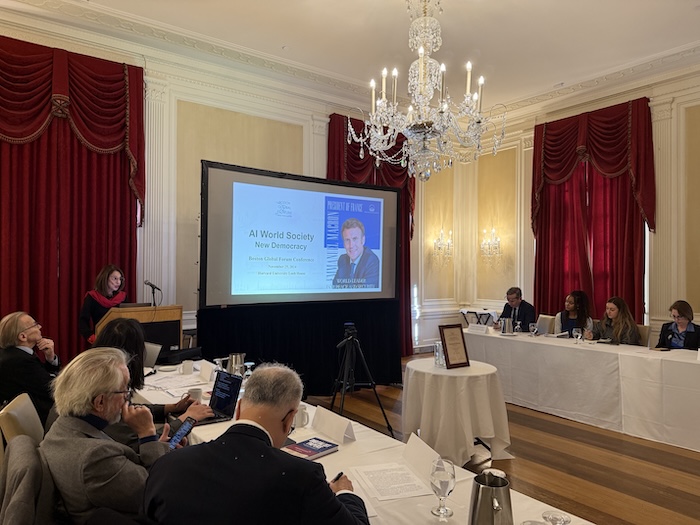
Boston, MA — On May 1, 2026, from 8:15 AM to 12:00 PM, the Boston Global Forum (BGF) and the AI World Society (AIWS) convened the America at 250: A Beacon for the AI Age conference at Harvard University’s Loeb House, marking the 250th anniversary of the United States with a forward-looking celebration of democratic leadership in the age of artificial intelligence.
The conference brought together leaders from government, academia, technology, healthcare, and culture around a central message: in the AI Age, America’s enduring strength is not only national power, but the capacity to design a trusted AI order that the world chooses to join—grounded in freedom, human dignity, accountability, and shared prosperity.
A featured milestone of the program was the introduction of the new book America at 250: A Beacon for the AI Age, co-authored by Governor Michael S. Dukakis and Nguyen Anh Tuan. The book provides the intellectual foundation for the conference and presents the AIWS framework as a practical blueprint for democratic renewal and trustworthy AI governance for the next 250 years.
Honoring a World Leader for Peace and Security
A highlight of the conference was the presentation of the World Leader for Peace and Security Award, part of BGF’s longstanding tradition of recognizing leadership that advances peace, security, and ethical governance. The award ceremony honored the values and ideals that have shaped America’s role in the world.
Announcing the Inaugural “America 250 AI Pioneers”
BGF also announced the creation of America 250 AI Pioneers, a new recognition designed to honor individuals whose breakthroughs and leadership are shaping trustworthy, human-centered AI. The initiative will spotlight achievements that strengthen democratic institutions, expand opportunity, advance healthcare and education, and reinforce public trust.
Advancing the AIWS Agenda: Trust, and Culture
The conference featured three flagship pillars aligned with the AIWS framework:
- AIWS Trust Infrastructure: A leadership session explored how democracies can build trust as infrastructure through standards, accountability mechanisms, and measurable trust tools that support safe adoption at scale.
- AIWS Film Park and Culture: Leaders discussed film and storytelling as democratic infrastructure in the AI Age—recognizing and accelerating America Films for Humanity at 250 as a cultural diplomacy platform that elevates compassion, dignity, and shared human values.
A Declaration for the Next 250 Years
In the closing segment, conference leaders adopted the Boston Declaration on America at 250, affirming commitments to trustworthy AI governance, inclusive prosperity, and cultural leadership for a humane AI Age.
BGF will publish conference highlights and outcomes, including the Boston Declaration and the inaugural America 250 AI Pioneers, as part of its continuing work to advance the AI World Society framework and strengthen democratic leadership in the AI era.
by Editor BGF | Mar 8, 2026 | News
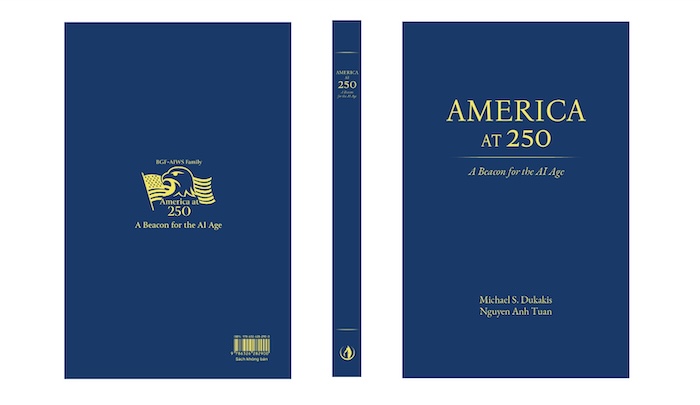
Co-authored by Governor Michael S. Dukakis and Nguyen Anh Tuan, the book presents the most comprehensive governance framework yet produced for America’s role in the AI age — released on the nation’s 250th anniversary.
The Boston Global Forum (BGF) and the AI World Society (AIWS) today announced the publication of America at 250: A Beacon for the AI Age — a landmark volume co-authored by Governor Michael S. Dukakis, Co-Founder and Chair of the Boston Global Forum, and Nguyen Anh Tuan, Co-Founder, Co-Chair, and CEO of the Boston Global Forum and Founder of the AI World Society. The book is published by Tri Thức Publishing and launched at the America at 250 conference at Loeb House, Harvard University, on May 1, 2026.
Written across twenty chapters and more than 112,000 words, America at 250 is at once a celebration of America’s democratic heritage, a rigorous analysis of the AI revolution underway, and a comprehensive governance roadmap for how the United States can lead the world in ensuring that artificial intelligence serves human dignity, democratic values, and the common good. It is, in the authors’ words, “not a history but a vision — an offering to the country we love.”
by Editor BGF | Mar 8, 2026 | Shinzo Abe Initiative for Peace and Security, News
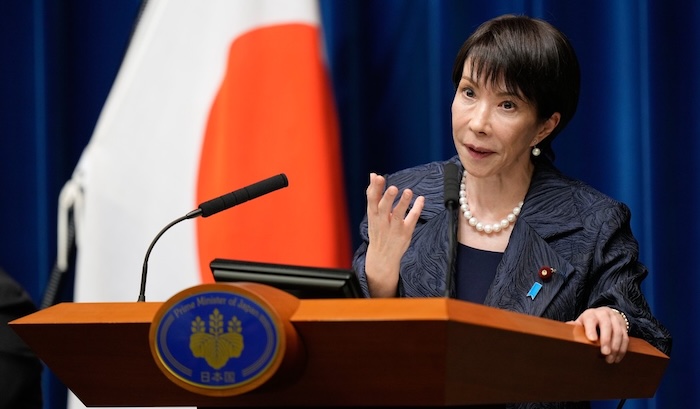
In his first term, Trump cultivated a close relationship with the late Prime Minister Shinzo Abe, assassinated in 2022. The two leaders shared not just a love of golf, but a clear-eyed view of China as the main threat to regional stability.
China’s rise inspired Abe’s vision of a Free and Open Indo-Pacific (FOIP) strategy, with Japan pledging itself to work with like-minded regional partners to uphold freedom of navigation, territorial and maritime sovereignty, and quality infrastructure.
Please see full here: