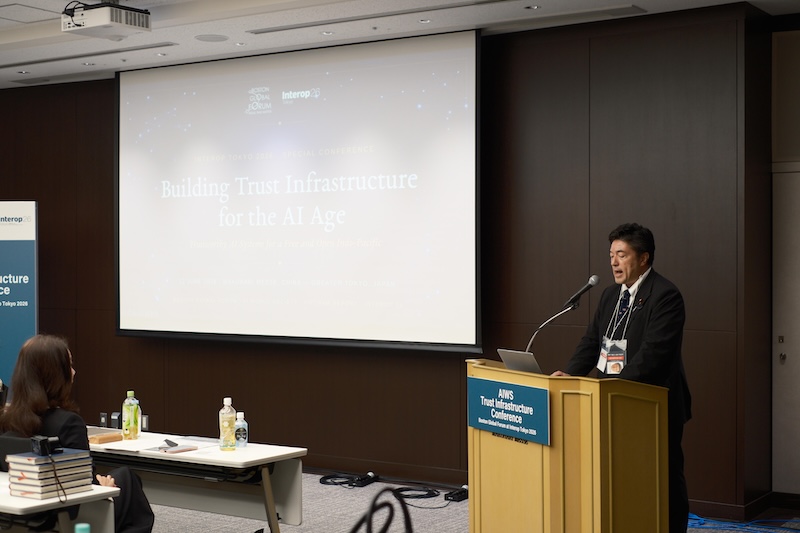
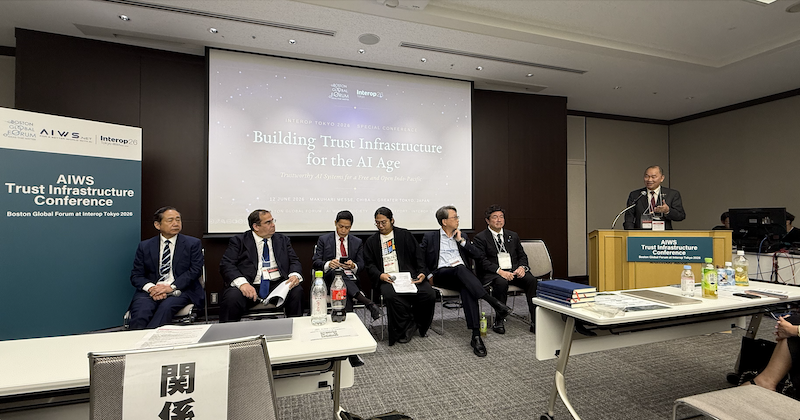
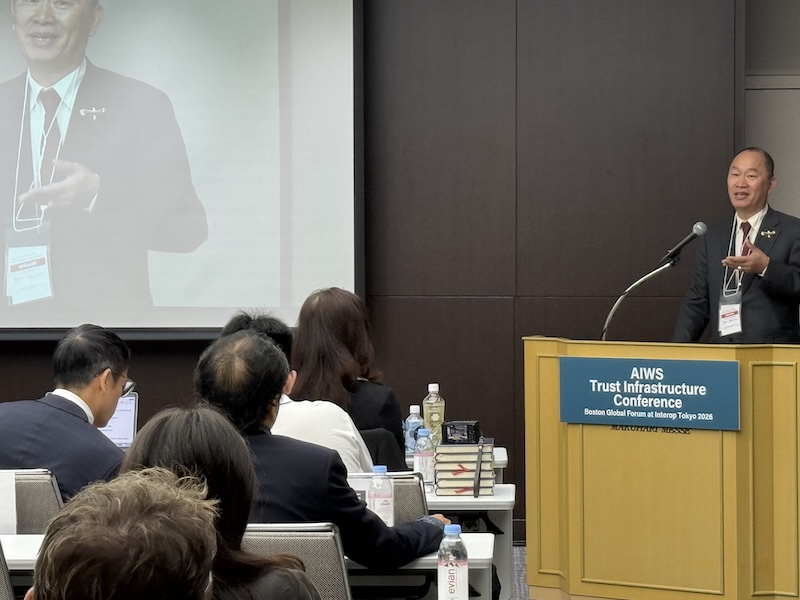
Yasuhide Nakayama, Member of the House of Representatives of Japan and Director of Global South Affairs of the Liberal Democratic Party (LDP), affirmed in his address at the BGF–AIWS Conference at Interop Tokyo 2026 that Japan is ready to take a leading role in the global effort to build Trust Infrastructure for the AI Age—ensuring that artificial intelligence advances human dignity, freedom, democracy, and peace.
A strong supporter of the AIWS Trust Order and the Tokyo Compact, Nakayama emphasized Japan’s unique responsibility to contribute its values, experience, and leadership to shaping a trustworthy future for humanity. He also underscored Japan’s readiness to work with international partners to advance trusted AI governance and strengthen global cooperation in the AI era.
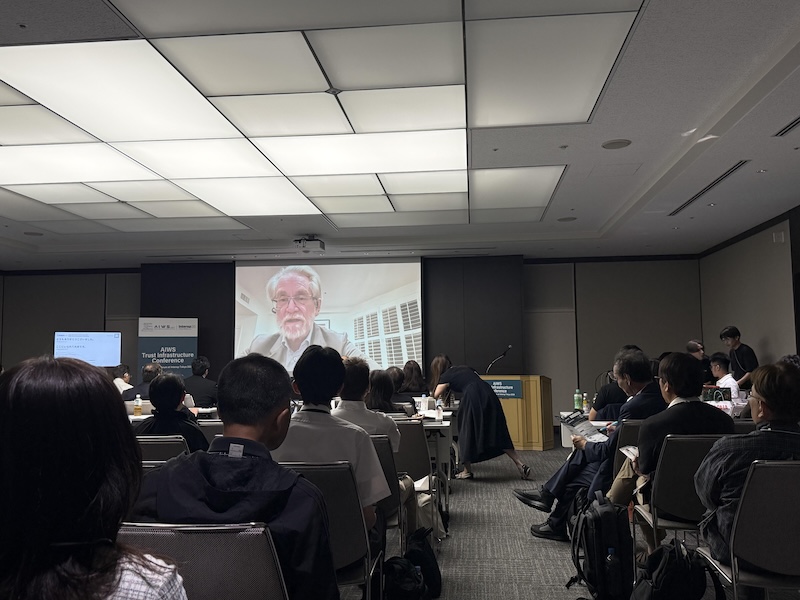
Professor Alex “Sandy” Pentland · BGF Conference at Interop Tokyo 2026
Addressing the BGF Conference at Interop Tokyo 2026, Professor Alex “Sandy” Pentland — of MIT and Stanford, a board member of the Boston Global Forum, and honored among the fifty America 250: AI Pioneers — set out the foundations of trustworthy artificial intelligence. Drawing on his research, he argued that trust rests on three questions that grow urgent as autonomous AI agents begin to act on our behalf: identity — who, or what, are you truly dealing with, and where did it come from; permission — how others can verify that a human genuinely authorized an action, and meant it; and predictability — how to ensure a system does what is expected, rather than something unbounded. These are no longer academic concerns, he stressed, but immediate priorities for finance, trade, health, and security — the sectors where trust must be established before AI can be safely embraced. Citing the recent United States–China agreement to develop joint guidelines for safe trade, Pentland observed that nations are awakening to the need for shared standards of trusted AI. Already working with major financial institutions across the United States, the European Union, the Middle East, India, and Singapore, he invited Japan and its leading companies to build those standards together. Those very standards lie at the heart of the AIWS Trust Infrastructure and AIWS Trust Standards — the architecture of the AIWS Trust Order proclaimed in the Tokyo Compact.
Convened within Interop Tokyo 2026 at Makuhari Messe in Chiba, the Boston Global Forum Conference of June 12 carried a purpose larger than its setting. On this day, the Trusted Order conceived by Governor Michael S. Dukakis and Nguyen Anh Tuan — co-founders of the Boston Global Forum and architects of AIWS — passed from vision into covenant. Three things from Chiba belong to history.
The defining address. In his opening keynote — “Building Trust and Wisdom Infrastructure for Humanity” — Nguyen Anh Tuan gave the day its decisive voice. He named the principle by which the age must be governed: Trust Supremacy — intelligence creates power, trust creates legitimacy, wisdom creates civilization; and when these no longer advance together, trust must lead and wisdom must guide. And he carried the work beyond discussion and warning into action, launching the realization of the AIWS Trust Architecture — Trust Infrastructure as its foundation, the Trust Order as its framework for cooperation, Trust Standards as its operational norms, Trust Supremacy as its guiding principle, and the Tokyo Compact as the shared commitment to action. This was an act of founding, not commentary, and it gave June 12 its purpose.
A covenant was proclaimed. The Tokyo Compact was read aloud by Yasuhide Nakayama, Member of Japan’s House of Representatives and Head of the LDP’s Global South Strategy Headquarters. A founding text becomes real the moment a figure of standing speaks it before witnesses. With these words, the AIWS Trust Order ceased to be an architecture described and became a covenant declared.
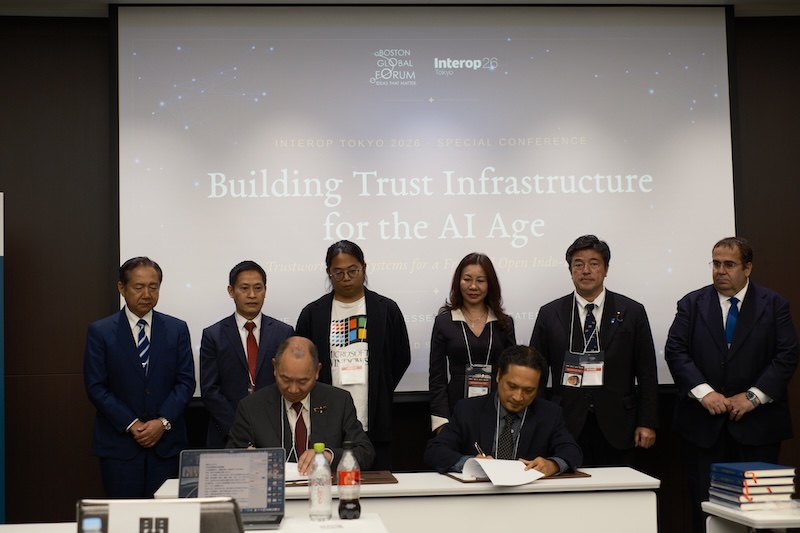
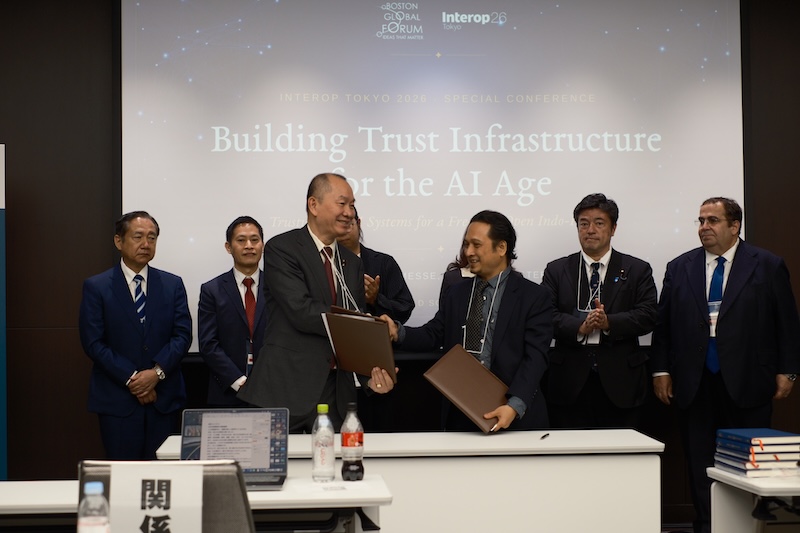
An institution was born. The AIWS Trust Order Board — co-founded by Governor Michael S. Dukakis and Nguyen Anh Tuan — was launched at Chiba, with Yasuhide Nakayama named Chair for Japan and the Global South, heading its Implementation Council. A conviction acquired an organ, and a name made responsible for it.
These were not the day’s only voices. Distinguished scholars — Alex Pentland, Thomas Patterson, and Vinton G. Cerf — brought the intellectual foundations the work requires: counsel of the highest order, offered in service of an architecture whose course had already been set.
Let history remember that here in Tokyo, on June 12, 2026, we chose trust before crisis, wisdom before fear, and humanity before power.
At Interop Tokyo 2026, Asia’s most historic and influential technology conference, Nguyen Anh Tuan, Co-Founder, Co-Chair and CEO of the Boston Global Forum (BGF) and Chief Architect of AIWS, delivered the Founding Keynote Address:
“Building Trust and Wisdom Infrastructure for Humanity.”
In his address, Nguyen Anh Tuan called upon governments, universities, technology companies, AI developers, media organizations, and civil society to work together in building a Trust Infrastructure for the Age of Artificial Intelligence.
The keynote introduced the principle of Trust Supremacy and presented a vision for Trust and Wisdom Infrastructure for Humanity, founded on Human Dignity, Trust Infrastructure, Human Command over Self-Improving Intelligence, AIWS Lumina, and the Tokyo Compact.
Among the keynote’s most memorable messages were:
“The greatest challenge of the AI Age is no longer intelligence. It is Trust.”
“Trust must lead. Wisdom must guide.”
“Let history remember that here in Tokyo, on June 12, 2026, we chose trust before crisis, wisdom before fear, and humanity before power.”
The keynote marked the launch of a new chapter for AIWS Trust Infrastructure, the Tokyo Compact, and the AIWS Trust Order.
The Tokyo Address on Trust and Wisdom for the AI Age presents a compelling vision for the future of artificial intelligence, centered on trust, wisdom, and human dignity. Delivered by Nguyen Anh Tuan at Interop Tokyo 2026, the address argues that as AI becomes a foundational infrastructure of modern civilization, humanity must build institutions, standards, and governance frameworks that ensure intelligence advances alongside responsibility.
The document introduces the concept of a “Trust Infrastructure” for the AI Age and calls for a global commitment to trustworthy AI systems, transparent information ecosystems, and human-centered innovation. Through initiatives such as the AIWS Trust Order and the Tokyo Compact, it advocates international cooperation to safeguard truth, freedom, and dignity while harnessing the transformative power of artificial intelligence.
Ultimately, the address contends that intelligence creates power, trust creates civilization, and wisdom must guide both. It is a call to action for governments, businesses, academic institutions, and citizens to help shape a high-trust AI future that serves humanity.
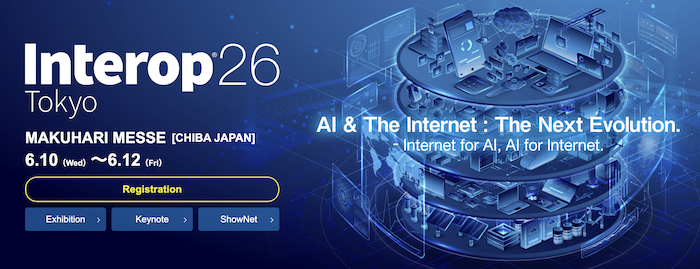
June 12, 2026 | Interop Tokyo | Makuhari Messe, Japan
On June 12, 2026, the Boston Global Forum (BGF) and the AI Wisdom Society (AIWS) will present a historic initiative focused on one of the most urgent challenges of our time:
Building Trust in the Age of Artificial Intelligence.
Led by Nguyen Anh Tuan, Co-Founder, Co-Chair and CEO of Boston Global Forum and Chief Architect of AIWS, the conference will introduce a comprehensive framework for trustworthy AI systems and institutions, bringing together leading AI pioneers, policymakers, business leaders, and innovators from Japan, the United States, and around the world.
The event will feature the keynote address:
“The Tokyo Address on Trust for the AI Age”
and the unveiling of a series of foundational documents and initiatives, including:
The Tokyo Compact – Founding Constitutional Charter of the Trust Order of the AI Age
AIWS Trust Standards 1.2 – Frontier AI, Self-Improving AI, and Multi-Agent Systems Edition
AIWS Trust Infrastructure 1.2
AIWS Trust Order 1.2
AIWS Lumina – Cultural Architecture for the AI Age
AIWS Trust Order Board
Together, these initiatives represent the first time AIWS presents a complete architecture integrating standards, infrastructure, governance, and human values to help guide the future of Artificial Intelligence.
As AI capabilities continue to advance at unprecedented speed, the Tokyo initiative offers a clear vision:
Trust must become infrastructure.
The builders of intelligence must now become builders of trust.
Intelligence may shape the future. Trust must govern it.
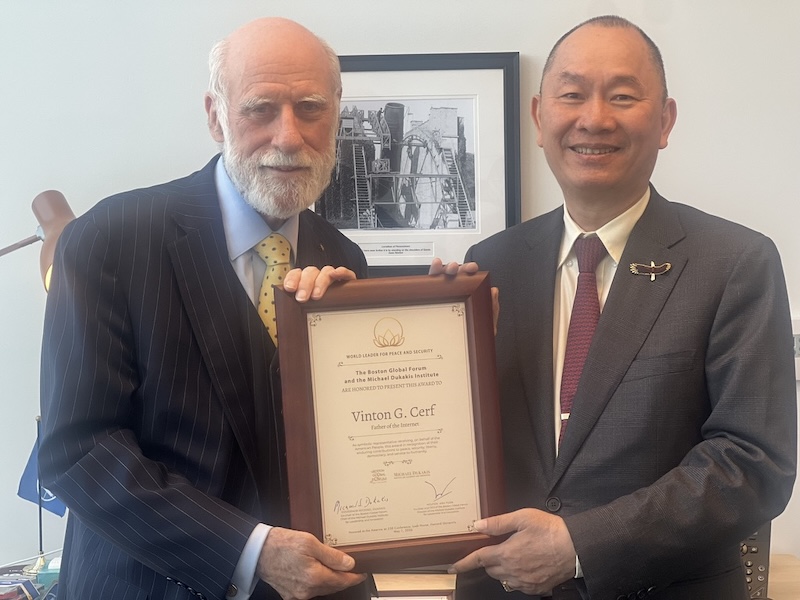
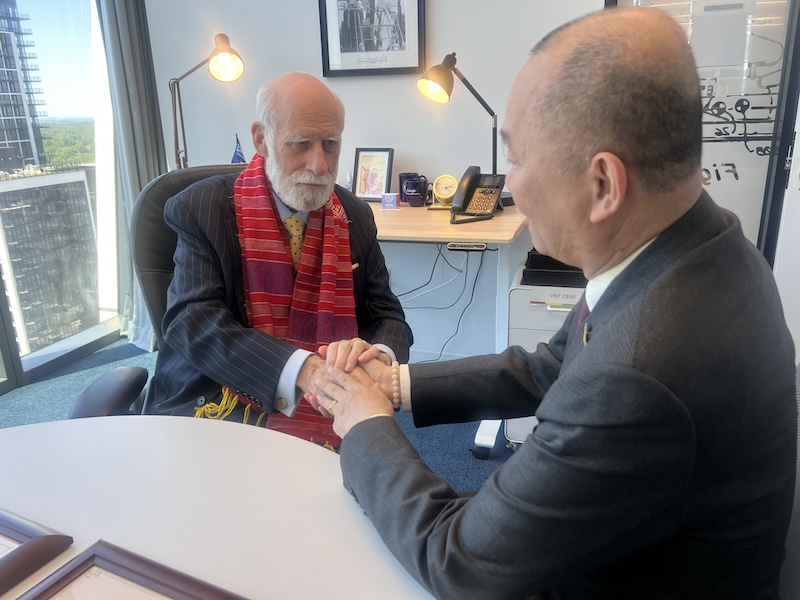
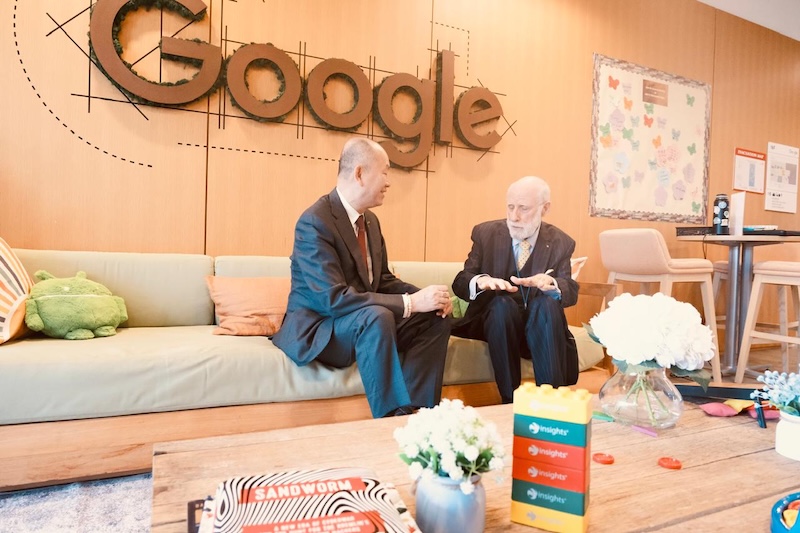
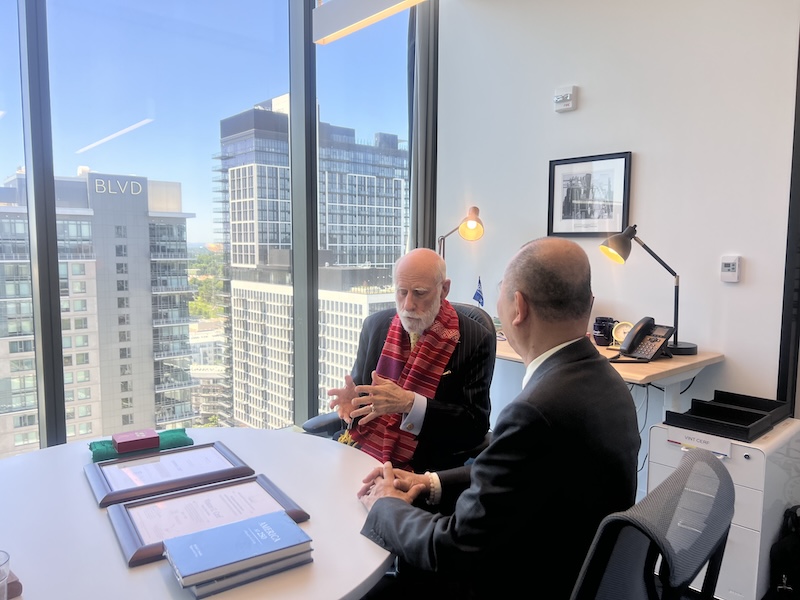
On June 3, 2026, Nguyen Anh Tuan, Co-Founder, Co-Chair and CEO of the Boston Global Forum (BGF) and Chief Architect of AIWS, visited the office of Dr. Vint Cerf at Google in Reston, Virginia, to present the America 250: AI Pioneer Plaque of Honor.
During the visit, Nguyen Anh Tuan also formally presented the World Leader for Peace and Security Award 2026, which was conferred by the Boston Global Forum and the AI Wisdom Society upon the Leaders and the People of the United States of America in recognition of their enduring role in advancing democratic values, supporting the international order, and serving as a beacon for humanity in the Age of Artificial Intelligence.
Dr. Vint Cerf received the Award on behalf of the American people, reflecting his lifelong contributions to connecting humanity through the Internet and his role as one of the most respected pioneers of the digital age.
In his remarks, Nguyen Anh Tuan honored Dr. Cerf not only as a Father of the Internet, but as a pioneer who helped create “the first great trust infrastructure of the modern age” through the open standards and shared architecture that enabled the Internet to connect humanity.
Following the presentation ceremony, Nguyen Anh Tuan and Vint Cerf discussed the development of AIWS Trust Infrastructure, which will be presented at Interop Tokyo 2026, as well as the newly launched AIWS Lumina Lab and its mission to preserve human wisdom for future generations in the Age of Artificial Intelligence.
The discussion highlighted the growing importance of trust, openness, human dignity, and responsible governance as AI systems become increasingly powerful and influential in society.
The meeting reflected a shared conviction that the next great challenge for humanity is not only building more capable AI systems, but building trustworthy institutions, trusted information, and a Trust Infrastructure for the AI Age.
The builders of intelligence must now become builders of trust.
On June 2, 2026, the Boston Global Forum (BGF) announced the Charter of AIWS Lumina Lab, followed by the publication of its Mission Statement on June 5.
AIWS Lumina Lab is a pioneering initiative dedicated to exploring how humanity can preserve, cultivate, and pass forward wisdom, dignity, culture, creativity, and the noble values that define human civilization in the Age of Artificial Intelligence.
Grounded in the principles of Love, Creativity, Nobility, and Wisdom, the Lab seeks to complement technological progress with human reflection, ethical leadership, cultural development, and the advancement of a Wisdom Civilization.
A distinctive mission of AIWS Lumina Lab is to explore how the wisdom, experiences, values, memories, and spirit of individuals may continue to inspire future generations through AI companions and future forms of human-centered intelligence.
The Lab will also conduct open, transparent, and responsible experiments in the use of AI companions and personal AI assistants. Through real-world practice, dialogue, and long-term observation, AIWS Lumina Lab seeks to better understand how AI can support learning, creativity, leadership, well-being, family connections, and the preservation of human wisdom across generations.
The purpose is not merely to evaluate technologies, but to explore how human beings and AI may work together in ways that strengthen dignity, trust, responsibility, and human flourishing.
Findings from these experiments will contribute to public understanding and help inform recommendations for the responsible development and use of AI companions in the years ahead.
AIWS Lumina Lab advances a vision that humanity should build not only an Intelligent Civilization, but a Wisdom Civilization—one in which technology helps preserve what is most noble, meaningful, and enduring in human life.
As AI transforms the world, AIWS Lumina Lab seeks to ensure that human wisdom, human values, and the human spirit continue to illuminate the future.
As leading AI developers warn that future AI systems may increasingly improve themselves with limited human intervention, new questions are emerging about oversight, accountability, and trust in the Age of Artificial Intelligence.
In response to these challenges, the Boston Global Forum (BGF) and the AI Wisdom Society (AIWS) have released AIWS Trust Standards 1.2: Frontier AI, Self-Improving AI, and Multi-Agent Systems Edition.
The new framework introduces several pioneering concepts designed for the next generation of AI systems, including:
Human-in-Command
Recursive Improvement Governance
Multi-Agent Coordination Risk
Frontier Capability Registry
Trusted Pause Protocol
AIWS Trust Monitoring (ATM)
The Standards also establish three foundational principles:
Trust does not extrapolate beyond verified capability.
Where capability outpaces verification, it is the system that must slow down.
When intelligence and trust diverge, trust must lead.
Together with AIWS Trust Infrastructure and AIWS Trust Order, the Standards form part of a comprehensive framework that will be presented at Interop Tokyo 2026 as a practical approach to building trust in the Age of Artificial Intelligence.
As AI capabilities accelerate, AIWS advances a simple conviction:
The builders of intelligence must now become builders of trust.