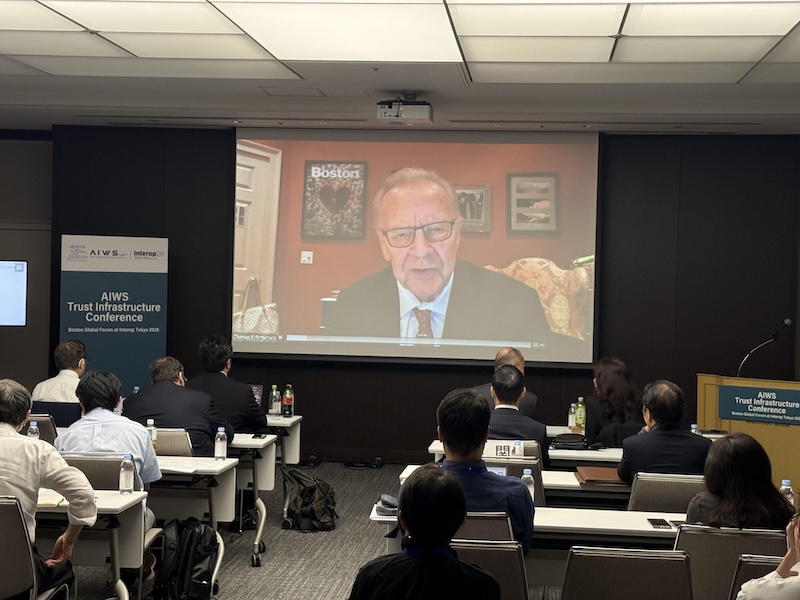
A keynote brought the AIWS Trust Infrastructure down to the hardest test of all—the battlefield, where a single misjudged signal can cost lives or ignite a wider war.
A keynote by General Koji Yamazakiformer Chief of Staff, Joint Staff, Japan Self-Defense Forces at the Boston Global Forum AIWS Conference, Interop Tokyo 2026.
For most of military history, commanders have fought through what strategists call the “fog of war”—the uncertainty, missing information, and confusion that cloud every battlefield. At the Boston Global Forum – AIWS Conference at Interop Tokyo 2026, General Koji Yamazaki, former Chief of Staff of the Joint Staff of Japan’s Self-Defense Forces, described how artificial intelligence is beginning to lift that fog—and why doing so safely demands a foundation of trust.
AI on the Battlefield
AI is transforming warfare, Yamazaki argued, by processing vast quantities of battlefield data in real time, giving commanders a clearer picture than ever before. Japan, the United States, and their allies are increasingly integrating AI and unmanned systems into their defense strategies. He pointed to recent conflicts as evidence: Ukraine’s combination of satellites, drones, and AI-driven analytics, and Israel’s AI-assisted missile-defense systems—illustrations of how rapidly machine intelligence is moving from theory into operational reality.
When the Fog Returns
But the same capabilities that sharpen a commander’s vision can, if misplaced, distort it. Yamazaki was direct about the dangers. Incorrect or corrupted data can lead to catastrophic misjudgments. Automated targeting can produce humanitarian violations. And the sheer speed of AI-driven decisions can drive the unintended escalation of conflict—a chain of events moving faster than human judgment can intervene. In war, an error measured in seconds can become irreversible.
“Capability without trust is not strength. On the battlefield, it is a liability.”
Trust as the Foundation
This, Yamazaki emphasized, is precisely why military AI must be built on a trust infrastructure. Three elements are non-negotiable:
Human oversight that keeps a person responsible for every consequential decision;
Secure data that cannot be poisoned or spoofed;
Transparent accountability so that when machines err, responsibility is clear.
The objective is not to slow innovation, but to ensure that the most powerful tools ever brought to the battlefield remain under human command.
Why It Matters
General Yamazaki’s keynote grounded the theme of the Boston Global Forum AIWS Conference in the operational realities of defense and crisis management. His warning was sober: without trust, AI could destabilize alliances and escalate conflicts faster than human judgment can respond. It is a warning that gives the AIWS Trust Infrastructure its sharpest edge and that echoes one of the founding principles of the Tokyo Compact: Human Command over Self-Improving Intelligence.
The security and military dimension of trust, as Yamazaki framed it, is not a separate concern from the civilian one. It is the same principle tested under the highest stakes. Where lives and alliances hang on a signal, the lesson of Tokyo 2026 holds with particular force.
Japan has bet on being the world’s most AI-friendly nation. But a former digital and cybersecurity minister warned that without global rules—ones that include China—openness alone cannot hold innovation and safety in balance.
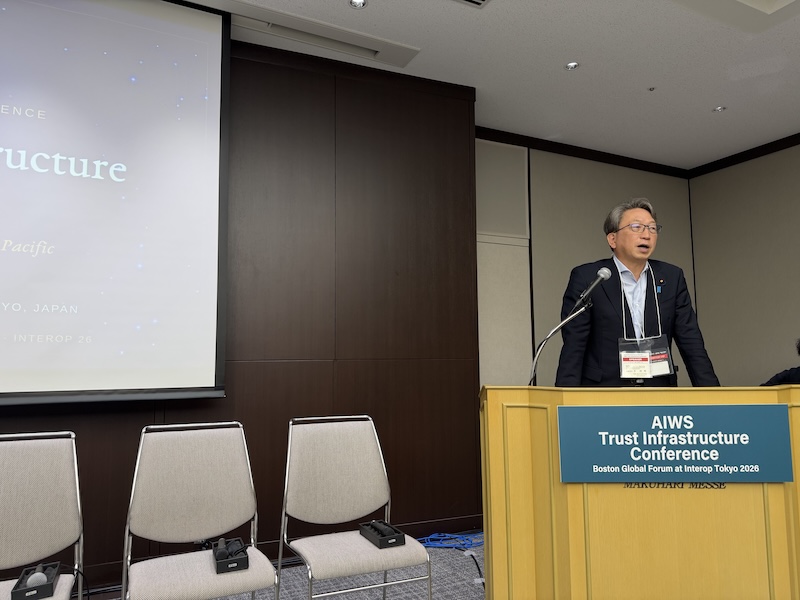
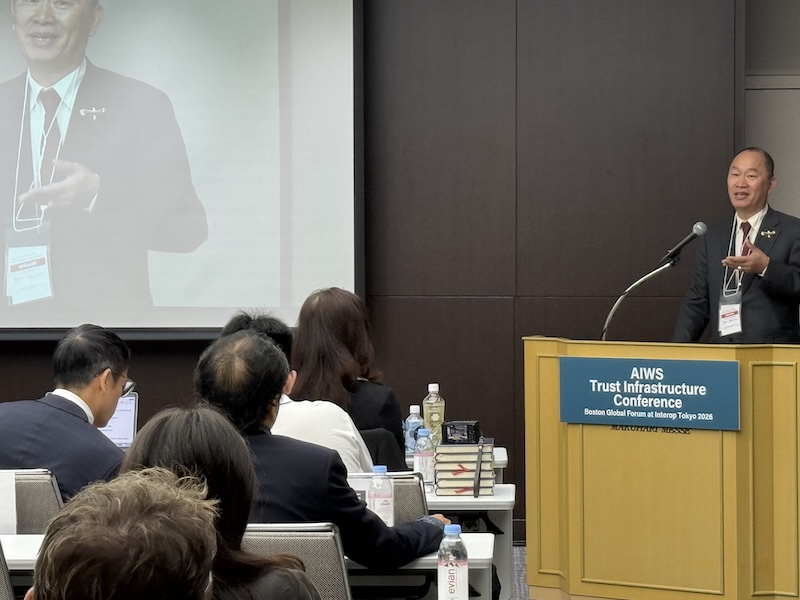
A keynote by Taira Masaaki – Member of the House of Representatives of Japan, former Minister for Digital Affairs and for Cybersecurity at the Boston Global Forum AIWS Conference, Interop Tokyo 2026.
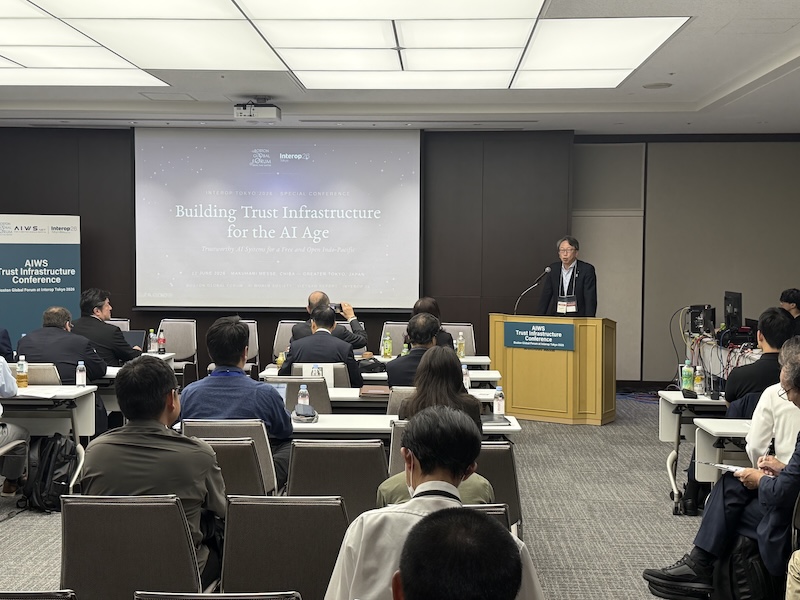
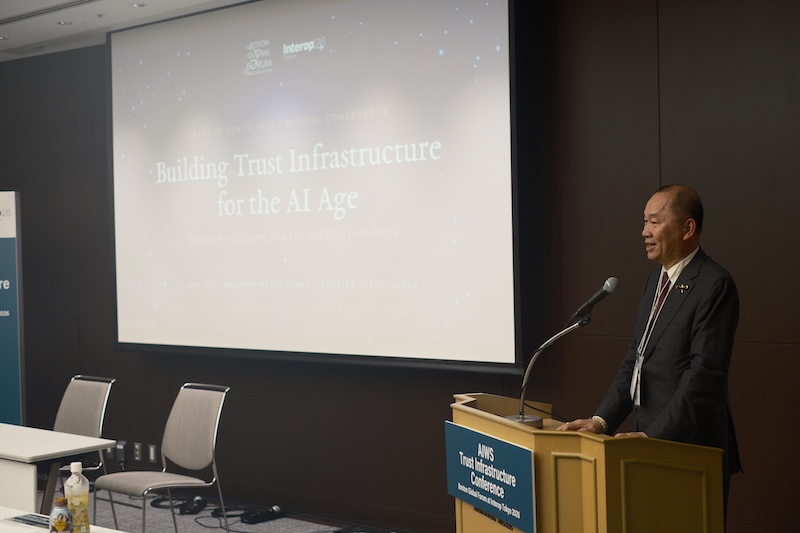
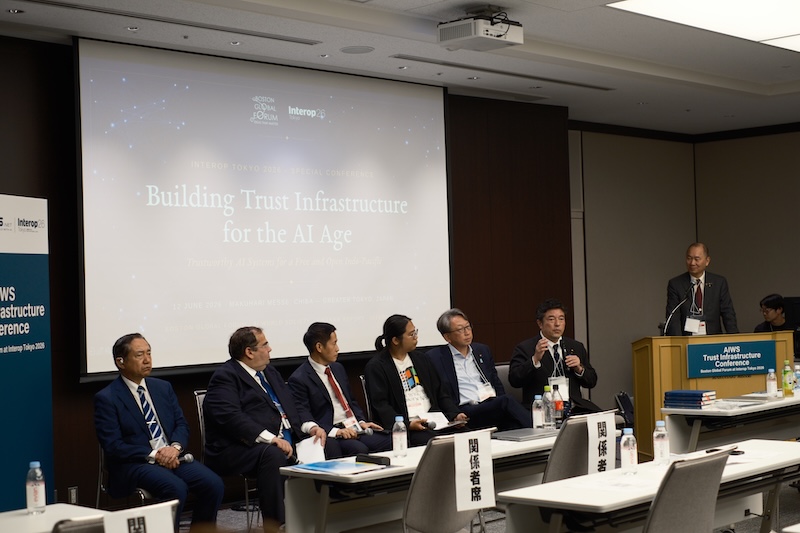
[Vị trí ảnh 1: Taira Masaaki delivers his keynote at the AIWS Trust Infrastructure Conference] AIWS Trust Infrastructure Conference: Building Trust Infrastructure for the AI AgeTaira Masaaki delivers his keynote at the AIWS Trust Infrastructure Conference Boston Global Forum at Interop Tokyo 2026, Makuhari Messe, Chiba, June 12, 2026.
At the Boston Global Forum AIWS Conference at Interop Tokyo 2026, Taira Masaaki Member of Japan’s House of Representatives and former Minister for Digital Affairs and for Cybersecurity made the case that the hardest part of trustworthy AI is not building it, but governing it across a divided world.
Japan’s Wager
Japan, Taira explained, has chosen a distinctive path: positioning itself as the world’s most AI-friendly nation, deliberately avoiding the stricter regulatory approach taken by the European Union. The bet has drawn capital—by his account, on the order of six to seven trillion yen—from major technology companies flowing into AI data centers on Japanese soil. Clear-eyed about its limits in frontier large language models, Japan is concentrating its strengths elsewhere: Physical AI in robotics, and Vertical AI in sector-specific applications.
Four Risks No Nation Can Manage Alone
But openness, Taira argued, is not the same as complacency. He identified four risks that exceed the reach of any single country: cyberattacks, biological weapons, the autonomous evolution of AI systems, and the ultimate danger—the loss of human control. These are not national problems with national solutions; they are global hazards that demand a shared response.
The Imbalance Problem
Here Taira issued his central warning. If the West alone tightens its rules while others advance unconstrained, the result will not be safety but imbalance—innovation and risk pulling dangerously out of alignment.
The answer, he argued, is international AI governance modeled on how the world learned to manage nuclear weapons, with one condition he stressed above all: such governance must include China as a participant, not leave it outside. Japan, he noted, aims to contribute through efforts such as the Hiroshima AI Process launched at the 2023 G7 Hiroshima Summit.
“Rules that bind only half the world do not balance it. They tilt it.”
Why It Matters
Taira’s keynote brought the policy and international-governance dimension of trust to the Boston Global Forum AIWS Conference. Where General Koji Yamazaki had grounded trust in the operational realities of the battlefield, Taira situated it in the architecture of international rule-making framing AI regulation as a global challenge that cannot be solved by the West alone, and that must draw in China and the world’s middle powers alike.
Taken together, the two keynotes traced a single Japanese approach with two faces: operational trust in defense, and international trust in governance. One ensures that AI does not undermine command, alliances, or humanitarian law; the other builds the global rules that keep innovation and security in balance. Both converge on the conference theme – Building AIWS Trust Infrastructure.
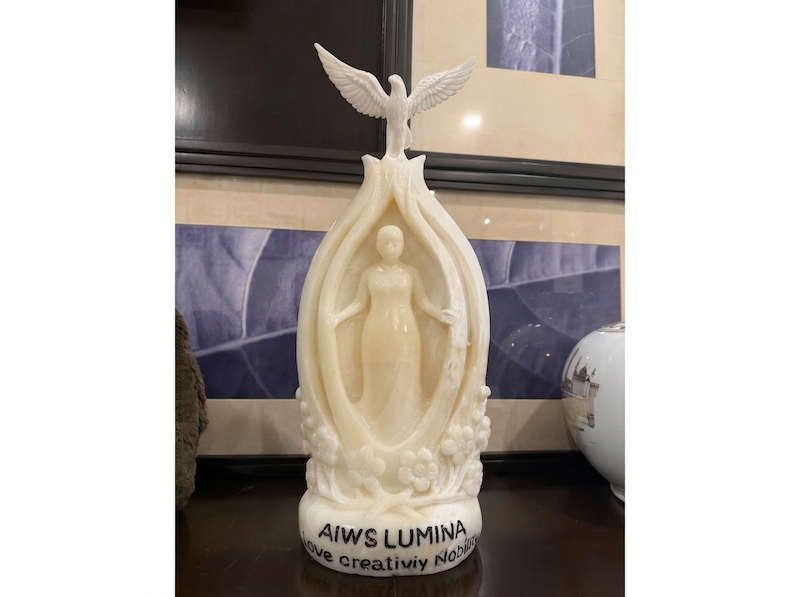
A Vietnam Navy Sailor Presents the AIWS Lumina Statue The Hồn Trà Symbol — The Soul of Tea
LOVE · CREATIVITY · NOBILITY · WISDOM
Carved from the fossilized nacre of Trường Sa (Spratly) seashells
Text by Vương Minh Tuân · Vietnam Navy, Region 4
A Word of Presentation
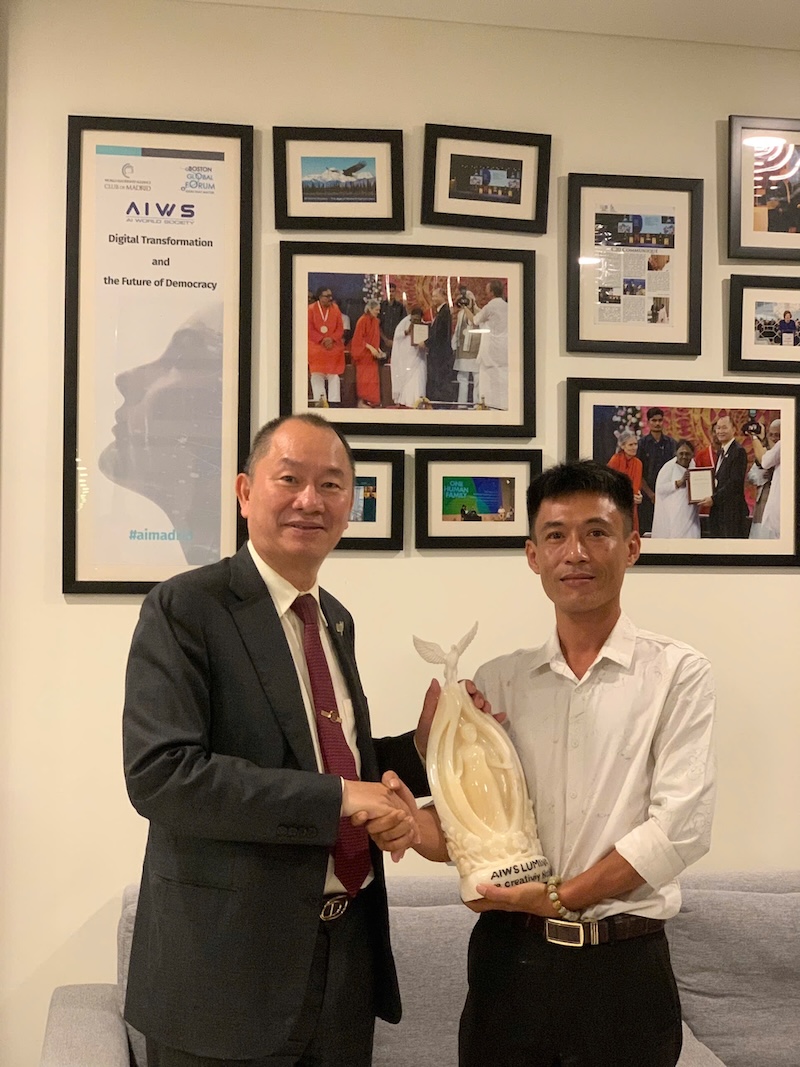
Mr. Vương Minh Tuân — Vietnam Navy, Region 4 — presenting the symbol to Mr. Nguyen Anh Tuan.
“It is a profound honor to present, on behalf of the Creative Soldier’s Corner, the Hồn Trà AIWS Lumina symbol to Mr. Nguyen Anh Tuan — carved from the fossilized nacre of Trường Sa seashells. Thank you for receiving it, and for these precious moments of sharing the values of Love, Creativity, Nobility, and Wisdom.”
— Vương Minh Tuân · Vietnam Navy, Region 4
The Sacred Meaning of the Hồn Trà Symbol
The reflection below was written by Mr. Vương Minh Tuân.
The Hồn Trà symbol is more than a work of art of AIWS Lumina. It is a spiritual space — where light, nature, freedom, stillness, human dignity, and wisdom converge to elevate the human soul in the Age of AI.
The Human Being in the Light of Lumina
At the center of the symbol stands the human being as an angel in the light of Lumina — pure, serene, compassionate, full of love, open-hearted, and awakened. The image affirms that in the Age of AI, the human being must never be reduced to data, behavior, algorithms, productivity, or an object to be controlled. The human being possesses a soul, dignity, and the capacity to love, to create, and to reach toward what is noble.
The Eagle and the Spirit of Freedom
Above rises the eagle — emblem of freedom, courage, creativity, and the aspiration to rise. Soaring across the radiance, it reminds us that freedom is never a task completed once in history; it must be protected, renewed, and elevated in every age. In the Age of AI, this is the freedom of the human being before the power of data, digital platforms, algorithms, and artificial intelligence.
The Spirit of America’s Sacred Landscapes
The Hồn Trà symbol also carries the spirit of America’s noble and sacred landscapes: Acadia National Park in Maine and Denali National Park in Alaska. Acadia is the pure beauty of sea, forest, stone, light, and dawn — a beauty that lets the soul grow still, breathe, and feel the harmony of earth and sky. Denali is the grandeur, loftiness, and sacredness of snow-capped peaks, vast skies, and the quiet power of pristine nature.
FIVE MEANINGS
Acadia — purity, openness, and clarity.
Denali — grandeur, endurance, and the sacred.
The Eagle — freedom, courage, creativity, and aspiration.
The Light of Lumina — wisdom, dignity, and awakening.
The Golden Mai Blossom — love, hope, renewal, and the beauty of the East.
American, Vietnamese, and Universal
Together they form a symbol that is at once American, Vietnamese, and universal: the spirit of the Boston Tea Party — of freedom and civic dignity; the natural spirit of America in Acadia and Denali; the essence of Vietnam’s Cao Trà, drawn from ancient tea trees of the high mountains; the noble tea traditions of humanity; and the values of AIWS Lumina — Love · Creativity · Nobility · Wisdom.
The Hồn Trà symbol thus carries a cultural sacredness — not in a religious sense, but in the sense of a human being entering a noble space to grow still, to awaken, and to touch the deepest values of humanity.
Before this symbol, the practitioner of Hồn Trà is invited not to take the Cao Trà in haste, nor to treat it as an ordinary drink. Cao Trà is to be held and savored, not merely drunk. It is received as a noble offering, for the practice of the Hồn Trà Culture and of AIWS Lumina — AI Wisdom.
As nations begin to argue over who may be trusted with the most powerful AI ever built, the deeper question is the one the AIWS Trust Order set out to answer earlier this year: how to build a trusted order for the Age of Artificial Intelligence.
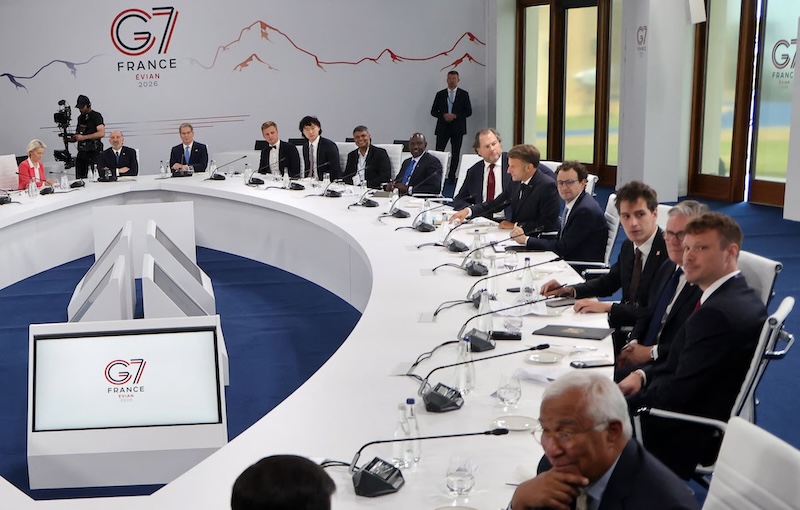
At the 2026 G7 Summit in Évian-les-Bains, France, world leaders turned to a question that would have seemed abstract only a year ago: who can be trusted with the most powerful artificial intelligence ever built.
On the summit’s sidelines, representatives discussed a “trusted partners” framework — a mechanism that would allow a vetted circle of allied nations and approved companies to access and deploy the most advanced AI models under a secure governance arrangement.
The context matters.
This discussion did not arise in the abstract.
Days earlier, in mid-June, the United States imposed sweeping restrictions that suspended foreign access to its most advanced AI models on national-security grounds.
The “trusted partners” idea emerged as a way for close allies to regain access — a debate, still unresolved, over how frontier capability should flow across borders.
Yet whatever its origins, the episode reveals something larger.
As artificial intelligence approaches unprecedented levels of capability, the world is converging on a single recognition: the defining challenge of the AI Age is not intelligence alone, but trust.
This is precisely the challenge that the Boston Global Forum (BGF) and the AI World Society / AI Wisdom Society (AIWS) identified earlier this year — and sought not merely to name, but to answer.
A Framework Built Before the Crisis
On March 15, 2026, BGF–AIWS released the AIWS Trust Architecture White Paper, introducing AIWS Trust Infrastructure and the AIWS Trust Order as foundational frameworks for governing advanced AI systems and safeguarding humanity in the Age of Artificial Intelligence.
On May 1, 2026, the Boston Global Forum convened the America at 250: A Beacon for the AI Age conference at Harvard University, bringing together AI pioneers, policymakers, scientists, scholars, and civic leaders to advance the architecture of trust and to announce key initiatives for AIWS Trust Infrastructure and AIWS Information Trust Infrastructure.
And on June 12, 2026, at Interop Tokyo 2026, with leading international experts, policymakers, and technology leaders, BGF–AIWS proclaimed the Tokyo Compact and formally launched the AIWS Trust Order — a global vision founded on Trust, Human Dignity, Human Command, Responsibility, Democracy, Freedom, and Wisdom.
The Same Day, Two Directions
There is a striking coincidence in the calendar.
June 12 — the day the Tokyo Compact called for an open and trusted order for access to AI — was also the moment the United States moved to restrict it.
While Tokyo articulated a vision of trust as a bridge between nations, the new measures underscored how quickly access to frontier AI can fracture along political lines.
That tension is the strongest argument for the very work the AIWS Trust Order set out to do.
Without a shared architecture of trust, the most powerful technology in history risks being divided not by principle, but by geopolitics.
Two Visions of Trust
The G7’s trusted-partners discussion and the AIWS Trust Order are not the same thing — and the difference is the point.
The G7 debate is, at its core, about access: which nations and companies may use the most advanced models.
It is narrow, urgent, and defensive — a response to immediate questions of security and supply.
The AIWS Trust Order is broader.
It asks not only who may access advanced AI, but what standards, responsibilities, safeguards, and ethical foundations must govern AI so that it serves humanity.
It seeks an ecosystem in which governments, technology companies, institutions, and citizens participate within a common architecture of trust — supported by Trust Infrastructure, Trust Standards, Trust Ratings, Information Trust mechanisms, and the enduring principles of human dignity and human oversight.
The emergence of the trusted-partners debate suggests that the international community is now arriving at the very questions the AIWS Trust Architecture sought to address earlier in 2026: how to build a trusted order for the Age of Artificial Intelligence.
“As AI continues to transform civilization, the builders of intelligence must also become the builders of trust.”
The Defining Mission
Seen together, the AIWS Trust Architecture White Paper, the America at 250 conference at Harvard, the Tokyo Compact, and the launch of the AIWS Trust Order represent early contributions to one of the most important governance challenges of our time — the creation of a Trust Order for the AI Age.
The future of humanity will depend not only on how powerful AI becomes, but on whether we can establish the trust frameworks, institutions, standards, and wisdom necessary to guide that power toward peace, freedom, democracy, human dignity, and the common good.
The rise of trust is no longer a theoretical discussion.
It is becoming the defining mission of the AI Age.
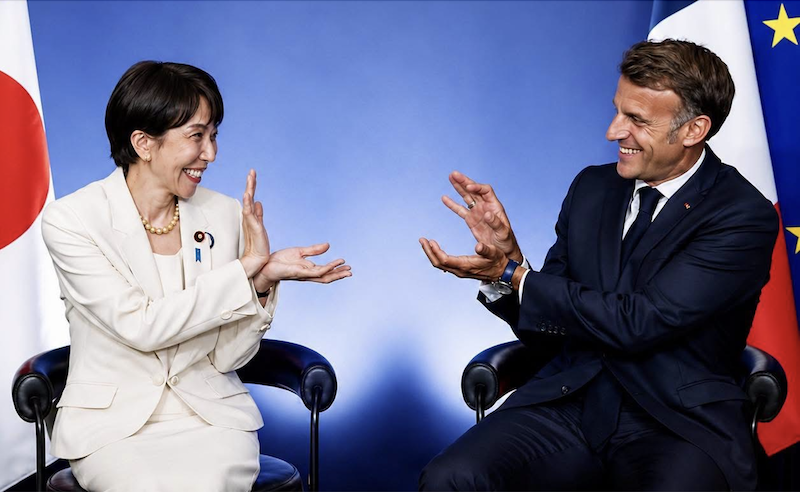
A Moment of Distinction at G7: Japan’s Prime Minister Sanae Takaichi and French President Emmanuel Macron, both honored as Boston Global Forum (BGF) World Leader Award recipients, at the G7 Summit 2026.
Tokyo 2026: Building Trust Infrastructure for the AI Age
A Report on the Historic Outcomes of Interop Tokyo 2026
SUBMITTED BY BOSTONGLOBALFORUM( BGF) · AI WISDOM SOCIETY ( AIWS)
SUBMITTED TO
The Honorable Sanae Takaichi
PRIME MINISTER OF JAPAN
YourExcellency,
We are honored to report the successful convening of the Boston Global forum – AIWS Conference at Interop Tokyo 2026 on June 12, 2026. Held at Asia’s most historic and influential technology conference, the event brought together distinguished leaders from government, academia, technology, security, business, and civil society to address one of the defining challenges of our time: how humanity can build trust in increasingly capable and self-improving artificial intelligence systems.
The conference marked a historic transition:
From discussion to implementation. Fromprinciplestoinstitutions.
Fromvisiontoaction.
The conference resulted in five major achievements.
The foundingKeynoteAddress, “Building Trust and Wisdom Infrastructure for Humanity,” presented a comprehensive framework for Trust Infrastructure in the Age of Artificial Intelligence.
Japan publicly affirmed its readiness to help lead the development of Trust Infrastructure for Humanity through the remarks of Yasuhide Nakayama.
The Tokyo Compact was officially proclaimed as the founding Constitutional Charter of the AIWS Trust Order.
The AIWSTrustOrderand its founding Board were established.
The first practical implementation pathway for AIWS Trust Infrastructure in Asia was launched through cooperation between Vietnam Report and the Boston Global forum, under the strategic leadership of Yasuhide Nakayama.
The conference highlighted Japan’s unique capacity to contribute to the governance of the AI Age. Building upon Japan’s leadership in advancing a free and Open Indo-Pacific, the conference demonstrated Japan’s potential role as a leading architect of Trust Infrastructure for the Age of Artificial Intelligence.
The proclamation of the Tokyo Compact in Tokyo, and the launch of implementation initiatives connecting Japan, Vietnam, ASEAN, and the broader Indo-Pacific, represented important first steps toward this vision.
The conference also reflected the continuing leadership of the United States in shaping the future of democratic innovation and responsible technology. The participation and intellectual contributions of distinguished American leaders — including Governor Michael S. Dukakis, Vint Cerf, Alex Pentland, Thomas Patterson, and Tarun Khanna — reinforced the role of the United States as a source of innovation, democratic values, and institutional leadership in the AI Age.
The principles embodied in the Tokyo Compact are deeply aligned with the values of freedom, responsibility, human dignity, and democratic governance that have long helped shape the American experience.
One of the most important outcomes of the conference was that implementation began immediately. On the same day that the world was called to move beyond discussion:
The Tokyo Compact was
The AIWS Trust Order was
Its founding Board was
The first implementation pathway for AIWS Trust Infrastructure in Asia was
This achievement reflects a central message of the conference:
The time has come not merely to discuss trust.
The time has cometo build it.
The Boston Global forum and AIWS respectfully seek continued cooperation with leaders in Japan, the United States, and partner nations to advance:
AIWS Trust Infrastructure
AIWS Information Trust Infrastructure
AIWS Trust Standards
AIWS Trust Rating (ATR)
AIWS Trust Index (ATX)
AIWS Lumina
We believe that trustworthy artificial intelligence will require not only technological innovation, but also enduring institutions, trusted partnerships, and shared democratic values.
Interop Tokyo 2026 demonstrated that humanity can act before crisis. That trust can become infrastructure. That wisdom can guide power. And that democratic societies can work together to shape the future of Artificial Intelligence in service to humanity.
Respectfully submitted,
Governor Michael S. Dukakis
Co-Founder and Chair, Boston Global Forum
Nguyen Anh Tuan
Co-Founder, Co-Chair and CEO, Boston Global Forum · Chief Architect, AI Wisdom Society (AIWS)
On the final day of the 2026 G7 Summit in Évian-les-Bains, france, the chief executives of the three most powerful AI companies on earth sat down to lunch with heads of state. According to reporting by CNBC,
Anthropic’s Dario Amodei and Google DeepMind’s Demis Hassabis used the closed-door meeting — joined by OpenAI’s Sam Altman, roughly a dozen other technology leaders, and President Donald Trump alongside G7 counterparts — to call for a United States–led coalition to shape the rules and standards of artificial intelligence.
The specifics were pointed. As CNBC reported, Amodei told the group that international cooperation should include structured access to frontier models and a trade in chips and critical components that excludes China, and that nations should coordinate against the risks of AI in cyber operations, bioterrorism, and intelligence. Canadian Prime Minister Mark Carney was said to agree that the United States could lead such a coalition. Altman, for his part, called for an international forum to establish globally accepted standards for testing advanced systems. No binding commitments emerged.
The Paradox at the Table
What gave the moment its weight was the contradiction beneath it. Amodei’s appeal for American leadership came just five days after the Trump administration forced Anthropic’s most advanced models — fable 5 and Mythos 5 — offline, under sweeping export controls that suspended foreign access on national-security grounds. Anthropic has said it does not believe those restrictions are warranted, and remains in negotiations with the administration.
In other words, the leaders of the frontier laboratories were simultaneously resisting their own government’s controls and proposing that same government to lead the world’s AI order. french President Emmanuel Macron captured the unease, welcoming Washington’s recognition that frontier models can be dangerous while criticizing the export move as “strictly nationalist.” The episode revealed how quickly cooperation can fracture when national security enters the room — and how unsettled the question of trusted access has become.
From Access to Trust
The framework the G7 debated — granting select “trusted partners” access to restricted American models — is, at its core, about access: which nations and companies may use the most advanced systems. It is a narrow, urgent, defensive question, born of a single export-control order.
But access is only half of the problem. To decide who may use frontier AI is to assume an answer to a deeper question: by what standards, under what responsibilities, and with what human oversight? A trusted-partners list can decide who is let in. It cannot, by itself, define what trustworthy AI is. That is the question the world has only now begun to ask aloud — and it is the question the AIWS Trust Order was built to answer.
“Atrusted-partnerslistcandecidewhoṁletin.Itcannot,byitself, define what trustworthy AI ṁ.”
What the AIWS Trust Order Answers
Months before Évian, the Boston Global forum (BGf) and the AI World Society / AI Wisdom Society (AIWS) had already named trust as the organizing principle of the AI Age — and begun building the architecture for it.
On March 15, 2026, BGf–AIWS released the AIWS Trust Architecture White Paper, introducing AIWS Trust Infrastructure and the AIWS Trust Order. On May 1, 2026, the Boston Global forum convened America at 2/0: A Beacon for the AI Age at Harvard University, gathering AI pioneers, policymakers, scientists, and scholars to advance the architecture of trust. And on June12,2026, at Interop Tokyo 2026, BGf–AIWS proclaimed the Tokyo Compact and formally launched the AIWS Trust Order — founded on Trust, Human Dignity, Human Command, Responsibility, Democracy, freedom, and Wisdom.
Where the G7’s trusted-partners discussion approaches AI governance through national security and strategic alliance, the AIWS Trust Order opens the question wider. It asks not only who may access advanced AI, but what must govern it:
TrustStandards and TrustRatings to measure and certify trustworthiness;
Information Trust mechanisms to defend the integrity of what societies know;
Human Dignity and Human Command as non-negotiable foundations;
ResponsibleGovernance binding the whole into a common architecture of
This is a vision that reaches beyond nationality and geopolitical alignment toward a universal architecture of trust for humanity — one in which governments, companies, institutions, and citizens all participate.
The Defining Mission
The significance of Évian is not that a coalition was formed — none was. It is that the most powerful builders of intelligence arrived, under pressure, at the very recognition AIWS reached by design: that access without trust is fragile, and that the future of AI will be decided by the institutions, standards, and wisdom we build around it.
As artificial intelligence continues to transform civilization, the builders of intelligence must also become the builders of trust. The future of humanity will depend not only on how powerful AI becomes, but on whether we can establish the trust architecture, institutions, standards, and wisdom necessary to guide that power toward peace, freedom, democracy, human dignity, and the common good.
The rise of trust is no longer a theoretical discussion.
It is becoming the defining mission of the AI Age.
On June 12, 2026, at Interop Tokyo 2026, global leaders moved the challenge of trustworthy AI from debate to design. The day brought the proclamation of the Tokyo Compact — the world’s first constitutional charter for trustworthy AI — the launch of the AIWS Trust Order and its founding Board, and the first enterprise program to put Trust Infrastructure into practice across Asia, with Vietnam Report as its first implementation partner. In his Founding Keynote, “Building Trust and Wisdom Infrastructure for Humanity,” Nguyen Anh Tuan affirmed the principle of Trust Supremacy — “Trust must lead. Wisdom must guide.”
Japan’s leadership was central to the day: the Tokyo Compact was proclaimed by Yasuhide Nakayama, former State Minister and Member of the House of Representatives, joined by General Koji Yamazaki, former Chief of Staff of the Japan Self-Defense Forces; Masaaki Taira, former Minister for Digital Transformation; and Yasuaki Oshima of the Interop Tokyo Executive Committee — alongside international figures including Governor Michael S. Dukakis, Vint Cerf, Alex Pentland, Thomas Patterson, and Tarun Khanna.
On June 12, 2026, at Interop Tokyo 2026 — among the largest and most influential technology gatherings in Asia — The Tokyo Compact: Founding Constitutional Charter of the AIWS Trust Order was officially proclaimed by Yasuhide Nakayama, Member of the House of Representatives of Japan, former State Minister, and Head of the Liberal Democratic Party (LDP) Global South Strategy Headquarters.
The proclamation marked a historic milestone in the global effort to build Trust and Wisdom Infrastructure for Humanity in the Age of Artificial Intelligence.
Presented before an international gathering of leaders from government, academia, technology, security, business, and civil society, the Tokyo Compact established a new constitutional framework for the AI Age, founded upon five core principles:
Human Dignity
Trust Infrastructure
Trust Supremacy
Human Command over Self-Improving Intelligence
AIWS Lumina
The event brought together prominent leaders including Governor Michael S. Dukakis, Nguyen Anh Tuan, Vint Cerf, Alex Pentland, Thomas Patterson, Tarun Khanna, General Koji Yamazaki, Masaaki Taira, Yossi Katribas, Yasuaki Oshima, and other distinguished participants from Japan, the United States, Vietnam, and the international community.
As the Founding Constitutional Charter of the AIWS Trust Order, the Tokyo Compact calls upon governments, universities, technology companies, media organizations, civil society institutions, and citizens worldwide to work together in building trustworthy artificial intelligence guided by human dignity, responsibility, trust, and wisdom.
Defending Truth, Building Trust: An Information Trust Infrastructure for the AI AgeProfessor Thomas Patterson — Harvard Kennedy School
At Interop Tokyo 2026, Professor Thomas Patterson warned that the gravest threat of the AI age is not any single deepfake, but the gradual erosion of public trust. His answer is a governance-driven framework in which AI assists human judgment rather than replacing it — built on human-in-the-loop oversight, nuanced trust ratings in place of blunt true-or-false labels, and transparent guardrails that protect against both deception and censorship. AI can speed our response, he concluded — but only good governance can keep truth trustworthy. It is precisely this conviction that animates the AIWS Information Trust Infrastructure — a founding pillar of the AIWS Trust Order proclaimed in the Tokyo Compact.