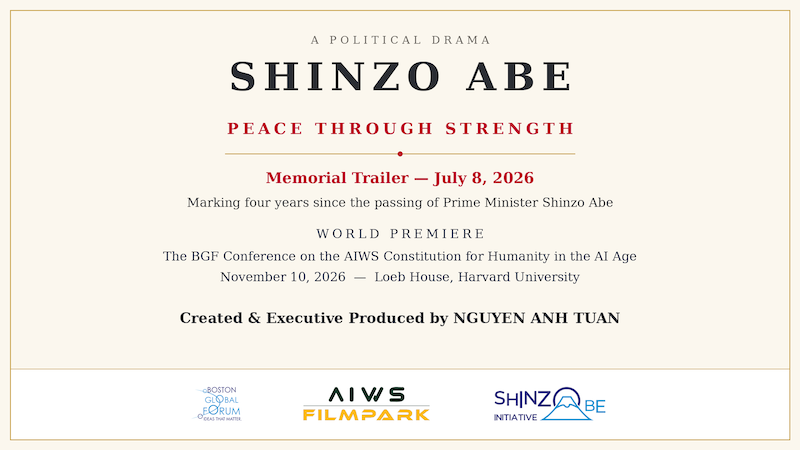
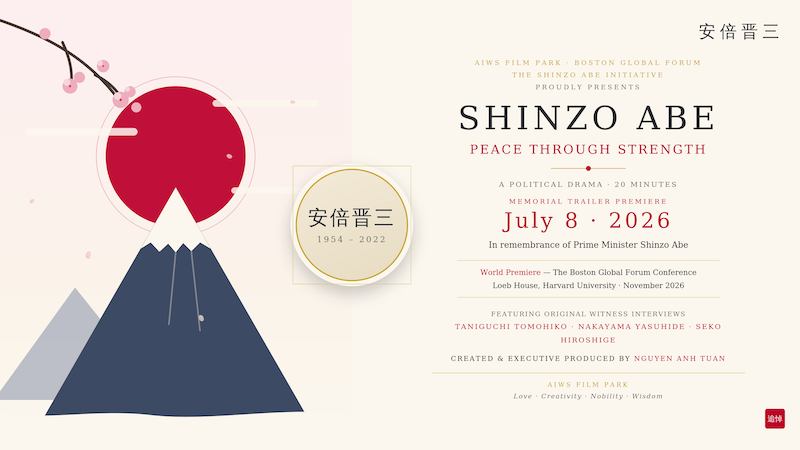
Boston, July 8, 2026 — On the fourth anniversary of the passing of Prime Minister Shinzo Abe, the Boston Global Forum and AIWS Film Park, under the Shinzo Abe Initiative, today released the memorial trailer of “Shinzo Abe — Peace Through Strength,” a 20-minute political drama created and executive produced by Nguyen Anh Tuan, Co-Founder, Co-Chair, and CEO of the Boston Global Forum.
The film returns to December 12, 2015, when the Boston Global Forum honored Prime Minister Abe at the Harvard Faculty Club as a World Leader for Peace and Security — and to a question asked in a small room that day: what does it take to keep the peace? It follows five decisive moments of his life: the resignation of 2007 and the quiet perseverance that followed; the security legislation of 2015; the Trump Tower meeting of November 2016; the North Korean missile crisis of August 2017; and July 8, 2022, in Nara, together with the State Funeral at the Nippon Budokan — where a nation bowed to the man who had once bowed to them.
Woven through the drama are original interviews conducted by Nguyen Anh Tuan with three men who stood close to Prime Minister Abe: Mr. Taniguchi Tomohiko, his adviser and speechwriter; the Honorable Nakayama Yasuhide, his ally in defense and security; and Mr. Seko Hiroshige, his long-time ally and communications strategist.
All imagery of Prime Minister Abe is authentic archival footage from videos the Government of Japan has made available to the public; no artificial recreation of his likeness or voice is used at any point. The film’s treatment of July 8 follows an absolute principle: no act of violence is depicted in any form — that morning is told through stillness, silence, and a single falling cherry blossom.
The film will have its world premiere at the Boston Global Forum Conference on the AIWS Constitution for Humanity in the AI Age on November 10, 2026, at Loeb House, Harvard University — returning to the very place where its founding question was first asked. The film closes with a torch carried forward: through the Indo-Pacific Spark Initiative and AIWS Lumina, where Hồn Trà — the Soul of Tea — joins Boston, Tokyo, and Nha Trang, inspiring a world of Love, Creativity, Nobility, and Wisdom in the age of AI.
Boston, July 8, 2026 — On the fourth anniversary of the passing of Prime Minister Shinzo Abe, Nguyen Anh Tuan, Co-Founder, Co-Chair, and CEO of the Boston Global Forum, sent a letter to Her Excellency Takaichi Sanae, Prime Minister of Japan, sharing the memorial trailer of “Shinzo Abe — Peace Through Strength” and respectfully inviting her to grace the film’s world premiere — in person, or with a video message — at the Boston Global Forum Conference on the AIWS Constitution for Humanity in the AI Age, on November 10, 2026, at Loeb House, Harvard University.
The letter recalls a circle across time: in 2015, Prime Minister Abe addressed Harvard by video message when the Boston Global Forum honored him as a World Leader for Peace and Security; in April 2023, at the same Harvard Faculty Club, the Forum honored then-Minister Takaichi with the World Leader in AIWS Award; and in 2026, at the same university, her words would complete the circle.
The letter also introduces Hồn Trà — the Soul of Tea — a new initiative of AIWS Lumina joining Boston, Tokyo, and Nha Trang, carrying Prime Minister Abe’s noble aspirations into the age of artificial intelligence — toward a world of Love, Creativity, Nobility, and Wisdom. As the letter observes: the film remembers the man; Hồn Trà continues his cultivation.
Boston, July 6, 2026 — On July 8, 2026 — four years to the day since the world lost Prime Minister Shinzo Abe — the Boston Global Forum and AIWS will premiere the official trailer of The Shinzo Abe Film, a major cinematic work of the Shinzo Abe Initiative for Peace and Security, founded by BGF in July 2022 in the days following his passing.
On that day of remembrance, the Boston Global Forum will also send an official letter to Prime Minister Sanae Takaichi of Japan, presenting the film to the leader who carries Shinzo Abe’s mission forward. Honored with the World Leader in AIWS Award at Harvard in 2023, Prime Minister Takaichi became Japan’s first woman Prime Minister in October 2025 — and in the year of America 250, she marked the anniversary at the White House with Japan’s gift of two hundred and fifty cherry trees. Her firm, hands-on leadership echoes Abe’s clarity and decisiveness; together with the Shinzo Abe Initiative, she represents the continuation of his vision: a stable, peaceful, and democratic Indo-Pacific built on courage, innovation, and unwavering resolve.
The Shinzo Abe Film is a work of remembrance and of continuity, telling the story of a statesman through five historic moments of his leadership — transmitting Abe’s philosophy of courage, dignity, and human-centered leadership to future generations, at a moment when the world enters deeper into the AI Age and needs such leadership more than ever.
The official trailer premieres on July 8. Full details will be announced by the Boston Global Forum.
Honoring the Human Spirit, Wisdom, and Nobility in the Age of Artificial Intelligence
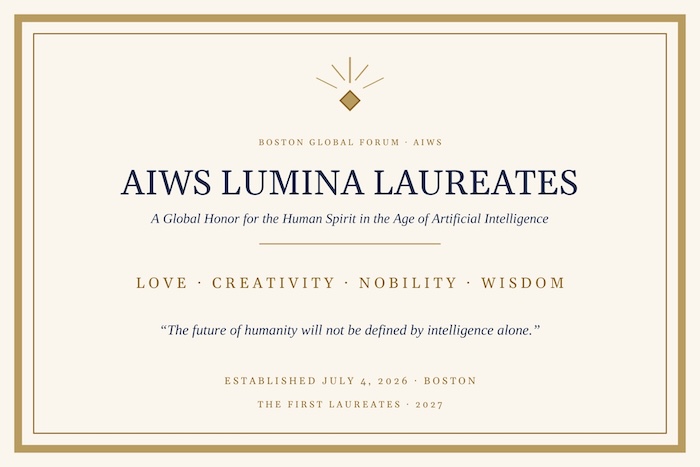
Boston, July 4, 2026 — On the historic occasion of the 250th anniversary of the United States Declaration of Independence, the Boston Global Forum (BGF) and AIWS announce the establishment of the AIWS Lumina Laureates, a global honor celebrating the world of culture, the arts, and sport — recognizing individuals whose lives and works elevate humanity and help build a more humane, wise, and noble civilization in the Age of Artificial Intelligence.
The announcement is part of The July 4, 2026 Collection: “A New Beacon for Humanity in the Age of Artificial Intelligence” — a landmark collection of declarations, publications, and initiatives inspired by the enduring values of freedom, democracy, human dignity, trust, innovation, and service to humanity.
At a moment when artificial intelligence is rapidly transforming civilization, the establishment of the AIWS Lumina Laureates affirms a profound principle:
The future of humanity will not be defined by intelligence alone. It must be guided by wisdom, compassion, creativity, nobility, and the highest values of the human spirit.
A New Honor for a New Era
The AIWS Lumina Laureates will recognize extraordinary individuals across nations and disciplines — including artists, writers, musicians, filmmakers, cultural figures, athletes, and spiritual and cultural voices — whose lives and works contribute to:
Elevating the human spirit through culture, the arts, and sport;
Nurturing beauty, meaning, and shared humanity in the AI Age;
Preserving and enriching human wisdom, culture, and creativity;
Inspiring future generations through lives of integrity, courage, compassion, and noble purpose.
The AIWS Lumina Laureates program represents the cultural and humanistic pillar of the AIWS vision — complementing AIWS Trust Infrastructure, AIWS Trust Order, and the development of the Constitution for Humanity in the Age of Artificial Intelligence.
The AIWS Lumina Laureates is distinct from — and complementary to — the World Leader in AIWS Award, which honors statesmen and leaders of public life, and the America 250: AI Pioneers, which honors the scientists and builders of the AI Age. The Lumina Laureates celebrates those who elevate humanity through culture, the arts, and sport.
From Artificial Intelligence to AI Wisdom
AIWS Lumina is founded on the conviction that the AI Age must become not only an era of more powerful technology, but an era of a more enlightened humanity. AI should help humanity become not merely more capable — but wiser, more compassionate, more creative, and more noble.
Through the AIWS Lumina Laureates, BGF and AIWS seek to honor those whose examples can become guiding lights for humanity — preserving the finest achievements of the human journey while inspiring a new civilization where technology serves wisdom and human dignity.
A Journey Toward the Constitution for Humanity in the AI Age
The establishment of the AIWS Lumina Laureates also marks the beginning of a broader global effort inspired by The Boston Declaration: On the Primacy of the Human Person in the Age of Artificial Intelligence.
BGF and AIWS will convene AI pioneers, scientists, thinkers, artists, religious leaders, policymakers, innovators, and citizens worldwide to contribute to the Constitution for Humanity in the Age of Artificial Intelligence, planned for presentation to the world in 2027.
Nguyen Anh Tuan, Co-Founder, Co-Chair and CEO of Boston Global Forum and Chief Architect of AIWS, stated:
“In the AI Age, humanity needs not only greater intelligence, but greater wisdom. The AIWS Lumina Laureates honors those whose lives remind us what makes humanity truly great: love, creativity, nobility, wisdom, and the enduring pursuit of a better world.”
The first AIWS Lumina Laureates will be announced in 2027.
About the Boston Global Forum
Founded in Boston by Governor Michael S. Dukakis, Nguyen Anh Tuan, and Professor Thomas Patterson, the Boston Global Forum brings together leaders, strategists, and thinkers to address the most critical issues facing the world. Through AIWS, founded in 2017, BGF pioneers the frameworks of a trustworthy AI age — AIWS Trust Infrastructure, the AIWS Trust Order, AIWS Lumina, and the America 250: AI Pioneers.
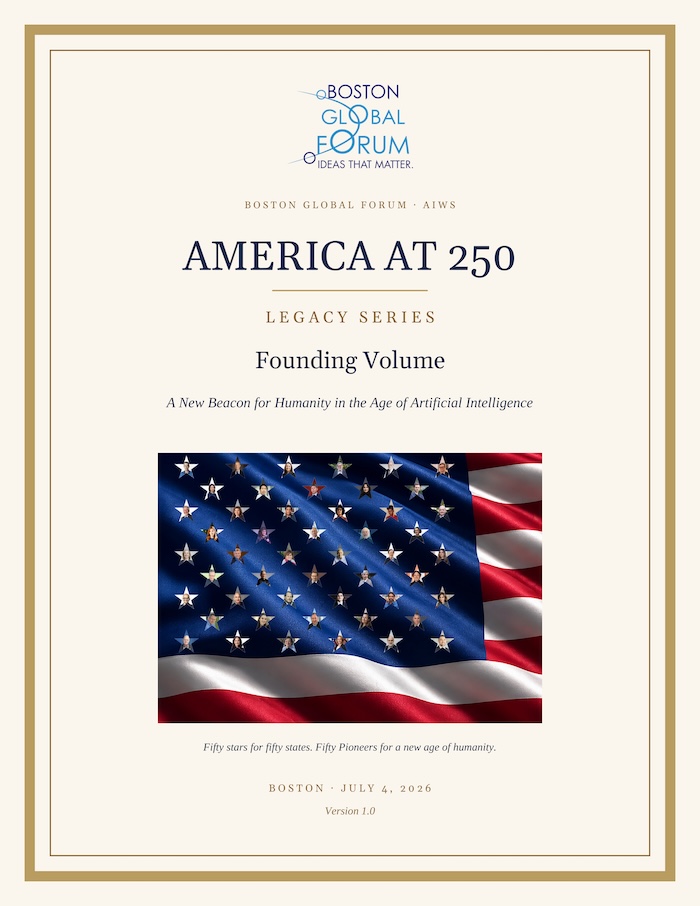
Boston, July 4, 2026 — As America marks its 250th anniversary, the Boston Global Forum publishes the America at 250 Legacy Series — Founding Volume (Version 1.0): A New Beacon for Humanity in the Age of Artificial Intelligence.
This Founding Volume documents a historic journey — from a vision of renewing America’s role as a beacon in the AI Age to a global movement for building a future where artificial intelligence serves humanity.
Inspired by the book America at 250: A Beacon for the AI Age by Governor Michael S. Dukakis and Nguyen Anh Tuan, the volume traces a decade of ideas, initiatives, and actions — from the founding of AIWS in 2017, through engagements with the G7, the OECD, Club de Madrid, the Riga Conference, the United Nations, and the G20 — that led to:
AIWS Trust Infrastructure — building trust as the foundation of the AI Age;
AIWS Trust Order — creating cooperation among leaders, innovators, and institutions committed to trustworthy AI;
AIWS Lumina — advancing a culture of Love, Creativity, Nobility, and Wisdom;
The Boston Declaration: On the Primacy of the Human Person in the Age of Artificial Intelligence — reproduced in full within this volume.
From the America at 250 Conference at Harvard University on May 1, 2026 — where the fifty America 250: AI Pioneers were honored — to the Tokyo Compact and the AIWS Trust Order advanced in Tokyo on June 12, 2026, the volume captures the milestones of a new effort to shape the AI Age.
The Founding Volume also opens the pathway toward the next historic mission: The Constitution for Humanity in the Age of Artificial Intelligence, to be shaped at the AIWS Constitutional Convention.
This edition is published as Version 1.0. Version 2.0 — enriched with historical photographs of the events and milestones recorded in these pages — will be officially released at the Boston Global Forum Conference in November 2026, at Loeb House, Harvard University.
At a time when artificial intelligence is transforming civilization, the central question is not only how powerful AI will become — but how wisely humanity will guide it, with dignity, trust, and wisdom.
We invite readers, leaders, innovators, and citizens around the world to explore this journey — and to join in building an AI Age for humanity.
RAISE SUMMIT 2026 AND MACHINA · PARIS · JULY 7–9, 2026
At RAISE Summit 2026 and MACHINA, taking place in Paris, France, July 7–9, 2026, global leaders in artificial intelligence will gather to explore the next great transformation of the AI era: the movement of AI beyond screens, software, and language models into the physical world.
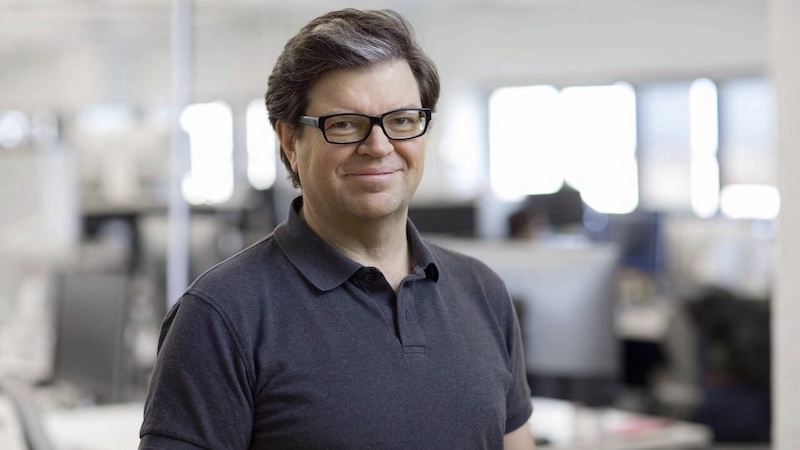
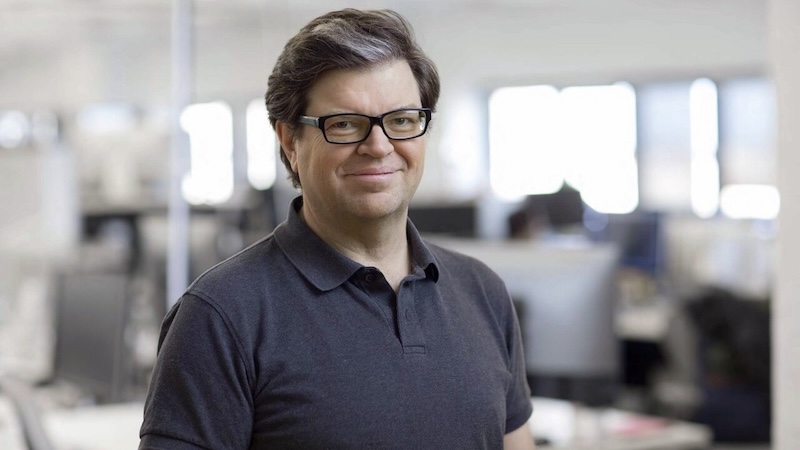
Organized by RAISE, with MACHINA as a dedicated forum for Physical AI, the summit brings together founders, researchers, technology executives, robotics innovators, investors, and policymakers shaping the future of embodied intelligence. Among the featured speakers is Yann LeCun — a pioneer of deep learning, honored among the America 250: AI Pioneers and a Founding Signatory of the Boston Declaration — alongside leaders in robotics and embodied AI from across the world.
The summit reflects a vision articulated by leaders of the new era of AI and computing, including Jensen Huang, who has described Physical AI as the next wave — intelligent systems that understand the laws of the physical world and operate through robots, autonomous machines, and industrial systems.
Physical AI — integrating artificial intelligence with robotics, humanoids, autonomous systems, digital twins, and intelligent machines — is becoming a strategic domain for manufacturing, healthcare, transportation, security, infrastructure, and society.
This transition raises a historic challenge: as AI gains the ability not only to generate information but also to act in the physical world, humanity must build new foundations of trust, safety, accountability, transparency, and Human-in-Command governance.
The rise of Physical AI reinforces the importance of the AIWS Trust Infrastructure and The Boston Declaration: On the Primacy of the Human Person in the Age of Artificial Intelligence — ensuring that intelligent machines, whether digital or physical, serve human dignity, freedom, and wisdom.
On the Primacy of the Human Person in the Age of Artificial Intelligence
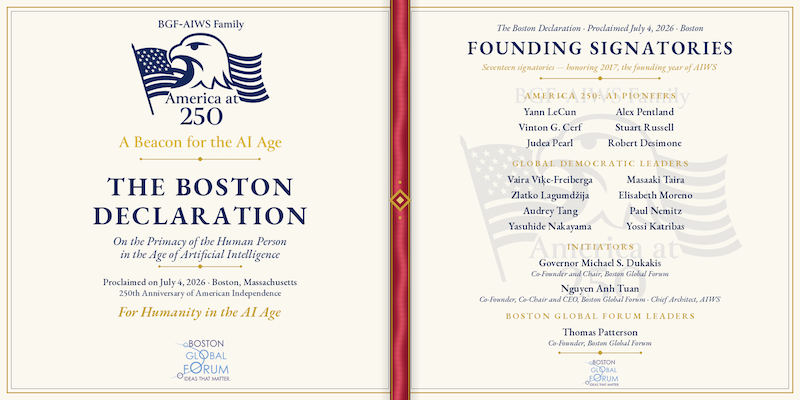
On the 250th Anniversary of American Independence, the Boston Global Forum (BGF) proudly proclaims The Boston Declaration—a historic call to uphold human dignity, freedom, democracy, responsibility, trust, and wisdom as the enduring foundations of the Age of Artificial Intelligence.
Inspired by the ideals that have shaped free societies for two and a half centuries, the Declaration affirms a timeless truth:
Artificial Intelligence may surpass human intelligence in many domains. It must never surpass the primacy of the human person.
The inaugural edition is presented with the support of distinguished Founding Signatories—world-renowned AI pioneers, global democratic leaders, the Initiators, and the leadership of the Boston Global Forum—who together affirm a shared commitment to ensuring that Artificial Intelligence always serves humanity.
More than a declaration, this document marks the beginning of a global journey toward the Constitution for Humanity in the Age of Artificial Intelligence, to be presented in 2027, on the tenth anniversary of AIWS (AI Wisdom Society).
We warmly invite leaders, scientists, innovators, educators, institutions, and citizens around the world to read, download, and share the official edition of the Boston Declaration. Together, let us build an AI Age guided not only by intelligence, but by trust, wisdom, freedom, and the enduring dignity of every human person.
The Circle is open. Join us in shaping a future where Artificial Intelligence serves humanity, strengthens democracy, advances peace, and elevates the human spirit.
Boston, July 4, 2026 — Two hundred and fifty years after the Declaration of Independence, the Boston Global Forum and AIWS publish their Historical Special Edition — and with it, The Boston Declaration: On the Primacy of the Human Person in the Age of Artificial Intelligence.
The Boston Declaration affirms a principle that must guide the future of civilization: “Artificial Intelligence may surpass human intelligence in many domains. It must never surpass the primacy of the human person.” It further affirms: “The destiny of Artificial Intelligence is fulfilled only when it advances human wisdom, human dignity, and human flourishing.” If the Declaration of Independence helped define the Age of Freedom, the Boston Declaration is offered to help inspire an age in which wisdom governs intelligence — and human dignity remains the guiding light of civilization.
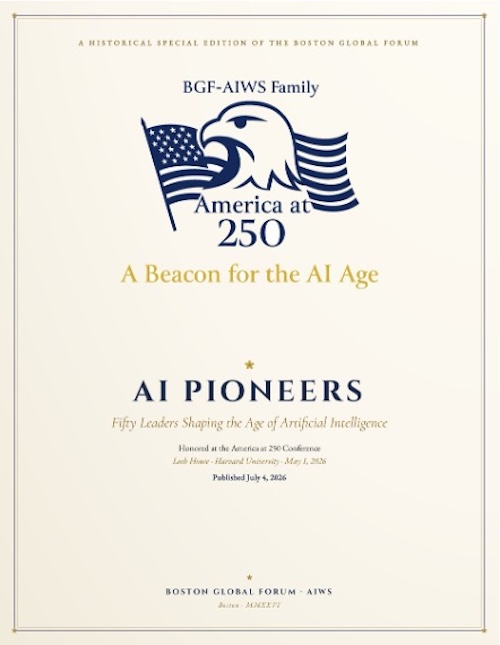
Alongside the Declaration, the Special Edition honors the fifty recipients of the America 250: AI Pioneers Award, presented at the America at 250: A Beacon for the AI Age Conference at Loeb House, Harvard University, on May 1, 2026. From Jeff Dean, Judea Pearl, and Vint Cerf to Katalin Karikó, Fei-Fei Li, Daniela Rus, and Paul Scharre, the fifty honorees are the researchers, builders, physicians, educators, and public servants whose work laid the foundations of the AI Age — and whose choices will help define America’s next 250 years.
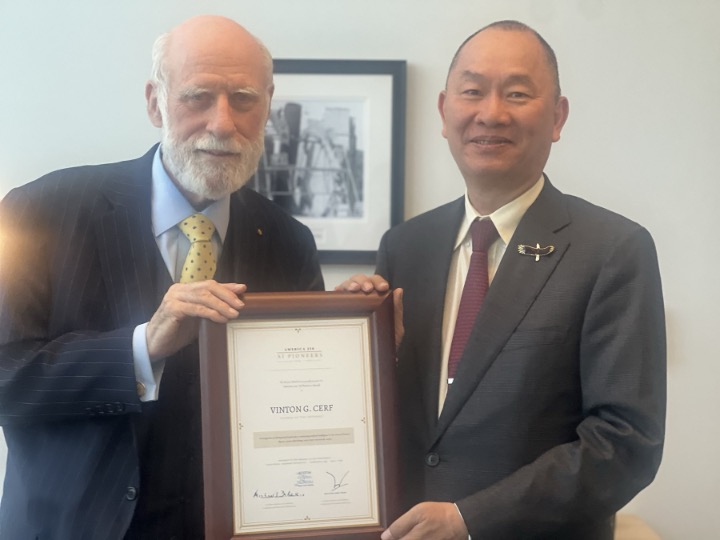
Nguyen Anh Tuan presents the America 250: AI Pioneers Award to Vint Cerf.
Initiated by Governor Michael S. Dukakis and Nguyen Anh Tuan, the volume opens with the essay The Idea and Its Realization and unfolds across more than three hundred pages: the roster of the fifty Pioneers, the Certificates of Honor, the Conference in Pictures, fifty Special Profiles, and The Award Presented in Person — photographs of presentations at the offices of Vint Cerf, Eric Lander, Robert Desimone, and Regina Barzilay.
The edition closes with Beacon for the Fourth of July, a statement that also inaugurates Beacon, a new weekly column by Nguyen Anh Tuan published by the Boston Global Forum.
America at 250 — AI Pioneers: the Historical Special Edition of the Boston Global Forum.
As the United States heads toward its 250th anniversary on July 4, Americans are looking forward to enjoying the parades, fireworks, and patriotic ceremonies.
But amid deep political division and renewed debate over the limits of executive power, voting rights, and the role of the courts, a reflective way to honor America’s 250th is to revisit the nation’s founding framework itself: the U.S. Constitution.
Boston Global Forum co-founder Tom Patterson created a way to do that. It’s a free, nonpartisan online Harvard University course that aims to make constitutional understanding accessible to everyday Americans. Created for a broad audience, the course breaks the subject into six short modules—about 30 minutes each—covering the Constitution’s origins and core design, including separation of powers, federalism, and the Bill of Rights. Participants can take the course at no cost by choosing the “audit” option.
The Anniversary is not only a celebration of the nation’s past, but also a reminder that the American experiment depends on shared civic knowledge. Reflecting on constitutional principles can offer common ground—helping Americans disagree more constructively by anchoring public debate in an understanding of their governing system.
Anyone interested in a meaningful July 4 observance can access the course here: https://bit.ly/FreeCourseHarvard (click “audit” for the free version).
We also encourage you to share the link widely—posting it to social media, including it in newsletters, or sending it directly to friends and family. A ready-to-use post reads: “Looking for a meaningful way to celebrate July 4? Take a free, short, nonpartisan Harvard online course on the U.S. Constitution: https://bit.ly/FreeCourseHarvard (click ‘audit’ for free version).”