Boston, Massachusetts — July 4, 2026 — On the 250th Anniversary of American Independence, the Boston Global Forum (BGF) proclaims The Boston Declaration: On the Primacy of the Human Person in the Age of Artificial Intelligence, a landmark declaration affirming that humanity must remain at the center of the AI Age.
The Declaration was conceived and drafted by Nguyen Anh Tuan, Co-Founder, Co-Chair and CEO of BGF and Chief Architect of AIWS, and initiated together with Governor Michael S. Dukakis, Co-Founder and Chair of BGF.
At this historic turning point — when artificial intelligence is rapidly transforming civilization — the Boston Declaration establishes a fundamental principle:
“Artificial Intelligence may surpass human intelligence in many domains. It must never surpass the primacy of the human person.”
Building upon the vision of the book America at 250: A Beacon for the AI Age by Governor Dukakis and Nguyen Anh Tuan, the Declaration advances a new foundation for a future where AI serves human dignity, freedom, democracy, creativity, and wisdom.
The Boston Declaration continues the journey of AIWS, founded in 2017 — from the Social Contract for the AI Age to AIWS Trust Infrastructure, AIWS Trust Order, and AIWS Lumina — transforming AIWS from AI World Society into AI Wisdom Society.
The Founding Signatories include distinguished America 250: AI Pioneers, scientists, and global leaders who have shaped technology, governance, and human progress — including pioneers of AI, the Internet, neuroscience, democracy, and international cooperation.
“The defining question before us is no longer only how powerful artificial intelligence will become — but how wisely humanity will guide it,” said Nguyen Anh Tuan.
The Declaration follows historic milestones:
May 1, 2026 — Harvard University: the America at 250 Conference gathered the AI Pioneers to build AIWS Trust Infrastructure.
June 12, 2026 — Tokyo: the Tokyo Compact and AIWS Trust Order advanced a global framework for trustworthy AI.
July 4, 2026 — Boston: the Boston Declaration establishes a moral foundation for the AI Age.
The Boston Declaration opens the path toward the next milestone: The Constitution for Humanity in the Age of Artificial Intelligence.
Founded in Boston by Governor Michael S. Dukakis, Nguyen Anh Tuan, and Professor Thomas Patterson, the Boston Global Forum brings together leaders, strategists, and thinkers to address the most critical issues facing the world. Through AIWS, founded in 2017, BGF pioneers the frameworks of a trustworthy AI age — AIWS Trust Infrastructure, the AIWS Trust Order, AIWS Lumina, and the America 250: AI Pioneers.
Media Contact: Helena Ellington · [email protected] · phone: +1 617 286 6589
Throughout history, humanity has advanced not only through great discoveries, but also through great ideas.
Ideas that inspired freedom. Ideas that strengthened democracy. Ideas that advanced science. Ideas that elevated human dignity. Ideas that illuminated new paths when the future was uncertain.
Today, as artificial intelligence rapidly reshapes our civilization, humanity once again stands at a historic turning point.
The Age of Artificial Intelligence will not be defined solely by faster computation, more powerful models, or increasingly capable autonomous systems. It will ultimately be defined by the ideas that guide how these technologies serve humanity.
That is why the Boston Global Forum is launching Beacon.
Beacon is a new weekly series of ideas by Nguyen Anh Tuan, Co-Founder, Co-Chair and CEO of the Boston Global Forum, and Founder and Chief Architect of AIWS.
Each Beacon will present one original idea intended to help guide humanity through the opportunities and challenges of the Age of Artificial Intelligence.
Some Beacons may begin with a major global event. Others may emerge from technological breakthroughs, meetings with world leaders, conversations with AI pioneers, or moments of quiet reflection.
Yet every Beacon shares the same purpose:To transform events into enduring ideas.
Beacon is not intended to comment on the news. It is intended to help shape the future.
The series will explore subjects including democracy, trust, human dignity, AI governance, wisdom, education, culture, peace, international cooperation, and the evolving relationship between humanity and artificial intelligence.
Many of these ideas will contribute to the continuing development of AIWS, AIWS Trust Infrastructure, AIWS Trust Order, AIWS Lumina, and other initiatives dedicated to building a better future for humanity.
The name Beacon carries a special meaning. Throughout history, a beacon has served as a light that guides travelers, warns of danger, and offers hope in times of uncertainty.
Today, humanity needs a different kind of beacon – not a physical light, but a beacon of ideas.
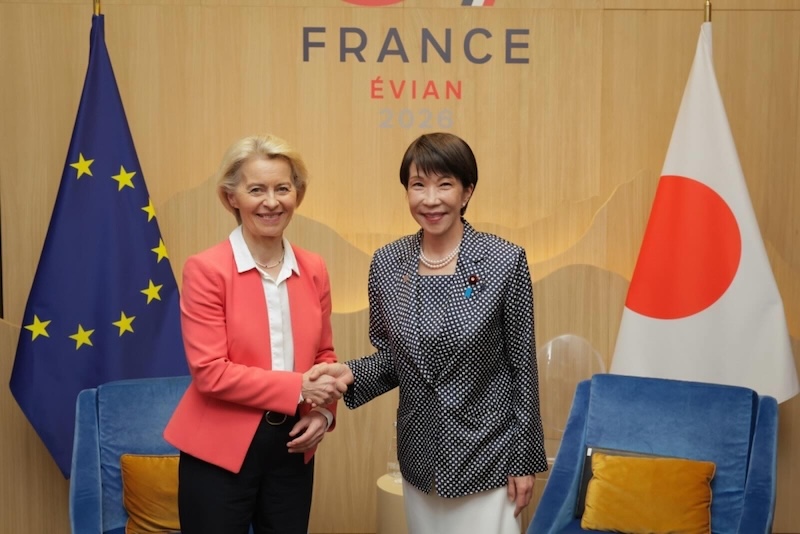
At the G7 Évian Summit (June 15-17, 2026), two leaders previously honored by the Boston Global Forum came together: Ursula von der Leyen, President of the European Commission and recipient of the 2020 World Leader for Peace and Security Award, and Sanae Takaichi, Prime Minister of Japan and recipient of the 2023 World Leader in AIWS Award. Following the working session on “Reviving a Balanced, Shared and Sustainable Economic Growth,” Prime Minister Takaichi held a meeting with President von der Leyen.
Their encounter is a small portrait of the Europe-Indo-Pacific cooperation on economic security and trustworthy technology that the AIWS Trust Order envisions. As Europe advances its own sovereign-AI and trust frameworks and Japan deepens the U.S.-Japan alliance and its economic-security agenda, the convergence of these two honorees – representing two of the Forum’s pillars, Peace & Security and AIWS – reflects a conviction at the heart of BGF’s work.
BGF Lens – two leaders the Forum has recognized now sit at the same table at the moment the global AI order is being redrawn — a reminder that the technologies reshaping our age must be governed by trust, and in the service of human dignity.
Sources: Prime Minister’s Office of Japan; Boston Global Forum Awards.
“There Is No Opportunity Without Threat”: Guiding AI with the Discipline of Security
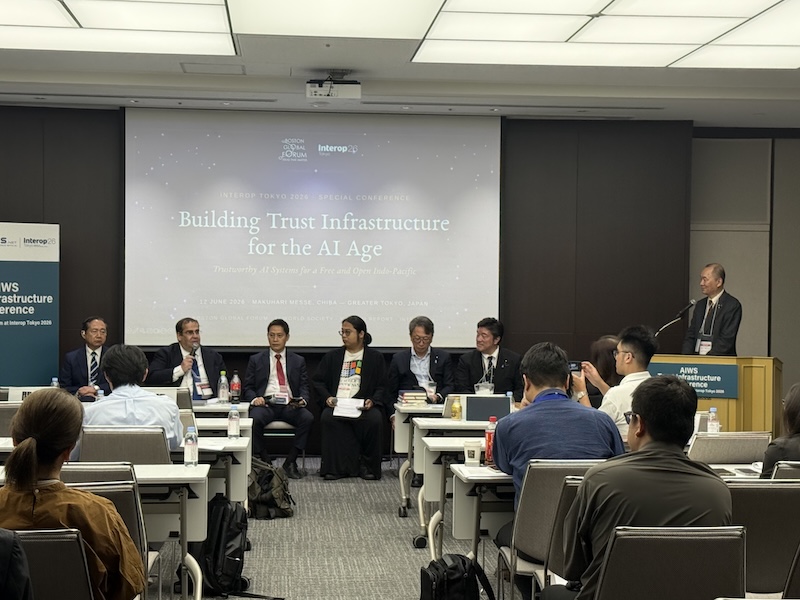
From the address of Yossi Katribas – Former Senior Deputy Director General of the Israeli Prime Minister’s Office; Representative of the Boston Global Forum in Israel and India at the BGF-Interop Tokyo Conference, June 12, 2026.
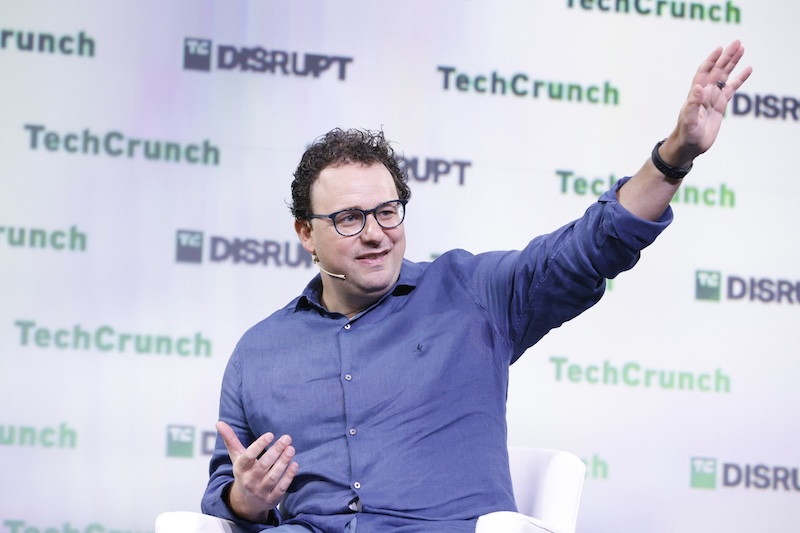
Yossi Katribas (with microphone) on the panel at the BGF-Interop Tokyo Conference, “Building Trust Infrastructure for the AI Age”.
Location: Makuhari Messe, Chiba-Greater Tokyo
Date: June 12, 2026
At the BGF-Interop Tokyo Conference on June 12, 2026, Yossi Katribas – Former Senior Deputy Director General of the Israeli Prime Minister’s Office and the Boston Global Forum’s Representative in Israel and India – offered a candid reflection on artificial intelligence, trust, and security. Drawing on a career spanning military intelligence, Israel’s national digital initiatives, and senior service in the Prime Minister’s Office, he opened with an Israeli maxim, “there is no opportunity without threat,” framing AI as a force that brings both, and that must be met with clear eyes.
His first message was one of confidence: humanity will not, and should not, halt the rise of AI. “We will not stop the emerging of AI,” he said; the task is to escort it and give it the right direction, rather than retreat from it in fear. He recalled how, some thirty years ago, militaries hesitated to adopt the then-new technology of the mobile phone – a reminder that transformative tools are first resisted, then become indispensable.
Yet he tempered that optimism with a security realist’s caution. Regulations and procedures matter, he noted, but there will always be states, organizations, and individuals who do not play by the rules – and so there is “no 100%.” Trust takes time to build and cannot be extended to adversaries or criminals, who will always seek to surprise. Governing AI is therefore, at root, an exercise in risk assessment, demanding the same discipline as cyber security. He illustrated the point with digital health and autonomous vehicles – technologies society cannot stop and must instead regulate, manage, and “live with,” moral dilemmas and all.
His central warning looked to the future: AI has not dethroned cyber security. “They have to live together.” As AI advances, dependence on computing deepens; systems left unguarded place trust itself at risk. He cautioned emerging societies in particular against leaping to AI capabilities before building the cyber-security foundations on which any trustworthy system must stand. AI is a good process but it must be escorted, given direction, and never separated from the discipline of security.
BGF Lens – his remarks sharpen a principle at the heart of AIWS Trust Infrastructure and the AIWS Trust Order: that trust in the AI Age is not a sentiment but a discipline – built over time, tested against real adversaries, and inseparable from security.
The setting is especially fitting: Mr. Katribas himself helped strengthen Israel-Japan cooperation around Prime Minister Shinzo Abe’s 2015 visit to Israel. In the spirit of the Shinzo Abe Initiative’s commitment to peace and security, his counsel reminds us that directing AI toward human benefit requires both moral vision and the hard, patient work of safeguarding the systems on which it runs.
Sources: Speaker’s remarks, BGF-Interop Tokyo Conference, June 12, 2026.
The most consequential AI story of the past week centered on Anthropic and its CEO, Dario Amodei – one of the America 250: AI Pioneers. The United States issued an export-control directive barring foreign nationals from accessing the company’s most advanced models; unable to separate foreign from domestic users in real time, Anthropic disabled those models worldwide. The episode escalated when the Director of the NSA testified that, in a classified red-team exercise, the model had autonomously breached nearly all of the agency’s classified systems within hours.
The controversy shifts the center of gravity in AI governance – from preventing misuse toward governing the autonomous capability of the model itself. It also accelerated a broader fracturing toward “sovereign AI”: rival states moved quickly to respond, and open-weight alternatives gained ground, underscoring the need for shared frameworks of trust across blocs.
BGF Lens – this is precisely the principle at the heart of AIWS – that human command must remain sovereign over intelligent systems, however capable they become. It is a real-world test of the very questions the Boston Declaration and the AIWS Trust Order were created to answer: in an age of increasingly autonomous machines, who holds final authority – the human person, or the instrument?
Sources: reporting on the U.S. export-control directive and NSA Senate testimony; industry coverage of sovereign-AI responses.
AIWS Lumina Laureates: Honoring Those Who Illuminate Humanity in the AI Age
AIWS Lumina As humanity enters the Age of Artificial Intelligence, the world must not only recognize technological achievement, but also honor those who illuminate the human spirit.
The Boston Global Forum will introduce the AIWS Lumina Laureates as a new initiative to honor artists, storytellers, writers, filmmakers, musicians, designers, athletes, and cultural stewards whose work, vision, and moral leadership advance human dignity, wisdom, creativity, compassion, and peace in the Age of Artificial Intelligence.
Inspired by the values of AIWS Lumina – Love, Creativity, Nobility, and Wisdom – this initiative reflects a simple but profound conviction: the future of artificial intelligence must be guided not only by intelligence, but by wisdom; not only by innovation, but by humanity.
The AIWS Lumina Laureates are the cultural counterpart to the America 250: AI Pioneers. Where the Pioneers built the foundations of the AI Age, the Laureates ensure that this age remains humane, beautiful, and worthy of the human spirit. They honor those who bring light to the human journey – the creators and cultural voices whose work helps society rise above fear, division, and narrow technological ambition.
The initiative will be formally announced on July 4, 2026, as part of the Boston Global Forum’s special program commemorating America at 250 and advancing a new beacon for humanity in the Age of Artificial Intelligence. The first Laureates will be honored in 2027.
In the AI Age, the world needs more than powerful machines. It needs luminous human beings.
BGF Lens – if the AI Pioneers give the age its intelligence, the Lumina Laureates help give it a soul. The initiative will celebrate those who help humanity see more beautifully, live more nobly, and build a wiser future together – ensuring that, at the height of its power, civilization chooses to remain human.
Sources: Boston Global Forum; AIWS Lumina Laureates Concept Note.
“Careful Adoption of Agentic AI Services” Five Eyes cybersecurity agencies, May 1, 2026
The rapid emergence of agentic AI marks a new chapter in artificial intelligence. Unlike earlier systems that primarily generated content or responded to prompts, agentic AI can independently plan, make decisions, coordinate with other agents, use digital tools, and execute complex tasks with limited human intervention.
For governments, this presents both extraordinary opportunity and unprecedented governance challenges. On May 1, 2026, the cybersecurity agencies of the Five Eyes nations – the United States, the United Kingdom, Canada, Australia, and New Zealand – took a first coordinated step, jointly publishing “Careful Adoption of Agentic AI Services,” the first multigovernment security guidance devoted specifically to autonomous AI systems. It identifies five categories of risk – privilege, design and configuration, behavioral, structural, and accountability – and insists that strong governance, explicit accountability, rigorous monitoring, and human oversight are essential prerequisites, not optional safeguards.
The Boston Global Forum welcomes this milestone – and believes the moment calls for more. While existing frameworks emphasize safety, transparency, privacy, and accountability, systems capable of autonomous action must do more than operate safely; they must remain trustworthy throughout their operational lifecycle. The next generation of AI governance should move beyond AI safety toward a new international standard built on Trust Infrastructure.
Such a standard should rest on several foundational principles:
Human Authority. Every agentic AI system must operate under clearly defined human authority, with meaningful human oversight of critical decisions.
Trust by Design. Trust should be engineered into the architecture of AI systems from the outset, rather than added after deployment.
Continuous Trust Evaluation. Agents should be continuously assessed through measurable trust indicators – reliability, factual integrity, cybersecurity resilience, behavioral consistency, and compliance with established governance standards.
Agent Accountability. Every autonomous action should be traceable, explainable, and auditable through secure logging and provenance mechanisms.
Collective Governance. Multi-agent ecosystems require governing not only individual agents but also their interactions, coordination, and emergent behaviors.
These principles align closely with the AIWS Trust Infrastructure. Rather than relying on regulation alone, AIWS proposes a practical governance architecture combining Trust Ratings, Trust Standards, Information Trust Infrastructure, continuous monitoring, and human-centered oversight.
As agentic AI becomes an essential component of government, business, healthcare, education, finance, and national security, the international community faces a choice: it can continue extending frameworks designed for earlier generations of AI, or it can establish a new paradigm built specifically for autonomous intelligent systems. The emergence of agentic AI calls not simply for stronger regulation, but for a new architecture of trust.
In the AI Age, trust is no longer merely an ethical aspiration. It is becoming essential public infrastructure.
The Five Eyes guidance is an important opening. It should evolve beyond national-security cooperation toward internationally interoperable governance standards that democratic societies can share with partners around the world. The Boston Global Forum will continue advancing AIWS Trust Infrastructure and working with governments, technology leaders, and international organizations to help build this new foundation for trustworthy agentic AI.
BGF Lens – the Five Eyes guidance treats agentic AI as a security problem; the Boston Global Forum reframes it as a trust problem. Security keeps autonomous systems from being exploited; trust ensures they remain worthy of the authority we grant them – with the human person always in command.
Sources: “Careful Adoption of Agentic AI Services,” Five Eyes cybersecurity agencies, May 1, 2026; Boston Global Forum AIWS Trust Infrastructure.
As the United States celebrates the 250th anniversary of the Declaration of Independence, the Boston Global Forum will present The July 4, 2026 Collection — a landmark set of declarations, publications, and initiatives inspired by the enduring ideals of freedom, democracy, human dignity, trust, and innovation.
These works look beyond today’s technological revolution. They ask a deeper question:
How can humanity flourish in the Age of Artificial Intelligence?
On July 4, 2026, the Boston Global Forum will publish and announce:
✦ The Boston Declaration: On the Primacy of the Human Person in the Age of Artificial Intelligence.
✦ A Founder’s Reflection by Nguyen Anh Tuan — The Boston Declaration: Renewing America’s Beacon for Humanity in the Age of Artificial Intelligence.
✦ America at 250: A Beacon for the AI Age — Special Edition.
✦ America 250: AI Pioneers — Special Edition.
✦ The establishment of AIWS Lumina Laureates, honoring those whose lives and work elevate humanity in the Age of Artificial Intelligence.
Together, these works affirm a simple but profound conviction:
Artificial Intelligence should not merely make humanity more capable. It should help humanity become wiser, more compassionate, more creative, and more noble.
July 4 will also mark the beginning of a new global journey. Inspired by The Boston Declaration, the Boston Global Forum and AIWS will launch the international initiative to develop the Constitution for Humanity in the Age of Artificial Intelligence, to be presented to the world in 2027 — bringing together AI pioneers, scientists, educators, artists, philosophers, public leaders, religious leaders, and citizens from around the world.
These initiatives are not simply publications. They represent a long-term commitment to building a future where intelligence serves wisdom, technology serves humanity, trust strengthens freedom, culture elevates civilization, and human dignity remains the guiding light of the AI Age.
We warmly invite friends, colleagues, partners, scholars, innovators, artists, and citizens around the world to join us in this new chapter.
To receive all official publications and announcements on the morning of July 4, 2026, please send your name, organization, and email address to: [email protected]
Subscribers will receive direct access to The July 4, 2026 Collection immediately upon its release.
From Harvard in May to Tokyo in June to the G7 in France, a single recognition is taking hold across the world: in the Age of AI, intelligence alone is not enough.
On May 1, 2026, the Boston Global Forum hosted the America at 250: A Beacon for the AI Age Conference at Harvard University, bringing together AI pioneers, policymakers, scholars, and civic leaders to discuss one of the defining questions of our time: How do we build trust in the Age of Artificial Intelligence?
At the conference, BGF-AIWS introduced key elements of the AIWS Trust Architecture, including AIWS Trust Infrastructure and the vision of an AIWS Trust Order—a framework to help guide the development of advanced AI systems in service of humanity.
Just weeks later, events around the world demonstrated the growing importance of this challenge. On June 12, 2026, at Interop Tokyo 2026, BGF-AIWS introduced The Tokyo Compact and formally launched the AIWS Trust Order, bringing together leaders, policymakers, and technology experts to advance a global framework founded on Trust, Human Dignity, Human Command, Responsibility, Democracy, Freedom, and Wisdom.
Only days afterward, leaders on the sidelines of the G7 Summit in Évian, France, discussed the concept of “trusted partners”—a framework for trusted access to the frontier AI capabilities developed by leading AI companies. Though these efforts emerged from very different contexts, together they reflect a common reality: trust is rapidly becoming a central organizing principle of the AI Age.
The conversation is evolving from how to build more powerful AI systems toward how to govern them responsibly, how to ensure trustworthy access, and how to protect human values in a world transformed by artificial intelligence.
A YEAR OF TRUST
March 15, 2026 – AIWS Trust Architecture White Paper
May 1, 2026 – America at 250: A Beacon for the AI Age, Harvard University
June 12, 2026 – The Tokyo Compact & AIWS Trust Order, Interop Tokyo 2026
June 2026 – The G7’s trusted-partners discussions, Évian, France
Seen together, this journey reflects a growing international recognition that intelligence alone is not enough. The future of AI will depend on trust. And as artificial intelligence continues to reshape civilization, the builders of intelligence must also become the builders of trust.
QUOTE OF THE WEEK
“The builders of intelligence must now become the builders of trust.”— America at 250: A Beacon for the AI Age