by Admin | Mar 31, 2014 | News
(Photo Credit: MARK RALSTON/RIE ISHII/AFP/Getty Images)
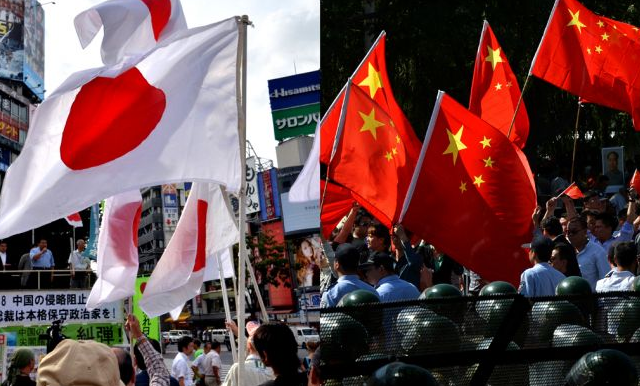
(BGF) – In this article, featured in The Globalist, J.D. Bindenagel looks to Europe in 1914 in an attempt to distill lessons for Chinese-Japanese relations. As Bindenagel notes, the outbreak of WWI demonstrated that economic and trade ties alone cannot necessarily prevent the onset of war and conflict. Thus, in order to avoid conflict China and Japan must find a way to “turn enmity in amity”. Bindenagel then provides four potential steps that can taken to successfully manage the tensions between Japan and China. The article can be viewed below as well as on The Globalist’s website.
Europe 1914: Lessons for China and Japan in 2014
By J.D. Bindenagel
Japan’s Prime Minister Shinzo Abe recently likened the tensions between Japan and China to the relationship between Germany as a rising power challenging the United Kingdom 100 years ago. He certainly had a point when he noted that trading relations and investments had not stopped the brewing conflict in Europe a century ago from engulfing the world in war.
It is ominous that China and Japan are currently so keen on butting heads. After all, this is 2014. People throughout Asia must nervously reflect on the hard lessons the Europeans learned.
Europeans are revisiting the Great War on the 100th anniversary of its outbreak in August 1914 after Gavrilo Princip, a local terrorist in Serbia, not one of the major belligerent countries, assassinated the Archduke Franz Ferdinand of Austria and launched a global war. The failure of European leadership a century ago brought calamity to Europe.
Domino-style, that war brought on a veritable tumbling of major empires, beginning with that led by the Russian Tsar, the Austro-Hungarians and the Ottomans. It also destroyed the foundations of the global economy and European governance. Fascism and dictatorship followed in the 1930s that led to the Second World War and the Cold War.
In East Asia leaders can consider these lessons, remember that economic relations offer no guarantee that rising powers will rise peacefully and prevent the world from sleepwalking into war.
The real challenge, whether then in Europe or now in Asia, is how to turn enmity into amity. Then as now, the best way to proceed is to begin with small steps in the resolution of many disputes. And this is where Japan’s Prime Minister must do much more than (implicitly) point the finger at China.
There is no denying that China suffered humiliation from the Japanese Imperial Army invasion in the Sino-Japanese Wars. Little wonder, given the absence of an apology from Japan, that the Second World War continues to feed Chinese anger.
This is part of the sentiments that are surfacing in thecompeting claims for the Senkaku/Diaoyu Islands in the East China Sea. The lack of recognition of the wartime conquest of Nanjing and Prime Minister Abe’s visit to the controversial Yasukuni shrine remain significant symbols of lack of justice for China.
Unlike the cultural context of Europe that respects apologies that accept responsibility for suffering brought on by the National Socialist regime in the Germany of World War II, Japan and China seem caught in a cultural context where shame is associated with apology.
German President Johannes Rau apologized to the victims of Nazi Germany in 1999, which was respected by the millions of living victims who suffered in the name of the German people. Unfortunately, reconciliation from the bitter events of the Second World War would be ideal, but resolution of all these issues is not likely.
There are several steps that can be taken to successfully manage these tensions:
1. Chinese, Japanese and regional leaders should set aside the use of force to resolve the tension. A code of conduct in the South China Sea is necessary to manage maritime operations.
2. the parties should engage with each other in clarifying narrative to promote mutual understanding and prevent angry populisms and xenophobic nationalism that can rebound to destroy leaders and countries.
3. Japan, China, Vietnam should set aside the unresolved issues and turn to joint management of national interests in fishing, energy and resource development. The Gulf of Tonkin-Hainan agreement between China and Vietnam is one example.
4. The United States should provide needed leadership among parties to create and share historical narratives that can lead to better understanding, maritime policing, adherence to the Law of the Sea and maintenance of the freedom of the seas for shipping, while helping to avoid political miscalculation and military confrontation.
Click here to view the article on The Globalist.
by Admin | Mar 29, 2014 | News
(Photo Credit: Flickr/The White House)
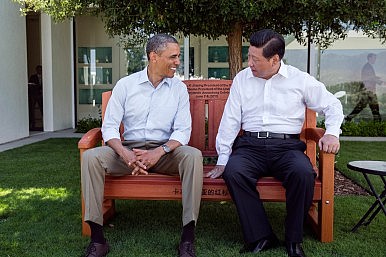
(BGF) – Often, the current relationship between the U.S. and China is viewed as a Thucydidean Trap – essentially a struggle for power between two powers. In this article Shannon Tiezzi looks back at the U.S.-Chinese diplomacy and rhetoric and challenges the view that U.S.-Chinese relations is a Thucydidean Trap. Rather, Tiezzi contends that the current U.S.-Chinese relations are best conceptualized as a Prisoner’s Dilemma. Tiezzi argues that U.S. and Chinese leaders recognize the importance of collaboration and cooperation between the two powers. However, forewshadowing what Kai would later write in The Diplomat there is a deep sense of distrust between the U.S. and China. Thus, both the U.S. and China fear that the other will not follow through on its commitments to cooperate. As a result, neither side wants to be “left holding the bag when the other side inevitably turns hostile.” Therefore, it appears that a lack of trust between the U.S. and China is holding back U.S.-Chinese relations. An excerpt of the article is included below. Click here to read the full article or visit The Diplomat‘s website.
US-China Relations: Thucydidean Trap or Prisoner’s Dilemma?
By Shannon Tiezzi
U.S.-China relations are at a crossroads. China, now the number two economy in the world (and, depending on who you ask, projected to pass the U.S. as number one in 2016, 2020, 2028, or not at all), has a growing political and military clout commensurate with its economic prowess. Accordingly, China has a strategy for achieving a long-time goal: gaining control of its near seas, at least out to the so-called “first island chain.” The U.S., for its part, is loathe to cede its role as the dominant power in the Asia-Pacific, especially given its alliance relationships with many of China’s close neighbors (including South Korea, Japan, the Philippines, Thailand, and, unofficially of course, Taiwan).
But the issue of military or diplomatic dominance in the Asia-Pacific is merely a microcosm of the greater challenge: finding a balance of power between the U.S. and China that is acceptable to both nations. Many analysts have framed this dilemma as the “Thucydidean trap” that arises each time a rising power challenges as established one. To try and escape this historical trap (which has generally led to war), China’s leaders have proposed that China and the U.S. seek a “new type of great power relationship.” But what does this actually mean?
At one meeting between the U.S. and Chinese presidents, there were plenty of ideas on how the U.S. and China could work together. According to the American president, “China and the United States share a profound interest in a stable, prosperous, open Asia” so cooperation on the issue of North Korea’s nuclear program is a must. There’s also a need “to strengthen contacts between our militaries, including through a maritime agreement, to decrease the chances of miscalculation and increase America’s ties to a new generation of China’s military leaders.”
On a global front, “the United States and China share a strong interest in stopping the spread of weapons of mass destruction and other sophisticated weaponry in unstable regions and rogue states, notably Iran.” In addition, there is “the special responsibility our nations bear, as the top two emitters of greenhouse gases, to lead in finding a global solution to the global problem of climate change.”
And the Chinese president offers a broader assessment of what U.S.-China relations should look like: “It is imperative to handle China-U.S. relations and properly address our differences in accordance with the principles of mutual respect, noninterference in each other’s internal affairs, equality, and mutual benefit.”
The above are solid (if vague) proposals that offer a blueprint for moving U.S.-China relations forward. But hold on—those quotes weren’t from President Barack Obama and President Xi Jinping. The speakers were President Bill Clinton and President Jiang Zemin during a press conference in 1997. 17 years later, in 2014, these same issues are still being hashed over and trotted out as areas for improvement. Despite a mind-boggling proliferation in high-level meetings, Beijing and Washington have made little progress on the very issues they’ve been highlighting as areas of cooperation for nearly 20 years. Outside of a steady increase in bilateral trade, have U.S.-China relations really progressed since the 1990s? And if not, how can Beijing and Washington be expected to draw closer now, when the competition between the two is even greater?
Forget the “Thucydidean trap”—China and the U.S. are caught in the foreign policy version of the “prisoners’ dilemma.” Both understand, on a theoretical level, that the best outcome can only be reached via cooperation. But neither country trusts the other to cooperate (for reasons outlined in detail in a report by Brookings’ Kenneth Lieberthal and Peking University’s Wang Jisi). Both sides can “win” through cooperation, but since neither Beijing nor Washington really believes that will happen, they both seek not to be the country left holding the bag when the other side inevitably turns hostile.
Click here to continue reading.
by Admin | Mar 26, 2014 | News
(Photo Credit: Reuters)
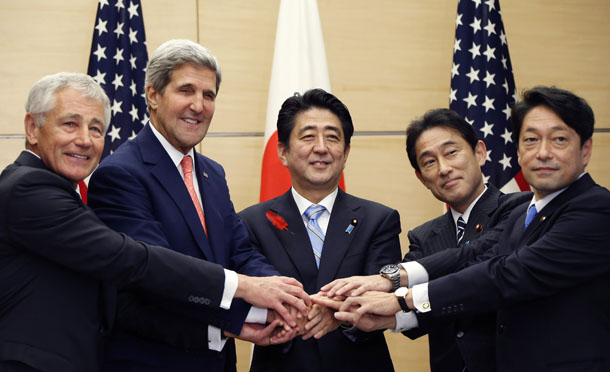
(BGF) – Recently BU Today published an article by Thomas U. Berger, Associate Professor of International relations at Boston University. In this article Professor Berger discussed the U.S.-Japanese security relationship and China’s increasingly bold actions in the South China Sea. As Professor Berger notes in the article, China’s aggressive maneuvers in East Asia have put a strain on the U.S.-Japanese security relationship. For example, the U.S. reaffirmed its commitment to its security pact with Japan, but only did so orally rather than in writing. This raised some concern in Japan. This comes at a time when Japan feels it is particularly vulnerable to threats from its neighbors. Japan, for its part, has experienced a resurgence of nationalist political leaders who have emerged in the face of the threat from its neighbors. Japan’s resurgence of nationalist political leaders have further exacerbated regional tensions. While the economic interdependence between Japan and China make conflict unlikely, Professor Berger argues that the U.S. must increase its support for Japan in order to prevent Japan from undertaking bold actions that could incite further conflict. Ideally, renewed support could encourage Japan to pursue diplomatic resolutions with its neighbors. Otherwise, Obama’s pivot to Asia could be in peril. To read the full article click here or visit the BU Today website.
POV: Obama’s Asian Pivot in Peril?
By Thomas U. Berger
The American-Japanese security relationship has been the cornerstone of US strategy in East Asia for more than half a century. The Obama administration’s “pivot to Asia,” a multipronged effort to keep the United States active in Asian affairs, depends on keeping that relationship strong. Yet while the two countries are investing considerable effort in strengthening ties, there are signs of growing strain. Left unattended, there is a serious and growing risk of a crisis and even a rupture.
Take the “2+2” meeting held in Tokyo last October, where the two governments began revising the guidelines governing defense cooperation between their military forces. They made progress in underlining their continued solidarity and work toward a closer cooperation to meet new security threats: a nuclear-armed North Korea and a more assertive China. But ambivalence was clear.
While Japan may move toward removing some of the legal barriers to closer cooperation, it wants to avoid becoming too entangled in broader US strategic designs. For its part, the United States offered only lukewarm support on the disputed Senkaku-Diaoyu Islands, which are under Japanese control, but are claimed by China. The US reaffirmed orally that if the islands were attacked, it was bound by the terms of its alliance with Japan to come to its aid, but declined to do so in writing, to the disappointment of some in Tokyo.
Past disputes between the United States and Japan didn’t negate the sense that their strategic interests were in substantial agreement. This time, that is being questioned. North Korean nuclear armament and China’s rise have led to a much higher level of threat perception on the part of the Japanese public than at any point since the end of World War II. Although the Soviet Union had far greater military capabilities, the possibility that Japan would be directly threatened seemed remote. Today’s repeated outbreaks of virulent anti-Japanese sentiments—including riots and mass demonstrations—in Beijing and Pyongyang, even in fellow US ally Seoul, has convinced many Japanese that in the event of a conflict, their closest neighbors are capable and eager to attack them. The Chinese-Japanese standoff over the uninhabited Senkaku-Diaoyu Islands and a less militarized dispute with South Korea over the Dokdo-Takeshima Islands reinforce Japanese fears.
This growing sense of threat has encouraged the reemergence of strongly nationalist political leaders, including Japanese Prime Minister Shinzo Abe, who holds revisionist views on Japan’s World War II-era atrocities that are profoundly offensive to Japan’s Asian neighbors. In a potentially vicious cycle, Japan’s resurgent conservative nationalism alarms its neighbors and feeds anti-Japanese sentiments, leading to a greater sense of threat in Japan and a greater readiness to support nationalist politicians. Washington views this with a mixture of trepidation and despair. It seems inconceivable, given the high level of economic interdependence between Japan and its neighbors and the limited strategic value of the disputed territories, that Japan and China would risk a conflict. Yet political realities in Tokyo and Beijing (and Seoul) have locked the sides into a belligerent stance on the disputed islands that sooner or later could lead to a disastrous conflict.
Washington bears some blame for its tensions with Japan. Its position on the territorial disputes is that such disputes be handled peacefully, according to international law. This legalistic position raises suspicions on all sides. Beijing suspects that the United States is trying to encourage the dispute to more firmly embed Japan into an anti-Chinese coalition. In Tokyo, our refusal to commit more fully raises doubts about our reliability in a crisis.
The United States may judge it has little choice but to carry on with its current policies. Revising Japan-US defense cooperation guidelines sends a strong message to Beijing that aggression is intolerable. It reassures the Japanese that the United States will stand by them in a crunch and may discourage Abe from taking a harder-line stance. At the same time, by not taking a position on the territorial issues, Washington warns Japan that its support should not be interpreted as a carte blanche to be more aggressive about history or other sensitive issues, and leaves open the possibility for constructive dialogue with Beijing.
Click here to continue reading
by Admin | Mar 28, 2014 | News
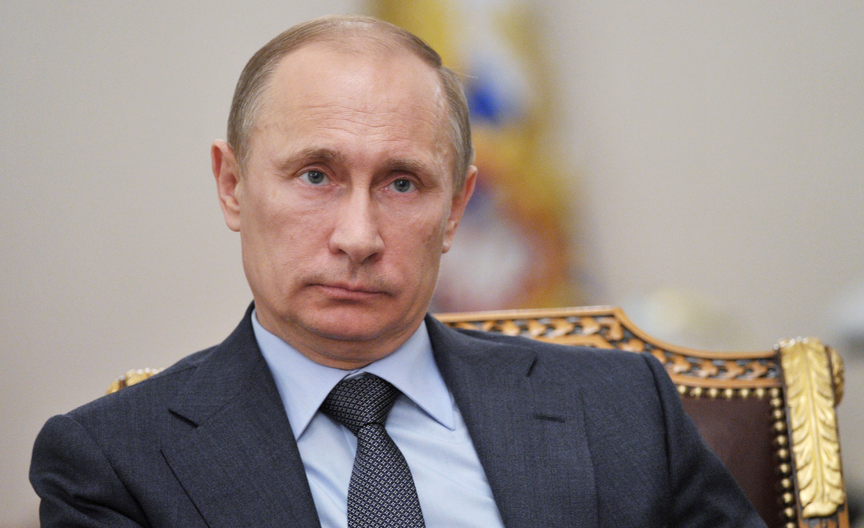
(BGF) – In this article, J.D. Bindenagel assesses Russia’s actions in the Ukraine through the lens of Putin’s experience in East Germany in 1989. During his time as KGB officer, Putin was stationed in East Germany during the German democratic revolution that ultimately led to Germany’s reunification. Bindenagel argues Putin’s experiences in East Germany, particularly witnessing the fall of Soviet rule in East Germany due to democratic street protests, has carried over to his stance on the Ukraine. Thus, we must understand Russia’s incursion into the Ukraine as a geopolitical move based on Putin’s past experience. An excerpt from the article is included below. Click here to read the full article or visit The Globalist‘s website.
Putin’s Russia Reset: What Putin learned from the 1989 German revolution — and how he misunderstood it
By J.D. Bindenagel
Russia’s President Vladimir Putin is a heavily traumatized man. Despite all the air of invincibility he is constantly trying to project to the world, the events in Ukraine ring home to him in a very personal manner.
In fact, Putin has seen this movie – a major ally falling, even though that country was decked out with leaders fully supportive of Russia’s cause – before.
What are the Maidan and the streets of Kiev now were the streets of East Germany back in 1989 – with one big difference: Putin himself was an operative in that battle against freedom.
Lt. Colonel Putin, who spent the 1980s as a KGB officer, had arrived as a near-omnipotent man in East Germany. His Angelikastrasse Villa in Dresden, Putin’s house as the local chief KGB resident, was located directly across the street from what was then the East German secret police, Stasi, headquarters in town.
From this perch, he witnessed a course of events in East Germany that he couldn’t stop from unfolding.
Before long, in August 1994, a once high and mighty Russia simply had to pick up and leave Germany, tail in hand. No doubt these events humbled and shamed him.
Decades later – on Tuesday, March 18, 2014 – and as if to gloss over all over that, Putin tried to be cute. In announcing the annexation of Crimea, he sought to equate it with German reunification and, given that context, asked the Germans to support it. They didn’t take the bait. Chancellor Merkel’s spokesman immediately rejected Putin’s proposition.
Putin thus tried to cast Crimea’s return into Russia’s web as a case akin to when the then-Soviet Union had supported German reunification in 1990.
The Sochi Games – to make shame undone
As part of the campaign for the shame he felt all along from the events of 1989/1990, which he has always perceived as the unnecessary self-diminution of Russia, Putin orchestrated the Sochi Olympic Games. His overarching goal was to celebrate the “new Russia” in the spring of 2014.
Alas, his costly “strategic” planning quickly came to naught. The Sochi Games now resemble an effort to put glossy red lipstick onto the face of the same old Soviet style of operations.
To Putin’s eternal chagrin, the “Ukrainian Street,” with its unbending demonstrations in Kiev, brought down the Russian-sponsored Communist government — and prompted Russia’s occupation of Crimea.
Doubly traumatized
That “his” Olympic Games were double-crossed by a chain of events that remarkably resembles the events Putin had witnessed in East Germany from his Dresden perch in the fall of 1989 was simply too much.
In September 1989, demonstrators in Putin’s Dresden neighborhood took to the streets and demanded freedom.
To add insult to injury, the East German demonstrators were encouraged by then-Soviet President Mikhail Gorbachev. To his eternal credit, he was pursuing new thinking in the Soviet Union to transform and revitalize the Soviet Union through economic restructuring (Perestroika) and openness (Glasnost).
Even though East Germany’s leader, Erich Honecker, rejected Gorbachev’s message, Gorbachev championed the new path and warned that those who came too late would be punished by history.
The East German Street in action
On Saturday, October 7, 1989, just over a month before the collapse of the Wall, East Germany celebrated its 40th anniversary with a massive torchlight parade down Berlin’s main boulevard Unter den Linden, followed by a gala dinner in thePalast der Republik with leaders from the Communist world. President Gorbachev returned to Moscow immediately following the dinner.
That night, as soon as the celebration had ended, the crackdown began. Demonstrators had gathered at theGethsemane Church in Berlin to appeal for the release of political prisoners, freedom to travel and adherence to the Helsinki Final Act guaranteeing human rights.
Around 10 p.m., they were answered by hundreds of police swooping down the streets beating and arresting more than 1,000 demonstrators.
The next day, on Sunday, demonstrators in Leipzig prepared for the by then usual Monday demonstration. Honecker also prepared — to end the counter-revolution in the streets.
East German police were stationed in Leipzig, medical doctors’ leaves were suddenly cancelled and blood supplies ordered. The press was banned from the city and the stage was set for confrontation and bloodshed.
Gorbachev’s East German supporters, notably Hans Modrow, the last communist prime minister in East Germany, saw the dilemma. If the use of force crushed the demonstrators, it would also end Glasnost and Perestroika.
Ridding oneself of Russia
That Monday, October 9, a small group of Leipzig civic and communist leaders convened and agreed to avoid violence. The renowned Leipzig Gewandhaus Orchestra conductor Kurt Masur called for no violence (“Keine Gewalt”) from the demonstrators.
The Leipzig police chief issued the same order to the police.
Demonstrators met at the Nicholaikirche for Pastor Christian Fuehrer’s peace vigil — and that night, 70,000 took to the streets, marching the Leipzig ring road in protest against their Communist government. Violence was avoided.
Days later East German leader Erich Honecker was deposed and on November 9 the Berlin Wall fell. In a few months East Germany ceased to exist.
Undoubtedly traumatized by the events, Putin has had plenty of opportunity to think about the course of events at the time.
He has obviously drawn lessons from his own experience during these months of the democratic revolution in Germany. Putin recalled an incident during the 1989 revolution in Dresden when a mass demonstration aimed at the Stasi office across the street from his residence.
Putin threatened to shoot — in Germany
After the crowd ransacked the Stasi office and then prepared to storm Putin’s building, he called in the Soviet military for protection, told the crowd in fluent German that the property was Soviet territory, and threatened to shoot trespassers. The crowd dispersed.
Gorbachev may have intended to revitalize the Soviet Union, but he failed to use force when he had 380,000 soldiers in East Germany to maintain Soviet rule.
It was a terrible thing to witness for Vladimir Putin, the judo fighter, to see a repeat of this strife for freedom now unroll on the streets of Kiev under his rule.
Worse, Kiev is not Berlin or Leipzig. It is much closer to home. One may have been the “forward” buffer, but Ukraine is essential for Russia and its hyper-security mindedness.
No question on Putin’s mind whatsoever that these street protests are the greatest threat to the Russian Federation yet — and must be stopped. And so it was that democratic demonstrations in the streets of Leipzig and Berlin brought down governments.
Crimea as a consolation prize
Seizing Crimea, at most, is a consolation prize. For that reason, the world has to count on a stealthy, if not overt campaign to destabilize Ukraine further, to make sure it remains, in whatever form, in Russia’s orbit.
Why is this so essential? Because letting it happen yet again isn’t “just” about reliving the East German experience. Kiev’s real precursor is in the streets of Moscow, topped by the last great hurrah – the August Coup in 1991 against President Gorbachev.
Coup plotters and hardline Communist Party leaders opposed both Gorbachev’s new thinking as well as the “Union of Sovereign States Treaty” that Gorbachev sought to avoid the collapse of the Soviet Union.
Click here to read the full article.
by Admin | Mar 25, 2014 | Event Updates
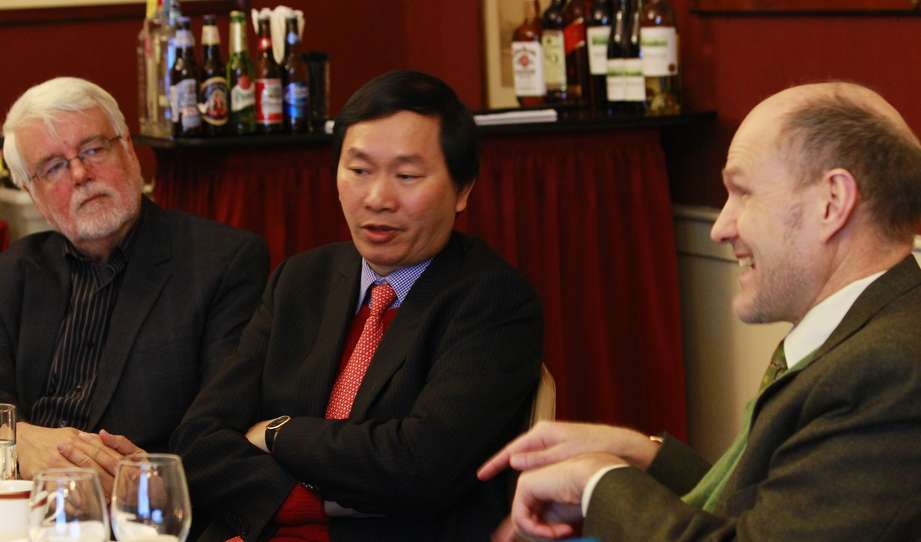
Professor Stephen Walt with Nguyen Anh Tuan, Co-Founder and Editor-in-Chief of the Boston Global Forum.
By Philip Hamilton
(BGF) – The dispute between Russia and Ukraine is currently the focus of extensive international debate. In an effort to clarify the reasons for Russia’s incursion into the Crimea region of Ukraine, as well as propose potential solutions to the conflict, Professor Stephen Walt, the Robert and Renee Belfer Professor of International Affairs at Harvard’s Kennedy School of Government, gave a talk on the situation in Ukraine at the Harvard Club.
A key to unraveling the current conflict between Russia and Ukraine in Crimea is understanding the reasons for Russia’s actions in the region. According to Professor Walt, the current situation in the Ukraine is rooted in Russia’s history. Historically, Russia has been invaded on numerous occasions, including by Napoleon, Germany in World War I, and then again by Germany in World War II. These experiences have led Russia to have a heightened sensitivity to the actions of its neighbors. What is more, Russia has long felt that the U.S. has advocated the steady movement of western institutions into its sphere of influence, especially following the collapse of the Soviet Union.
Russia’s history of being invaded, its subsequent sensitivity to its neighbors, and its perception that the U.S. is moving western institutions further eastward towards Russia has led Russia to take, what are at times, extreme defensive actions. In particular, Professor Walt cites the Russian invasion of Georgia, which he argues was ultimately Russia’s way of sending a message that further eastward expansion by NATO was something Russia would resist by any means necessary.
How does this play into the current situation in Ukraine? Professor Walt argues that we need to recognize these historical antecedents and conceptualize the situation in Ukraine as a geopolitical conflict. Russia’s actions are not motivated by economic strategies or even domestic political pressures. Rather, Russia’s recent actions in Ukraine are a defensive reaction.
Looking back to the origin of the Ukrainian uprisings, Professor Walt noted: “there was an EU economic plan which Putin didn’t like so he upped the ante by offering Yanukovych, it’s previous leader, a better deal: more money, fewer terms, etcetera and probably leaned on him in some other ways. Yanukovych then essentially erased the EU plan, took the Russian plan, and that was one of many things, including his own incompetence and corruption, that started the uprisings against him in Ukraine.” The U.S. response to the Ukrainian uprisings, however, did not help ease the tensions in the region. Rather, the U.S. clearly favored the demonstrators thereby reinforcing the perception in Moscow that the U.S. was trying to shape events in the region. Thus, in reaction, Russia utilized the means it viewed as necessary to exert control in Ukraine and stave off western intrusions in its sphere of influence.
Moving forward, Professor Walt is not optimistic that the conflict will be resolved. However, he made two suggestions for how the U.S. should handle the conflict. Firstly, he proposed that the U.S. defend Ukraine’s territorial integrity. Ideally this would include Crimea but he does not feel that including Crimea is absolutely necessary. Importantly, U.S. efforts to defend the territorial integrity of Ukraine should discourage further Russian incursions in Eastern Ukraine.
Secondly, Professor Walt suggested that the U.S. re-establish Ukraine’s neutrality. In essence, this means that “Ukraine will be a buffer state between east and west – it will not become part of NATO, it might at some point down the road have an association with the European Union…it will not be part of the Russian sphere of influence, it will not be part of our sphere of influence.” Using Ukraine as a neutral buffer zone between the east and west is “better for us, it’s ultimately better for the Ukrainians because if they start heading towards the west Russia will do lots of things to hurt them, and ultimately that’s better for Russia because dividing up Ukraine will be a source of much trouble between us and the Russians.” Furthermore, the U.S. may even want to go so far as to provide reassurances to Russia that the U.S. is not currently attempting, nor will it attempt in the future, to incorporate Ukraine into the west.
In many ways, the current conflict between Ukraine and Russia is difficult for the U.S. The U.S. does not have an extensive history of being invaded. However, Professor Walt argues that the U.S. must make some effort to empathize with Russia, even if it does not fully understand and certainly does not support Russia’s actions: “They, the Russians, have a view of how we got into this and what’s at stake and we’re not showing any sort of empathy for what they’re doing – we don’t have to like what they’ve done but we at least ought to be trying to understand what their view of it is.”
Additionally, Russia has a much deeper interest in what happens in Ukraine. Thus, the U.S. and Europe must be aware of Russia’s commitment to this conflict because Russia is willing to pay a much higher price to get what it wants in the Ukraine than the U.S. or Europe. In fact, the failure of the U.S. to realize that Russia would react in the manner it has to the events in Ukraine is a significant failure. However, despite the fact that Russia may have a deeper interest in what happens in Ukraine, the U.S. must not accept a scenario in which Ukraine falls under Russia’s influence to a point where Ukraine is barred by Russia from having economic relations with the U.S. and Europe – that would be an entirely unacceptable scenario.
While the U.S. and Russia are at odds over the conflict in Ukraine, Professor Walt emphasizes that we must not let the relations between the U.S. and Russia deteriorate to the point where they cannot agree on key issues such as Iran, Syria, and China. Efforts must be made to find the minimum requirements necessary to satisfy both the U.S. and Russia in order to resolve the conflict in Ukraine and salvage the U.S.-Russian relationship. Although the U.S. may have failed to adequately understand and anticipate Russia’s reaction to the situation in Ukraine, the understanding provided by Professor Walt can certainly go a long way towards guiding the U.S. policy regarding the conflict in Ukraine going forward.