by Admin | Apr 10, 2014 | Event Updates
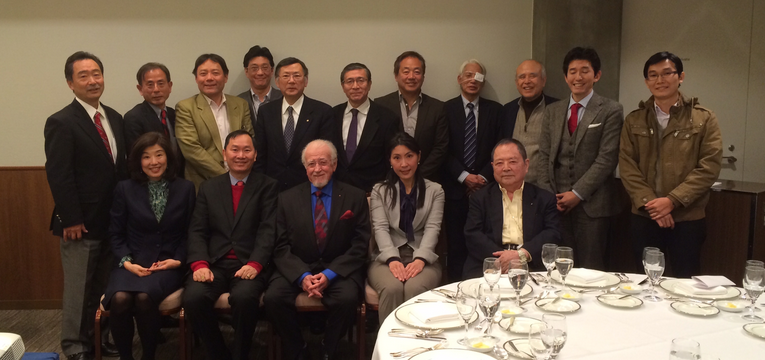
(BGF) – As part of our effort to engage the international community in discussion and debate on key issues of international concern, Boston Global Forum (BGF) recently met with Japanese leaders and scholars in Tokyo.
The visit to Tokyo was led by Nguyen Anh Tuan, CEO and Editor-in-Chief of BGF.. On March 21st, Mr. Tuan officially opened a BGF branch in Japan. Additionally, Mr. Tuan met with Representative Nobue Mita and gave a talk on the role of Japan in the world today. Following his presentation, Mr. Tuan sat down to dinner with Japanese business leaders and scholars at the International House of Japan in Tokyo.
Mr. Tuan’s visit to Tokyo was designed to engage with Japan, particularly on BGF’s 2014 Issue of the Year, which is U.S.-Chinese-Japanese relations. During his visit, Mr. Tuan sought to: invite guests and attendees for BGF conferences, events and ceremonies; to call on Japanese companies and scholars to sponsor BGF events, conferences, and research; and to organize BGF events in Japan.
Going forward, BGF will seek to build on the momentum generated by this successful trip to Japan in order to continue to actively engage Japanese leaders and scholars in debate on key international issues, such as U.S.-Chinese-Japanese relations.


by Admin | Apr 7, 2014 | News
(Photo Credit: REUTERS/Kyodo)
(BGF) – This article, published in the International Business Times, elaborates on a recent decision by the Japanese Government to approve a new set of textbooks which claim that the Senkaku Islands (known as the Diaoyu Islands in China) are Japanese territory. This set of uninhabited islets has been the center of tensions between Japan and China recently, with both countries laying claim to the islands. In response to Japan’s approval of the textbooks, Chinese scholars are making a push to create textbooks claiming that the islands belong to China. As such, this dispute has spilled over into the classroom with real implications for how future generations understand the tensions. To read this full article click here to visit the International Business Times website.
Chinese And Japanese Scholars Take Diaoyu / Senkaku Territorial Disputes To Textbooks
By Michelle FlorCruz
The tug-of-war between China and Japan over the resource-rich islands in the East China Sea has spilled over onto the textbook pages of Chinese and Japanese students. After several years of political posturing, scholars from both nations are going head-to-head in print.
Last week Japan’s government approved new elementary school textbooks that claim the islands, known to the Japanese as the Senkaku, are Japan’s territory. The new textbooks will be distributed to Japanese students in fifth and sixth grade starting in the next academic year, April 2015, with the stamp of approval from Japan’s Education Ministry.
All social studies textbooks submitted and approved for use by the ministry will mention the cluster of islands and refer to them as the Senkaku, Japan’s Asahi Shimbun daily newspaper reported.
The news quickly provoked a backlash of criticism from Chinese officials and historians, who steadfastly refute Japan’s claims to the Diaoyu Islands, the name used by the Chinese.
“Japan should tell its next generation true facts about the Diaoyu Islands — that they are China’s and they were illegally stolen,” Chinese Foreign Ministry spokesman Hong Lei said at a press briefing in Beijing. Now, Chinese academics are making a similar push for refreshed textbooks for mainland China students that would clearly attribute the islands to China.
According to Chinese state-run news agency Xinhua, Chinese scholars are hoping to revive literary texts from the Qing Dynasty to show that Chinese officials took a trip to the Diaoyus in 1808, 76 years before the date when Japan says it laid claim to the islands. According to Fu Xuangcong, director of the classic literature research center at Beijing’s Tsinghua University, the literary works prove that the isles belong to China.
Click here to continue reading.
by Admin | Apr 4, 2014 | News
(Photo Credit: Flickr/US State Department)
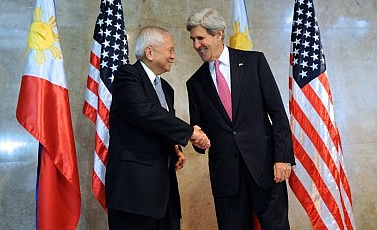
(BGF) – In this article, published in The Diplomat, Shannon Tiezzi argues that third parties, namely the Philippines, Japan, and North Korea, have the potential to destabilize U.S.-Chinese relations. As Tiezzi notes, the U.S. defense of the Philippines’ actions on the Second Thomas Shoal and the U.S. commitment to defend Japan in the event that conflict breaks out over the Senkaku Islands (called the Diaoyu in China) has raised tensions between the U.S. and China. Likewise, the U.S. feels that China is not taking sufficient measures to control North Korea’s actions, such as the recent missile launches. This highlights the role that third parties play in U.S.-Chinese relations. Accordingly, the U.S. and China need to remember that these third parties are autonomous states who will act in their own interest. Potentially this could help minimize the impact of third parties on the U.S. relationship with China. To read the full article click here or visit The Diplomat‘s website.
The X Factors: How Third Parties Destabilize US-China Relations
By Shannon Tiezzi
As fellow Diplomat blogger Zach Keck wrote yesterday, the dispute between China and the Philippines over the Second Thomas Shoal, known in the Philippines as Ayungin Shoal and in China as Ren’ai Reef, is heating up. A Philippine transport ship has been grounded on the shoal since 1999, with Filipino troops stationed aboard as a sign of Philippine control of disputed territory. On Sunday, China for the first time blocked civilian vessels that were headed to Second Thomas Shoal on a resupply run.
Since then, the Philippines and China have traded diplomatic barbs, each side accusing the other of violating international law and agreements. On Wednesday, the U.S. State Department waded into the fray, and predictably backed its ally. According to the Associated Press, Spokesperson Jen Psaki called China’s action “a provocative move that raises tensions.” She added, “Pending resolution of competing claims in the South China Sea, there should be no interference with the efforts of claimants to maintain the status quo.”
The Chinese government was incensed enough at these remarks to offer a special statement in response to Psaki’s comments. In the statement, Foreign Ministry Spokesman Qin Gang reiterated China’s claim that the Philippine vessels on their way to Second Thomas Shoal “were loaded with concrete and rebar rather than food,” suggesting that the Philippines was seeking to build additional facilities on the shoal. “It is an out-and-out provocation,” Qin said. Qin also argued that the original grounding of the ship in 1999 was itself an illegal change to the status quo. In regards to Psaki’s comments, Qin said they were “in disregard of facts” and “inconsistent with its non-party capacity.”
China says the ships represent an illegal attempt to build on the reef; the Philippines insists the ships were stocked with food and water as a “humanitarian mission” to resupply the soldiers on the grounded vessel. The diplomatic row over the cargo and intentions of the Philippine ships may be just beginning. According toReuters, a “senior military official” from the Philippines has said that Manila plans to send another round of civilian ships to the disputed reef.
The China-Philippine dispute is just the latest example of the way third parties influence U.S.-China relations—usually for the worse. China and the U.S. are engaged in a long-term strategic battle for influence in the Asia-Pacific region. China, with its growing economic, diplomatic, and military might, expects to be the top dog in its own backyard, while the U.S. does not want to vacate its role as the dominant presence (Washington would say guarantor of stability) in the region. Yet this sort of long-term strategic battle is generally kept on a low boil, with little threat of tensions actually spilling over. In the short term, U.S.-China relations are generally shaken not by intrinsic differences between Washington and Beijing, but by disagreements involving third parties.
The example of the Philippines is one typical such case. As the Philippines is a U.S. ally, Washington (despite its officially neutral stance on the dispute itself) has repeatedly voiced concern over Chinese actions that deny Philippine access to disputed territories. The China-Philippines disputes are flashpoints where the long-term U.S.-China strategic competition erupts into present-day friction. As such, the decisions and comments of Philippine officials have an outsized impact on U.S.-China relations, forcing both Beijing and Washington to respond (and placing them on opposing sides).
Japan is another such “x-factor,” where a third party’s actions have serious consequences for U.S.-China relations. Indeed, although China-Japan tensions have received less attention lately, the disputes over territory and historical memory have even more serious consequences for U.S.-China relations. The U.S. has gone on record as saying that the Senkaku Islands (called Diaoyu in China) fall under the purview of the U.S.-Japan Mutual Defense Treaty—meaning that, should conflict break out over the islands, the U.S. would be obligated to assist Japan. As such, escalatory moves by Japan could have serious consequences for the U.S.-China relationship. Japanese Prime Minister Shinzo Abe’s visit to the Yasukuni Shrine last December, as well as inflammatory comments about wartime history from Japanese officials, have contributed to the rapid decline in China-Japan relations, with a corresponding dip in U.S.-China ties.
Click here to read the full article.
by Admin | Apr 2, 2014 | News
(Photo Credit: Flickr/US Department of State)
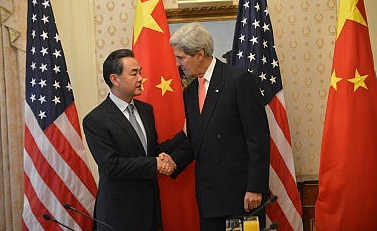
(BGF) – In this article, featured in The Diplomat, Jin Kai addresses the challenges facing the U.S. effort to reinvent its relations with China. Kai notes that Max Baucus, the new U.S. Ambassador to China, strives to “strengthen economic ties with China, to be a partner with China to tackle common global challenges, and to do everything possible to promote stronger people-to-people ties.” While this is all fine and well, Kai notes, echoing a similar point made by Shannon Tiezzi, that the lack of trust and political will present key issues to the improvement of U.S.-Chinese relations. An excerpt of the article is provided below. To read the full article click here or visit The Diplomat‘s website.
Reinventing US-China Relations: Mission Plausible?
By Jin Kai
In his first press conference in Beijing, the new U.S. Ambassador to China Max Baucus said he has three goals: to strengthen economic ties with China, to be a partner with China to tackle common global challenges, and to do everything possible to promote stronger people-to-people ties.
Beyond all doubt, these have been the most important jobs for all U.S. ambassadors to China during the past few decades. In particular, both Baucus and his predecessor, Gary Locke, highlighted strengthening economic ties with China as their top priority. This seems to be telling the world that these two leading economies might just find their way out of the potential doom awaiting two rival great powers. They seek to make this great escape through the type of grand and comprehensive approaches that have been talked up and stereotyped repeatedly, although such strategies are indeed very important.
But there is a problem. Based on their respective strategic perceptions, it is obvious that there is no genuine mutual trust between China and the U.S. So, is there any mechanism for China and the U.S. to try to build a minimum level mutual trust at least on strategically important issues? There seems to be an important one. Five rounds of Sino-U.S. Strategic and Economic Dialogues have been held since 2009, but true Sino-U.S. mutual trust is still nowhere to see. Rather, these two giants seem to be tangled with each other in a“Thucydidean trap” or a “prisoner’s dilemma.” Issues that could have made China and the U.S. join hands or at least might have helped them reach a mutual understanding instead turn out to be potential flashpoints or excuses for reciprocal accusations. One such issue is cybersecurity, which has heightened distrust between Chin and the U.S. in recent days after media reports said that the NSA “put considerable efforts into spying on Chinese politicians and firms.” Are these two giants ready to be entangled in a cyber-war?
The consequences of a Sino-U.S. violent conflict are unacceptable and unbearable not only for China and the U.S., but also for the rest of the world. China-U.S. economic ties are already very close and these two economies can hardly find an easy way to depart from each other. However, on many regional and global issues, these two powers still hold very different views and positions. As a result, their partnership is simply no more than diplomatic rhetoric so far.
People-to-people exchanges, one of Baucus’ goals, is a reasonable and profitable approach to enhancing mutual understanding and improving bilateral relations. Such exchanges may bring about far-reaching and profound changes to future China-U.S. relations. However, given the regional and world situation and especially the possibility of intensifying Sino-U.S. distrust, it’s better to get to the point and make changes happen quickly. The puzzle of closer economic ties accompanied by deeper distrust must be changed.
On March 18, former U.S. Ambassador to China Jon Huntsman made a comment in Shanghai on China-U.S. relations in the context of the search for Flight MH370. He pointed out that both countries have the capability, but what is missing is coordination. To go a little further, the current China-U.S. relationship as a whole may be evaluated in the following three categories: capability, coordination, and political will.
Click here to continue reading.
by Admin | Apr 3, 2014 | News
(Photo Credit: REUTERS/Tyrone Siu)
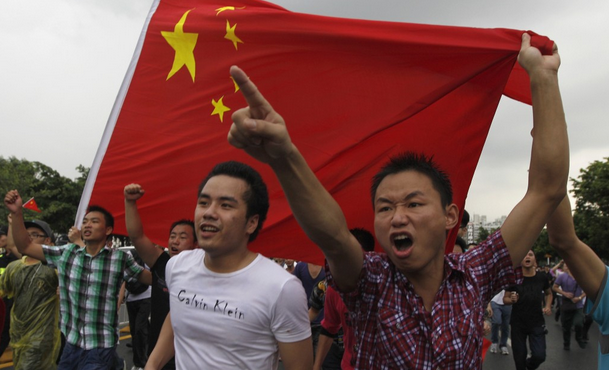
(BGF) – Earlier this year the Chinese Foreign Minister, Fu Ying, remarked that China’s relationship with Japan was “at its worst”. Taking that statement as his starting point Ian Bremmer analyzes China and Japan’s current relationship, the likelihood of conflict, and the prospects for de-escalating the tensions between these two countries. As Bremmer notes, neither China nor Japan want to engage the other in armed conflict. However, this, Bremmer argues, may lead both countries to push the envelope knowing that the other would not dare to instigate a conflict. This is particularly the case given that the tense relationship has become an outlet for nationalist pressures in China and Japan. While Bremmer feels that conflict between China and Japan is unlikely, it is possible that we will face longer periods of tension between the two countries.To read the full article click here or visit the Reuters website.
Is the China-Japan relationship ‘at its worst’?
By Ian Bremmer
At the Munich Security Conference last month, Chinese Vice Foreign Minister Fu Ying said the China-Japan relationship is “at its worst.” But that’s not the most colorful statement explaining, and contributing to, China-Japan tensions of late.
At Davos, a member of the Chinese delegation referred to Shinzo Abe and Kim Jong Un as “troublemakers,” lumping the Japanese prime minister together with the volatile young leader of a regime shunned by the international community. Abe, in turn, painted China as militaristic and overly aggressive, explaining how — like Germany and Britain on the cusp of World War One — China and Japan are economically integrated, but strategically divorced. Even J.K. Rowling has played her part in recent weeks, with China’s and Japan’s ambassadors to Britain each referring to the other country as a villain from Harry Potter.
Of course, actions speak louder than words — and there’s been no shortage of provocative moves on either side. In November, Beijing declared an East Asian Air Defense Identification Zone (ADIZ) — which requires all aircraft to follow instructions issued by Chinese authorities, even over contested territory, which pushed tensions to new highs. The following month, Abe visited Yasukuni Shrine — a site associated with Japanese World War militarism that makes it an automatic lightning rod for anti-Japanese sentiment among Japan’s neighbors.
But despite the clashes and growing conflict, it remains exceedingly unlikely that China-Japan fallout will escalate into military engagement. China won’t completely undermine economic relations with Japan; at the provincial level, Chinese officials are much more interested in attracting Japanese investment. And Japan still sees the success of its businesses in the vast Chinese market as an essential part of efforts to revive its own domestic economy, even if its companies are actively hedging their bets by shifting investment away from China. The relationship is unlikely to reach a boiling point. Rather, we are more likely to see sustained cycles of tension.
So if both sides intend to limit the potential for conflict, how concerned should we be? Even if military engagement is highly unlikely, China-Japan is still the world’s most geopolitically dangerous bilateral relationship and that will remain the case. There are a number of reasons why.
First and foremost, there’s always the chance, even if it’s remote, for miscalculation with major consequences. When fighter jets are routinely being scrambled to deal with Chinese “incursions” into what the Japanese consider to be their territory, the potential for a mistake looms large. And given the frigid relations between these two countries, if there is a mistake, China and Japan are going to assume the worst of the other side’s intentions.
On top of this, the sheer size and integration of the economies — China and Japan are the world’s second and third-largest economies, respectively — makes the relationship hard to ignore. Japan has 23,000 companies operating in China, with 10 million Chinese workers on their payrolls. But Japanese companies are actively diversifying away from China now, with foreign direct investment waning and Japan shifting to Southeast Asia in particular. China-South Korea trade is fast approaching the levels of China-Japan trade as a result of fallout from tensions between Tokyo and Beijing. If the Chinese and Japanese start thinking their economic relationship is deteriorating, the potential for confrontation grows.
Furthermore, the size and duration of the conflict makes it a crucial global risk: the tensions are rooted in historical animosity with no viable solution. There’s no diplomatic outreach going on between China and Japan — and neither the United States nor any other foreign power is doing enough to help facilitate that relationship. There is no one in China trying to see the world from Japan’s perspective, and vice versa. According to a recent Pew Research poll, just 6 percent of Chinese had a favorable view of Japan, and only 5 percent of Japanese view China favorably. Both sides may be well aware that a full-fledged conflict is not in the other’s best interest — but that only gives them more reason to push the envelope. As a senior Chinese official recently explained to me, the Chinese aren’t worried about pushing Japan (they “don’t want war” and the Japanese “don’t dare”).
Click here to continue reading.