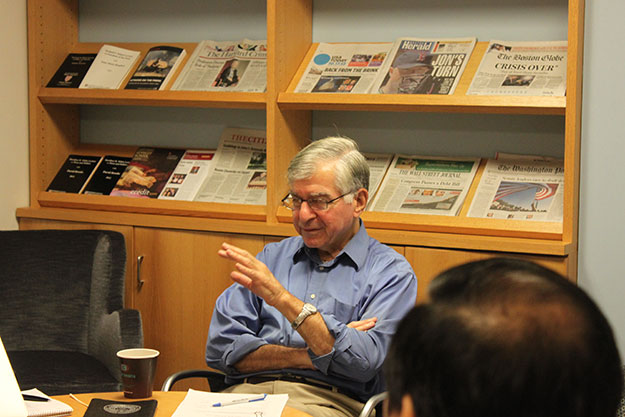
(BGF) – On December 5, 2013, Boston Global Forum Co-founder and Harvard Kennedy School Bradlee Professor of Government and the Press, Thomas Patterson, sat down with Boston Global Forum’s Tuan Nguyen and Jonas Brunschwig in the inaugural installment of the BGF Leaders Series. Professor Patterson spoke about his new book, Informing the News: The Need for Knowledge-Based Journalism. In Informing the News, Professor Patterson addresses American journalism’s current need for a deeper, stronger knowledge base. According to Prof. Patterson, journalists lack knowledge and expertise in the subject matter on which they report. Consequently, journalists in the American media have had to rely heavily on the knowledge of the policy makers and other experts they interview.
To further illustrate the knowledge-dependence of American journalism, Prof. Patterson draws a distinction between the profession of journalism and professions in other fields, such as law and medicine. He asserts that as opposed to professions in those fields, journalism has no body of knowledge. Rather, it is a profession built on borrowed knowledge and the complex skill of story-telling . “[Journalists] are taught to gather information, put it together in a story and communicate it effectively,” says Prof. Patterson. “So that’s the longstanding tradition in American journalism—heavily dependent on sources and on what sources know.”
Several contemporary trends in politics and journalism have magnified the impact of knowledge-dependence in the American journalistic tradition, thereby highlighting the importance of deepening and strengthening the knowledge base of American journalism. Firstly, Prof. Patterson notes that there is a greater amount of spin in contemporary politics than we have seen in previous periods. As such, journalists have to become increasingly knowledgeable about the subject-matter they are reporting on in order to be able to discern the validity of information they obtain from their sources. Secondly, public policy has experienced tremendous growth in terms of complexity. The increasing complexity of public policy makes it imperative that journalists increase their subject-based knowledge so that they can provide thorough and accurate reporting. Lastly, Prof. Patterson cites the myriad of news sources that are now available to the public, the number of which has grown exponentially compared to decades past. These new outlets have aimed to attract attention, instead of informing and edifying the public.
Further expounding on the media’s focus on attracting attention rather than informing the public, Prof. Patterson noted that it is of the utmost importance to strike an appropriate balance between simplicity and complexity in international reporting. In this regard, Prof. Patterson admits a need for simplification for a wide American audience. However, he says, “the simplification occurs in the story. The simplification does not occur across the range of stories that are used to cover a particular area of our public life.” As an example, he mentions news coverage of Africa often being negative – covering war and disease – because that is what captures people’s interest. Unfortunately, what it leads to is a simplification of larger issues.
Relatedly, Prof. Patterson sees Boston Global Forum’s 2013 issue of Minimal Standards for Worker Safety as an example of journalism’s problematic tendency to report on issues only after instances of disaster or scandal. As he notes, labor experts are hardly present in any newsroom, while economic and business reporters are growing in number. Furthermore, Prof. Patterson argues “we don’t have enough reporters who know enough about labor to bring that issue to us in a full way.” Had the media devoted more attention to the issue of worker safety and rights earlier on, the Rana Plaza building collapse in Bangladesh may have been prevented.
Given the need to deepen and strengthen the knowledge base of American Journalism, in light of the aforementioned contemporary trends, there must be key changes in both the newsroom and the classroom. According to Prof. Patterson, a key change that must occur within the newsroom is the need to have people who can not only tell a story, but also possess solid knowledge of the subjects related to the stories they tell. Moreover, journalism education has to evolve so that students learn a body of knowledge in addition to the traditional methods of observation and reporting.
Additionally, in order to break from the journalistic norms that prevent a broader base of issues from being reported, Prof. Patterson suggests that journalists remove themselves from cities such as New York City or Washington, D.C., where many journalists congregate and report heavily on the problems of politicians and business executives. With better training, journalists could apply a broader lens on their reporting and break from traditions engrained in the profession, with the goal to make journalism more democratic over time.
Looking forward, there is little evidence that news outlets will publish more knowledge-based reporting. However, “there is strong evidence that weak reporting is bad for business,” says Prof. Patterson. Weak reporting and “info-tainment” might not be bad for news outlets in the short run, but in the long run people will begin to look for alternate sources of news. According to evidence, longer, better-informed stories tend to have greater longevity on the Internet. Moreover, we must be patient with the transition towards knowledge-based journalism, as it will not occur overnight. Many of the necessary changes discussed by Prof. Patterson are structural changes within the tradition of American journalism that will require a long-term time horizon in order to realize.
As for social media, Prof. Patterson sees it as an overrated component, lacking the ability to truly inform people. Given the knowledge deficiency Prof. Patterson sees in journalism, he believes the average person sharing stories on social media is even less equipped to serve as a reliable source for information on current affairs. However, social media does better at engaging, energizing, and mobilizing people to form communities than traditional media.
When prompted on his next research project, Prof. Patterson mentioned an interest in working on the restoration of the center of American politics against the current level of polarization. His interest is not in deliberate efforts that fuel polarization, but rather, in the unintentional things that the news media does that fuel polarization.
BGF is calling for contributions to building up a set of Minimal Global Standards for Workers Safety and Rights. At the same time, we would like to put into discussion the question of Mr. Duc-Lai Bui, Assistant to Chairman of Vietnam National Assembly: Are there common solutions to improving minimal standards for workers from countries having different political systems and cultural values?
Opinions, comments and suggestions are welcome at [email protected]. And, here are some opinions from our fellows:
Jyoti Sinha, Phd, Research Associate, Sloan School of management, MIT
I don’t think a common solution for improving minimal standards for workers from countries having different political systems and cultural values would be a good option. It would be a very “generic set of standards” The different cultural set up and political system wouldn’t allow the common standard to be implemented at real work situations it differs nation wise. Nonetheless I am for a common solution for improving minimal standards globally but with nation wide rules implementations and amendments of labor laws wherever necessary. I dont know how much would an International body be ready to pay attention to the national issues. But because these developing nations produce garment consumed by the developed countries their intervention is justified and much needed.
Right to association at work place (one of the core labor standards) should be enforced in these workplaces and the workers needs and demand as a human should be attended. On the safety culture issues, in the third world countries like Bangladesh, India, Pakistan the word safety doesn’t exist and they lack positive attitude towards safety issues. Electrical appliances outburst if produces the spark for fire at work, there should be different rounds of testing for these appliances.
Sharing an article which talks about the inhumane clause of the garment sector employers in India which we should be addressing to. As i am researching on garment workers safety issues on South Asian Countries (India,Bangladesh,Pakistan) i thought i should share this point which would be much similar. http://www.telegraphindia.com/1130918/jsp/opinion/story_17337269.jsp#.UjmS2dJmiSq
Selima Akhtar, Country Manager in Bangladesh, Impactt
When you are saying common solution to improve minimal standards for workers. To me there are three areas needs to focus:
– Government Role:
+ What are the policies government has applied in place? And who will look after that?
+ If someone not followed what would be the consequence and who will implement that?
– Workers Role:
+ What is the definition of a worker? Poor, no food in home and no education meaning worker?
+ Set up some criteria for a worker – minimum education needs to have,
+ Know about human role in the society and work – stay clean, live healthy, try to learn and listen to others – these are totally absent.
– Business Sector Role:
+ Follow govt rules and set up own criteria in the locality – e.g. not recruit less than five class pass, provide all working facility
+ Respect and treat worker as a human
+ Make a norm on share information and listen each other and solve problem or act quickly
+ These are the areas if all the parties role is recognized and they follow ; it would be very easy to implement a minimum standard for workers.
Mr. Duc-Lai Bui, Assistant to Chairman of Vietnam National Assembly.
I think there are common issues about Worker Safety and Rights (WSR for short) among less developed countries. However, establishing a common set of Minimal Global Standards (MGS) needs considering carefully. Such a set of MGS must correspond with very low standards in order to be in accordance with real conditions of less developed countries, hence lead to complacency in more developed countries whose conditions, if we put them in criteria for WSR, are not sufficient.
Another aspect is how to implement MGS. Workers’ problems needs the involvement of their organizations, authorities, governments and international organizations. This involvement differs from country to country according to economic and cultural development, politic system, and qualification of authorities. For example in Vietnam, WSR in some businesses are as bad as that of the case studied in Bangladesh. However, the reaction of workers is quitting their job and then there are always many others willing to replace them because of the lack of employment. Workers’ struggles via going on strike are limited because the operation of labor unions depends completely on business owners and never support any strike. Also, governmental authorities are corruptible. Therefore, while we wait for improvements inside the country, we need involvement from international communities who play important role in fostering the improvements. Civil organizations, customers associations of developed countries should put pressure on distributors, on governments of these countries and of producing countries to contribute to the implementation of MGS for WSR, as they are established. In current conditions, media play a very important, even the most important, in denouncing and condemning false activities as well as in calling for common actions.
(BGF) – We are very honored to announce that on Boston Global Forum’s first year anniversary, December 12, 2013, Chairman Michael Dukakis – Distinguished Professor of Harvard University will give a lecture at 9:45 am at the McGovern Institute for Brain Research at MIT, starting BGF Distinguished Lecture Series. Before the distinguished lecture, Governor Dukakis will visit the McGovern Institute and meet Professor Robert Desimone, Director of the Institute.
Chairman Dukakis will discuss BGF’s activities during its first year, with a particular emphasis on our work on the issue of the year addressing minimal standards for worker safety, followed by a Q&A session. His discussion will include also a broader analysis of the world as he sees it today. The lecture is open to the public and will also be webcast live on our website. Further details will be announced on our website shortly.
Questions and comments relating to the lecture are welcome at [email protected].
(BGF) – Today, November 3, Michael S. Dukakis, the founding chairman of the Boston Global Forum (BGF), turned 80 years old.
This outstanding American leader, in his days as Governor, created the remarkable story of Massachusetts. He earned the love and respect of everyone. People who worked with him held him in special honor. Those who sat in his audience embraced his words.
Michael is genuinely interested in the well-being of the people in front of him, and always wants to do the utmost best for mankind. That is his passion and his reason for being. He cares for each person as well as the whole community.
As an example of Michael’s priorities: A week after the horrible collapse of the Rama Plaza factory building in Bangladesh, Chairman Michael Dukakis convened the BGF members to discuss solutions for global standards for worker safety. That subject became a project priority for 2013 in BGF. Michael always cares about the work environment for working people, their safety, their rights, and their well-being.
As the Red Sox faced the Cardinals at Fenway Park in the evening of October 30, the seat price became very expensive. He passed words to his BGF colleagues who invited him to “get the cheapest bleacher seats. Save your money to help people in the community.”
As founding chairman of BGF, Michael S. Dukakis is always inspiring and encouraging. Urging colleagues to offer their best to BGF, he has been able to invite many intellectuals from Harvard, MIT and surrounding communities, with his authenticity, vision, passion and depth.
Many still think America would be a better country had he won the 1988 presidential race.
At his birthday party, many leading Americans expressed their love and respect for Michael. People like Senator Elizabeth Warren, George Stephanopoulos, and President Bill Clinton were there. Michael spoke and urged everyone to care for children, especially those who live in hardship, so they can have a better life.
In late June, I asked him what his 80th birthday party will be like, Michael gently smiled and said “The best way is to organize it so people can think of ideas to better this world and humanity.”
That said it all about Michael S. Dukakis. Happy Birthday!
BGF would like to introduce here an article by Mr. Van-Phu Nguyen, Managing Editor of Saigon Times relating the TPP negotiation to garment industry. The original version can be found at http://english.thesaigontimes.vn/Home/features/general/32153/The-power-of-bargain.html.
The power of bargain
By Nguyen Van Phu
Do a lot of people know that out of a price tag of US$22.12 for a pair of jeans sold in Britain, just 90 cents goes to cutting and making the jeans, which includes labor and factory expenses such as rent, energy, and safety measures? I didn’t, until I read a report by Bloomberg on the cost of garment production in Bangladesh in 2013.
So I have my doubts when American Ambassador to Vietnam David Shear tried to sell the Trans-Pacific Partnership, a free trade agreement that the U.S., Vietnam and 10 other countries are negotiating, to the Vietnamese people. “Vietnam will benefit greatly from expanded access to the U.S. and other markets as the TPP reduces tariffs in several key export areas,” Shear told Can Tho University students last Thursday.
Pure logic tells us that economic benefits shall be proportional according to the assigned role each country plays in the globalized trade. The price breakdown for a pair of jeans reflects this proportional benefit quite well. But more on that later.
The Bloomberg garment report was made in response to the worse labor accident in 2013 when 1,129 workers were killed and at least 1,500 more were injured as the Rana Plaza garment factory they worked in collapsed on April 24 in Bangladesh. After the accident, voices were raised to demand more corporate accountability. Fashion brands, apparel producers and retailers promised to take responsibility for what happens to the factories that make the clothing they sell. But despite all the public outrage, people tend to forget that all required improvements in the working conditions demanded of the factories were squeezed out of the 90 cents the factories get from making a pair of jeans. “Let us earn those few cents, and nobody has to die while making basic jeans,” factory owner Tipu Munshi was quoted by Bloomberg as complaining.
Negotiators to free trade agreements like the TPP realize the situation only too well. That’s why, under pressure from their own consumers, developed countries like the U.S. demand poorer countries like Vietnam to treat its workers better in exchange for greater market access. But again, somehow Vietnam has to manage treating its workers better with the same 90 cents it gets.
Getting back to the American ambassador’s remarks, he’s right in saying that “expected gains are more clear, can be roughly estimated, and generally occur in existing sectors, such as footwear and apparel, where Vietnam is already competitive”. The TPP can help Vietnamese garment makers ignore bids from non-member competitors from Bangladesh or China, thus avoiding the race to the bottom normally seen in the global apparel industry. Without the TPP, Vietnamese garment makers might have to lower their bids to win contracts. But their share from the supply chain in this industry remains a pittance compared to other stages in the value chain.
So the best way to sell the TPP to Vietnamese people is neither a promise of enormous gains in GDP growth or bigger export volumes nor a promise of more foreign investment. It should be a bigger share of the pie. Somehow, that is sort of a “mission impossible” task but increasing the share that garment workers in particular or other players in the globalization game can get is the only way to persuade people of the sustainability of free trade.
Independent safety inspections of garment and footwear factories are useful but not crucial in guaranteeing the workers’ safety. If they get more than the 90 cents, they will have bigger power of bargain and they will take care of their own safety measures.
People might wonder why middlemen whose job is to collect and pass orders from retailers on to garment makers earn five times as much as the workers who make the garment. And more importantly, do negotiators at free trade agreement negotiations ever discuss narrowing the gap?
Of course, they don’t. Negotiators always try to snatch the biggest share for their own businesses and one would be so naive as to thinking otherwise. And intellectual property rights are among the tools that people use to maintain their edge over others.
Pressure from the consumers, therefore, should not focus on working conditions. It should be more specific: how much is paid for those who make the clothes or shoes they wear. If the right price is paid, the working conditions will take care of itself. But don’t ask me how the fruit of globalization can be divided fairly. It can’t and thus, we have the contradictory nature of free trade agreements, the TPP included.