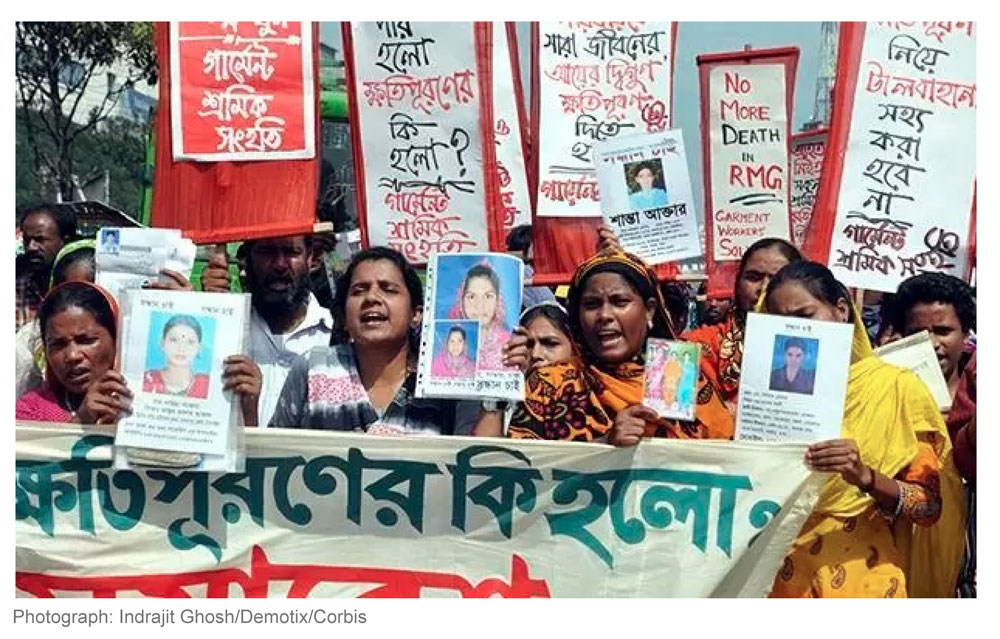
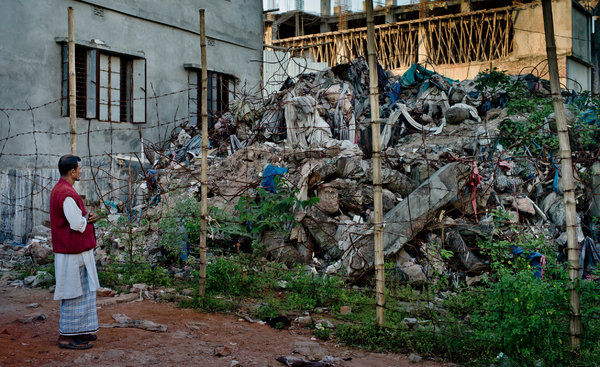
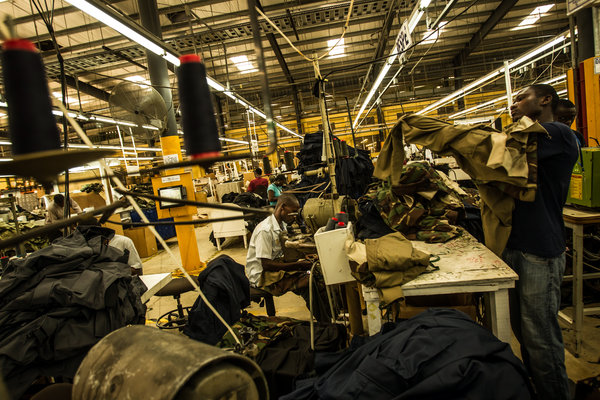
(BGF) – Over the past fourteen months, in the wake of the Tazreen Fashions Fire in Dhaka, Bangladesh on November 24, 2012 and the subsequent Rana Plaza collapse in April 2013, the issue of worker safety and rights has seen a surge in global attention. The New York Times (NYT) has continuously covered the issue, both in the aftermath of these tragedies as well as the ensuing debate on what measures ought to be taken. Moreover, their coverage has highlighted the impacts these tragedies have had on the lives of the victims.
(Photo Credit: A.M. Ahad File / AP Photo)
A recent editorial published by the NYT on December 20th, 2013 focused in on the financial hardships facing victims of the Rana Plaza collapse. As the editorial noted, many victims suffered debilitating physical and mental trauma that has left them unable to work. Consequently, the victims are struggling to make ends meet and, in some cases, have even sent their children to work to help make up for lost income. This is coupled with the lack of financial support from the Bangladeshi Government and many of the brands who utilized Rana Plaza. While the Bangladeshi Government has collected private funds designated for the purpose of taking care of victims and their families, the Bangladeshi High Court has stated that the funds will not be fully distributed until every dead body has been identified. The brands and companies, on the other hand, have largely turned their focus towards disaster prevention rather than relief and support for victims. Thus, only a handful of brands and companies, including Primark, have committed to providing compensation to victims and their families.
With pressure rising, it did not take long for some brands and companies to take action in conjunction with the Bangladeshi Government. Only days later a $40 million fund was announced to compensate the victims of the Rana Plaza collapse. The fund should begin disbursing compensations in February 2014. As such, each victim’s family would receive approximately $25,000. Moreover, this fund is remarkable in that it represents contributions from only a modest number of companies and brands. To date, no U.S. brands or companies have contributed to this fund. Yet, the distribution of the fund will go a long way towards helping the victims of Rana Plaza and their families.
Going beyond the impacts that the recent tragedies have had in Bangladesh, the NYT has highlighted the difficulties that lie ahead for any efforts to improve working conditions and to ensure that future tragedies are prevented. For example, the lack of direct contact between buyers and suppliers, gaps in federal procurement policies, and foreign policies that have the unintended consequence of creating a “race to the bottom” have all contributed to the purchasing of goods produced in unsafe conditions, including in Rana Plaza. As Ian Urbina of the NYT has noted, this is even occurring in the procurement policies used by agencies of the United States Government. Moreover, the sheer power of the garment industry has hindered efforts to improve worker safety and rights. As Gardiner Harris noted in an article on December 22, 2013, the power and economic importance of the garment industry in Bangladesh has led the Bangladeshi Government to protect factory owners against unionization efforts and has resulted in the failure to prosecute factory owners who ignore safety protocols. Thus, the recent decision to charge the owners of the Tazreen Fashions Factory, which burned to the ground killing 112 workers, with culpable homicide marks a significant step forward.
As the NYT coverage indicates, there is a complexity to the issue of worker safety and rights that must not be overlooked. While consumers are sensitive to increases in the cost of clothing items, this must not hinder the safety of garment factories globally; while preventing future catastrophes is of the utmost importance, it must not come at the expense of ignoring the needs of the victims of past tragedies, such as the Tazreen Fashions Factory fire and the Rana Plaza collapse; while improvements in worker safety and rights will require punishing factories that ignore safety regulations, these efforts must be sensitive to their impacts on the lives of the workers who rely on the garment industry for a living. This broadened awareness of the issue must guide our efforts to improve worker safety and rights, and the human element, which ultimately drives these efforts, must not get lost in the fray.
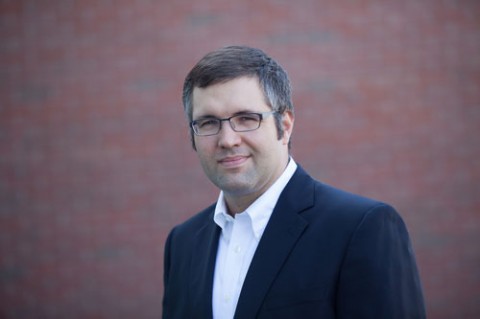
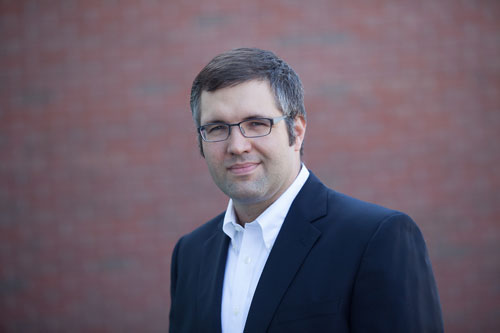
(BGF) – Nicco Mele – entrepreneur, angel investor, consultant to Fortune 1000 companies, and member of BGF’s Board of Thinkers, will have a talk at 5:00 pm on January 15 (Boston Time) in Meet Boston Global Forum Leaders Series. As one of America’s leading forecasters of business, politics, and culture in our fast-moving digital age, he will give a speech about Internet in 2014 and his book The End of Big: How The Internet Makes David The New Goliath.
The talk lasts about 20 minutes and is followed by a Q&A session. Follow the discussion live on our website and send us your questions before the talk to [email protected].
Nicco Mele’s remarks prior to the talk
Our ability to stay connected — constantly, instantly, and globally — is dramatically changing our world. This radical connectivity has brought about a new nature of power, overwhelming virtually every establishment it touches and providing a tremendous opportunity to re-imagine the kind of society in which we want to live. But these new technologies come with unintended consequences — some good, some not so clearly so.
Already, social media and online communities have started to completely transform politics, culture, and business. Governments are being upended by individuals relying only on social media. Major political parties are seeing their power eroded by grassroots forces through online fundraising. Universities are scrambling to preserve their student populations in the face of less expensive, more accessible online courses. Print and broadcast news outlets are struggling to compete with citizen journalists and bloggers. I am concerned about what will happen if we do not approach this moment in human history with purpose and intention.
One of the greatest misconceptions about the technical revolution is that the destruction of old institutions is an inherently good thing; that the creative potential unleashed by a radically connected world always outweighs the harmful consequences that may come with it. The End of Big reminds us that the creation of these exciting new technologies has largely been directed by a small group of computer nerds whose own anti-establishment ideology is embedded throughout. As their power has grown, it has shone a light on the necessity to exercise better and stronger control over the design and use of these advances. Our failure to provide a clear and moral vision in this arena may very well lead to a dark and wildly unstable future — one where our political, military, and economic leaders unwittingly cede control to online demagogues and other more insidious entities.
About Nicco Mele
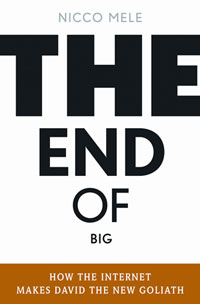
Cover of “The End of Big”
Born to Foreign Service parents, Nicco spent his early years in Asia and Africa before graduating from the College of William and Mary in Virginia with a bachelor’s degree in government. He then worked for several high-profile advocacy organizations where he pioneered the use of social media as a galvanizing force for fundraising. As webmaster for Governor Howard Dean’s 2004 presidential bid, Nicco and the campaign team popularized the use of technology and social media that revolutionized political fundraising and reshaped American politics. Subsequently, he co-founded EchoDitto, a leading internet strategy and consulting firm, whose non-profit and corporate clients have included Barack Obama’s successful Senate campaign, the Clinton Global Initiative, Sierra Club, UN World Food Programme, St. Jude Children’s Research Hospital, AARP, and Medco. Nicco is also on the faculty at the Harvard Kennedy School where he teaches graduate-level classes on the internet and politics.
Nicco’s first book, The End of Big: How The Internet Makes David The New Goliath, was published by St. Martin’s Press in April 2013. In it, he explores the consequences of living in a socially-connected society, drawing upon his years of experience as an innovator in politics and technology.
Since his early days as one of Esquire Magazine’s “Best and Brightest” in America, Nicco has been a sought-after innovator, media commentator, and speaker. He serves on a number of private and non-profit boards, including the Nieman Foundation for Journalism at Harvard and Breakthrough.tv. Nicco is also co-founder of the Massachusetts Poetry Festival.
For more, including the latest resources to help you start managing the “end of big” in your work and community, visit NiccoMele.com.
BGF would like to share the article by STEVEN GREENHOUSE about the aid set for Bangladesh Garment Workers since the collapse of the Rana Plaza factory. The original can be found the New York Times website.
$40 Million in Aid Set for Bangladesh Garment Workers
By STEVEN GREENHOUSE
Eight months after the Rana Plaza factory building collapsed in Bangladesh, killing more than 1,100 workers and leaving hundreds of families bereft and financially adrift, several prominent retailers and labor groups have joined with the Bangladesh government to create an estimated $40 million compensation fund to aid the victims’ families.
So far, four retailers — Bonmarché, El Corte Inglés, Loblaw and Primark — have pledged to contribute to the fund, which is intended to compensate the families of those who died last April 24 in what was the deadliest disaster in garment industry history. The new fund is considered a landmark in compensating families of garment industry victims, in terms of both the amount to be paid and the sophistication of the arrangements. No United States-based retailers have signed on.
Several officials involved in negotiations to establish the fund said in interviews that the families of the dead would receive, on average, more than $25,000 each, while hundreds of workers who were injured or maimed would also receive compensation. Per capita income in Bangladesh is about $1,900 a year.
The fund’s members said they hoped to begin making payments in February, although they have yet to decide how much each firm will contribute, which depends in part on whether governments donate. The money is to be paid in installments to ensure that the families have a steady source of income for years to come. “We think the agreement is a really good result,” said Ineke Zeldenrust, international coordinator of the Clean Clothes Campaign, a European antisweatshop group that has pressed retailers to do far more to help the families of the disaster’s victims. “The agreement will deliver to all the victims and the families of the Rana Plaza disaster full and fair compensation in a credible manner. What we need now is for other companies to agree to pay into the fund.”
Families of the victims have already received several months of short-term emergency aid from the Bangladesh government as well as from Primark, an Anglo-Irish retailer. But these families have been pressing for long-term compensation.
In some families, with the mother dead, children have quit school and gone to work. In other cases, workers who were seriously injured and cannot work are desperate for income.
Talks to establish the fund, coordinated by the International Labor Organization, began in September but stalled over such issues as how to collect information on claims, how to determine which claims were legitimate and who should administer the fund. The amount to be paid will be based on the anticipated wage loss of each worker killed, tied to the number of children, or, if the beneficiary is a parent, to the life expectancy of an adult.
With 1,800 workers having died in garment industry disasters in Bangladesh over the last decade, Dan Rees, program director for the Better Work organization, an affiliate of the International Labor Organization, said: “If you look at the history of compensation efforts in the Bangladesh garment industry, it’s not a good one. But this is a potential breakthrough.”
Among the groups that signed the agreement to create the compensation were the Bangladesh Garment Manufacturers and Exporters Association, IndustriAll Global Union, the Bangladesh Employers Federation and the main Bangladesh coalition of labor unions.
Some retailers and labor rights groups have expressed dismay that no United States retailers have agreed to join the compensation effort.
“Following the collapse, we came very quickly to the conclusion that compensation was not only a necessity for the survivors and their families, but a responsibility for the many retailers sourcing from Rana Plaza,” said Robert Chant, senior vice president for corporate affairs at Loblaw, a Canadian company. “We are still hopeful that other retailers will join us in meeting the obligation, but we’ve already made public our disappointment in the failure of others to step forward.”
Loblaw owns the Joe Fresh apparel chain, with apparel from one of Rana Plaza’s factories.
Amid warnings that its columns were crumbling, the poorly constructed building collapsed, crushing hundreds of workers in tons of concrete and steel.
Labor rights groups say they found documents and remnants of apparel tying 25 European and American retailers and brands to the five garment factories spread across Rana Plaza’s eight floors. Several of the firms have since denied their apparel came from any of the factories. Mango, a Spanish apparel brand, said, for instance, that it only had a test order in a factory there.
Walmart has been urged to help the Rana Plaza families because production documents found in the rubble indicated that a Canadian contractor was producing jeans for Walmart in 2012 at the Ether Tex factory inside the building. Walmart said an unauthorized contractor was producing garments there without its knowledge. It says it is focused on assuring that there are no such disasters in the future.
The Children’s Place, which had obtained apparel from one of the factories inside Rana Plaza, said the factory was not supplying it at the time of the collapse.
A Walmart official said the company had no comment about requests for it to contribute to the fund. The Children’s Place did not respond to inquiries.
“These brands produced at Rana Plaza, yet did nothing to protect the workers who made their clothes, despite a history of deadly building collapses in Bangladesh,” said Scott Nova, executive director of the Worker Rights Consortium, a monitoring group based in Washington that is financed by American colleges and universities. “Incredibly, some companies do not seem to feel the slightest responsibility to the families whose lives were destroyed as a result of this negligence.”
Officials involved in the compensation fund say they have not yet worked out how much money each participant should contribute. That will depend, in part, on how many retailers ultimately agree to participate and whether various governments agree to give money.
Some industry experts say the American companies are afraid to participate for fear of being exposed to legal liability or appearing hypocritical after denying that they knowingly did business at Rana Plaza at the time of the collapse.
Mr. Rees, the I.L.O. official, said contributions would not lead to liability. “At the moment, this effort needs support,” he said. “It needs the backing of companies that were in Rana Plaza when it collapsed, that were there in the recent past before it collapsed and that weren’t in there at all and want to show solidarity with the industry.”
BGF would like to introduce here an article by IAN URBINA about the U.S. Government’s procurement of clothing countries where working conditions do not meet standards. The original can be found at http://www.nytimes.com/2013/12/23/world/americas/buying-overseas-clothing-us-flouts-its-own-advice.html?pagewanted=1&_r=0
U.S. Flouts Its Own Advice in Procuring Overseas Clothing
By IAN URBINA
One of the world’s biggest clothing buyers, the United States government spends more than $1.5 billion a year at factories overseas, acquiring everything from the royal blue shirts worn by airport security workers to the olive button-downs required for forest rangers and the camouflage pants sold to troops on military bases.
But even though the Obama administration has called on Western buyers to use their purchasing power to push for improved industry working conditions after several workplace disasters over the last 14 months, the American government has done little to adjust its own shopping habits.
Labor Department officials say that federal agencies have “zero tolerance” for using overseas plants that break local laws, but American government suppliers in countries including Bangladesh, the Dominican Republic, Haiti, Mexico, Pakistan and Vietnam show a pattern of legal violations and harsh working conditions, according to audits and interviews at factories. Among them: padlocked fire exits, buildings at risk of collapse, falsified wage records and repeated hand punctures from sewing needles when workers were pushed to hurry up.
In Bangladesh, shirts with Marine Corps logos sold in military stores were made at DK Knitwear, where child laborers made up a third of the work force, according to a 2010 audit that led some vendors to cut ties with the plant. Managers punched workers for missed production quotas, and the plant had no functioning alarm system despite previous fires, auditors said. Many of the problems remain, according to another audit this year and recent interviews with workers.
In Chiang Mai, Thailand, employees at the Georgie & Lou factory, which makes clothing sold by the Smithsonian Institution, said they were illegally docked over 5 percent of their roughly $10-per-day wage for any clothing item with a mistake. They also described physical harassment by factory managers and cameras monitoring workers even in bathrooms.
At Zongtex Garment Manufacturing in Phnom Penh, Cambodia, which makes clothes sold by the Army and Air Force, an audit conducted this year found nearly two dozen under-age workers, some as young as 15. Several of them described in interviews with The New York Times how they were instructed to hide from inspectors.
“Sometimes people soil themselves at their sewing machines,” one worker said, because of restrictions on bathroom breaks.
Federal agencies rarely know what factories make their clothes, much less require audits of them, according to interviews with procurement officials and industry experts. The agencies, they added, exert less oversight of foreign suppliers than many retailers do. And there is no law prohibiting the federal government from buying clothes produced overseas under unsafe or abusive conditions.
“It doesn’t exist for the exact same reason that American consumers still buy from sweatshops,” said Daniel Gordon, a former top federal procurement official who now works at George Washington University Law School. “The government cares most about getting the best price.”
Frank Benenati, a spokesman for the Office of Management and Budget, which oversees much of federal procurement policy, said the administration has made progress in improving oversight, including an executive order last year tightening rules against federal suppliers using factories that rely on debt bondage or other forms of forced labor.
“The administration is committed to ensuring that our government is doing business only with contractors who place a premium on integrity and good business ethics,” he said.
Labor and State Department officials have encouraged retailers to participate in strengthening rules on factory conditions in Bangladesh — home to one of the largest and most dangerous garment industries. But defense officials this month helped kill a legislative measure that would have required military stores, which last year made more than $485 million in profit, to comply with such rules because they said the $500,000 annual cost was too expensive.
Federal spending on garments overseas does not reach that of Walmart, the world’s biggest merchandiser, which spends more than $1 billion a year just in Bangladesh, or Zara, the Spanish apparel seller, but it still is in a top tier that includes H & M, the trendy fashion business based in Sweden, Eddie Bauer and Lands’ End, sellers of outerwear and other clothing.
Like most retail brands, American agencies typically do not order clothes directly from factories. They rely on contractors. This makes it challenging for agencies to track their global supply chain, with layers of middlemen, lax oversight by other governments, few of their own inspectors overseas and little means of policing factories that farm out work to other plants without the clients’ knowledge. When retailers, labor groups or others inspect these factories, the audits often understate problems because managers regularly coach workers and doctor records.
The United States government, though, faces special pressures. Its record on garment contracting demonstrates the tensions between its low-bid procurement practices and high-road policy objectives on labor and human rights issues.
The Obama administration, for example, has favored free-trade agreements to spur development in poor countries by cultivating low-skill, low-overhead jobs like those in the cut-and-sew industry. The removal of trade barriers has also driven prices down by making it easier for retailers to decamp from one country to the next in the hunt for cheap labor. Most economists say that these savings have directly benefited consumers, including institutional buyers like the American government. But free-trade zones often lack effective methods for ensuring compliance with local labor laws, and sometimes accelerate a race to the bottom in terms of wages.
Along a dirt road in Gazipur, about 25 miles north of the Bangladeshi capital, riot police fired tear gas shells, rubber bullets and sound grenades in a fierce clash with garment workers last month, sending scores to the hospital. The protesters demanding better conditions included some from a factory called V & R Fashions. In July, auditors rated that factory as “needs improvement” because workers’ pay was illegally docked for minor infractions and the building was unsafe, illegally constructed and not intended for industrial use.
Unsafe and Repressive
Like dozens of other factories in the area, V & R makes clothes for the American government, which is constantly prowling for the best deals. In interviews, workers at a half-dozen of these suppliers described the effect of such cost pressures.
At Manta Apparels, for example, which makes uniforms for the General Services Administration, employees said beatings are common and fire exits are kept chained except when auditors visit. The local press has described Manta as one of the most repressive factories in the country. A top labor advocate, Aminul Islam, was organizing there in 2010 when he was first arrested by the police and tortured. In April 2012, he was found dead, a hole drilled below his right knee and his ankles crushed.
Several miles from Manta, 40 women from another supplier, Coast to Coast, gathered late one night to avoid being seen publicly talking to a reporter. Dressed in burqas, the women said that prices of the clothing they make for sale on American military bases are now so cheap that managers try to save money by pushing them to speed up production. In the rush, workers routinely burn themselves with irons, they said, often requiring hospitalizations.
Work does not stop, they said, when it rain pours through a six-foot crack in the ceiling of the top floor of the factory — a repurposed apartment building with two extra floors added illegally to increase capacity. Even after the manager swipes their timecards, they say, he orders them to keep sewing.
While giving a tour of the plant, the manager described the building crack as inconsequential and too expensive to repair. He denied the workers’ other allegations. The owner of Manta declined to comment.
Conditions like those are possible partly because American government agencies usually do not know which factories supply their goods or are reluctant to reveal them. Soon after a fire killed at least 112 people at the Tazreen Fashions factory in Bangladesh in November 2012, several members of Congress asked various agencies for factory addresses. Of the seven agencies her office contacted, Representative Carolyn Maloney, Democrat of New York, said only the Department of the Interior turned over its list.
Over the summer, military officials told Representative George Miller, Democrat of California, that order forms for apparel with Marine Corps logos had been discovered in Tazreen’s charred remains but that the corps had ties to no other Bangladeshi factories. Several weeks later, the officials said they were mistaken and had discovered a half-dozen or so other factories producing unauthorized Marine Corps apparel. On Sunday, the owners of Tazreen and 11 employees were charged with culpable homicide.
President Obama has long pushed for more transparency in procurement. As a senator, he sponsored legislation in 2006 creating the website USASpending.gov, which open-government advocates say has made it far easier to track federal contracting. However, procurement experts fault the website for requiring agencies to name their contractors, but not identifying the specific factories doing the work. Some states and cities already require companies to disclose that information before awarding them public contracts, said Bjorn Skorpen Claeson, senior policy analyst at the International Labor Rights Forum.
Federal officials still have to navigate a tangle of rules. Defense officials, for instance, who spend roughly $2 billion annually on military uniforms, are required by a World War II-era rule called the Berry Amendment to have most of them made in the United States. In recent years, Congress has pressured defense officials to cut costs on uniforms. Increasingly, the department has turned to federal prisons, where wages are under $2 per hour. Federal inmates this year stitched more than $100 million worth of military uniforms.
No sooner had the Transportation Security Administration, or T.S.A., signed a $50 million contract in February for new uniforms for its 50,000 airport security agents and other workers, than the agency was attacked from all sides.
Union officials, opposed to outsourcing work overseas, objected because the Mexican plant making the clothing, VF Imagewear Matamoros, was the same one that had treated uniforms with chemicals that caused rashes in hundreds of T.S.A. agents. Congress called an oversight hearing, where some lawmakers questioned why two-thirds of the uniforms would be made in foreign factories, saying the deal was a missed chance to stimulate domestic job growth. Other lawmakers faulted the agency for spending too much money on clothing, especially on the cusp of a federal budget crisis, no matter where the merchandise was made.
“Bottom line,” John W. Halinski, T.S.A. deputy administrator, told Congress, “we go for the lowest-cost uniform, sir.”
The hunt for lower costs and the expansion of free-trade pacts have meant that more of this work is being done abroad, often in poor countries where the Obama administration is trying to spur competition and development.
In Haiti, for instance, trucks loaded with camouflage pants, shirts and jackets, some of them destined for American military bases, idle in front of a factory called BKI.
Next year, BKI managers hope to double the amount of camouflage clothing made for the American government, part of a contract worth more than $30 million between a division of Propper International, a Missouri-based uniform company, and the General Services Administration, which outfits workers for more than a dozen federal agencies.
Three years ago, much of this camouflage clothing was made in Puerto Rico, where workers earned the minimum wage of about $7.25 an hour. By 2011, many of these jobs moved to a factory in the Dominican Republic called Suprema. Wages there were about 80 cents per hour and unpaid overtime was routine, according to workers in recent interviews and a 2010 audit. Since then, most of these jobs have migrated again, this time to BKI in a Haitian free-trade zone called Codevi. Average hourly wages at BKI are about 8 cents less per hour than those at Suprema, according to workers.
Standing near the factory entrance, several BKI workers said they were proud of the clothes they made for the American government. “We push hard because we know they expect better,” said Rodley Charles, 29, a quality inspector at the factory.
But there is basic math: the average pay of 72 cents per hour (which is illegal and below Haiti’s minimum wage) barely covers food and rent, said Mr. Charles, who has since quit, and two other BKI workers.
These wage pressures may soon intensify. Codevi will soon face new competition from another industrial park called Caracol, which is being built partly with money from the United States Agency for International Development as part of reconstruction efforts after the earthquake of 2010.
American officials predict that Caracol will eventually create 60,000 new jobs. Current wages there? About 57 cents per hour, or roughly 15 cents less than typical wages at Codevi.
Big Business
At a military store in Bethesda, Md., Tori Novo smiled as she looked over a pair of $19.99 children’s cargo pants made in Bangladesh that sell for $39 in most department stores. The best part of living on base, said Ms. Novo, a 31-year-old Navy recruiter, was “savings like these.”
Known as exchanges, these big-box stores on military bases around the world offer a guarantee: to beat or match any price from rivals. That promise puts the exchanges in direct competition with the deep discounts offered by stores like Gap and Target. It also adds to already intense pressure to lower costs by using the cheapest factories, industry analysts say.
These stores, run by the Defense Department, do big business, selling more than $1 billion a year in apparel alone. Exempt from the Berry Amendment, the exchanges get more than 90 percent of their clothes from factories outside the United States, according to industry estimates. The profits from these tax-free stores mostly go toward entertainment services like golf courses, gyms and bowling alleys on bases.
Though the Government Accountability Office criticized the exchanges over a decade ago for exerting less oversight than private retailers and for failing to independently monitor their overseas suppliers, little has improved.
The Marine Corps and Navy still do not require audits of these factories. The Air Force and Army exchanges do, but the audits can come from retailers, and defense officials fail to do routine spot checks to confirm their accuracy.
For example, Citadel Apparels, a factory in a seven-story building in Gazipur, has cut, stitched and shipped more than 11 metric tons of cotton boys’ T-shirts and other clothes for sale at exchanges on Army and Air Force bases in recent months. This summer, lawmakers in Congress asked the Defense Department for proof that Citadel was safe. Defense officials produced an audit conducted for Walmart, another client of the factory, showing that it had an “orange” risk ranking in July 2012, the same high level of alarm that Walmart had given the Tazreen factory before the fatal fire there last year.
While allowing the factory to stay open, the audit offered an alarming statistical snapshot.
Sixty-five percent: number of workers barefoot, some on the building’s roof. Fifty percent: workers without legally required masks to protect against cotton dust. Sixteen percent: workers missing time-sheets, a common sign of forced overtime. Most serious infractions: cracks in the walls that could compromise the building, and partly blocked exit routes and stairwells.
By January, Citadel’s auditors concluded that most of these dangers had been fixed. However, a half-dozen Citadel workers offered a starkly different picture. Virtually none of the original problems had ever been corrected, they said in interviews last month with The Times.
“We aren’t sewing machines,” one worker said. “Our lives are worth more.”
For now, Bangladesh’s garment sector continues to grow, as do purchases from one of its bulk buyers. In the year since Tazreen burned down, American military stores have shipped even more clothes from Bangladesh.
BGF is pleased to introduce here the interview by Here & Now with John Quelch, professor of business administration at Harvard Business School, Co-Founder, and Member of Board of Directors of Boston Global Forum, about Ranza Plaza tragedy. The original version can be found at http://english.thesaigontimes.vn/Home/features/general/32153/The-power-of-bargain.html.
Bangladesh Garment Factories See Slow Recovery
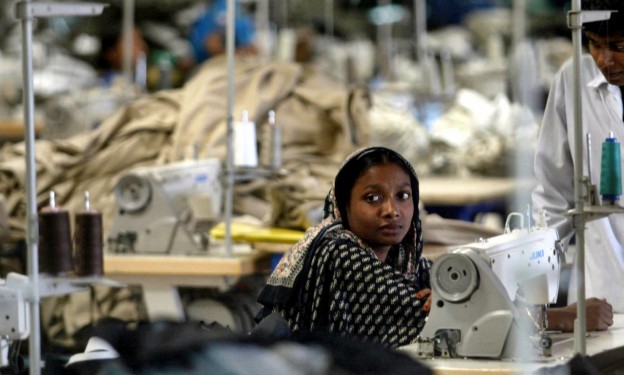
A Bangladeshi woman works in a textile factory on the outskirts of Dhaka, Bangladesh, Wednesday, Feb. 2, 2005. (Manish Swarup/AP)
In April, more than 1,100 people died when an eight-story building that housed garment factories in Bangladesh collapsed.
Since the tragedy at Rana Plaza, many promises have been made by the country’s government and international retailers alike, promising better safety for garment workers.
Here & Now’s Robin Young speaks to Harvard business professor John Quelch about the aftermath of the collapse.
Transcript
ROBIN YOUNG, HOST:
It’s HERE AND NOW.
J.C. Penney, Macy’s, Hollister are all opening their doors tomorrow despite the holiday. One hopes the employees are OK with working on Thanksgiving. And while we’re thinking about American workers selling the products, how about the foreign workers making them? Look at your labels. Bangladesh is the world’s second largest clothing exporter behind China.
And we remember earlier this year that terrible factory collapse. More than 1,100 people killed when Rana Plaza crumbled. The tragedy shocked consumers and had many taking a closer look at their tags. But will you this holiday season? Clothing companies, countries, consumers all promised changes. What happened?
John Quelch is professor of business administration at Harvard Business School. He’s taken a close look in several recently released Harvard Business School case studies, and he joins us from the Harvard studios. Professor, start with retailers. You write that there was a pact, a safety accord following this collapse. What happened?
JOHN QUELCH: The magnitude of the tragedy resulted in considerable media coverage. A lot of retailers who source in Bangladesh, particularly lower price retailers, felt the pressure of the media and consumer opinion that they should take a closer look at the workplace safety conditions of the folks in the factories in Bangladesh, which – not owned by the retailers but which were integral to their supply chains.
So we had two agreements that were agreed upon. One was a group of a hundred mainly European retail brands who came together with a five-year legally binding agreement to maintain order levels in Bangladesh for at least two years, but to share the cost of factory upgrades in the 1,500 or so factories in which they manufacture their products. Secondly, there was a counterpart American agreement that included Wal-Mart, The Gap and other American retail brands that is known as the alliance.
That covers an additional 600 factories. Around about a quarter of the workers employed in the garment industry in Bangladesh work in those factories. But this was a non-legally binding agreement but with pretty much the same objectives of pulling up the wage levels in the factories as well as improving workplace safety conditions.
YOUNG: Well, and what is your sense that anything’s actually happening? I mean, we read this week that this Swedish brand, H&M, second largest retailer in the world, they pledged to pay a living wage to their more than 850,000 textile workers. Does that extend to Bangladesh? You know, what is your sense that these pledges, accords, agreements, are having an effect?
QUELCH: Robin, I think a lot more is happening than might have been expected. To have over a hundred retail brands, primarily European, come together in an alliance to commit for a five-year period to improve workplace safety and working conditions in Bangladesh, it’s very important. But it’s self-interest. These companies need the garment industry in Bangladesh.
They need workers who are healthy and committed and not on strike every other week for higher wages. They need to manage their subcontractors and contractors in those countries in order that the supply chain be efficient and in order to have a sustainable supply chain coming out of Bangladesh.
YOUNG: You’re saying it’s in their own better interest.
QUELCH: So it’s self-interest.
YOUNG: Yeah. Right. And we know that – previously we’ve spoken of this on this program. American and other countries outside of countries like Bangladesh would hire middle people, other companies to do the inspections. They claim those companies were failing. It sounds now like they’re going to step up and take more care with it.
But what about the Bangladeshi government? We know that many of the members of Bangladesh’s parliament were also factory owners, that in the case of the Rana Plaza there have been a huge crack, a loud crack everyone heard, and yet the management still made the workers stay inside the building. So what’s the sense that somebody’s going to be punished for what happened and that there’ll be less corruption and more oversight going forward?
QUELCH: Well, on the Bangladesh economic side, it’s important to note that the garment industry in Bangladesh is probably the most important export earner for the country. And it employs a staggering number of people, around about five million workers operating in around about 5,000 factories. The garment industry has developed very quickly over the last 10 years, principally on the basis of low cost. And as a result of the quick development of the industry, quite frankly, the standards that have been in place and the enforcement of those standards has been lax, leave aside the issue of corruption and payoffs to inspectors and so forth.
The fact of the matter is that whenever an industry grows that quickly, that substantially in an emerging economy, you’re inevitably going to run into oversight and enforcement problems. That’s a key problem.
YOUNG: Well – and in just the couple of minutes we have, what about consumers? Rana Plaza was said to change the behavior of Americans. They would look at labels. They would make demands. And has that happened? And also, you say that when it comes to what Americans can do, it’s not just a federal government problem. State governments can do things. So what do you mean by that?
QUELCH: Well, first of all, regarding consumers, what we don’t want to have happen is for consumers to boycott product that is made in Bangladesh. That will only rebound on the workers in the factories and put them out of work entirely. So the objective, really, has to be to improve the environment of workplace safety in Bangladesh. But more than that, we have to improve the entire worker rights environment in Bangladesh because workplace safety oversight issue is really just the tip of an iceberg that relates to basic worker rights, ability of unions to organize and so forth.
YOUNG: Well – and this is where you say states can come into play because they can pass legislation about where they get, for instance, their uniforms for their police officers, for prison inmates, for other state-funded textiles. They can make demands.
QUELCH: That’s right. There is no reason why customers, not necessarily boycotting Bangladesh but working to encourage and put further pressure on Bangladesh and the factory owners in Bangladesh, can help by specifying procurement standards that require certain workplace safety and worker rights standards to be met in order for those – for the products of those factories to qualify for procurement by state governments.
YOUNG: John Quelch, professor of business administration at Harvard Business School. They’ve just released some reports on the aftermath of the terrible collapse of the Rana Plaza factories in Bangladesh. Professor Quelch, thanks so much.
QUELCH: Thanks, Robin.
YOUNG: And you’re listening to HERE AND NOW. Transcript provided by NPR, Copyright NPR.