by Robert Whitcomb | May 26, 2016 | Initiative
(May 30th, 2016) China’s Defense Ministry asserted on May 26 that its aircraft followed proper rules after two Chinese fighter jets carried out what the United States called an “unsafe” intercept of a U.S. military reconnaissance aircraft over the South China Sea, where China has been seeking to gain hegemony, especially by occupying and militarizing some disputes reefs and islands.
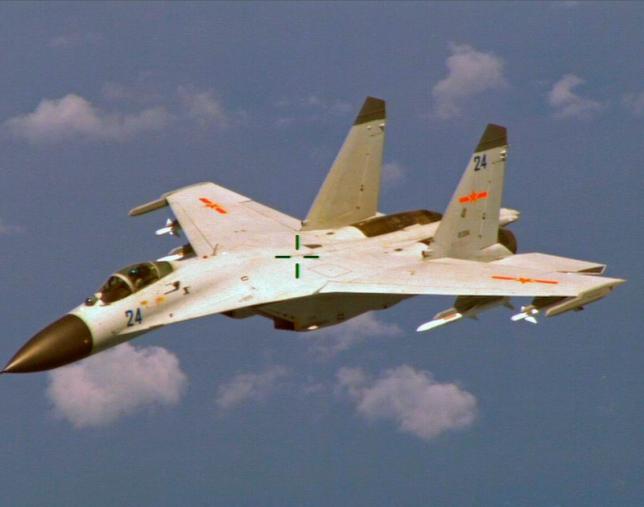
File photo of a Chinese J-11 fighter jet seen flying near a U.S. Navy P-8 Poseidon about 215 km (135 miles) east of China’s Hainan Island in this U.S. Department of Defense handout photo taken August 19, 2014. REUTERS/U.S. Navy/Handout
The Pentagon said that incident happened in international airspace last week as the plane carried out “a routine U.S. patrol,” the Pentagon said.
A U.S. defense official said two Chinese J-11 fighter jets flew within 50 feet of the U.S. EP-3 aircraft, which was flying east of Hainan island.
Chinese Defense Ministry spokesman Yang Yujun asserted that the Chinese pilots acted professionally and in line with an agreement reached between the countries on rules governing such encounters.
However, he said the agreement, called the Rules of Behavior for Safety of Air and Maritime Encounters, could only provide a “technical standard,” and the best way of resolving the problem was for the U.S. to stop such flights.
by Robert Whitcomb | May 26, 2016 | Initiative
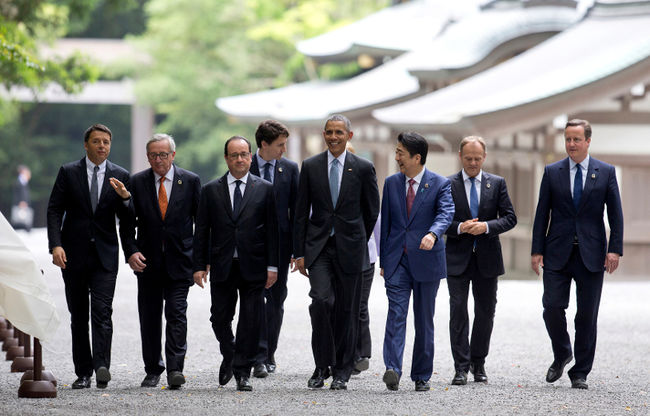
(May 30th, 2016) The Group of Seven (G7) leaders agreed on May 26 at their summit in Japan on the need to send a strong message to China about its maritime claims in the western Pacific, where an increasingly aggressive China has territorial disputes with Japan and several Southeast Asian nations. China has been seizing and militarizing some disputed islands and reefs in the region and threatening nations in the region that have challenged the seizures.
“Prime Minister (Shinzo) Abe led a discussion on the current situation in the South China Sea and East China Sea. Other G7 leaders said it is necessary for G7 to issue a clear signal,” Japan’s Deputy Chief Cabinet Secretary Hiroshige Seko told reporters after a session on foreign policy.
At a news conference late on Wednesday, Mr. Abe said that Japan welcomed China’s peaceful rise. But he repeated Tokyo’s opposition to acts aimed at changing the status quo by force and urging respect of the rule of law.
Chinese Foreign Ministry spokeswoman Hua Chunying retorted in Beijing that the South China Sea issue had “nothing to do” with the G7 or any of its members.
“China is resolutely opposed to individual countries hyping up the South China Sea for personal gain,” she said.
U.S. President Obama called on China to resolve maritime disputes peacefully and he reiterated that the United States was concerned about freedom of navigation and overflights in the region, through which 30 percent of world trade passes.
Read more
by Robert Whitcomb | May 26, 2016 | Initiative
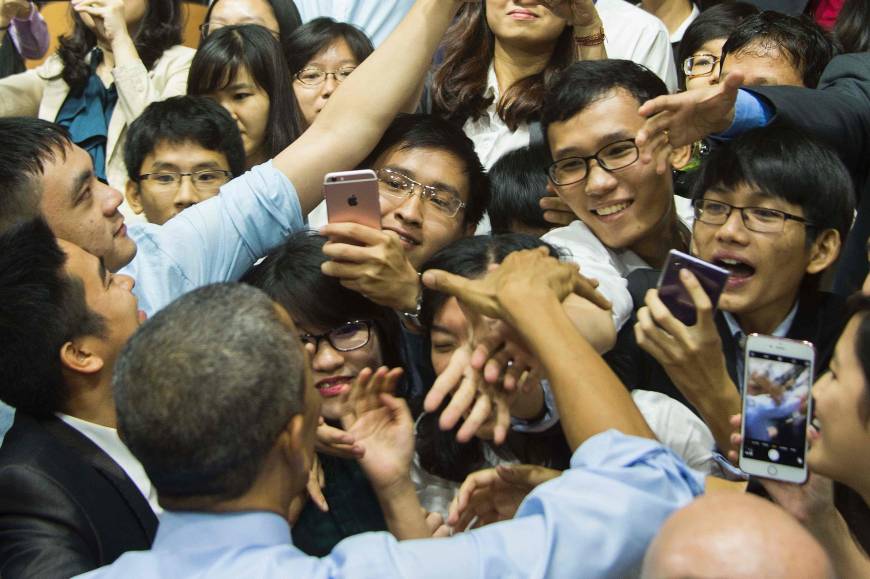
(May 30th, 2016) China has played down the U.S. decision to lift a decades-old ban on sales of arms to Vietnam because it is trying to avoid worsening relations already strained by Chinese military expansionism in the South China Sea.
On May 24, a day after U.S. President Obama expressed his desire for closer U.S. economic and military ties with Vietnam, the vice foreign ministers of China and Vietnam met in a Chinese border province to discuss their relationship.
“China and Vietnam are friendly neighbors connected by mountains and rivers,” said Chinese Foreign Ministry spokeswoman Hua Chunying at a news conference. China, Ms. Hua said, is willing to work with Vietnam to implement a range of legal agreements “to elevate boundary management and cooperation.”
That suggests that Beijing wants to reassure the Vietnamese that the two communist nations should put their shared interests above their dispute over who owns what in the South China Sea, especially as the Obama administration offers more support to Association of Southeast Asian Nations countries worried about China’s expansionism.
Read more