by Robert Whitcomb | Jun 7, 2016 | AI World Society Summit
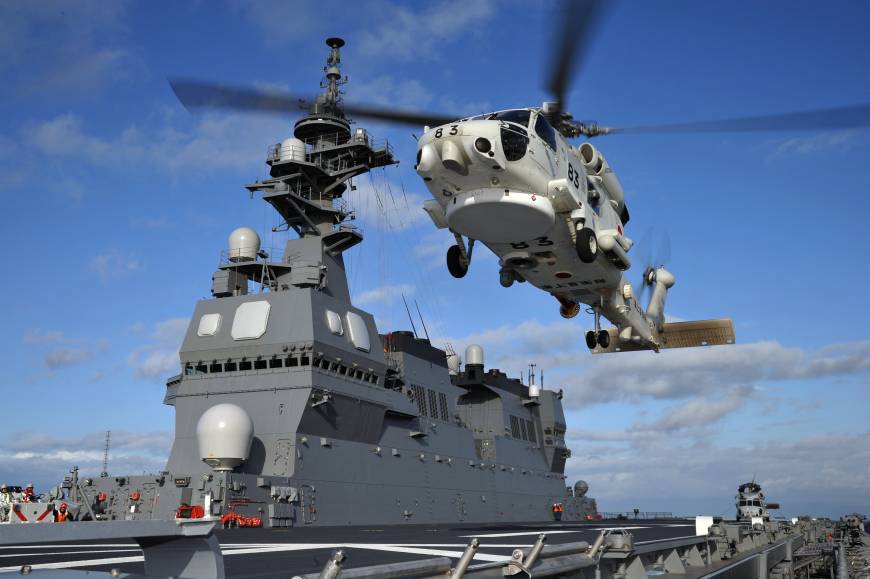
(June 13th, 2016) In the context of China’s repeated incursions into Japanese territorial waters in the East China Sea and attempts to dominate the South China Sea by military force, Japan, India and the United States will hold major trilateral naval exercises off the east coast of Okinawa Prefecture through June 17, the Japan Maritime Self Defense Forces said June 7.
The large-scale exercises are part of an annual event that since last year has included Japan as a permanent member.
The Japan Times reported that drills, “which will focus on anti-submarine warfare and air-defense training, are likely to bolster ties among the three allies.’’
China has been rapidly bolstering its submarine and other naval forces in the East China and South China Seas for the past several years, worrying other nations in the Asia/Pacific region.
For more information hit this link.
by Robert Whitcomb | Jun 6, 2016 | Initiative
(June 13th, 2016) Scarborough Shoal, in the South China Sea, may be becoming a line in the sand against Chinese militaristic expansionism in that sea, most of which China claims. China seized and occupied the shoal in 2012.
It is unclear what the United States and nations friendly to it in the region would do if China continues to seize and militarize reefs and islands in the sea.
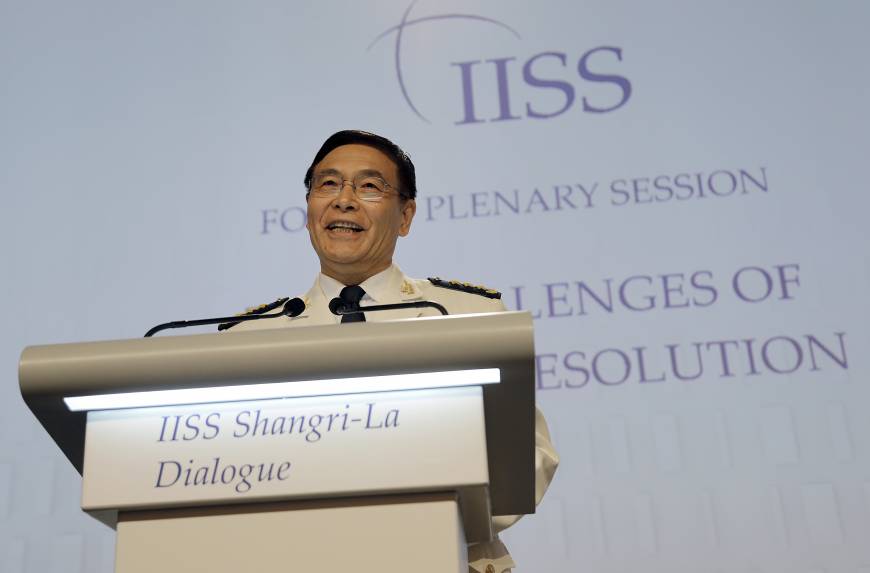
China has warned that it might respond to an unfavorable international arbitration ruling against its claim to the “island’’ in favor of the Philippines by putting structures on the shoal to give it a military outpost very close to the Philippines’s door. Chinese Admiral Sun Jianguo says China will not accept the tribunal’s ruling, expected sometime this summer.
Speaking at a Singapore forum, U.S. Defense Secretary Ash Carter said that the U.S., as an ally of the Philippines, would take action, without elaborating. Hit this link for more information.
by Robert Whitcomb | Jun 3, 2016 | Initiative
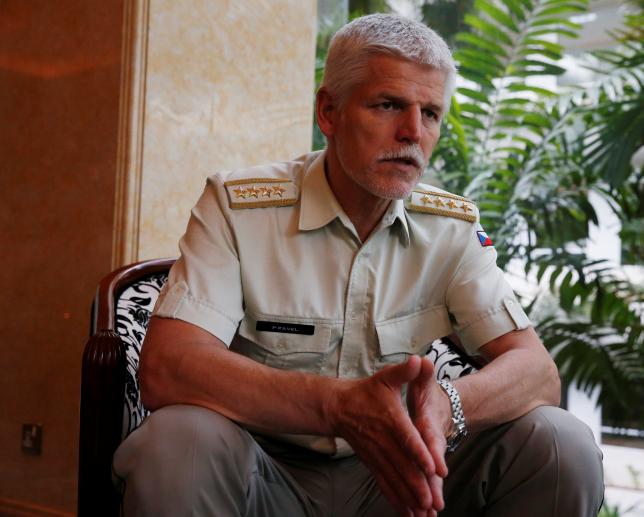
(June 6th, 2016) NATO’s top military officer, Gen. Petr Pavel, has denounced U.S. presidential candidate Donald Trump for calling the alliance obsolete and said that such comments played into the hands of its opponents.
Chairman of NATO’s military committee Petr Pavel speaks to Reuters on the sidelines of the IISS Shangri-La Dialogue in Singapore June 3, 2016. REUTERS/Edgar Su
In unusual criticism of a presidential candidate, Pavel, chairman of the NATO Military Committee, said that Russian “President (Vladimir) Putin and some others may be pleased by this approach”.
“To take such an approach would be a great mistake,” he said.
Mr. Trump has criticized the NATO alliance, created in 1949, as allegedly obsolete and too costly for America.
The North Atlantic Treaty Organization was set up in a different era, Trump has said, when the main threat to the West was the Soviet Union. He said that it was ill-suited to fighting terrorism.
Pavel, a former Czech Republic army chief, said the NATO alliance formed in 1949 was not perfect but it had great potential to protect the security of members.
He also said about Chinese expansionism in the South China Sea:
“Freedom of navigation in this region, through the South China Sea, is crucial for any further development in the region and it’s difficult to imagine that without this freedom, there will be stability and peace in this region.’’ For more information, read this link.
by Robert Whitcomb | Jun 3, 2016 | Initiative
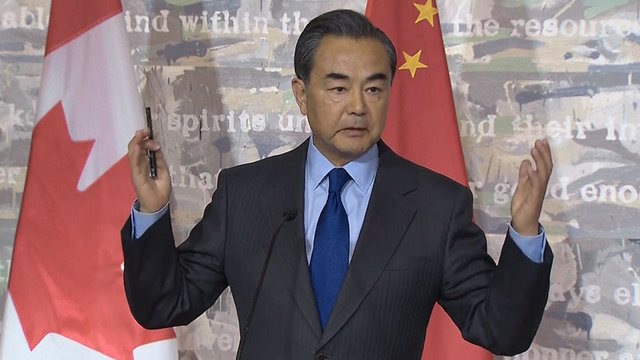
(June 6th, 2016) Chinese Foreign Minister Wang Yi, on a trip to Canada, denounced Canadian journalist Amanda Connolly for asking an “irresponsible” question about China’s human-rights record.
Ms. Connolly said: “There are no shortages of concerns about China’s treatment of human rights advocates such as the Hong Kong booksellers …,not to mention the destabilizing effects of its territorial ambitions in the South China Sea.”
Mr. Wang angrily told the reporter: “I have to say that your question is full of prejudice against China and arrogance … I don’t know where that comes from. This is totally unacceptable,” he said through an interpreter.
He continued: “Other people don’t know better than the Chinese people about the human rights condition in China and it is the Chinese people who are in the best situation, in the best position to have a say about China’s human rights situation.”
See more
by Robert Whitcomb | May 26, 2016 | AI World Society Summit
The biggest issues at the G7 Summit have been how to get the global economy humming again; the refugee crisis in Europe and the Mideast; Chinese expansionism in the East and South China Sea, and cybersecurity. Read this link.
The last item has been a priority of The Boston Global Forum this year. BGF experts have presented their proposals on how to improve cybersecurity in particular and cyberbehavior in general to the G7 leaders. Indeed, a key part of the BGF’s BGF-G7 Summit Initiative is its Ise-Shima Norms for cyberbehavior, named for the location of the summit.
As for the refugees: European Council President Donald Tusk said on Thursday he would seek G7 support for more global aid for them.
“If we (G7) do not take the lead in managing this crisis, nobody would,” Mr. Tusk told reporters. A flow of migrants to Europe from Syria, other parts of the Mideast and Africa confronts the continent with its biggest refugee crisis since World War II.
In a closing communiqué, leaders were also expected to cite the importance of maritime security, including calling for respect for the rule of law and opposition to provocative acts that try to change the status quo by force – in a clear reference to Chinese expansionism.
Although full agreement on macro-economic policy looks difficult, the G7 leaders are expected to promote monetary, fiscal and infrastructure policies to spur growth in the final summit communiqué.
Britain and Germany are resisting calls for fiscal stimulus, and so Japanese Prime Minister Shinzo Abe will urge the G7 leaders to adopt a flexible fiscal policy, taking into account each country’s economic and political situation.
